
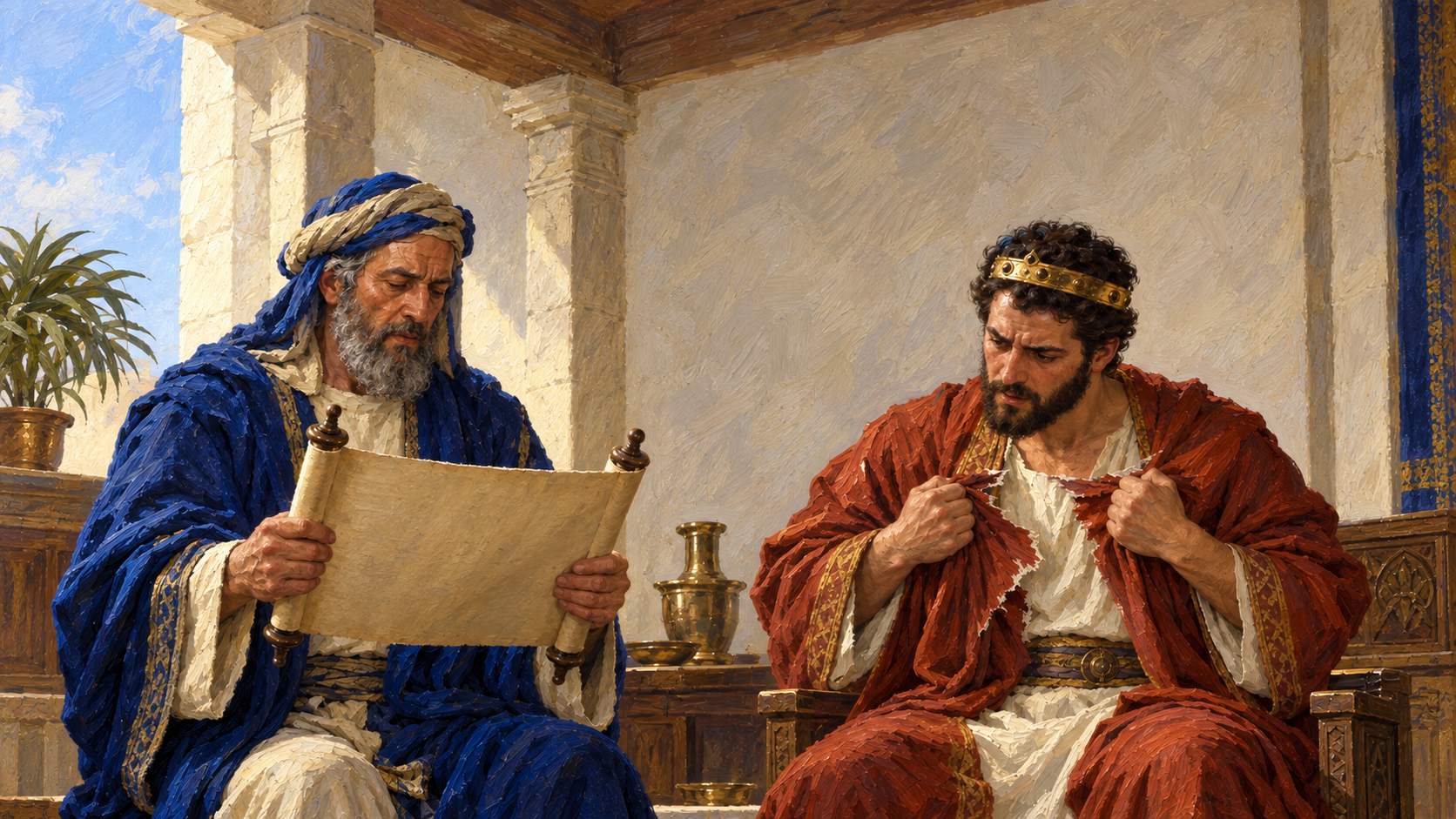
God required Israel’s king to write his own copy of the Law and read it throughout his life. I notice that the command reaches beyond how he governed to what happened in his own heart. Even on the throne, he remained a brother among his people who needed correction from God’s Word. Israel’s kings help us see why that responsibility could never be set aside.
God Put the King Under His Written Word
When Moses spoke Deuteronomy to Israel, the nation had not yet crossed the Jordan or established a monarchy with a palace and royal court. Yet God already knew that the people would ask for a king like the nations around them. Before they made that request, the LORD gave the standard by which every king would be judged.
Deuteronomy 17 allowed Israel to have a king, but it did not give them permission to copy pagan kingship without limits. God would choose the man, and he had to be an Israelite from among his brethren. Calling him their brother helps me see the limit of his royal position. The throne gave him authority without making him a different class of man. He was still their brother and answered to the same covenant they did.
When you come to the land which the LORD your God is giving you, and possess it and dwell in it, and say, “I will set a king over me like all the nations that are around me,” you shall surely set a king over you whom the LORD your God chooses; one from among your brethren you shall set as king over you; you may not set a foreigner over you, who is not your brother.
The king was also warned about several temptations before Israel ever had a throne. He was not to multiply horses or send the people back toward Egypt to obtain them. He was not to multiply wives, because they could turn his heart away. Nor was he to gather great stores of silver and gold for himself.
But he shall not multiply horses for himself, nor cause the people to return to Egypt to multiply horses, for the LORD has said to you, “You shall not return that way again.” Neither shall he multiply wives for himself, lest his heart turn away; nor shall he greatly multiply silver and gold for himself.
These restrictions addressed ways a king could begin trusting what he controlled instead of the God who placed him on the throne. Horses could make him look to chariots for Israel’s security rather than to the LORD. Egypt could not be their source of deliverance. Seeking horses there meant turning back toward the place where God’s people had been in bondage and from which He had freed them. Marriages could serve political alliances as well as personal desire, while the pursuit of wealth could lead a ruler to treat his people as a source of money for himself.
Then came the command at the center of this study:
Also it shall be, when he sits on the throne of his kingdom, that he shall write for himself a copy of this law in a book, from the one before the priests, the Levites. And it shall be with him, and he shall read it all the days of his life, that he may learn to fear the LORD his God and be careful to observe all the words of this law and these statutes, that his heart may not be lifted up above his brethren, that he may not turn aside from the commandment to the right hand or to the left, and that he may prolong his days in his kingdom, he and his children in the midst of Israel.
What God told the new king to do first helps me understand the kind of ruler He wanted. The command was to keep a personal copy of the Law near him and read it, rather than begin with a palace or a larger army. Securing tribute and assembling political advisers did not take its place. A copy displayed at the coronation would not satisfy a command to read for the rest of his life. Through those words he was to learn the fear of the LORD and careful obedience, remembering that he remained a brother whose heart must not rise above the people.
Power is dangerous in the hands of sinners because a ruler who begins in dependence on God can gradually become determined to defend his position at any cost. Religious language may remain even as fear and pride begin to govern his decisions. Political pressure can make convenience seem reasonable, or personal desire can take precedence over obedience. God placed His written Word beside the throne to expose that gradual departure before it brought ruin.
David later expressed the same standard in a few direct words:
He who rules over men must be just, ruling in the fear of God.
A ruler could not decide for himself what counted as righteousness. He had to rule justly in the fear of God, and Deuteronomy shows how he was to learn that fear through continuing attention to God’s Word.
The King’s Copy Had to Be Personal and Trustworthy
God did not simply tell the king to keep scribes nearby. He told him to write a copy for himself, making him personally responsible for the command. I can’t describe exactly how that copy was produced because Scripture doesn’t give us those details. What it does require is the king’s own involvement with words he was to keep reading until they shaped his judgment.
His copy had to come “from the one before the priests, the Levites.” The priests had been entrusted with the covenant text, so the king’s copy had to agree with that guarded Word. He could not produce a private version to suit his policies. I see a necessary limit on his power here: possessing the Book gave him no right to revise what God had said. He remained subject to its authority.
This command belonged to a larger pattern in Israel. Moses wrote the Law and delivered it to the priests and the elders so the covenant would be preserved. Because it was written, the people could read what God had said, and the same words could stand as a witness against their disobedience.
So Moses wrote this law and delivered it to the priests, the sons of Levi, who bore the ark of the covenant of the LORD, and to all the elders of Israel.
At the appointed time in the seventh year, the Law also had to be read publicly before the whole nation. It was not to disappear into a priestly room or royal archive.
And Moses commanded them, saying: “At the end of every seven years, at the appointed time in the year of release, at the Feast of Tabernacles, when all Israel comes to appear before the LORD your God in the place which He chooses, you shall read this law before all Israel in their hearing.”
Then Moses described the Book itself as a continuing witness:
Take this Book of the Law, and put it beside the ark of the covenant of the LORD your God, that it may be there as a witness against you.
The written covenant gave Israel something more dependable than a shifting memory of what God might have said. It could confront their forgetfulness and test a ruler’s claims long after that king and his dynasty were gone. But I also notice that preserving the text did not relieve the king of reading it himself. A king could hire teachers and attend worship yet remain personally distant from the words he quoted. Deuteronomy required him to stay personally attentive to Scripture so that it could correct the pride rising in his own heart.
Joshua was not a king, but God gave him a closely related command as Israel’s leader:
This Book of the Law shall not depart from your mouth, but you shall meditate in it day and night, that you may observe to do according to all that is written in it.
God told Joshua to meditate on the Word so that he would obey it, not simply talk about it. Isaiah later described what happened when rulers exercised power without submitting to God:
Woe to men mighty at drinking wine, woe to men valiant for mixing intoxicating drink, who justify the wicked for a bribe, and take away justice from the righteous man!
Isaiah’s warning shows how neglect of God’s Word corrupts justice until people are treated as tools for those in power. The king in Deuteronomy was to learn the fear of God through Scripture and remember that the people he governed were his brethren. He had no right to treat them as his possessions.
Israel’s Kings Show Why the Command Was Needed
Scripture never records a scene in which a named king physically writes his personal scroll, so I cannot point to one as proof that a particular king obeyed this instruction. The command remains clear. The historical books let us see how kings responded to God’s revealed Word, whether they resisted it and faced judgment or humbled themselves and brought needed reform.
Israel’s first request for a king already exposed the danger. In 1 Samuel 8, the people wanted to be like the surrounding nations. Samuel warned that such a king would take their sons and daughters along with servants to meet his demands. Their fields and the produce they grew would not be spared, nor would their flocks. Deuteronomy had described a ruler who remained subject to Scripture and remembered that he was a brother among brethren.
Saul’s reign shows how pressure and concern for public appearance could govern a leader’s decisions. When Samuel confronted him, Saul defended himself rather than yield to God’s command. Samuel told him, “You have not kept the commandment of the LORD your God” (1 Samuel 13:13). Later he said, “Because you have rejected the word of the LORD, He also has rejected you from being king” (1 Samuel 15:23). I see Saul trying to protect the very position God had given him when obedience required him to admit he was wrong.
David sinned grievously, yet he returned to the LORD’s Word, and his psalms show genuine love for the Law. We can see his willingness to accept correction in how he brought the ark to Jerusalem. His first attempt ignored God’s prescribed order, but he later corrected the procession and placed it under Levitical oversight according to the command. David was not sinless, but he recognized that even the king needed correction.
Solomon may be the clearest warning in this history because his God-given wisdom did not excuse him from obedience or keep him faithful once he stopped submitting to the truth. He violated the instructions for kings almost point by point, multiplying horses and importing them from Egypt while gathering enormous wealth. He also loved many foreign women who turned his heart after other gods. I find it sobering that Deuteronomy had already warned about the course he took. Knowing the truth did not protect Solomon once he stopped submitting to it.
Jehoshaphat sent leaders through Judah with Levites and priests who carried the Book of the Law of the LORD and taught the people. That action fits the purpose of the king’s command, though Scripture does not present it as proof that he wrote his personal copy. A king’s submission to God’s Word should also lead him to want his people taught by it.
Uzziah’s life closely matches Deuteronomy’s warning about a lifted heart. He prospered while he sought the LORD, but once he became strong, his heart was lifted up to his destruction. He entered the temple to burn incense, taking upon himself work God had assigned to the priesthood. His royal power gave him no authority to cross that boundary or set God’s order aside.
Hezekiah trusted the LORD and held fast to Him, keeping His commandments and removing the high places. His reforms show the good that can follow when a king returns to God’s revealed will instead of protecting popular idolatry. Josiah’s response to the Book of the Law makes that submission especially clear. When it was found and read to him, he tore his clothes and sought the LORD. He later read the covenant before the people and acted against the idolatry that had become rooted in Judah.
I would not use Josiah’s response as evidence that he personally copied a scroll. What we do see is a king whose heart broke under the authority of the written Word, which is what the command was meant to produce. He responded to what he heard with repentance and covenant renewal, then brought public practice back under what God had said.
Being near Scripture did not make any of these kings sinless, and their rebellion did not always bring visible ruin overnight. Still, their reigns help me see why God required more than possession of a book. Ignoring its words allowed pride and idolatry to spread, while a king’s humility before it led him to call the nation back toward the LORD.
Jesus Is the King Whose Heart Never Turned Aside
Every earthly king in Israel was eventually found lacking. Saul rejected the Word that David loved, yet David also sinned and needed mercy. Solomon’s wisdom did not stop him from turning away from the royal command. Even Judah’s better kings were gifts to the nation for only a time. None was the final righteous Son promised to David, and their failures leave me longing for a King whose heart never turns aside.
I delight to do Your will, O my God, and Your law is within my heart.
Zechariah spoke of the promised King as just, lowly, and bringing salvation:
Behold, your King is coming to you; He is just and having salvation, lowly and riding on a donkey, a colt, the foal of a donkey.
Jesus is David’s Son and David’s Lord, fully God and fully man. He is the eternal Son who took on flesh without ever ceasing to be God. In His true humanity He grew and learned, and His obedience continued through suffering and temptation without sin. In the wilderness we see Him answer Satan’s temptation with the written Word.
But He answered and said, “It is written, ‘Man shall not live by bread alone, but by every word that proceeds from the mouth of God.'”
Jesus refused to bow to Satan in exchange for the kingdoms of this world, and He would not turn stones into bread merely to serve His appetite. He lived as the obedient Son and never used kingship to exalt Himself. I don’t want His use of Scripture to leave us thinking of Him only as a good reader of the Bible. He is the Word made flesh, the divine Son and promised Messiah. His earthly obedience shows us a King who never despised Scripture, whose heart held the Law and whose rule is righteous.
The King who obeyed perfectly also willingly gave Himself for sinners. No other king or leader has done what Jesus did, nor has any priest, prophet, or parent. Wicked men physically tortured and punished Him before killing Him, and He bore that real punishment for our sins in His innocent body. He shed His blood and died, then was buried and rose bodily. The Father did not abandon or curse the Son. He did not punish, strike, or bruise Him, nor did He pour wrath on Him. Christ died for the whole world, and everyone who repents and believes in Him is forgiven and born again. The Holy Spirit indwells and seals that person, who is eternally secure in Christ.
Leaders Still Need Scripture’s Correction
Christians are not Israelite kings under the Mosaic monarchy, and the church is not a theocratic nation. For that reason, I would not treat Deuteronomy 17 as a command for every modern leader to physically copy the Law. We can respect that covenant setting and still recognize the continuing need for leadership governed by Scripture. Having authority does not lessen our need for the Bible. The temptations that accompany it help us see why our hearts need correction.
Paul told Timothy to keep the public ministry of the Word central:
Till I come, give attention to reading, to exhortation, to doctrine.
He also explained what God-breathed Scripture does in the life of His servant:
All Scripture is given by inspiration of God, and is profitable for doctrine, for reproof, for correction, for instruction in righteousness.
Paul gave Timothy a different instruction from the covenant command addressed to Israel’s kings, but both placed the leader under God’s Word as a servant. He was not free to revise it or judge it as though he had the final say. Scripture teaches us the truth and exposes where we have gone wrong, then corrects us so that we learn to live rightly. I cannot see how a leader could safely become too busy for that correction. A father needs it in his family just as a shepherd, teacher, or elder needs it in serving others.
In homes and churches as well as public leadership, quoting the Bible in a mission statement or to support a decision already made does not give it its proper place. Its teaching needs to shape our judgment and correct our speech, exposing pride and governing how we worship. Parents need it in the home, and elders and teachers need it to guide their doctrine and care for people. Even civil leaders who do not confess God remain accountable to Him.
A leader needs to keep reading Scripture steadily, and I need to receive its correction myself before using it to correct someone else. It is easy to state that responsibility and harder to practice it when the heart can turn so gradually. God is kind to give us His Word before that departure becomes ruin.
Several related studies develop these parts of the subject further. The Kings of Israel traces the monarchy as a whole, while King Saul, The Life of King David, and The Wisdom of Solomon examine three important kings in greater depth. The studies on The Mosaic Covenant and The Davidic Covenant explain the covenant setting and promise. You may also want to read The Law, The Fear of the LORD, How to Study the Bible Properly, and Jesus Knowing the Scriptures From His Youth.
My Final Thoughts
God required Israel’s king to keep the Book near because a throne could never make a sinful heart safe from pride. Scripture taught him the fear of the LORD and called him to obey while reminding him that he remained a brother among the people. Israel’s history demonstrates the wisdom of that command. It helps me recognize my own need for correction, whatever authority God has entrusted to me. It also directs our hope beyond every failed ruler to Jesus Christ, whose heart never turned from the Father’s will. We should receive His Word humbly and let it correct us before our hearts begin to drift.