
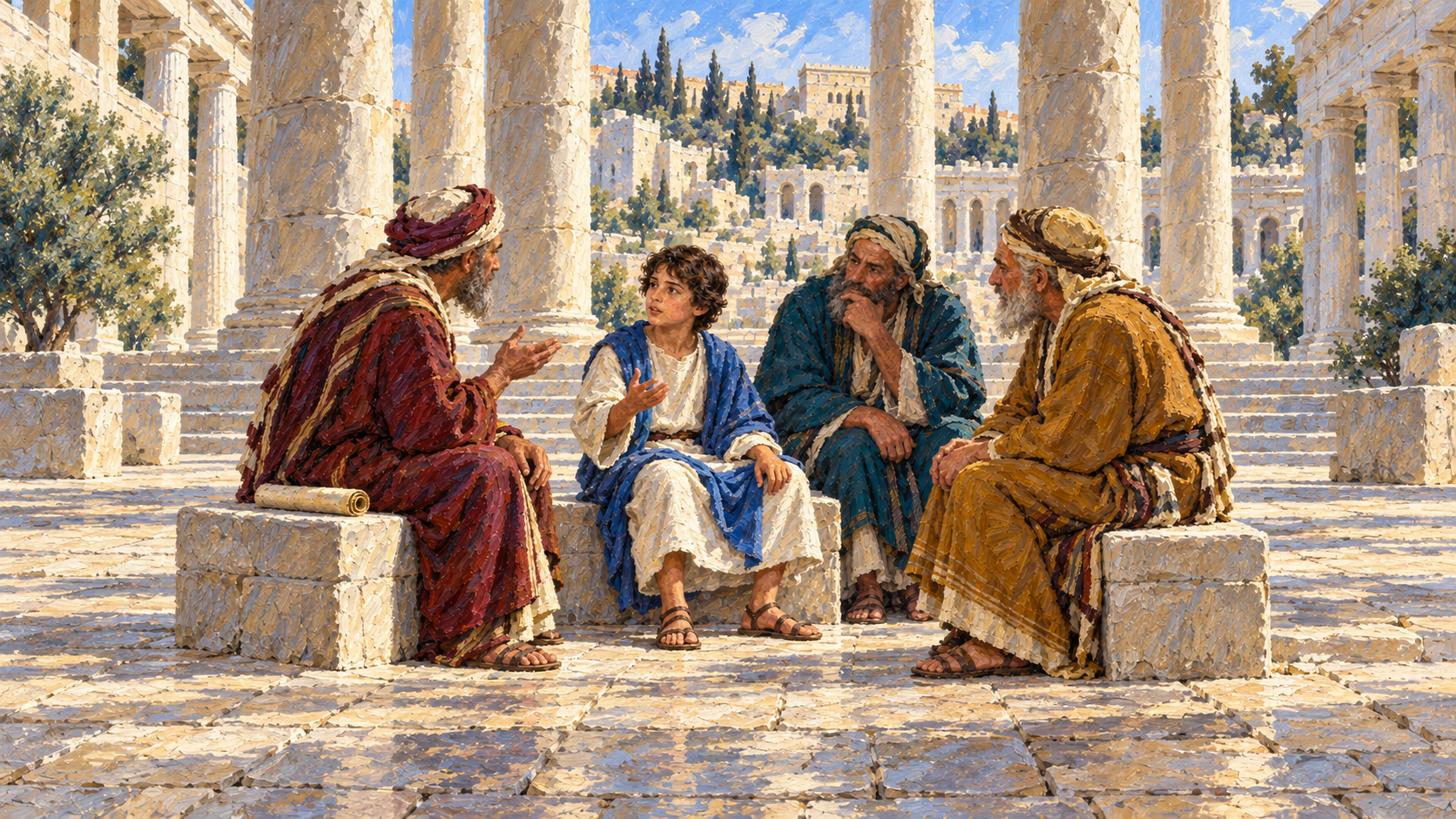
Jesus’ knowledge of Scripture raises a question we should answer without overlooking either His deity or His humanity. He is the eternal Son of God, yet Luke says He genuinely grew in wisdom through childhood. I want to receive both statements and follow the Gospel evidence, rather than imagine a childhood Scripture never describes or treat His learning as a threat to who He is.
Jesus Truly Grew Through a Human Childhood
So when they had performed all things according to the law of the Lord, they returned to Galilee, to their own city, Nazareth. And the Child grew and became strong in spirit, filled with wisdom; and the grace of God was upon Him. His parents went to Jerusalem every year at the Feast of the Passover. And when He was twelve years old, they went up to Jerusalem according to the custom of the feast. When they had finished the days, as they returned, the Boy Jesus lingered behind in Jerusalem. And Joseph and His mother did not know it; but supposing Him to have been in the company, they went a day's journey, and sought Him among their relatives and acquaintances. So when they did not find Him, they returned to Jerusalem, seeking Him. Now so it was that after three days they found Him in the temple, sitting in the midst of the teachers, both listening to them and asking them questions. And all who heard Him were astonished at His understanding and answers. So when they saw Him, they were amazed; and His mother said to Him, "Son, why have You done this to us? Look, Your father and I have sought You anxiously." And He said to them, "Why did you seek Me? Did you not know that I must be about My Father's business?" But they did not understand the statement which He spoke to them. Then He went down with them and came to Nazareth, and was subject to them, but His mother kept all these things in her heart. And Jesus increased in wisdom and stature, and in favor with God and men.
Luke places Jesus in a real household in Nazareth, with parents, relatives, and acquaintances. Joseph and Mary traveled to Jerusalem for Passover each year. When Jesus was twelve, they began the return journey assuming He was with their company, then went back when they could not find Him. Their anxious search ended in the temple, where He was listening to the teachers, asking questions, and giving answers that astonished those who heard Him.
I do not read the parents’ distress as evidence that Jesus had sinned against them. They did not yet understand His statement about His Father, and Luke goes on to describe His submission to them. Nor does the passage picture a child delivering a lecture to humiliate learned adults. Jesus listened and asked questions while already displaying extraordinary understanding. We should retain that whole encounter instead of choosing between a silent pupil and an adult teacher disguised as a boy.
Luke twice emphasizes His development: the Child grew, became strong, and was filled with wisdom, then continued increasing in wisdom and stature and in favor with God and men. His growth was real. The same account leaves most of His childhood unrecorded, giving us no warrant for spectacular childhood miracles or secret journeys to foreign masters. Israel’s own Scriptures supply a more responsible setting for understanding the instruction He encountered.
"Hear, O Israel: The LORD our God, the LORD is one! You shall love the LORD your God with all your heart, with all your soul, and with all your strength. "And these words which I command you today shall be in your heart. You shall teach them diligently to your children, and shall talk of them when you sit in your house, when you walk by the way, when you lie down, and when you rise up. You shall bind them as a sign on your hand, and they shall be as frontlets between your eyes. You shall write them on the doorposts of your house and on your gates.
Israelite parents were to keep God’s words in their own hearts and teach them throughout ordinary life: at home, along the road, at bedtime, and at the beginning of the day. The feasts also kept God’s mighty acts before successive generations. Luke identifies Mary and Joseph as people who observed the law’s requirements and made the Passover journey, so Jesus grew within Israel’s covenant life. His later customary synagogue attendance supplies another recorded setting in which Scripture was heard and read.
That tells us about His surroundings without giving us a daily curriculum. We cannot identify who first taught Him a particular passage or reconstruct each lesson. Children develop language, memory, and practical understanding through time and relationships, and Luke does not present Jesus as possessing an adult human mind concealed in a child’s body. His humanity was complete and developing, without sin. His divine nature was not becoming wiser; the one eternal Son was living a genuinely human childhood.
His first recorded words also reveal an awareness of His unique relationship with God. Mary spoke of “Your father and I,” while Jesus answered that He must be about His Father’s business. The expression concerns the things of His Father and the necessity of His mission. Faithful Israelites could speak of God as Father in a covenant sense, but Luke had already identified Jesus as the Son of God through His supernatural conception. The twelve-year-old in the temple knew a relationship with the Father that was uniquely His.
He then returned to Nazareth and was subject to Mary and Joseph. Knowing His identity did not lead Him to treat the household with contempt or excuse rebellion as a special calling. His obedience at home belonged to the righteous human life He was living. The later public Teacher had not emerged from a sinful youth in which He gradually discovered how to obey God.
No Rabbinic Credential, Yet the Father’s Doctrine
During the Feast of Tabernacles, the authorities in Jerusalem marveled that Jesus knew letters without having studied.
But when His brothers had gone up, then He also went up to the feast, not openly, but as it were in secret. Then the Jews sought Him at the feast, and said, "Where is He?" And there was much complaining among the people concerning Him. Some said, "He is good"; others said, "No, on the contrary, He deceives the people." However, no one spoke openly of Him for fear of the Jews. Now about the middle of the feast Jesus went up into the temple and taught. And the Jews marveled, saying, "How does this Man know letters, having never studied?" Jesus answered them and said, "My doctrine is not Mine, but His who sent Me. If anyone wills to do His will, he shall know concerning the doctrine, whether it is from God or whether I speak on My own authority. He who speaks from himself seeks his own glory; but He who seeks the glory of the One who sent Him is true, and no unrighteousness is in Him. Did not Moses give you the law, yet none of you keeps the law? Why do you seek to kill Me?" The people answered and said, "You have a demon. Who is seeking to kill You?" Jesus answered and said to them, "I did one work, and you all marvel. Moses therefore gave you circumcision (not that it is from Moses, but from the fathers), and you circumcise a man on the Sabbath. If a man receives circumcision on the Sabbath, so that the law of Moses should not be broken, are you angry with Me because I made a man completely well on the Sabbath? Do not judge according to appearance, but judge with righteous judgment."
The phrase “Having never studied” concerned recognized training in the sacred writings, not whether He had ever learned anything or could read. The UBS and SIL translation discussions of John 7:15 explain this as a reference to formal instruction under the recognized Jewish teachers. His mastery surprised people who did not know Him as a pupil of the teachers they expected.
Jesus directed them to the Father as the source of His doctrine. His authority did not depend on their approving His education. Someone willing to do God’s will could recognize the teaching’s source, while a teacher seeking his own glory exposed a different aim. Jesus sought the glory of the One who sent Him and had no unrighteousness in Him. Their desire to kill Him contradicted their claim to defend Moses.
He made that contradiction concrete by addressing their Sabbath accusation. They accepted circumcision on the Sabbath so that the law would be kept, yet were angry that He had made a man completely well. They needed to judge related commands together and stop condemning by appearances. His exact understanding of the law exposed the weakness of a judgment defended by people who considered themselves its experts.
I cannot use this passage to despise disciplined study. A school can help someone learn biblical languages, history, and careful reading. It cannot authorize him to contradict Scripture. Refusing education gives an independent teacher no special authority either. We need to examine what a person teaches, rather than accept his credentials or his rejection of credentials as proof that he speaks for God.
The Eternal Word Became Truly Man
John identifies the Teacher who spoke with the Father’s authority as the eternal Word who became flesh.
In the beginning was the Word, and the Word was with God, and the Word was God. He was in the beginning with God. All things were made through Him, and without Him nothing was made that was made. In Him was life, and the life was the light of men. And the light shines in the darkness, and the darkness did not comprehend it. There was a man sent from God, whose name was John. This man came for a witness, to bear witness of the Light, that all through him might believe. He was not that Light, but was sent to bear witness of that Light. That was the true Light which gives light to every man coming into the world. He was in the world, and the world was made through Him, and the world did not know Him. He came to His own, and His own did not receive Him. But as many as received Him, to them He gave the right to become children of God, to those who believe in His name: who were born, not of blood, nor of the will of the flesh, nor of the will of man, but of God. And the Word became flesh and dwelt among us, and we beheld His glory, the glory as of the only begotten of the Father, full of grace and truth. John bore witness of Him and cried out, saying, "This was He of whom I said, 'He who comes after me is preferred before me, for He was before me.'" And of His fullness we have all received, and grace for grace. For the law was given through Moses, but grace and truth came through Jesus Christ. No one has seen God at any time. The only begotten Son, who is in the bosom of the Father, He has declared Him.
John takes us back before Bethlehem to the Word who already existed in the beginning. He was with God and was God, and everything was made through Him. This eternal Person became flesh and dwelt among us. Jesus did not begin to exist when He was born, and His genuine human growth did not turn an ordinary child into God.
The eternal Word, or Logos, is the Son Himself. Scripture is God’s inspired written Word, which bears authoritative testimony to Him. We receive both without confusing the Person and the text: ink and paper are not divine, and the pages did not become flesh. The study on The Word Logos explains John’s language more fully.
As the divine Lord, Jesus knows Scripture with divine authority. As the human Messiah, He also read, listened, learned, obeyed, and fulfilled it within history. John’s account directs us to more than a religious scholar. The world made through Him failed to recognize Him, yet those who receive Him by faith become God’s children. He gives the life to which the written testimony points.
Let this mind be in you which was also in Christ Jesus, who, being in the form of God, did not consider it robbery to be equal with God, but made Himself of no reputation, taking the form of a bondservant, and coming in the likeness of men. And being found in appearance as a man, He humbled Himself and became obedient to the point of death, even the death of the cross. Therefore God also has highly exalted Him and given Him the name which is above every name, that at the name of Jesus every knee should bow, of those in heaven, and of those on earth, and of those under the earth, and that every tongue should confess that Jesus Christ is Lord, to the glory of God the Father.
The Son’s humility consisted in taking a servant’s form and becoming truly man, not in ceasing to be God. He is one Person with a complete divine nature and a complete human nature. The incarnation does not blend those natures into a third kind of being or divide Him into two persons. His human mind developed while His divine nature remained all-knowing. Scripture does not explain the inner workings of that union, and I would not pretend to supply a mechanism it has not revealed.
We should therefore receive His hunger, fatigue, temptation, and suffering as real features of His human life, alongside His divine authority and rightful reception of worship. His deity cannot be used to erase His humanity, and His development cannot be used to deny His deity. The study on The Deity of Jesus considers the wider evidence. Hebrews brings His real experience and complete sinlessness together in explaining His priesthood.
Seeing then that we have a great High Priest who has passed through the heavens, Jesus the Son of God, let us hold fast our confession. For we do not have a High Priest who cannot sympathize with our weaknesses, but was in all points tempted as we are, yet without sin. Let us therefore come boldly to the throne of grace, that we may obtain mercy and find grace to help in time of need.
So also Christ did not glorify Himself to become High Priest, but it was He who said to Him: "You are My Son, Today I have begotten You." As He also says in another place: "You are a priest forever According to the order of Melchizedek"; who, in the days of His flesh, when He had offered up prayers and supplications, with vehement cries and tears to Him who was able to save Him from death, and was heard because of His godly fear, though He was a Son, yet He learned obedience by the things which He suffered. And having been perfected, He became the author of eternal salvation to all who obey Him, called by God as High Priest "according to the order of Melchizedek,"
Paul says in Hebrews that Jesus was tempted as we are, yet without sin, and that He learned obedience through suffering. Those statements explain one another. The Son was not abandoning disobedience or discovering that rebellion was wrong. He experienced the cost of obedience as man, remaining faithful through hunger, rejection, and suffering that reached death.
Being perfected likewise does not mean His earlier life contained sin. It concerns reaching the appointed goal through that obedient life and being fully qualified for His priestly work. The translation discussion of Hebrews 5:9 explains why the word must be read without suggesting a prior moral defect. Our High Priest’s sympathy rests in suffering He truly endured. We can come for mercy and help because He knows human weakness without sharing our sin.
Jesus Read, Obeyed, and Fulfilled Scripture
In the wilderness, Jesus answered Satan from Deuteronomy while genuinely hungry after fasting.
Then Jesus was led up by the Spirit into the wilderness to be tempted by the devil. And when He had fasted forty days and forty nights, afterward He was hungry. Now when the tempter came to Him, he said, "If You are the Son of God, command that these stones become bread." But He answered and said, "It is written, 'Man shall not live by bread alone, but by every word that proceeds from the mouth of God.'" Then the devil took Him up into the holy city, set Him on the pinnacle of the temple, and said to Him, "If You are the Son of God, throw Yourself down. For it is written: 'He shall give His angels charge over you,' and, 'In their hands they shall bear you up, Lest you dash your foot against a stone.'" Jesus said to him, "It is written again, 'You shall not tempt the LORD your God.'" Again, the devil took Him up on an exceedingly high mountain, and showed Him all the kingdoms of the world and their glory. And he said to Him, "All these things I will give You if You will fall down and worship me." Then Jesus said to him, "Away with you, Satan! For it is written, 'You shall worship the LORD your God, and Him only you shall serve.'" Then the devil left Him, and behold, angels came and ministered to Him.
The passages Jesus quoted concerned Israel’s dependence on God, exclusive worship of Him, and refusal to test Him. Jesus lived by their truth where Israel had failed. He did not treat their words as a formula that could compel a result or as quotations selected merely to win a debate.
Satan also quoted Scripture, using Psalm 91 to urge Him to throw Himself from the temple. The promise of God’s protection did not authorize a reckless demand that God prove it. Jesus answered with the command not to tempt the LORD. I need to look beyond whether a speaker can recite a verse: its meaning, its relation to the rest of Scripture, and the response it actually requires must govern how we use it.
At Nazareth, Jesus followed His custom of entering the synagogue on the Sabbath. He received Isaiah’s scroll, found the passage, read it, and sat down to teach.
Then Jesus returned in the power of the Spirit to Galilee, and news of Him went out through all the surrounding region. And He taught in their synagogues, being glorified by all. So He came to Nazareth, where He had been brought up. And as His custom was, He went into the synagogue on the Sabbath day, and stood up to read. And He was handed the book of the prophet Isaiah. And when He had opened the book, He found the place where it was written: "The Spirit of the LORD is upon Me, Because He has anointed Me To preach the gospel to the poor; He has sent Me to heal the brokenhearted, To proclaim liberty to the captives And recovery of sight to the blind, To set at liberty those who are oppressed; To proclaim the acceptable year of the LORD." Then He closed the book, and gave it back to the attendant and sat down. And the eyes of all who were in the synagogue were fixed on Him. And He began to say to them, "Today this Scripture is fulfilled in your hearing." So all bore witness to Him, and marveled at the gracious words which proceeded out of His mouth. And they said, "Is this not Joseph's son?" He said to them, "You will surely say this proverb to Me, 'Physician, heal yourself! Whatever we have heard done in Capernaum, do also here in Your country.'" Then He said, "Assuredly, I say to you, no prophet is accepted in his own country. But I tell you truly, many widows were in Israel in the days of Elijah, when the heaven was shut up three years and six months, and there was a great famine throughout all the land; but to none of them was Elijah sent except to Zarephath, in the region of Sidon, to a woman who was a widow. And many lepers were in Israel in the time of Elisha the prophet, and none of them was cleansed except Naaman the Syrian." So all those in the synagogue, when they heard these things, were filled with wrath, and rose up and thrust Him out of the city; and they led Him to the brow of the hill on which their city was built, that they might throw Him down over the cliff. Then passing through the midst of them, He went His way.
His declaration, “Today this Scripture is fulfilled in your hearing,” identified Him as the Spirit-anointed One the prophet announced. He was not simply offering a clever application of an old text.
The congregation marveled at His words, but His references to Elijah and Elisha exposed their expectation of privileged signs. God’s help had reached the widow at Zarephath and Naaman the Syrian, rather than being confined to Israel. Jesus knew those accounts and applied them to hearers resisting God’s grace. Their anger became a murderous attempt to throw Him from the hill, but He passed through their midst and left. Familiarity with Joseph’s household had not led them to receive the One standing before them.
In the Sermon on the Mount, Jesus explained His relationship to the Law and the Prophets He knew so well.
"Do not think that I came to destroy the Law or the Prophets. I did not come to destroy but to fulfill. For assuredly, I say to you, till heaven and earth pass away, one jot or one tittle will by no means pass from the law till all is fulfilled. Whoever therefore breaks one of the least of these commandments, and teaches men so, shall be called least in the kingdom of heaven; but whoever does and teaches them, he shall be called great in the kingdom of heaven. For I say to you, that unless your righteousness exceeds the righteousness of the scribes and Pharisees, you will by no means enter the kingdom of heaven.
Jesus expressly denied that He had come to destroy the Law or the Prophets. He obeyed God’s will perfectly, fulfilled the promises and patterns that pointed to Him, and taught the law’s true demand. Even its smallest written details remained dependable until God’s purpose was fulfilled. He warned against breaking the commandments and teaching others to break them, while requiring righteousness deeper than outward religious performance.
That standard exposes the heart rather than making righteousness something we can manufacture through an impressive appearance. I cannot use fulfillment as permission to discard the Old Testament, or set Jesus against writings He upheld. He corrected human traditions that distorted God’s command and challenged unbelief that refused its testimony. His authority and reverence for Scripture belonged together.
The Sermon on the Mount ends with the necessity of hearing and doing “these sayings of Mine.”
"Therefore whoever hears these sayings of Mine, and does them, I will liken him to a wise man who built his house on the rock: and the rain descended, the floods came, and the winds blew and beat on that house; and it did not fall, for it was founded on the rock. "But everyone who hears these sayings of Mine, and does not do them, will be like a foolish man who built his house on the sand: and the rain descended, the floods came, and the winds blew and beat on that house; and it fell. And great was its fall." And so it was, when Jesus had ended these sayings, that the people were astonished at His teaching, for He taught them as one having authority, and not as the scribes.
In the picture of the two houses, both builders encounter the storm, but the house founded on obedient reception of His words stands. Jesus made the response to His teaching decisive in the face of judgment. The crowds recognized an authority different from that of their scribes.
That does not mean every scribe was ignorant or that citing an earlier teacher was automatically wrong. Jesus spoke with an immediate authority no school could create. Prophets commonly introduced the message with “Thus says the LORD.” Jesus could say, “But I say to you,” and rightly define obedience. His teaching requires more than admiration for His skill or memory.
The Scriptures Testify of Christ
In John 5, Jesus confronted people who searched the Scriptures while refusing the One those writings revealed.
"If I bear witness of Myself, My witness is not true. There is another who bears witness of Me, and I know that the witness which He witnesses of Me is true. You have sent to John, and he has borne witness to the truth. Yet I do not receive testimony from man, but I say these things that you may be saved. He was the burning and shining lamp, and you were willing for a time to rejoice in his light. But I have a greater witness than John's; for the works which the Father has given Me to finish–the very works that I do–bear witness of Me, that the Father has sent Me. And the Father Himself, who sent Me, has testified of Me. You have neither heard His voice at any time, nor seen His form. But you do not have His word abiding in you, because whom He sent, Him you do not believe. You search the Scriptures, for in them you think you have eternal life; and these are they which testify of Me. But you are not willing to come to Me that you may have life. "I do not receive honor from men. But I know you, that you do not have the love of God in you. I have come in My Father's name, and you do not receive Me; if another comes in his own name, him you will receive. How can you believe, who receive honor from one another, and do not seek the honor that comes from the only God? Do not think that I shall accuse you to the Father; there is one who accuses you–Moses, in whom you trust. For if you believed Moses, you would believe Me; for he wrote about Me. But if you do not believe his writings, how will you believe My words?"
Jesus named several witnesses to His identity: John the Baptist, the works His Father gave Him, the Father Himself, and the Scriptures. His opponents searched those writings while remaining unwilling to come to Him for life. Their diligent reading was not the offense. Their unbelief allowed them to handle the testimony while refusing the Person it revealed.
Their appeal to Moses therefore became an accusation against them. If they believed his writings, they would believe the One about whom he wrote. Jesus neither separated Himself from Scripture nor made Himself identical to the book. The written Word testified to Him, and receiving that testimony in faith meant coming to the living Son for life.
After His bodily resurrection, Jesus met two disciples on the road to Emmaus and explained from Moses and the Prophets why the Christ had to suffer before entering His glory.
Then He said to them, "O foolish ones, and slow of heart to believe in all that the prophets have spoken! Ought not the Christ to have suffered these things and to enter into His glory?" And beginning at Moses and all the Prophets, He expounded to them in all the Scriptures the things concerning Himself. Then they drew near to the village where they were going, and He indicated that He would have gone farther. But they constrained Him, saying, "Abide with us, for it is toward evening, and the day is far spent." And He went in to stay with them. Now it came to pass, as He sat at the table with them, that He took bread, blessed and broke it, and gave it to them. Then their eyes were opened and they knew Him; and He vanished from their sight. And they said to one another, "Did not our heart burn within us while He talked with us on the road, and while He opened the Scriptures to us?" So they rose up that very hour and returned to Jerusalem, and found the eleven and those who were with them gathered together, saying, "The Lord is risen indeed, and has appeared to Simon!" And they told about the things that had happened on the road, and how He was known to them in the breaking of bread. Now as they said these things, Jesus Himself stood in the midst of them, and said to them, "Peace to you." But they were terrified and frightened, and supposed they had seen a spirit. And He said to them, "Why are you troubled? And why do doubts arise in your hearts? Behold My hands and My feet, that it is I Myself. Handle Me and see, for a spirit does not have flesh and bones as you see I have." When He had said this, He showed them His hands and His feet. But while they still did not believe for joy, and marveled, He said to them, "Have you any food here?" So they gave Him a piece of a broiled fish and some honeycomb. And He took it and ate in their presence. Then He said to them, "These are the words which I spoke to you while I was still with you, that all things must be fulfilled which were written in the Law of Moses and the Prophets and the Psalms concerning Me." And He opened their understanding, that they might comprehend the Scriptures. Then He said to them, "Thus it is written, and thus it was necessary for the Christ to suffer and to rise from the dead the third day, and that repentance and remission of sins should be preached in His name to all nations, beginning at Jerusalem. And you are witnesses of these things. Behold, I send the Promise of My Father upon you; but tarry in the city of Jerusalem until you are endued with power from on high."
The two Emmaus disciples recognized Him when their eyes were opened at the meal. They returned to Jerusalem and told the gathered disciples what had happened, then Jesus stood among them Himself.
He showed His hands and feet, invited them to handle Him, and ate before them. Luke records flesh and bones, not an appearance that was only spiritual. The risen Lord then opened their understanding of the Law of Moses, the Prophets, and the Psalms concerning Himself. He explained His suffering and resurrection and commissioned them to proclaim repentance and remission of sins in His name to all nations.
The message rested on both the written promises and events the disciples witnessed. Reading with Christ at the center means following Scripture’s promises, patterns, offices, and covenants to their fulfillment in Him. It does not permit us to assign a secret meaning to any detail we choose. Jesus taught His disciples to believe what God had written and recognize what He had brought to pass.
Paul reminded Timothy that he had known the Holy Scriptures from childhood and told him to continue in what he had learned.
But you must continue in the things which you have learned and been assured of, knowing from whom you have learned them, and that from childhood you have known the Holy Scriptures, which are able to make you wise for salvation through faith which is in Christ Jesus. All Scripture is given by inspiration of God, and is profitable for doctrine, for reproof, for correction, for instruction in righteousness, that the man of God may be complete, thoroughly equipped for every good work.
All Scripture is inspired by God, literally God-breathed. Its writers worked in real historical settings, yet the Holy Spirit carried them so that their words were God’s truthful Word. It teaches, reproves, corrects, and trains God’s servant for good work, making a person wise for salvation through faith in Christ.
The Son shares in Scripture’s divine authorship as the One who shares the divine nature with the Father and the Spirit. Scripture also calls the Holy Spirit the Spirit of Christ and describes the prophets testifying beforehand to Christ’s sufferings and glories. Yet inspiration is ordinarily described as the Spirit’s work. The loose slogan “Jesus wrote every verse” can obscure how Scripture describes inspiration through the Spirit and human writers. His divine authority, human growth, sinlessness, and anointing by the Spirit must be received together.
For us, study has a purpose beyond collecting information. Pastors must be able to teach, handle the Word rightly, and correct error. Languages and history can help us read carefully, but neither credentials nor independence from institutions can make error true. No modern teacher possesses Jesus’ deity, sinlessness, or immediate authority. A faithful teacher explains the passage, admits what he does not know, and submits his conclusions to Scripture. I need to apply that standard to voices I already like as well as to those I question.
Peter describes the sinless conduct of the Savior who bore our sins, directing us to what His obedience accomplished.
For to this you were called, because Christ also suffered for us, leaving us an example, that you should follow His steps: "Who committed no sin, Nor was deceit found in His mouth"; who, when He was reviled, did not revile in return; when He suffered, He did not threaten, but committed Himself to Him who judges righteously; who Himself bore our sins in His own body on the tree, that we, having died to sins, might live for righteousness–by whose stripes you were healed. For you were like sheep going astray, but have now returned to the Shepherd and Overseer of your souls.
The Savior to whom Scripture points willingly carried out the work it announced. He committed no sin, spoke without deceit, and refused sinful retaliation when abused. Wicked men inflicted real bodily torture and punishment before killing Him, but He willingly bore that suffering for our sins and shed His blood for the whole world. His saving work through His blood and death was complete before His burial and bodily resurrection. The Father did not punish, curse, abandon, strike, bruise, or pour wrath on Jesus.
God genuinely offers salvation, though people may resist His grace. Everyone who repents and believes in Christ receives forgiveness and is justified, meaning declared righteous before God. That person is born again, and the Holy Spirit indwells and seals the believer, making salvation eternally secure. Our actions should give evidence of new life; they do not earn salvation or keep us saved. A Christian profession alone does not prove new birth, and security never excuses lawlessness.
Knowing that salvation changes the purpose of our study. I read as someone accountable to the King, willing to be corrected when a passage overturns a cherished idea. We should follow the writer’s thought, ask honest questions, compare related passages, and obey what God has made clear. Trustworthy teachers can help without becoming our final authority. The study on How to Study the Bible Properly develops those habits.
The risen Jesus led His disciples into Scripture, so meeting Him does not mean bypassing the text. The Holy Spirit will not lead us away from the Word He inspired. We seek wisdom from God while doing the careful work of reading, so that we trust the Son Scripture reveals and build our lives on His words.
My Final Thoughts
I want to receive Jesus’ genuine growth in wisdom without reducing Him to a gifted student. He is the eternal Son who became truly man, lived without sin, and knew His Father’s will. He read, obeyed, and fulfilled Scripture with an authority no human training could give. His example calls us to careful study, while His identity calls us to trust and obey Him. We should test every teacher, including ourselves, by God’s Word and receive the correction it gives as we come to the Savior it reveals.