
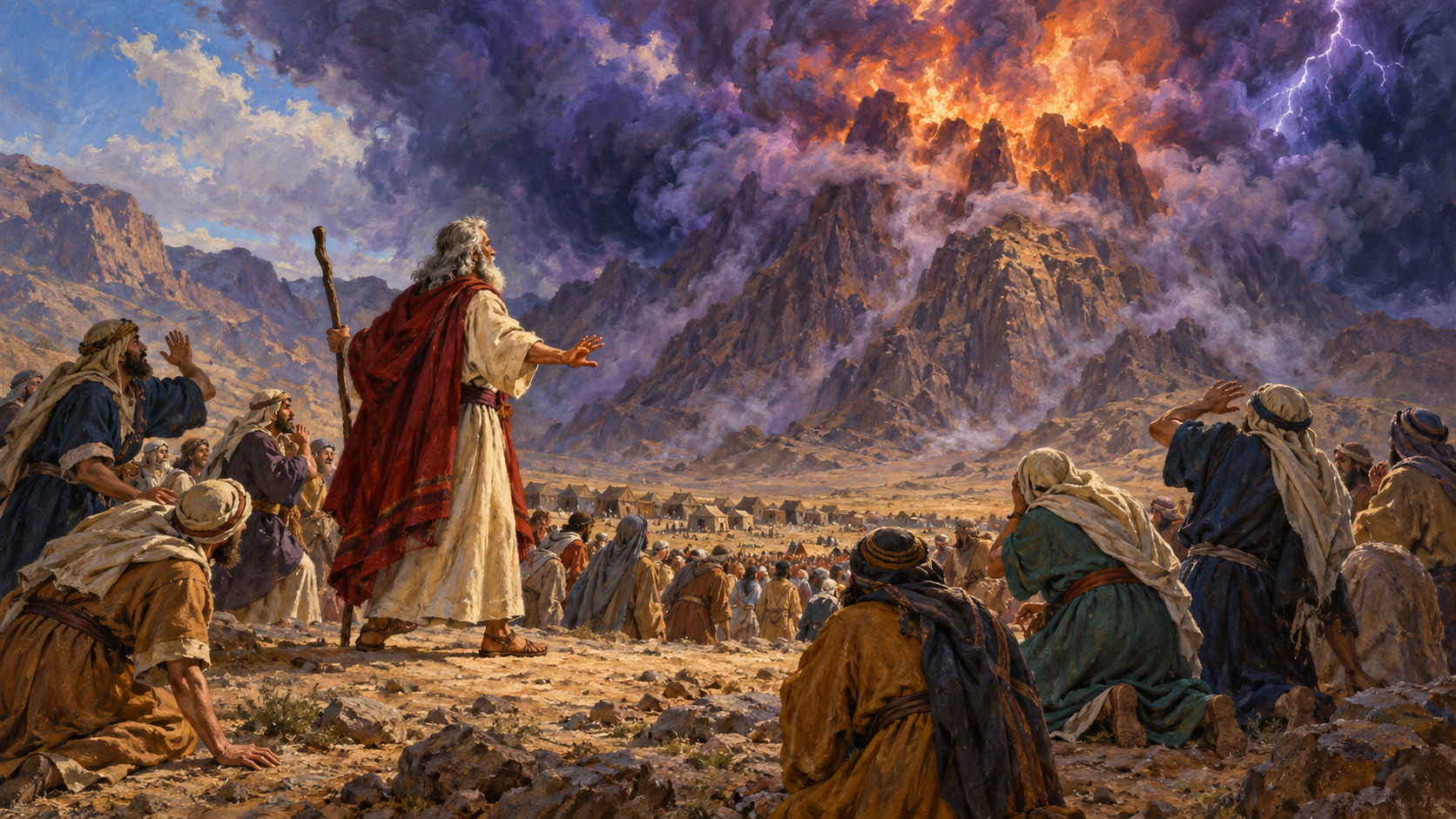
Why did God give Israel the Law if no one can be saved by keeping it? The order in Exodus helps me answer that question. God redeemed Israel before Sinai, then shaped the nation through a covenant that exposed sin and pointed ahead to Christ.
Redemption Came Before the Covenant at Sinai
God made the Mosaic Covenant with Israel through Moses at Mount Sinai, after delivering the people from Egypt. He judged Egypt and brought Israel through the sea by His power before leading them to the mountain. I need to keep that sequence clear. He did not ask slaves to earn their deliverance by keeping commandments; He gave the covenant’s commands to people He had already redeemed.
God gave the Law to a redeemed nation to govern their worship and national life. It showed them what holiness required and exposed the sin in their hearts, preparing them for Christ. We cannot turn it into a way for sinners to climb toward salvation. The Law could neither justify them nor give spiritual life to sinful flesh. Its righteous standard revealed what was wrong with man, rather than being evil itself.
The people receiving this covenant were Israel, not all nations as in the Noahic Covenant. God had remembered His promises to Abraham, Isaac, and Jacob and brought their descendants out of bondage. Sinai did not cancel His promise to Abraham. It placed redeemed Israel under a national covenant governing their life before God in the land.
Exodus 19 identifies the people as the house of Jacob and the children of Israel. I cannot treat every command given to them at Sinai as though it were addressed directly to the church on the same terms. Still, those commands remain deeply useful to everyone. They teach us about God’s righteousness and our need for a Savior, even though they were given in that specific setting.
Israel had seen God’s power in Egypt and at the sea, yet that outward deliverance did not cure their sinful hearts. Neither did their privileges as a nation enable them to produce righteousness through fleshly effort. The covenant told them plainly what was right. Their continued sin showed how much they still needed God’s mercy and a greater work within the heart.
Before telling Israel what they must do, God reminded them that He had carried them on eagles’ wings and brought them to Himself. Their covenant calling followed what He had already done for them.
“Now therefore, if you will indeed obey My voice and keep My covenant, then you shall be a special treasure to Me above all people; for all the earth is Mine.
And you shall be to Me a kingdom of priests and a holy nation.” These are the words which you shall speak to the children of Israel.
The condition “if you will indeed obey” helps me understand how Israel was to enjoy covenant blessing in the land. That enjoyment depended on obedience. The ultimate promise to Abraham rests on God’s oath and faithfulness, but at Sinai Israel entered a covenant of law with real blessings and curses. That does not mean grace was absent from Sinai; it means we need to understand the terms God gave this nation.
As God’s special treasure, Israel was to live as a holy nation and make Him known among the surrounding peoples. The priesthood and sacrifices taught them how sinful people could approach a holy God. Through the feasts and purity regulations, along with the other laws, He set them apart from idolatry and taught them to live on His terms.
The Law Revealed Holiness and Exposed Sin
Before commanding, “You shall have no other gods before Me,” the LORD reminded Israel that He was the One who had delivered them. Even the Ten Commandments begin by recalling His grace.
“I am the LORD your God, who brought you out of the land of Egypt, out of the house of bondage.”
The commandments revealed the moral will of the God who had redeemed Israel. Israel’s obedience was meant to be a response to His deliverance, never its purchase price. They were to worship Him alone and revere His name, while honoring His requirements for family life and righteous treatment of their neighbors.
I can admire the Law in general and still find it exposing sin when I consider what it requires. God’s commands govern whom we worship and how we speak, including whether we tell the truth. They address sexuality and property, and reach into our desires by forbidding coveting. The Law identifies sin precisely, but it cannot make sinful flesh righteous.
Therefore by the deeds of the law no flesh will be justified in His sight, for by the law is the knowledge of sin.
Paul also explains how the Law’s work of exposing sin directed Israel toward Christ.
Therefore the law was our tutor to bring us to Christ, that we might be justified by faith.
A tutor in that setting guarded and directed a child until the appointed time. The Law similarly showed Israel what holiness required and exposed their transgressions. Its sacrifices and other shadows prepared the nation for what only the Messiah could fulfill. Since Christ has come, I would not return to Sinai as though that preparation were the final reality.
Christians often speak of the Law’s moral, civil, and ceremonial requirements. These categories help us understand its range, but Moses gave Israel one national covenant, not three. The Ten Commandments expressed God’s righteous standards. Civil statutes ordered society by governing the courts and their penalties, including what people owed in restitution. Ceremonial instructions governed the priesthood and sacrifices, along with purity, feasts, and worship at the tabernacle.
I find those categories useful as long as I remember that God gave the covenant as a whole. He ordered life in Israel’s courtroom as well as its sanctuary, and His commands governed everyday dealings alongside formal worship. The Law gives us that full picture of covenant life even though we now relate to God under the New Covenant. Dividing its requirements into categories should help us understand it, not pull it apart carelessly.
The church does not offer Levitical sacrifices because Christ is the final sacrifice. Nor does it enforce Israel’s civil code, since the church is not Israel under Sinai. God’s moral righteousness has not changed, however. The New Covenant still condemns idolatry and murder. Adultery and theft remain sins, as do false witness and coveting.
Our pursuit of holiness grows out of union with Christ and the Spirit dwelling in us. We are not living as Israelites under the Sinai covenant. Love fulfills the Law because it does no harm to a neighbor, so I cannot reduce biblical love to a feeling that ignores God’s commands. It produces obedience shaped by His character.
Blood, Priesthood, and Sacrifice Pointed Beyond Sinai
Exodus 24 records Israel’s solemn entrance into the covenant. Moses read the Book of the Covenant, and the people promised to obey all that the LORD had said. He then sprinkled blood on the altar and on the people.
Then he took the Book of the Covenant and read in the hearing of the people. And they said, “All that the LORD has said we will do, and be obedient.”
And Moses took the blood, sprinkled it on the people, and said, “This is the blood of the covenant which the LORD has made with you according to all these words.”
Blood stands at the center of this covenant ceremony because sin brings death and life belongs to God. Under Moses, sacrifices provided ceremonial cleansing and taught Israel about atonement, but they could not perfect the conscience or remove sin forever. The need to repeat them kept pointing ahead to the better sacrifice of Christ.
I see God’s mercy in the way He provided access to Himself. Along with His commandments, He gave Israel a priesthood and a tabernacle where they could approach Him. He required holiness without leaving sinful people unable to confess their sin or receive the cleansing He prescribed. The altar and the Day of Atonement taught them that they needed a mediator, someone to stand between them and God.
For the life of the flesh is in the blood, and I have given it to you upon the altar to make atonement for your souls; for it is the blood that makes atonement for the soul.
The animal sacrifices taught Israel and provided the cleansing required within the covenant. Yet their continual repetition showed that they could not cleanse the conscience in the final way sinners need. They were never equal to Christ’s final sacrifice.
For the law, having a shadow of the good things to come, and not the very image of the things, can never with these same sacrifices, which they offer continually year by year, make those who approach perfect.
Calling those sacrifices a shadow does not make them false. A shadow has value because it points to the reality that casts it, and here that reality is Christ. He is both the better Priest and the better sacrifice. The earlier sacrifices taught Israel how serious sin was and anticipated redemption. Christ accomplished that redemption by giving Himself, instead of bringing the blood of bulls and goats.
The Hebrew word תּוֹרָה (torah) can mean law, instruction, or teaching. That range helps me read the Law more accurately than if I treated it as nothing but cold legalism. God was teaching Israel how to worship and offer sacrifices, and how to practice justice and holiness throughout their covenant life. The fault lay in the sinful human heart, not in His instruction.
The Sabbath, Blessings, and Curses Marked Israel’s Covenant
Exodus 31 identifies the Sabbath as a sign between the LORD and Israel. It included a principle of rest, but under Moses it also served as a visible covenant marker for the nation God had set apart.
“Speak also to the children of Israel, saying: ‘Surely My Sabbaths you shall keep, for it is a sign between Me and you throughout your generations, that you may know that I am the LORD who sanctifies you.'”
The word translated “sign” is אוֹת (oth), which can mean a sign, token, or visible marker. Scripture also uses it for the rainbow and circumcision, but the shared word does not give every sign the same meaning. I need to read what God says about each one. Here He identifies the Sabbath as a sign between Himself and Israel.
The church does not stand under Sinai, so Christians should not be bound to Mosaic Sabbath keeping. Colossians 2 tells believers not to let anyone judge them over festivals, new moons, or sabbaths, describing these as shadows whose substance belongs to Christ. We should still value rest and worship, and make room to gather with other believers. Jesus gives true rest to those who come to Him. Hebrews 4 describes entering that rest by faith, without returning to Sinai as our covenant.
The blessings and curses of the Mosaic Covenant addressed Israel’s life in the land. Leviticus 26 and Deuteronomy 28 promised rain and harvest when the nation obeyed, with peace and protection as well. Rebellion would bring covenant discipline through disease and famine, military defeat, and exile. Israel’s later history showed that God had not given empty warnings.
“Yet they did not obey or incline their ear, but everyone followed the dictates of his evil heart; therefore I will bring upon them all the words of this covenant, which I commanded them to do, but which they have not done.”
Israel’s exile confirms that God told the truth about the covenant’s consequences. The nation broke His covenant and faced the judgment He had warned would come. I do not read that as a failure of His faithfulness. Israel’s painful failure helps us understand why the prophets promised a New Covenant bringing forgiveness and inward transformation. They had received commands and failed to obey them, then offered sacrifices and faced judgment. Forgiveness and a changed heart would address what that repeated cycle could not.
Christ Fulfilled the Law and Established the New Covenant
Paul explains that the Law was added because of transgressions until the promised Seed, Christ, came. Its role was therefore temporary. It did not replace God’s promise to Abraham and was never intended to be His final covenant.
What purpose then does the law serve? It was added because of transgressions, till the Seed should come to whom the promise was made; and it was appointed through angels by the hand of a mediator.
Jesus said He came to fulfill the Law and the Prophets, not destroy them. He obeyed the Law perfectly and fulfilled its shadows, bearing its curse and bringing the righteousness it pointed toward. As the true sacrifice and greater Priest, He provides what the old priesthood could not. He is also the true temple presence and the Mediator of the New Covenant.
Likewise He also took the cup after supper, saying, “This cup is the new covenant in My blood, which is shed for you.”
Christ established a better covenant through His blood. The New Covenant is not a repaired version of Sinai. Our forgiveness rests on His finished work as its Mediator. That means I must look to what He has accomplished rather than put confidence in fleshly effort. Obedience now flows from a heart changed by God.
Christ has established the New Covenant in His blood, so believers are not under the Mosaic Covenant. We do not offer animals through a Levitical priesthood, and the church is not responsible for enforcing Israel’s national civil code. Nor does the church bear the Sabbath as the sign of the Sinai covenant. Yet this freedom does not make sin harmless. Romans 8 explains that God did what the Law could not do because sinful flesh was weak. Through His Son, He made it possible for the Law’s righteous requirement to be fulfilled in those who walk according to the Spirit.
Christ has redeemed us from the curse of the law, having become a curse for us, for it is written, “Cursed is everyone who hangs on a tree.”
Jesus bore the curse for us, so I have no grounds to boast as though keeping commandments had saved me. Neither can I make peace with the sin from which He redeemed me. The Son of God shed His blood to free us from sin and give us a new life of obedience.
The Mosaic Covenant Leads Us to the Gospel
At Sinai we encounter God’s holiness in the thunder and see the seriousness of sin in the sacrifices. The priesthood shows why we need someone to stand between us and God, while the covenant curses reveal what rebellion costs. I am left with a question that human effort cannot answer: who can stand righteous before God?
The answer is Jesus Christ. The eternal Son of God became fully man without ceasing to be fully God. He lived without sin under the Law and willingly went to the cross. He was mocked, beaten, scourged, and crucified. He shed His blood and died, bearing the punishment for our sins in His innocent body. After He was buried, He rose bodily from the dead on the third day. Salvation is by grace through faith in Him, not by works of the Law.
That if you confess with your mouth the Lord Jesus and believe in your heart that God has raised Him from the dead, you will be saved.
For with the heart one believes unto righteousness, and with the mouth confession is made unto salvation.
For “whoever calls on the name of the LORD shall be saved.”
For related studies, see A Complete Bible Study on the Law, A Complete Bible Study on The New Covenant, A Complete Bible Study on the Blood of Christ for Salvation, and A Complete Bible Study on The Gospel.
My Final Thoughts
The Mosaic Covenant shows me how seriously God takes both holiness and sin. He redeemed Israel before Sinai, then gave the nation a covenant that ordered its worship and exposed the weakness of sinful flesh. Its sacrifices and priesthood kept pointing beyond themselves until Christ came. He fulfilled the Law and bore its curse, then established the New Covenant in His blood. Christians should not return to Sinai as though Jesus has not come, but we should never dismiss what the Law reveals about God’s character. I want its testimony to lead me away from works-righteousness and toward grateful obedience through the Spirit, resting completely in the Savior who has done what the Law could never do.