
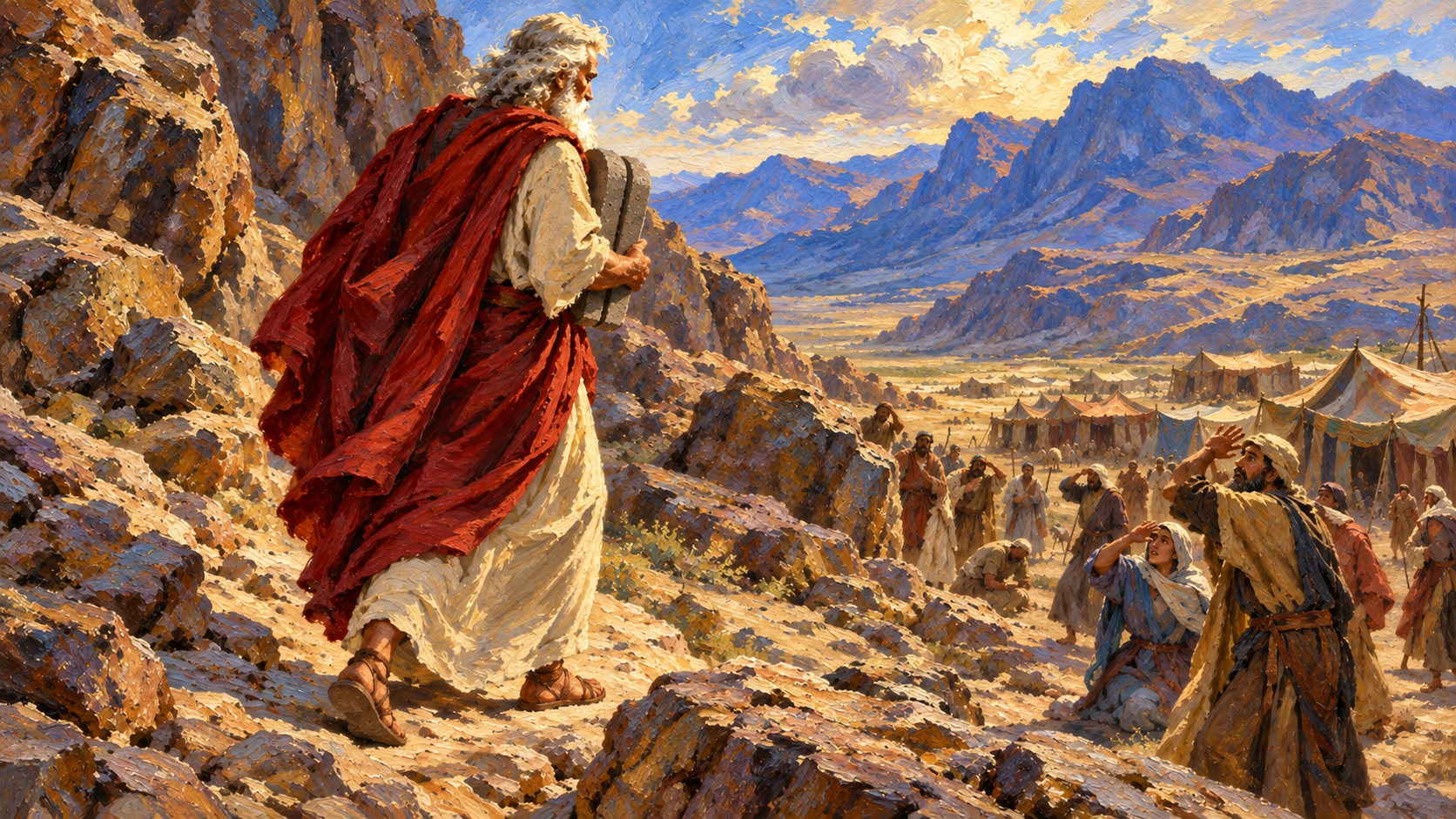
How should a Christian read the Law of Moses? I keep seeing two opposite mistakes: people trying to earn righteousness through its commands and people treating grace as permission to ignore God’s authority. I want to understand what God gave Israel in that covenant and how its teaching leads us to Christ. Then we can consider what obedience looks like as we live in the Holy Spirit.
The Law in Scripture and the Mosaic Covenant
The Hebrew word torah includes instruction and direction as well as teaching or law. When we come to the Greek word nomos, context may point to the Mosaic Law or to Scripture more broadly. It can also name a particular command or a governing principle, as in the law of sin. Even “The Law” can refer to Genesis through Deuteronomy, where we find narrative and promise alongside covenant commands. Understanding that range helps us read honestly: we cannot assume that every occurrence means only the Ten Commandments or the whole Sinai code.
A covenant establishes a binding relationship with stated promises and obligations. God made the Mosaic covenant with Israel through Moses at Sinai, after redeeming the nation from Egypt. Living under that Law meant belonging to the whole covenant. Its priesthood and sacrifices governed worship, while its calendar and national courts ordered Israel’s life. The covenant also set out blessings and penalties. It could not, however, declare guilty sinners righteous or give them new hearts. Christ brought its patterns and purposes to their intended goal and established the new covenant in His blood.
When we understand Torah as instruction, we should hear both the warmth of God’s teaching and His authority. His commands do not become optional advice. Through them He teaches the truth about Himself and the worship He requires, defining justice and exposing sin while revealing mercy within the covenant.
Paul sometimes uses nomos in several ways within the same letter. In Romans, he discusses the Mosaic Law as well as the moral witness of God’s law in people’s hearts. He also writes about the law of faith and the law of the mind, and elsewhere speaks of the law of sin. Before I build a doctrinal conclusion on that word, I need to know which sense his sentence requires.
That range of meaning helps us approach Psalm 19. David begins with the heavens declaring God’s glory, then turns to His written revelation. He praises the LORD’s law and testimony, along with His statutes and commandment. The psalm also speaks of the fear of the LORD and His righteous judgments. Creation truly reveals God’s power and glory and leaves humanity accountable. Through His written Word, we learn clearly what He has said.
David describes the LORD’s law as perfect and His testimony as sure. The Hebrew expression translated “converting the soul” can describe restoring or refreshing someone, or bringing life back. I would not make that phrase say that keeping Mosaic rules produces New Testament regeneration. David is praising the reliable power of God’s instruction.
God’s words give wisdom to the simple and joy to the heart. They enlighten the eyes and warn those who serve Him, exposing hidden faults as well as presumptuous sins. I cannot stop at admiring such a Word. Its light should lead me to examine myself honestly and pray.
Sin did not begin when Moses received the tablets at Sinai. Adam had already broken God’s command, and Cain had been guilty of murder. God judged a violent world through the Flood and afterward gave Noah commands about life and blood. He also judged Sodom and commended Abraham for faith and obedience. Those events show that people were morally accountable long before the covenant at Sinai.
Romans 5 tells us that sin was already in the world before the Law. People died even when their transgressions differed from Adam’s violation of a specific command. What the Mosaic covenant gave Israel was a detailed standard, publicly known and administered within the nation. It did not bring holiness or human accountability into existence.
That is why some moral truths remain binding beyond Sinai. Murder violates the Creator’s authority and the image of God, so its wrongness does not depend merely on an Israelite statute. Adultery is wrong because it violates God’s design for marriage, and idolatry rejects the one true God.
Notice how the Ten Commandments begin: the LORD identifies Himself as Israel’s God who brought them out of Egypt. They had not first kept the Law to persuade Him to rescue them. He brought them out through His covenant mercy and power before leading them to Sinai.
National deliverance from Egypt did not mean that every Israelite was eternally saved. The wilderness generation included people who rebelled in unbelief. Still, God gave the national covenant to a people He had already delivered from bondage.
No one in the Old Testament earned justification through Moses. Centuries before Sinai, Abraham believed the LORD and was counted righteous. David later described the blessedness of forgiven sin, and Habakkuk said the just shall live by faith. The Law governed a redeemed nation, but it never gave guilty people a way to earn eternal life.
When Israel reached Sinai in the third month after leaving Egypt, the scene made the holiness of the covenant unmistakable. Thunder and lightning covered the mountain as a trumpet sounded and smoke rose, and God set boundaries around it. The people were meeting the holy God, not a tribal deity they could approach casually. He reminded them that He had carried them to Himself and promised that, if they obeyed His voice and kept His covenant, they would be His special treasure. He called them to serve as a kingdom of priests and a holy nation. I notice that this calling came from the God who already owned the whole earth. Choosing Israel to represent His holiness did not put the other nations beyond His ownership.
Exodus 20 records the Ten Commandments. Chapters 21-23 then apply covenant justice to Israel’s worship and daily life. In Exodus 24, sacrifices were offered before Moses read the Book of the Covenant to the people. They agreed to obey, and he sprinkled the covenant blood on them. Leviticus explains how the priesthood and sacrifices ordered worship, with purity commands bringing holiness into ordinary life as well. Deuteronomy addresses the next generation before they entered the land, restating the covenant with its blessings and curses.
God made this covenant with Israel, rather than with humanity generally or with the church. National faithfulness brought covenant blessings, while rebellion brought national judgments that included exile. Those conditions governed the nation and should not be confused with an individual’s justification by faith.
Israel repeatedly broke the covenant. That failure revealed the need for inward transformation and the better covenant promised through the prophets.
Christians often group the Mosaic commands into moral, ceremonial, and civil categories. Moral commands address right and wrong, while ceremonial commands govern worship and ritual purity. Civil commands deal with the nation’s public justice. These descriptions can help us see why a prohibition of adultery works differently from an instruction for a sin offering. A rule about liability when an uncovered pit injures an animal serves yet another purpose.
Those categories do not mean Scripture gave Israel three separate codes. The commands belonged to one covenant, where moral questions often stood alongside ritual concerns. National obligations could be woven into both. We need to read the commands as they were given, rather than imagine that Scripture labeled each one for us.
For that reason, I would not say, “I am under the moral third of Sinai,” as though I could choose which covenant obligations still apply to me. The New Testament releases believers from the Mosaic covenant itself while directly reaffirming God’s moral will under Christ.
I find these categories helpful when they remain servants of the text. They can help us ask what a command did, but the covenant setting and the rest of Scripture must tell us how it applies now.
The Law’s Functions and Its Limits
The Law’s moral commands show us God’s character and reach beyond outward behavior. His prohibition of idolatry reflects His unique holiness and rightful claim to worship. The laws against murder show His care for human life, and the command against adultery protects covenant faithfulness. Theft disregards both God’s ownership and a neighbor’s rights. False testimony opposes His truth, while the command against coveting reaches sinful desire within the heart. Jesus and the apostles reaffirm these truths in their teaching.
Moses’ writings also call for love toward God and our neighbors, not merely outward compliance. The command against coveting reaches the heart’s desires. Holiness shapes honest business and sexual faithfulness, but it also governs how people speak and live in their families. Public justice must reflect it too, including the treatment of strangers and care for the poor.
A command can tell us what kind of heart we should have without creating that heart in us. I could restrain my outward conduct and still leave pride untouched. Politeness can conceal resentment, just as lust or greed can continue to govern the imagination. Jesus exposed that inward rebellion in the Sermon on the Mount. He did not offer a shorter list that would be easier to keep. He claims the whole person and gives the Holy Spirit to produce fruit within.
Israel’s ceremonial commands taught the nation how a holy God could dwell among sinful people. The sacrifices and priesthood gave that teaching concrete form. Burnt, grain, and peace offerings served different functions from sin and trespass offerings. Through them Israel learned dedication and tribute, and how to enjoy fellowship with God. Covenant worship also made provision for thanksgiving and cleansing. It addressed restitution and atonement, while the Day of Atonement brought an annual cleansing of the sanctuary and nation. Keeping these functions distinct helps us understand what Israel was learning through its worship.
The sanctuary made God’s presence visible among His people. Purity rules shaped ordinary life by making distinctions about food and disease, as well as bodily conditions and washing. The feasts marked the agricultural year and directed worship toward remembered acts of God. Together these commands set Israel apart and taught the people to expect cleansing. They also prepared them to understand why they needed a mediator and a sufficient offering to give them true access to God.
Hebrews calls the Law a shadow of good things to come. The offerings had to be repeated because they could not make worshipers perfect or cleanse the conscience finally. That repetition showed that the promised fulfillment had not yet arrived.
Jesus is the final sacrifice and the eternal High Priest. Through His body and blood, He accomplishes what animal offerings could only picture. We therefore do not return to Levitical sacrifices or look for mediation at a temple. Ceremonial washing no longer determines our purity before God, and the feast calendar is not imposed on the church as a covenant obligation.
I don’t want to dismiss those shadows as bad simply because Christ has fulfilled them. They were holy teaching in the time God appointed for them. We can still learn from them how rich Christ’s work is and why we need it.
Israel’s civil commands governed a nation with its own judges and a defined inheritance in the land. They addressed property and crime, requiring public testimony from witnesses. They also required restitution and regulated debt, alongside rules concerning servants and warfare. The penalties they assigned restrained personal vengeance and placed public justice under God’s authority.
“Eye for eye” required proper authorities to keep punishment proportionate to the wrong. It did not give individuals permission to take revenge. In serious cases, multiple witnesses protected people against unsupported accusations. A command to build a parapet required a person to guard a neighbor against foreseeable danger, while restitution required an offender to address the measurable loss he had caused.
The church has no civil sword because it is not a nation-state. It cannot impose Israel’s land laws or criminal penalties. Modern governments are accountable to justice, but Scripture does not require them to adopt Israel’s complete covenant code.
We can still learn from these laws that punishment should fit the wrong and that justice needs a trustworthy process. People must take responsibility for property entrusted to them. The same laws protect vulnerable people and limit the use of power, so their wisdom remains useful even outside Israel’s national arrangement.
The Ten Commandments hold a foundational place within this covenant. God spoke them publicly to Israel and wrote them on tablets that were later placed in the ark. They summarize the people’s loyalty to God and their responsibility to live rightly with one another.
That foundational place does not separate them from Sinai. Deuteronomy calls the tablets the words of the covenant. When we speak of the Decalogue, or Ten Commandments, we need to remember that setting rather than place the church under the same code and sanctions.
New Testament teaching directly reaffirms the moral truths expressed in nine of the commandments. Christ and His apostles require faithfulness to God, so Christians must reject idolatry and blasphemy. Dishonoring parents and committing murder remain wrong, as do adultery and theft. The same teaching condemns lies and coveting. These truths belong to the holy life Christ calls us to live.
The Sabbath differs in covenant function. It is explicitly called a sign between the LORD and the children of Israel. The New Testament does not impose that seventh-day sign upon the church.
With the Sabbath, we need to understand both its roots in creation and its role in the covenant. Genesis gives the pattern of God ceasing on the seventh day. Exodus 16 then shows Israel being prepared through the manna cycle. At Sinai, God commanded the seventh-day Sabbath on the basis of creation, and later connected it to redemption from Egypt.
Exodus 31 calls the Sabbath a perpetual sign between God and Israel, with a national death penalty for violating it. That penalty shows why we cannot reduce the command to general advice about getting some rest.
So let no one judge you in food or in drink, or regarding a festival or a new moon or sabbaths, which are a shadow of things to come, but the substance is of Christ.
Colossians names festivals, new moons, and Sabbaths together, following the familiar pattern of annual, monthly, and weekly observances. Paul calls them shadows whose substance is Christ and tells believers not to accept judgment over them. Romans 14 likewise makes room for a believer who esteems a particular day and one who esteems every day alike. Each is to act toward the Lord.
We should gather faithfully with the church and can establish wise patterns of rest and worship. A believer may esteem a particular day to the Lord, but Saturday observance must not become a condition of salvation or fellowship. The New Testament does record believers gathering on the first day. That does not make Sunday the Mosaic Sabbath under a new name, and Revelation 1:10 alone does not establish that “the Lord’s Day” means Sunday.
The Law gives us a concrete understanding of God’s holiness, showing what love and justice require. It defines transgression and brings hidden desires into the open. Its warnings leave no doubt about judgment and give the sinner no excuse. Those are real purposes, even though the Law cannot do everything a sinner needs.
The Law instructed Israel in worship and restrained public evil within the nation. Its history and wisdom continue teaching later generations. Its sacrifices and institutions pointed forward to Christ.
The Law also takes away our grounds for boasting. I might feel righteous when I compare myself with a neighbor, but hearing the holy Lawgiver requires a much more searching examination. I must examine my heart and the motives behind my conduct, answering for any duties left undone as well as sins committed in secret. God requires complete loyalty, not merely a favorable comparison.
Moses’ writings remain inspired Scripture for believers. They teach sound doctrine and correct our errors, instructing us in righteousness. Being free from the Mosaic covenant does not give me a reason to leave those writings unread.
The Law and the Gospel of Grace
Now we know that whatever the law says, it says to those who are under the law, that every mouth may be stopped, and all the world may become guilty before God. Therefore by the deeds of the law no flesh will be justified in His sight, for by the law is the knowledge of sin.
By this point in Romans 1-3, Paul has shown that both Gentiles and Jews are under sin. Gentiles have the witness of creation and conscience. Jews possess the written Law, yet do not keep it perfectly. So when the Law stops every mouth, it leaves neither group a way to defend itself as innocent. Having a clearer standard increases accountability rather than exempting anyone from judgment.
A law can tell us what is right and declare us guilty when we break it, but it cannot make a guilty past innocent. A verdict of “not guilty” does not follow simply because an offender promises to behave better tomorrow. More effort after the offense cannot erase what has already been done.
The fault does not lie in God’s command. Romans 7 describes the Law as holy and just, and also as good and spiritual. Sin seizes upon the command, exposing the desire already at work in us, and the result is death. The weakness lies in our sinful flesh, not in the Law God gave.
Galatians says that no law was given that could impart life. If a law could make us righteous, Christ would not have needed to die. A sinner needs to be forgiven and justified before God, but he also needs the new birth and the Holy Spirit dwelling within him.
Romans 2 helps us understand accountability among people outside the Mosaic covenant. Paul describes Gentiles who do not possess that Law yet do by nature things it contains. They show the work of the law written in their hearts as their conscience and thoughts accuse or excuse them.
Paul is not saying that every Gentile naturally knows Israel’s sacrificial rules or food distinctions. Someone without Moses would not simply know when Israel must keep its feasts or how an Israelite court should proceed. He is describing a moral witness that makes people accountable even when they do not possess the Mosaic Law.
Conscience is a witness rather than an infallible Bible within. It can be weak or defiled. Persistent sin may even sear it, while false teaching can train it wrongly. The conscience must therefore be informed and corrected by Scripture.
Across cultures, people recognize moral obligations even while often suppressing what they know. They distort that witness and apply it inconsistently. Such awareness makes people accountable, but it cannot tell them the saving gospel.
Galatians places the covenant within the unfolding of God’s promise. The Law was added because of transgressions until the promised Seed came. Paul’s Greek image of a guardian refers to a household custodian who supervised a child before maturity, rather than simply to a modern classroom teacher. He uses that familiar social role to explain a temporary period in redemption: the Mosaic covenant kept Israel under its supervision and directed the nation’s expectation toward Christ.
I do not think we should reduce the tutor language to an evangelistic illustration in which every person must feel enough guilt before believing. The Law certainly exposes individual guilt, yet Paul’s main argument concerns the historical place of Moses between promise and Christ.
Now that Christ has come, God’s people live by faith within the fulfillment He has brought. They are no longer under that tutor. Gentiles can become Abraham’s children through faith without first entering the Mosaic covenant.
The promise to Abraham was not canceled by a covenant given centuries later. Salvation remains rooted in God’s promise and received by faith.
"Do not think that I came to destroy the Law or the Prophets. I did not come to destroy but to fulfill. For assuredly, I say to you, till heaven and earth pass away, one jot or one tittle will by no means pass from the law till all is fulfilled. Whoever therefore breaks one of the least of these commandments, and teaches men so, shall be called least in the kingdom of heaven; but whoever does and teaches them, he shall be called great in the kingdom of heaven. For I say to you, that unless your righteousness exceeds the righteousness of the scribes and Pharisees, you will by no means enter the kingdom of heaven.
Jesus explains fulfillment in His own words in the Sermon on the Mount. Some hearers might have taken His authoritative teaching as opposition to Moses and the Prophets, but He denied that charge. Fulfill means more than “continue every covenant form unchanged” or “throw the Old Testament away.” Jesus fulfills prophecy and lives the righteousness the Law requires. He also completes its sacrificial patterns, bringing the covenant to the goal God intended.
When Jesus speaks of the smallest letter and stroke, He assures us that none of God’s revelation can fail before its purpose is accomplished. I cannot take that to mean every covenant form must remain unchanged forever. The same New Testament goes on to explain how the sacrifices and priesthood reach completion in Christ, along with the purity distinctions and covenant signs.
Jesus rejected the scribes’ shallow righteousness by exposing what was happening within the heart. He began with sinful anger and lust, then addressed divorce and truthful speech. He also taught people how to respond to injury and commanded love for their enemies. God seeks obedience from the heart, not ways of avoiding His commands while appearing to keep them.
Jesus lived as an Israelite under the Law and obeyed it without sin. His perfect obedience establishes Him as the sinless Savior who alone could give His life for sinners. It does not mean we can earn salvation by trying to reproduce His record.
Christ has redeemed us from the curse of the law, having become a curse for us (for it is written, "Cursed is everyone who hangs on a tree"), that the blessing of Abraham might come upon the Gentiles in Christ Jesus, that we might receive the promise of the Spirit through faith.
Galatians 3 connects that fulfillment directly to the cross. Deuteronomy uses the language of a public curse for a person hanged on a tree, and Jesus endured that shameful death despite His complete innocence. Wicked men mocked and scourged Him before nailing Him to the cross. They physically punished and killed the sinless Son.
Jesus willingly bore that real punishment for our sins in His innocent body. The Father did not punish or curse His beloved Son, and He did not abandon Him. Nor did He strike or bruise Jesus or pour wrath upon Him. The suffering of the cross never divided the Trinity.
Through His blood, Christ redeems believers from guilt and opens the blessing promised to Abraham to Gentiles who believe. Their reception into Christ is marked by the promised Holy Spirit, not by Mosaic circumcision.
The New Covenant and the Law of Christ
Therefore, my brethren, you also have become dead to the law through the body of Christ, that you may be married to another–to Him who was raised from the dead, that we should bear fruit to God. For when we were in the flesh, the sinful passions which were aroused by the law were at work in our members to bear fruit to death. But now we have been delivered from the law, having died to what we were held by, so that we should serve in the newness of the Spirit and not in the oldness of the letter.
Romans 7 opens with marriage as an illustration of how death changes a legal bond. The law binds a married person while the spouse lives. Paul then applies the picture to believers who, through Christ’s body, have died to the Law’s covenant claim and now belong to the risen Christ. He is not saying that God’s Law died or became evil. Our release from Moses has a purpose: we belong to Christ so that we can bear fruit to God.
Being “Not under law but under grace” does not leave a believer without authority or moral responsibility. We still receive commands from our Lord. What has changed is that our standing and service no longer belong under the Mosaic covenant’s condemning administration.
We now serve with the Holy Spirit living within us. An external command can identify sin, but the Spirit changes our desires and produces fruit. That inward work makes our service new.
The Spirit’s new life fulfills Jeremiah’s promise of a new covenant with the house of Israel and the house of Judah. It would differ from the covenant the nation broke after leaving Egypt. God promised to write His law within His people and forgive their iniquity. Every member of the covenant would know Him personally.
At the final Passover meal before His crucifixion, Jesus announced the new covenant in His blood. Paul explains in Hebrews that Christ’s once-for-all offering of Himself and His eternal priesthood establish better access and forgiveness. The first covenant is called obsolete because the promised better covenant has now been established. It no longer governs God’s people, but that does not make it mistaken or uninspired.
The church participates in new-covenant spiritual blessings through union with Christ. This does not erase the promise’s stated Israel-and-Judah setting or cancel God’s future purposes for Israel.
God’s law being written within us does not mean we become sinlessly perfect. It does not give us private revelation with authority above Scripture either. The Spirit changes our hearts by applying God’s truth, and He always leads us to obey the written Word.
and to the Jews I became as a Jew, that I might win Jews; to those who are under the law, as under the law, that I might win those who are under the law; to those who are without law, as without law (not being without law toward God, but under law toward Christ), that I might win those who are without law;
Paul’s ministry shows how freedom from the Mosaic covenant works without abandoning obedience. He could adapt to Jewish or Gentile customs in order to share the gospel because those customs did not determine justification. Yet he immediately explained that he was not without law toward God. He remained under law toward Christ.
Jesus is Lord, so every believer answers to His teaching and to the commands He gave through His apostles. God’s moral will has not become optional. That is why Galatians calls us to bear one another’s burdens and fulfill the law of Christ.
Christ’s authority is personal, but it is also given to us in writing. I cannot use the claim “The Spirit led me” to excuse disobeying Scripture. The Holy Spirit inspired the Word and does not contradict Himself.
Owe no one anything except to love one another, for he who loves another has fulfilled the law. For the commandments, "You shall not commit adultery," "You shall not murder," "You shall not steal," "You shall not bear false witness," "You shall not covet," and if there is any other commandment, are all summed up in this saying, namely, "You shall love your neighbor as yourself." Love does no harm to a neighbor; therefore love is the fulfillment of the law.
Romans 13 shows what this obedience looks like in love. Paul does not replace moral commands with a vague feeling. He names the things love will refuse to do: adultery violates a neighbor’s marriage covenant, and murder attacks the life God gave. Theft and falsehood cause harm too, while coveting turns even our inward desires against a neighbor’s good.
Jesus brings love for God and love for our neighbor together as the great summary of the Law and the Prophets. Such love directs every part of us toward God and seeks what is genuinely good for our neighbor.
We cannot redefine love by how gentle something feels when it contradicts God’s truth. Approving sin can cause serious harm, as can concealing abuse or flattering someone who lives in rebellion. Seeking a person’s genuine good will sometimes require me to offer correction instead of avoiding a difficult conversation.
Applying Scripture Without Legalism
When I work through a command from Moses, I begin with its original audience and covenant. I ask what the command required of those who first received it and what problem it addressed. Then I consider how it related to Israel’s worship or national life. That context helps us see what the command reveals about God and how He expects people to treat their neighbors.
Then we follow that command through the rest of Scripture. The New Testament may reaffirm it directly, or it may explain how the institution has been fulfilled in Christ. The apostles may release believers from its covenant observance. They may also draw out an enduring moral principle even though the command’s particular Israelite form no longer binds us.
That is why Christians do not offer animals or seek purity through Levitical ceremonies. Israel’s food distinctions do not bind the church, and we should not recreate Israel’s civil penalties. Circumcision is not a requirement for salvation or fellowship, nor does the feast calendar bind our conscience. Acts 15 separately commands Gentile believers to abstain from blood, a concern whose roots reach back before Sinai.
Israel’s tithes supported worship and the nation’s order within its covenant. In the New Testament, giving comes willingly from a generous heart. We should give in proportion to what God has provided and with appropriate accountability, without treating our gift as a tax that purchases His blessing.
A parapet protected a neighbor from danger, so the command teaches responsibility for another person’s safety. Requirements for witnesses teach us to seek reliable evidence, and restitution shows that wrongdoing calls for repair. Gleaning expresses God’s concern for generosity toward the poor, while honest measures bring righteousness into commerce. We can learn from all of these commands without imposing their precise Israelite forms on the church.
This approach also helps when a command becomes a slogan in a debate. Leviticus forbids an Israelite garment woven from two kinds of material, but the New Testament does not impose that distinction on the church. I would not invent a hidden explanation where the text gives none. We can recognize Israel’s visible covenant boundaries without declaring every modern blended fabric sinful.
Leviticus 19:28 places cutting the flesh for the dead alongside tattoo marks. We should take that passage seriously by rejecting pagan devotion and self-harm, as well as bodily markings that honor evil. But the church is not under Israel’s covenant code. Quoting the verse does not settle every question about a modern marking by itself. New Testament teaching on holiness and the body must govern our application. A believer must consider his witness and conscience, submit to rightful authority, and reject idolatry.
Reading Scripture this way helps me distinguish legalism from obedience. Legalism begins when someone tries to be justified by works. It also appears when obedience becomes a way to stay saved or claim spiritual superiority over other believers. Circumcision cannot add to Christ’s saving work, and neither can rules about food or special days. A style of dress cannot improve His sacrifice. Even generous giving and other religious performance cannot complete what Jesus has already accomplished.
Legalism also teaches a tradition or personal conviction as though God commanded it of everyone. Jesus condemned leaders who set aside God’s command while teaching human rules as doctrine.
Obeying an actual command is not legalism simply because it costs us something. Sexual purity requires self-denial, and truthfulness or the proper exercise of church discipline can be difficult too. Love can also be costly without becoming an attempt to earn salvation. If I call every difficult act of obedience legalism, I have emptied the word of its meaning.
Christian liberty belongs where God has left us free. My conscience cannot turn explicit sin into an optional matter or make an explicit command merely a personal preference.
For the grace of God that brings salvation has appeared to all men, teaching us that, denying ungodliness and worldly lusts, we should live soberly, righteously, and godly in the present age, looking for the blessed hope and glorious appearing of our great God and Savior Jesus Christ, who gave Himself for us, that He might redeem us from every lawless deed and purify for Himself His own special people, zealous for good works.
Titus 2 explains why freedom from legalism must never become lawlessness. Grace trains us to turn away from ungodliness and live righteously as we wait for Christ. Jesus gave Himself to redeem people from lawless deeds and purify a people eager to do good.
A person who is truly born again is eternally secure, indwelt by the Holy Spirit and sealed for the day of redemption. That security does not make rebellion safe. The Father disciplines the believer precisely because this is His child. Within that secure relationship, we grow by honestly confessing sin and continuing in obedient faith.
A superficial profession without transformation should not be confused with new birth. Fruit does not purchase salvation, but new life bears fruit.
The Gospel and Our Response
The Law leaves us without a defense before God. Comparing myself with someone worse cannot remove my guilt, and keeping selected commands cannot erase the ones I have broken. Nor can a promise to improve change the past. Every command carries the authority of the same holy God.
Jesus Christ is the eternal Son who became fully human while remaining fully God and completely sinless. Wicked men physically tortured and punished Him, then killed Him on the cross. He willingly bore that real punishment for our sins in His innocent body. His blood was shed when He died, and He rose bodily from the grave. The Father did not punish or curse His beloved Son, nor did He abandon Him. He did not strike or bruise Jesus or pour wrath upon Him.
Because Christ died for the whole world, salvation is genuinely offered to everyone. We receive it by grace through repentant faith. God justifies the believer and gives that person new birth, while the Holy Spirit comes to dwell within and seal him. God keeps His child eternally.
Morality cannot remove our need for grace, and grace cannot defend our disobedience. We come to the crucified and risen Savior empty-handed, receiving justification and new life through faith. Then we follow His commands from a transformed heart, depending on the Spirit’s power. That is why I want to hear Moses first as he speaks to Israel within its covenant. From there we can follow each command through Christ and the apostles without sending the church back to Sinai or inventing laws of our own.
My Final Thoughts
After working through these passages, I do not believe Christians should treat the law as either a ladder to earn salvation or a relic with nothing left to teach us. The law reveals God’s holy character and exposes our need for Christ. Jesus fulfilled the Law and redeemed us from its curse. Those who trust Him are saved by grace and taught by the Spirit to love God and neighbor in the newness of life.