
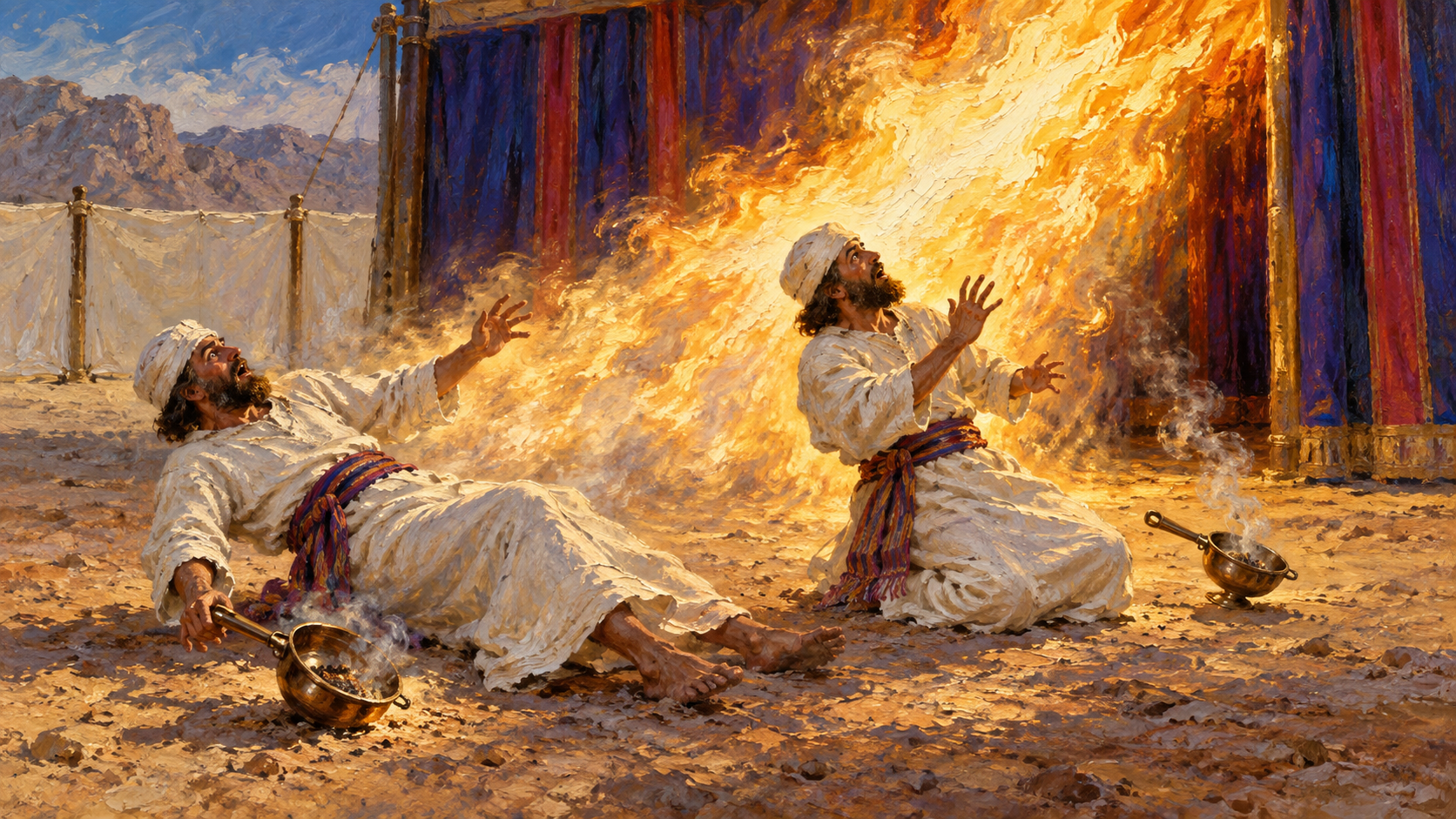
Nadab and Abihu had seen God’s glory, been consecrated as priests, and received careful instructions for their service. Yet they died when they brought an offering He had not commanded. I want to understand that judgment without turning a possible explanation into a fact Scripture never states. The rest of Leviticus 10 also deserves our attention, because it records Aaron’s response to his sons’ deaths and how Moses listened when another priestly action troubled him.
Privilege and Consecration Made Their Disobedience More Serious
Now these are the records of Aaron and Moses when the LORD spoke with Moses on Mount Sinai. And these are the names of the sons of Aaron: Nadab, the firstborn, and Abihu, Eleazar, and Ithamar. These are the names of the sons of Aaron, the anointed priests, whom he consecrated to minister as priests. Nadab and Abihu had died before the LORD when they offered profane fire before the LORD in the Wilderness of Sinai; and they had no children. So Eleazar and Ithamar ministered as priests in the presence of Aaron their father.
Nadab and Abihu were Aaron’s two eldest sons. Their younger brothers were Eleazar and Ithamar, and all four had been set apart to serve as priests. They were not outsiders unfamiliar with the sanctuary. Numbers looks back on their deaths and records that neither man had children; Eleazar and Ithamar continued ministering with Aaron.
Before entering that service, the two older brothers had shared a remarkable privilege at Mount Sinai.
Now He said to Moses, “Come up to the LORD, you and Aaron, Nadab and Abihu, and seventy of the elders of Israel, and worship from afar. And Moses alone shall come near the LORD, but they shall not come near; nor shall the people go up with him.” So Moses came and told the people all the words of the LORD and all the judgments. And all the people answered with one voice and said, “All the words which the LORD has said we will do.” And Moses wrote all the words of the LORD. And he rose early in the morning, and built an altar at the foot of the mountain, and twelve pillars according to the twelve tribes of Israel. Then he sent young men of the children of Israel, who offered burnt offerings and sacrificed peace offerings of oxen to the LORD. And Moses took half the blood and put it in basins, and half the blood he sprinkled on the altar. Then he took the Book of the Covenant and read in the hearing of the people. And they said, “All that the LORD has said we will do, and be obedient.” And Moses took the blood, sprinkled it on the people, and said, “This is the blood of the covenant which the LORD has made with you according to all these words.” Then Moses went up, also Aaron, Nadab, and Abihu, and seventy of the elders of Israel, and they saw the God of Israel. And there was under His feet as it were a paved work of sapphire stone, and it was like the very heavens in its clarity. But on the nobles of the children of Israel He did not lay His hand. So they saw God, and they ate and drank.
After Moses read the covenant and applied its blood, he went up with Aaron, Nadab, Abihu, and seventy elders. They saw the God of Israel, with something like a sapphire pavement beneath His feet, and ate and drank without God laying His hand on them. The passage describes a genuine manifestation of God. It does not mean these men comprehended the fullness of His being, but they had witnessed far more than an ordinary ceremony.
Later, Moses consecrated Aaron and his sons for the priesthood at the tabernacle. To consecrate someone is to set him apart for God’s service. The clothing, sacrifices, blood, and anointing oil were all prescribed; the family did not devise its own entrance into this ministry.
Then Moses took some of the anointing oil and some of the blood which was on the altar, and sprinkled it on Aaron, on his garments, on his sons, and on the garments of his sons with him; and he consecrated Aaron, his garments, his sons, and the garments of his sons with him. And Moses said to Aaron and his sons, “Boil the flesh at the door of the tabernacle of meeting, and eat it there with the bread that is in the basket of consecration offerings, as I commanded, saying, ‘Aaron and his sons shall eat it.’ What remains of the flesh and of the bread you shall burn with fire. And you shall not go outside the door of the tabernacle of meeting for seven days, until the days of your consecration are ended. For seven days he shall consecrate you. As he has done this day, so the LORD has commanded to do, to make atonement for you. Therefore you shall stay at the door of the tabernacle of meeting day and night for seven days, and keep the charge of the LORD, so that you may not die; for so I have been commanded.” So Aaron and his sons did all the things that the LORD had commanded by the hand of Moses.
The priests remained at the tabernacle entrance for seven days under a solemn warning to keep the LORD’s charge so they would not die. Their own need for atonement was part of the consecration. Wearing priestly garments did not make them sinless, and being permitted to handle holy things did not put them above God’s commands.
I need to take that responsibility seriously when reading about their later offense. These men had been given instruction as well as privilege. An extraordinary experience of God’s presence could not substitute for obeying Him when they began their work.
God Accepted the Commanded Offering and Judged What He Had Not Commanded
On the eighth day, Aaron offered the appointed sacrifices for himself and the people.
Then Aaron lifted his hand toward the people, blessed them, and came down from offering the sin offering, the burnt offering, and peace offerings. And Moses and Aaron went into the tabernacle of meeting, and came out and blessed the people. Then the glory of the LORD appeared to all the people, and fire came out from before the LORD and consumed the burnt offering and the fat on the altar. When all the people saw it, they shouted and fell on their faces.
Moses and Aaron went into the tabernacle, then came out and blessed Israel. God’s glory appeared to the congregation, and fire from before Him consumed the burnt offering and fat on the altar. The people shouted and fell on their faces. The LORD had publicly accepted the service He commanded.
The next account describes fire coming from before the LORD again, this time in judgment upon two of the priests.
Then Nadab and Abihu, the sons of Aaron, each took his censer and put fire in it, put incense on it, and offered profane fire before the LORD, which He had not commanded them. So fire went out from the LORD and devoured them, and they died before the LORD. And Moses said to Aaron, “This is what the LORD spoke, saying: ‘By those who come near Me I must be regarded as holy; And before all the people I must be glorified.'” So Aaron held his peace. Then Moses called Mishael and Elzaphan, the sons of Uzziel the uncle of Aaron, and said to them, “Come near, carry your brethren from before the sanctuary out of the camp.” So they went near and carried them by their tunics out of the camp, as Moses had said. And Moses said to Aaron, and to Eleazar and Ithamar, his sons, “Do not uncover your heads nor tear your clothes, lest you die, and wrath come upon all the people. But let your brethren, the whole house of Israel, bewail the burning which the LORD has kindled. You shall not go out from the door of the tabernacle of meeting, lest you die, for the anointing oil of the LORD is upon you.” And they did according to the word of Moses.
Each brother took a censer, a vessel used to hold burning coals, and added fire and incense. Incense produces fragrant smoke as it burns. They presented this before the LORD, but their offering was outside His direction. Leviticus explains the offense with the words “which He had not commanded them.” The fact that the men were ordained priests did not authorize whatever offering they decided to bring.
Fire devoured them, and Moses repeated God’s declaration that those who came near Him must regard Him as holy and that He must be glorified before the people. The priests’ conduct represented God to Israel. They could not treat the approach to His presence as something under their own control immediately after He had confirmed the offering He required.
The Hebrew expression is esh zarah. Esh means fire; zarah, the feminine form of zar, describes what is strange or foreign. In this setting it concerns what does not belong within God’s prescribed service. The Hebrew usage helps explain both the familiar wording “Strange fire” and the NKJV’s description of profane fire. The phrase does not describe a flame that looked visibly sinister. The offering was unacceptable because God had not commanded it.
We should also understand what holiness means. God is completely pure and distinct from His creation. When He sets apart a person, object, place, or day for His purpose, that created thing can also be called holy. Something common is ordinary rather than consecrated; the word does not always mean sinful. Priests needed to recognize those distinctions instead of deciding for themselves how something set apart for God should be used.
Scripture Names the Sin Without Giving Every Detail
Several nearby commands help us consider what may have made the brothers’ offering unauthorized. We need to read them carefully without claiming that any one supplies every missing detail.
“You shall make an altar to burn incense on; you shall make it of acacia wood. A cubit shall be its length and a cubit its width–it shall be square–and two cubits shall be its height. Its horns shall be of one piece with it. And you shall overlay its top, its sides all around, and its horns with pure gold; and you shall make for it a molding of gold all around. Two gold rings you shall make for it, under the molding on both its sides. You shall place them on its two sides, and they will be holders for the poles with which to bear it. You shall make the poles of acacia wood, and overlay them with gold. And you shall put it before the veil that is before the ark of the Testimony, before the mercy seat that is over the Testimony, where I will meet with you. “Aaron shall burn on it sweet incense every morning; when he tends the lamps, he shall burn incense on it. And when Aaron lights the lamps at twilight, he shall burn incense on it, a perpetual incense before the LORD throughout your generations. You shall not offer strange incense on it, or a burnt offering, or a grain offering; nor shall you pour a drink offering on it. And Aaron shall make atonement upon its horns once a year with the blood of the sin offering of atonement; once a year he shall make atonement upon it throughout your generations. It is most holy to the LORD.”
Aaron was to burn sweet incense on its appointed altar in the morning and at twilight. Other kinds of offerings did not belong on that altar, and strange incense was expressly forbidden. Exodus 30:34-38 also specified the incense mixture and forbade copying it for personal fragrance. The priests had no authority to alter a service whose purpose and materials God had defined.
Leviticus 6 required the altar fire to be kept burning. Leviticus 16 later directed the high priest to take coals from the altar before the LORD when entering within the veil on the Day of Atonement. These commands have led readers to suggest that Nadab and Abihu took fire from another source. Others consider an unauthorized incense mixture or an improper time of offering. Leviticus 10 does not identify the source of their coals, describe the mixture, or state whether the timing was wrong.
Leviticus 16 begins by recalling their deaths and warning Aaron not to enter the inner sanctuary whenever he wished. That gives us reason to consider an improper entrance as well. But the earlier account never says the brothers crossed the veil. The connection between the chapters supports a possibility; it does not let us add an entrance the text does not record.
Leviticus 10 itself records a command about wine given directly to Aaron after the deaths and the instructions concerning mourning.
Then the LORD spoke to Aaron, saying: “Do not drink wine or intoxicating drink, you, nor your sons with you, when you go into the tabernacle of meeting, lest you die. It shall be a statute forever throughout your generations, that you may distinguish between holy and unholy, and between unclean and clean, and that you may teach the children of Israel all the statutes which the LORD has spoken to them by the hand of Moses.”
Priests were not to drink when going into the tabernacle. The prohibition was broader than a warning against obvious drunkenness, and disobedience carried the warning “lest you die.”
Its placement raises the possibility that alcohol contributed to the brothers’ offense, perhaps by impairing their judgment. Still, Leviticus does not state that Nadab and Abihu were drunk or even that they had been drinking. We can explain why the context raises that question while leaving their actual condition unclaimed.
God also explained the responsibilities requiring sober judgment: priests had to distinguish holy from unholy and clean from unclean, then teach Israel His statutes. A man whose judgment was impaired could mislead people about God as well as mishandle a ritual.
The text leaves those details unresolved while stating the offense plainly: the brothers offered what God had not commanded. Moses explained their judgment in terms of God’s holiness. I understand its immediacy in the setting of the priesthood’s inauguration: the men entrusted with teaching Israel obedience were not permitted to begin their ministry by disregarding His direction.
Other passages record immediate judgments at significant moments, including Uzzah’s death when the ark was being moved toward Jerusalem and the deaths of Ananias and Sapphira in the early church. These do not establish a rule that every sin results in immediate earthly death. They do warn us against mistaking God’s patience for approval. We should repent when His Word exposes wrongdoing, without waiting for a more frightening warning.
Holiness Includes Grief, Sober Judgment, and Careful Listening
Leviticus 10:3 records that Aaron held his peace when Moses repeated God’s words. Scripture does not explain everything his silence meant. Submission may have been present alongside shock and grief, but we are not given a description of his inward response. I would not turn that silence into a claim that he felt no sorrow or that faithful people must become emotionally numb when a loved one dies.
Moses called Mishael and Elzaphan, relatives from Uzziel’s family, to carry the bodies outside the camp. Aaron and his remaining sons had a different charge. They were to stay at the tabernacle entrance and refrain from the usual public signs of mourning, uncovering their heads and tearing their clothes. The anointing oil was upon them, and they had to continue the work assigned to them during this crisis.
Israel was expressly allowed to mourn the burning, so God was not forbidding everyone to grieve. Nor should we transfer the priests’ particular restriction to Christian ministers and tell them they may never mourn a family member. The chapter preserves the weight of their duty without suggesting that obedience removed their loss.
The remaining priests continued serving, but a dispute over the sin offering required Moses to listen before settling his assessment.
And Moses spoke to Aaron, and to Eleazar and Ithamar, his sons who were left: “Take the grain offering that remains of the offerings made by fire to the LORD, and eat it without leaven beside the altar; for it is most holy. You shall eat it in a holy place, because it is your due and your sons’ due, of the sacrifices made by fire to the LORD; for so I have been commanded. The breast of the wave offering and the thigh of the heave offering you shall eat in a clean place, you, your sons, and your daughters with you; for they are your due and your sons’ due, which are given from the sacrifices of peace offerings of the children of Israel. The thigh of the heave offering and the breast of the wave offering they shall bring with the offerings of fat made by fire, to offer as a wave offering before the LORD. And it shall be yours and your sons’ with you, by a statute forever, as the LORD has commanded.” Then Moses made careful inquiry about the goat of the sin offering, and there it was–burned up. And he was angry with Eleazar and Ithamar, the sons of Aaron who were left, saying, “Why have you not eaten the sin offering in a holy place, since it is most holy, and God has given it to you to bear the guilt of the congregation, to make atonement for them before the LORD? See! Its blood was not brought inside the holy place; indeed you should have eaten it in a holy place, as I commanded.” And Aaron said to Moses, “Look, this day they have offered their sin offering and their burnt offering before the LORD, and such things have befallen me! If I had eaten the sin offering today, would it have been accepted in the sight of the LORD?” So when Moses heard that, he was content.
Moses instructed Aaron, Eleazar, and Ithamar about the portions of the offerings they were to eat. Then he discovered that the goat of the sin offering had been burned. Because its blood had not been taken into the inner sanctuary, its flesh should have been eaten in the holy place. Moses became angry with the surviving sons over what appeared to be another failure to follow the command.
Aaron answered by referring to the sacrifices offered that day and the terrible things that had happened to him. His question concerned whether eating the sin offering in those circumstances would have been acceptable to the LORD. Moses heard the explanation and was content. The passage does not supply a detailed account of Aaron’s reasoning, but it plainly records that Moses accepted it.
I think we need to give that exchange room alongside the deaths at the beginning of the chapter. Moses did not insist that his first assessment had to stand because he was the leader. He listened to a truthful explanation and recognized that this action was not to be treated as another instance of the brothers’ presumption. Taking holiness seriously required him to understand the circumstances rather than simply repeat his initial accusation.
That is no excuse to call disobedience acceptable whenever someone feels distressed. Aaron was concerned about whether the offering would please God, and Moses found his answer satisfactory. The same chapter that condemns unauthorized worship also shows a leader willing to hear and accept an explanation. We should preserve both parts when we teach it.
New-Covenant Worship Is Governed by Truth and Draws Near Through Christ
Christians need to learn from Israel’s worship without attempting to recreate Aaron’s priesthood. Jesus addressed the change in worship when a Samaritan woman asked about the rival claims of her people’s mountain and Jerusalem.
The woman said to Him, “Sir, I perceive that You are a prophet. Our fathers worshiped on this mountain, and you Jews say that in Jerusalem is the place where one ought to worship.” Jesus said to her, “Woman, believe Me, the hour is coming when you will neither on this mountain, nor in Jerusalem, worship the Father. You worship what you do not know; we know what we worship, for salvation is of the Jews. But the hour is coming, and now is, when the true worshipers will worship the Father in spirit and truth; for the Father is seeking such to worship Him. God is Spirit, and those who worship Him must worship in spirit and truth.”
She was asking about Mount Gerizim, where the Samaritans worshiped, and the Jewish sanctuary in Jerusalem. Jesus did not treat their conflicting beliefs as equally true, but He also announced an hour when worship of the Father would no longer depend on either location. The Father seeks worshipers who come in spirit and truth.
Worship “in spirit” cannot be reduced to emotional excitement, and worship “in truth” does not describe correct words spoken with no inward devotion. We worship from the inner person through the Holy Spirit in agreement with God’s revelation in Christ. Sincerity cannot make false teaching true, and accurate teaching should call forth an honest response to the God it reveals.
Jesus fulfilled what Israel’s sacrifices and sanctuary anticipated. We do not bring animal blood into a tabernacle, burn incense on Aaron’s altar, or put on priestly garments to gain access to God. The apostolic Scriptures govern the church under the new covenant. Nadab and Abihu do not give us a command to reproduce Levitical worship, but their offense warns us against inventing another mediator, changing the gospel, or presenting disobedience as devotion.
Some understand “which He had not commanded” as a rule that a church may make no choice unless Scripture explicitly names it. I do not think Leviticus 10 establishes that rule. A congregation must choose a meeting time and language, arrange seating and lighting, and decide how to make its teaching audible. Those practical decisions serve the gathering; they are not priestly offerings introduced into a ritual God had already prescribed.
The brothers’ offense concerned an approach to God whose ministers, materials, place, and order He had defined. They were not choosing a useful arrangement to carry out His instruction. Under the new covenant, Scripture likewise governs the church’s teaching, prayer, singing, giving, baptism, Communion, and leadership. Our practical arrangements should help us obey what Christ commands rather than compete with it.
Before condemning a practice because it is unfamiliar, I need to identify what Scripture actually requires or forbids. An old custom can conceal error, and a new arrangement can be useful. The question is whether we tell the truth about God, edify the congregation, and obey His Word. We should also take conscience seriously and avoid manipulating people through spectacle or emotional pressure.
Paul tells believers in Hebrews that they can enter God’s presence with confidence by the blood of Jesus.
Therefore, brethren, having boldness to enter the Holiest by the blood of Jesus, by a new and living way which He consecrated for us, through the veil, that is, His flesh, and having a High Priest over the house of God, let us draw near with a true heart in full assurance of faith, having our hearts sprinkled from an evil conscience and our bodies washed with pure water. Let us hold fast the confession of our hope without wavering, for He who promised is faithful. And let us consider one another in order to stir up love and good works, not forsaking the assembling of ourselves together, as is the manner of some, but exhorting one another, and so much the more as you see the Day approaching.
God has opened the way Himself through the Son’s sacrifice. We are not improving on a human ritual or making ourselves sufficiently impressive to be admitted. Jesus has given His body and shed His blood for us, and He lives as the great High Priest over God’s house.
That access also brings responsibilities toward one another. We hold firmly to our confession because God is faithful, and we gather to encourage love and good works. Coming to God through Christ does not give me a private spiritual status that makes other believers unnecessary. Paul connects drawing near with helping one another remain faithful in our shared life.
The confidence Christ gives does not mean God has become less holy. Nadab and Abihu approached outside His command; believers receive the way He has provided. Hebrews continues to join this welcome with a solemn warning.
For you have not come to the mountain that may be touched and that burned with fire, and to blackness and darkness and tempest, and the sound of a trumpet and the voice of words, so that those who heard it begged that the word should not be spoken to them anymore. (For they could not endure what was commanded: “And if so much as a beast touches the mountain, it shall be stoned or shot with an arrow.” And so terrifying was the sight that Moses said, “I am exceedingly afraid and trembling.”) But you have come to Mount Zion and to the city of the living God, the heavenly Jerusalem, to an innumerable company of angels, to the general assembly and church of the firstborn who are registered in heaven, to God the Judge of all, to the spirits of just men made perfect, to Jesus the Mediator of the new covenant, and to the blood of sprinkling that speaks better things than that of Abel. See that you do not refuse Him who speaks. For if they did not escape who refused Him who spoke on earth, much more shall we not escape if we turn away from Him who speaks from heaven, whose voice then shook the earth; but now He has promised, saying, “Yet once more I shake not only the earth, but also heaven.” Now this, “Yet once more,” indicates the removal of those things that are being shaken, as of things that are made, that the things which cannot be shaken may remain. Therefore, since we are receiving a kingdom which cannot be shaken, let us have grace, by which we may serve God acceptably with reverence and godly fear. For our God is a consuming fire.
Paul contrasts the terror of Sinai with Mount Zion and the heavenly Jerusalem, where believers come to Jesus, the Mediator of the new covenant. The privilege is extraordinary, but it does not justify refusing the One who speaks. Because we receive an unshakable kingdom, we are to serve God with reverence and godly fear. The passage still calls our God a consuming fire.
I need to receive Christ’s invitation without making His welcome an excuse to ignore Him. We can confess sin honestly and come gratefully through His blood while listening with a willingness to obey. Reverence does not require a particular musical style or volume: the Israelites shouted as well as fell on their faces when God accepted the offering in Leviticus 9. Their response acknowledged Him, rather than treating worship as something designed chiefly for their own approval.
Spiritual Leaders and Believers Must Serve Under God’s Word
Nadab and Abihu’s position increased their responsibility because their actions taught Israel how God could be approached. Church elders are not Aaronic priests and do not control anyone’s access to the Savior. They teach and shepherd under Jesus, the Chief Shepherd, while remaining accountable to His Word. Every elder must meet the biblical qualifications; holding office never makes him immune from correction.
A leader must not label every disagreement “strange fire” to protect his preferences. Moses listened to Aaron in this very chapter. If I appeal to the passage while refusing to hear a legitimate question, I am overlooking part of what it teaches. Faithful leadership explains and obeys Scripture instead of demanding unquestioning personal loyalty.
The priests’ need for sober judgment also warns those serving in Christian ministry. We cannot surrender clear thinking and assume our teaching, counsel, and decisions will remain reliable. Anyone teaching about God needs to reckon with the harm false teaching can cause. Invented spiritual claims can mislead an entire congregation. Sexual hypocrisy, financial exploitation, and entertainment that makes the gospel trivial can also corrupt ministry. Visibility gives a teacher more people to answer for, not a special right to be careless.
Coming to Him as to a living stone, rejected indeed by men, but chosen by God and precious, you also, as living stones, are being built up a spiritual house, a holy priesthood, to offer up spiritual sacrifices acceptable to God through Jesus Christ. Therefore it is also contained in the Scripture, “Behold, I lay in Zion A chief cornerstone, elect, precious, And he who believes on Him will by no means be put to shame.” Therefore, to you who believe, He is precious; but to those who are disobedient, “The stone which the builders rejected Has become the chief cornerstone,” and “A stone of stumbling And a rock of offense.” They stumble, being disobedient to the word, to which they also were appointed. But you are a chosen generation, a royal priesthood, a holy nation, His own special people, that you may proclaim the praises of Him who called you out of darkness into His marvelous light; who once were not a people but are now the people of God, who had not obtained mercy but now have obtained mercy.
Peter describes believers united with Jesus as a spiritual house and a holy priesthood. Our spiritual sacrifices are acceptable through Him, and they do not repeat His completed sacrifice for sin. We offer praise and prayer, obey His Word, care generously for others, and proclaim His mercy. None of these earns access to God. A sermon, song, sacrament, intense feeling, or costly act cannot provide a second way of acceptance beside Christ.
The gospel therefore calls sinners to come, not remain at a distance imagining that their guilt is beyond His mercy. Jesus is the eternal Son, fully God and fully man, born of a virgin and completely without sin. Wicked men physically tortured and punished Him before killing Him, and He willingly bore that punishment for our sins in His innocent body. He shed His blood and died, completing His saving sacrifice. He was buried and then rose bodily from the grave. The Father did not punish, curse, abandon, strike, bruise, or pour wrath on Jesus.
Christ died for the sins of the whole world, and God’s offer of salvation is genuine for everyone, although people can resist His grace and reject Him. Everyone who repents and believes in Jesus is forgiven and justified, meaning God declares that person righteous. The believer is born again and made new, indwelt and sealed by the Holy Spirit, and eternally secure in Christ.
That security does not authorize lawlessness or make a shallow profession proof of new birth. Baptism and faithful service follow salvation; they do not purchase it. We receive the cleansing Christ’s blood provides instead of presenting a payment or mediator of our own making. Because He rose bodily, we also look forward to sharing His resurrection life. Our confidence rests in the Savior God provided, and our service should express gratitude for His mercy.
My Final Thoughts
Nadab and Abihu had genuine privileges without authority to disregard God’s direction. I need to remember that when I am tempted to treat experience or a position of service as an excuse for carelessness. Their deaths warn us to approach God as He commands, and the rest of the chapter teaches us to make room for grief and to listen before judging someone’s conduct. Through Jesus Christ we can draw near confidently, receiving the cleansing of His blood and the welcome God Himself has given. That confidence belongs with reverence, a readiness to obey His Word, and a willingness to be corrected by it.