
Saul began his reign with God’s appointment and help, yet he died on Mount Gilboa after years of disobedience. I don’t think we can understand that fall by treating him as a fraud from the beginning. As we follow his life, we need to consider how a king with such promise kept choosing his own judgment over God’s Word.
A Promising King Still Had to Obey
Before Saul became king, Israel’s elders came to Samuel with a real concern. He was old, and his sons were not following his faithful example. But the solution the elders wanted revealed a problem of their own. They asked for a king like the nations around them, someone to judge them and fight their battles. God told Samuel that in making this demand they had rejected Him as their King.
Then all the elders of Israel gathered together and came to Samuel at Ramah, and said to him, "Look, you are old, and your sons do not walk in your ways. Now make us a king to judge us like all the nations." But the thing displeased Samuel when they said, "Give us a king to judge us." So Samuel prayed to the LORD. And the LORD said to Samuel, "Heed the voice of the people in all that they say to you; for they have not rejected you, but they have rejected Me, that I should not reign over them. According to all the works which they have done since the day that I brought them up out of Egypt, even to this day–with which they have forsaken Me and served other gods–so they are doing to you also. Now therefore, heed their voice. However, you shall solemnly forewarn them, and show them the behavior of the king who will reign over them." So Samuel told all the words of the LORD to the people who asked him for a king. And he said, "This will be the behavior of the king who will reign over you: He will take your sons and appoint them for his own chariots and to be his horsemen, and some will run before his chariots. He will appoint captains over his thousands and captains over his fifties, will set some to plow his ground and reap his harvest, and some to make his weapons of war and equipment for his chariots. He will take your daughters to be perfumers, cooks, and bakers. And he will take the best of your fields, your vineyards, and your olive groves, and give them to his servants. He will take a tenth of your grain and your vintage, and give it to his officers and servants. And he will take your male servants, your female servants, your finest young men, and your donkeys, and put them to his work. He will take a tenth of your sheep. And you will be his servants. And you will cry out in that day because of your king whom you have chosen for yourselves, and the LORD will not hear you in that day." Nevertheless the people refused to obey the voice of Samuel; and they said, "No, but we will have a king over us, that we also may be like all the nations, and that our king may judge us and go out before us and fight our battles." And Samuel heard all the words of the people, and he repeated them in the hearing of the LORD. So the LORD said to Samuel, "Heed their voice, and make them a king." And Samuel said to the men of Israel, "Every man go to his city."
Samuel warned that a king would take their sons into his army and their daughters into his service. He would claim their fields and require their servants to work for him, with demands on their produce and flocks as well. Even after hearing the cost, Israel insisted on having the visible security the surrounding nations seemed to enjoy.
Kingship itself was not sinful. Deuteronomy had anticipated a king, and Jacob’s blessing had already connected rule with Judah. I need to distinguish that provision from the unbelief behind Israel’s demand here. God gave them the king they requested without surrendering His own rule. Both king and people would still answer to His Word.
Saul was Kish’s son from Benjamin, a tribe still marked by the civil war at the end of Judges. Handsome and taller than the people from his shoulders upward, he looked like the king Israel expected. There was nothing wrong with his appearance, but it could not tell anyone whether he was spiritually fit to lead. God would later remind Samuel that people look at the outside while He sees the heart.
We first meet Saul searching for his father’s lost donkeys. After searching for some time, he worried that Kish would stop thinking about the animals and start worrying about him. His servant suggested asking Samuel for help. Through that ordinary concern, God was bringing Saul to the prophet He had prepared to meet him.
Then Samuel took a flask of oil and poured it on his head, and kissed him and said: "Is it not because the LORD has anointed you commander over His inheritance? When you have departed from me today, you will find two men by Rachel's tomb in the territory of Benjamin at Zelzah; and they will say to you, 'The donkeys which you went to look for have been found. And now your father has ceased caring about the donkeys and is worrying about you, saying, "What shall I do about my son?"' Then you shall go on forward from there and come to the terebinth tree of Tabor. There three men going up to God at Bethel will meet you, one carrying three young goats, another carrying three loaves of bread, and another carrying a skin of wine. And they will greet you and give you two loaves of bread, which you shall receive from their hands. After that you shall come to the hill of God where the Philistine garrison is. And it will happen, when you have come there to the city, that you will meet a group of prophets coming down from the high place with a stringed instrument, a tambourine, a flute, and a harp before them; and they will be prophesying. Then the Spirit of the LORD will come upon you, and you will prophesy with them and be turned into another man. And let it be, when these signs come to you, that you do as the occasion demands; for God is with you. You shall go down before me to Gilgal; and surely I will come down to you to offer burnt offerings and make sacrifices of peace offerings. Seven days you shall wait, till I come to you and show you what you should do." So it was, when he had turned his back to go from Samuel, that God gave him another heart; and all those signs came to pass that day. When they came there to the hill, there was a group of prophets to meet him; then the Spirit of God came upon him, and he prophesied among them.
Samuel privately anointed Saul as commander over the Lord’s inheritance, and the detailed signs confirmed that his message came from God. God gave Saul another heart for the work before him. The Spirit of the Lord came upon him, and he prophesied. Knowing how Saul’s reign ended cannot make me dismiss these real acts of God in choosing and equipping him.
When Saul was publicly selected, he was found hiding among the equipment. He may have been humble or reluctant, and fear is another possibility. More than one motive could have been involved. Since Scripture doesn’t tell us, I wouldn’t explain every later sin as the inevitable result of insecurity we have assumed here.
Then Nahash the Ammonite came up and encamped against Jabesh Gilead; and all the men of Jabesh said to Nahash, "Make a covenant with us, and we will serve you." And Nahash the Ammonite answered them, "On this condition I will make a covenant with you, that I may put out all your right eyes, and bring reproach on all Israel." Then the elders of Jabesh said to him, "Hold off for seven days, that we may send messengers to all the territory of Israel. And then, if there is no one to save us, we will come out to you." So the messengers came to Gibeah of Saul and told the news in the hearing of the people. And all the people lifted up their voices and wept. Now there was Saul, coming behind the herd from the field; and Saul said, "What troubles the people, that they weep?" And they told him the words of the men of Jabesh. Then the Spirit of God came upon Saul when he heard this news, and his anger was greatly aroused. So he took a yoke of oxen and cut them in pieces, and sent them throughout all the territory of Israel by the hands of messengers, saying, "Whoever does not go out with Saul and Samuel to battle, so it shall be done to his oxen." And the fear of the LORD fell on the people, and they came out with one consent. When he numbered them in Bezek, the children of Israel were three hundred thousand, and the men of Judah thirty thousand. And they said to the messengers who came, "Thus you shall say to the men of Jabesh Gilead: 'Tomorrow, by the time the sun is hot, you shall have help.'" Then the messengers came and reported it to the men of Jabesh, and they were glad. Therefore the men of Jabesh said, "Tomorrow we will come out to you, and you may do with us whatever seems good to you." So it was, on the next day, that Saul put the people in three companies; and they came into the midst of the camp in the morning watch, and killed Ammonites until the heat of the day. And it happened that those who survived were scattered, so that no two of them were left together. Then the people said to Samuel, "Who is he who said, 'Shall Saul reign over us?' Bring the men, that we may put them to death." But Saul said, "Not a man shall be put to death this day, for today the LORD has accomplished salvation in Israel." Then Samuel said to the people, "Come, let us go to Gilgal and renew the kingdom there." So all the people went to Gilgal, and there they made Saul king before the LORD in Gilgal. There they made sacrifices of peace offerings before the LORD, and there Saul and all the men of Israel rejoiced greatly.
At Jabesh-gilead, we see what Saul could do as Israel’s king. Nahash threatened the city with a cruel covenant requiring every man to lose his right eye. When Saul heard about it, the Spirit of God came upon him and his anger was aroused. He gathered Israel and led a decisive rescue.
Afterward, some people wanted to execute those who had questioned his kingship, but Saul refused. He credited the Lord with Israel’s deliverance that day and showed mercy to his critics. I want to remember both the courage and the restraint he showed here. His later rebellion does not make these earlier acts of faithfulness disappear.
Pressure Exposed Saul’s Self-Rule
"Now therefore, here is the king whom you have chosen and whom you have desired. And take note, the LORD has set a king over you. If you fear the LORD and serve Him and obey His voice, and do not rebel against the commandment of the LORD, then both you and the king who reigns over you will continue following the LORD your God. However, if you do not obey the voice of the LORD, but rebel against the commandment of the LORD, then the hand of the LORD will be against you, as it was against your fathers. "Now therefore, stand and see this great thing which the LORD will do before your eyes: Is today not the wheat harvest? I will call to the LORD, and He will send thunder and rain, that you may perceive and see that your wickedness is great, which you have done in the sight of the LORD, in asking a king for yourselves." So Samuel called to the LORD, and the LORD sent thunder and rain that day; and all the people greatly feared the LORD and Samuel. And all the people said to Samuel, "Pray for your servants to the LORD your God, that we may not die; for we have added to all our sins the evil of asking a king for ourselves." Then Samuel said to the people, "Do not fear. You have done all this wickedness; yet do not turn aside from following the LORD, but serve the LORD with all your heart. And do not turn aside; for then you would go after empty things which cannot profit or deliver, for they are nothing. For the LORD will not forsake His people, for His great name's sake, because it has pleased the LORD to make you His people. Moreover, as for me, far be it from me that I should sin against the LORD in ceasing to pray for you; but I will teach you the good and the right way. Only fear the LORD, and serve Him in truth with all your heart; for consider what great things He has done for you. But if you still do wickedly, you shall be swept away, both you and your king."
At the renewal of the kingdom, Samuel put king and people under the same command. They could continue following the Lord if they feared Him and obeyed His voice, but His hand would oppose them if they rebelled. The storm outside the normal season exposed the sin in their demand for a king. Even then, Samuel urged them to keep following the Lord and promised to continue praying for them and teaching them the right way.
God remained faithful to His great name without releasing His people from accountability. Saul would be judged by God’s command, whatever other kings might do. At Gilgal, military pressure would test whether he was willing to accept that authority when obedience became difficult.
Then the Philistines gathered together to fight with Israel, thirty thousand chariots and six thousand horsemen, and people as the sand which is on the seashore in multitude. And they came up and encamped in Michmash, to the east of Beth Aven. When the men of Israel saw that they were in danger (for the people were distressed), then the people hid in caves, in thickets, in rocks, in holes, and in pits. And some of the Hebrews crossed over the Jordan to the land of Gad and Gilead. As for Saul, he was still in Gilgal, and all the people followed him trembling. Then he waited seven days, according to the time set by Samuel. But Samuel did not come to Gilgal; and the people were scattered from him. So Saul said, "Bring a burnt offering and peace offerings here to me." And he offered the burnt offering. Now it happened, as soon as he had finished presenting the burnt offering, that Samuel came; and Saul went out to meet him, that he might greet him. And Samuel said, "What have you done?" Saul said, "When I saw that the people were scattered from me, and that you did not come within the days appointed, and that the Philistines gathered together at Michmash, then I said, 'The Philistines will now come down on me at Gilgal, and I have not made supplication to the LORD.' Therefore I felt compelled, and offered a burnt offering." And Samuel said to Saul, "You have done foolishly. You have not kept the commandment of the LORD your God, which He commanded you. For now the LORD would have established your kingdom over Israel forever. But now your kingdom shall not continue. The LORD has sought for Himself a man after His own heart, and the LORD has commanded him to be commander over His people, because you have not kept what the LORD commanded you."
With an enormous Philistine force gathered against them, Israelites hid and Saul’s troops began to scatter. Samuel had not yet arrived, so Saul went ahead and presented the burnt offering. Samuel came as soon as Saul had finished.
Some readers explain Saul’s sin simply by pointing out that he was not a priest. What the passage emphasizes is his failure to keep the Lord’s command given through Samuel. Saul described the scattering troops and the threat of attack as reasons he felt compelled to act. I can see the pressure he faced, but feeling compelled did not give him permission to disregard what God had told him.
Samuel announced that Saul’s dynasty would not continue and that the Lord had sought a man after His own heart. Saul remained king for years, but the judgment against his dynasty had been given. His desperate circumstances had not changed what God required of him.
And the men of Israel were distressed that day, for Saul had placed the people under oath, saying, "Cursed is the man who eats any food until evening, before I have taken vengeance on my enemies." So none of the people tasted food. Now all the people of the land came to a forest; and there was honey on the ground. And when the people had come into the woods, there was the honey, dripping; but no one put his hand to his mouth, for the people feared the oath. But Jonathan had not heard his father charge the people with the oath; therefore he stretched out the end of the rod that was in his hand and dipped it in a honeycomb, and put his hand to his mouth; and his countenance brightened. Then one of the people said, "Your father strictly charged the people with an oath, saying, 'Cursed is the man who eats food this day.'" And the people were faint. But Jonathan said, "My father has troubled the land. Look now, how my countenance has brightened because I tasted a little of this honey. How much better if the people had eaten freely today of the spoil of their enemies which they found! For now would there not have been a much greater slaughter among the Philistines?" Now they had driven back the Philistines that day from Michmash to Aijalon. So the people were very faint. And the people rushed on the spoil, and took sheep, oxen, and calves, and slaughtered them on the ground; and the people ate them with the blood. Then they told Saul, saying, "Look, the people are sinning against the LORD by eating with the blood!" So he said, "You have dealt treacherously; roll a large stone to me this day." Then Saul said, "Disperse yourselves among the people, and say to them, 'Bring me here every man's ox and every man's sheep, slaughter them here, and eat; and do not sin against the LORD by eating with the blood.'" So every one of the people brought his ox with him that night, and slaughtered it there. Then Saul built an altar to the LORD. This was the first altar that he built to the LORD. Now Saul said, "Let us go down after the Philistines by night, and plunder them until the morning light; and let us not leave a man of them." And they said, "Do whatever seems good to you." Then the priest said, "Let us draw near to God here." So Saul asked counsel of God, "Shall I go down after the Philistines? Will You deliver them into the hand of Israel?" But He did not answer him that day. And Saul said, "Come over here, all you chiefs of the people, and know and see what this sin was today. For as the LORD lives, who saves Israel, though it be in Jonathan my son, he shall surely die." But not a man among all the people answered him. Then he said to all Israel, "You be on one side, and my son Jonathan and I will be on the other side." And the people said to Saul, "Do what seems good to you." Therefore Saul said to the LORD God of Israel, "Give a perfect lot." So Saul and Jonathan were taken, but the people escaped. And Saul said, "Cast lots between my son Jonathan and me." So Jonathan was taken. Then Saul said to Jonathan, "Tell me what you have done." And Jonathan told him, and said, "I only tasted a little honey with the end of the rod that was in my hand. So now I must die!" Saul answered, "God do so and more also; for you shall surely die, Jonathan." But the people said to Saul, "Shall Jonathan die, who has accomplished this great deliverance in Israel? Certainly not! As the LORD lives, not one hair of his head shall fall to the ground, for he has worked with God this day." So the people rescued Jonathan, and he did not die. Then Saul returned from pursuing the Philistines, and the Philistines went to their own place.
In 1 Samuel 14, Saul again imposed his own judgment, this time through a rash oath. Jonathan had already acted in faith against the Philistines when Saul forbade the army to eat until evening. The soldiers grew faint, while Jonathan, who had not heard the oath, tasted a little honey and regained his strength.
After the battle, the famished men rushed to the spoil and ate meat with its blood. Saul was even willing to execute Jonathan, although God had worked deliverance through him. The people had to intervene and rescue him. Saul’s determination to enforce his words could not make a reckless vow righteous or turn Jonathan’s innocent service into grounds for death.
Rebellion Hid Behind Religious Words
Samuel also said to Saul, "The LORD sent me to anoint you king over His people, over Israel. Now therefore, heed the voice of the words of the LORD. Thus says the LORD of hosts: 'I will punish Amalek for what he did to Israel, how he ambushed him on the way when he came up from Egypt. Now go and attack Amalek, and utterly destroy all that they have, and do not spare them. But kill both man and woman, infant and nursing child, ox and sheep, camel and donkey.'" So Saul gathered the people together and numbered them in Telaim, two hundred thousand foot soldiers and ten thousand men of Judah. And Saul came to a city of Amalek, and lay in wait in the valley. Then Saul said to the Kenites, "Go, depart, get down from among the Amalekites, lest I destroy you with them. For you showed kindness to all the children of Israel when they came up out of Egypt." So the Kenites departed from among the Amalekites. And Saul attacked the Amalekites, from Havilah all the way to Shur, which is east of Egypt. He also took Agag king of the Amalekites alive, and utterly destroyed all the people with the edge of the sword. But Saul and the people spared Agag and the best of the sheep, the oxen, the fatlings, the lambs, and all that was good, and were unwilling to utterly destroy them. But everything despised and worthless, that they utterly destroyed.
I find God’s command concerning Amalek one of the hardest parts of Saul’s life to read. Amalek had attacked Israel’s vulnerable rear during the exodus, and the Lord had announced that judgment would follow. Through Samuel, He now placed Amalek under herem, the Hebrew term for total destruction under divine judgment.
The passage identifies the Lord as Judge of the nations and Saul as the king He commissioned to carry out this particular sentence. I cannot read it as an expression of private hatred or an ordinary attempt to gain territory. Nor does that specific commission give a modern person or government permission to commit ethnic violence.
Saul sent the Kenites away because they had shown kindness to Israel. But in carrying out the command against Amalek, he spared Agag and kept the best livestock while destroying what seemed worthless. He was deciding for himself which parts of God’s command to follow, according to what he found useful.
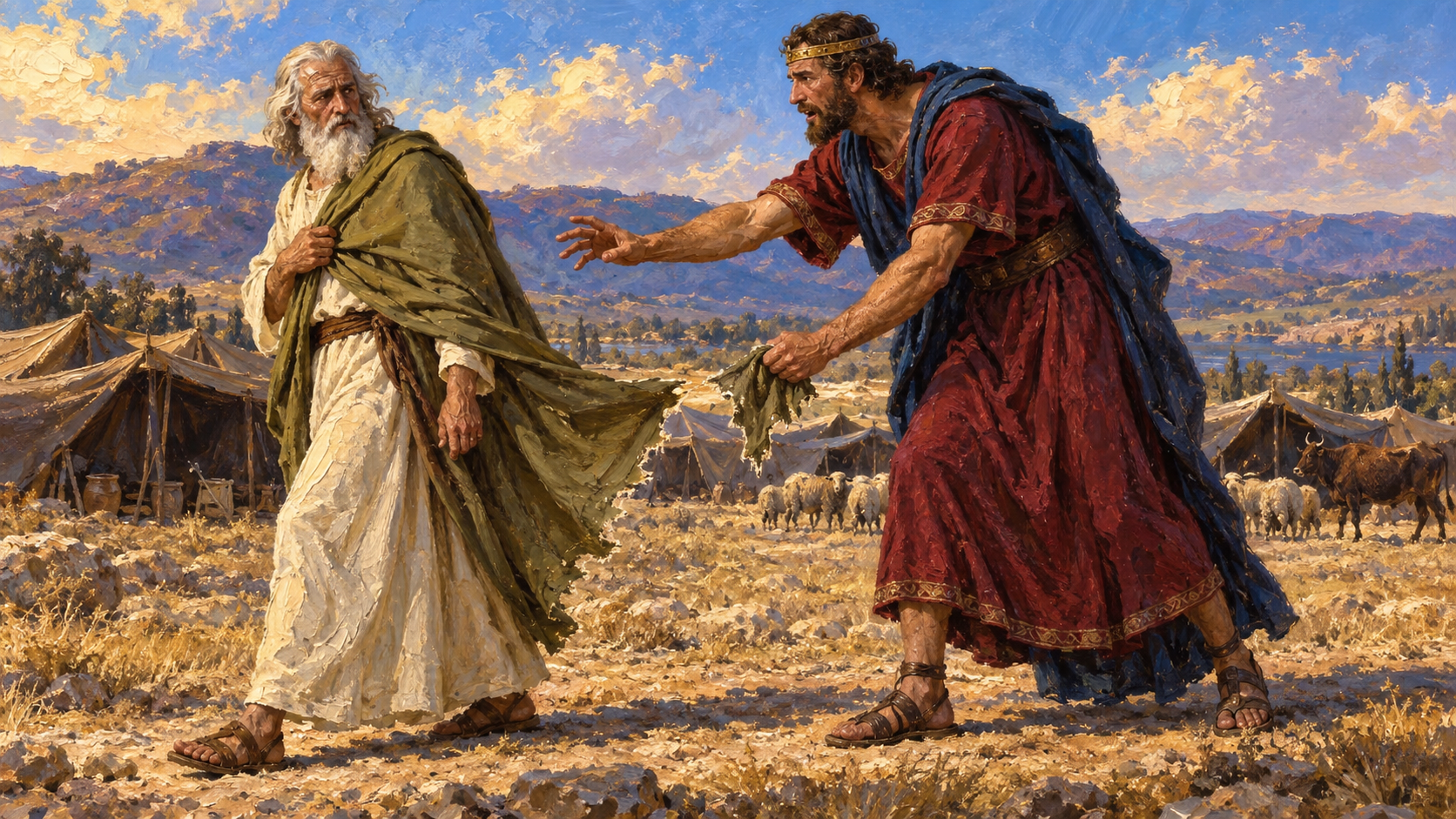
Now the word of the LORD came to Samuel, saying, "I greatly regret that I have set up Saul as king, for he has turned back from following Me, and has not performed My commandments." And it grieved Samuel, and he cried out to the LORD all night. So when Samuel rose early in the morning to meet Saul, it was told Samuel, saying, "Saul went to Carmel, and indeed, he set up a monument for himself; and he has gone on around, passed by, and gone down to Gilgal." Then Samuel went to Saul, and Saul said to him, "Blessed are you of the LORD! I have performed the commandment of the LORD." But Samuel said, "What then is this bleating of the sheep in my ears, and the lowing of the oxen which I hear?" And Saul said, "They have brought them from the Amalekites; for the people spared the best of the sheep and the oxen, to sacrifice to the LORD your God; and the rest we have utterly destroyed." Then Samuel said to Saul, "Be quiet! And I will tell you what the LORD said to me last night." And he said to him, "Speak on." So Samuel said, "When you were little in your own eyes, were you not head of the tribes of Israel? And did not the LORD anoint you king over Israel? Now the LORD sent you on a mission, and said, 'Go, and utterly destroy the sinners, the Amalekites, and fight against them until they are consumed.' Why then did you not obey the voice of the LORD? Why did you swoop down on the spoil, and do evil in the sight of the LORD?" And Saul said to Samuel, "But I have obeyed the voice of the LORD, and gone on the mission on which the LORD sent me, and brought back Agag king of Amalek; I have utterly destroyed the Amalekites. But the people took of the plunder, sheep and oxen, the best of the things which should have been utterly destroyed, to sacrifice to the LORD your God in Gilgal." So Samuel said: "Has the LORD as great delight in burnt offerings and sacrifices, As in obeying the voice of the LORD? Behold, to obey is better than sacrifice, And to heed than the fat of rams. For rebellion is as the sin of witchcraft, And stubbornness is as iniquity and idolatry. Because you have rejected the word of the LORD, He also has rejected you from being king." Then Saul said to Samuel, "I have sinned, for I have transgressed the commandment of the LORD and your words, because I feared the people and obeyed their voice. Now therefore, please pardon my sin, and return with me, that I may worship the LORD." But Samuel said to Saul, "I will not return with you, for you have rejected the word of the LORD, and the LORD has rejected you from being king over Israel." And as Samuel turned around to go away, Saul seized the edge of his robe, and it tore. So Samuel said to him, "The LORD has torn the kingdom of Israel from you today, and has given it to a neighbor of yours, who is better than you. And also the Strength of Israel will not lie nor relent. For He is not a man, that He should relent."
Saul greeted Samuel by claiming he had obeyed, even as the surviving animals could be heard nearby. He first blamed the people for keeping them, then offered a religious explanation: the livestock would be used for sacrifice. Samuel answered that obedience was better than sacrifice. The animals Saul wanted to offer were evidence of the command he had refused to keep.
Samuel was not belittling sacrifices God had commanded. He was exposing the use of worship to cover a refusal to listen. That makes me consider why he compared rebellion with divination. Both seek a way forward outside submission and trust in God. In stubborn self-rule, I put my own judgment where His should be, which explains the comparison with idolatry.
Saul eventually admitted that he had sinned because he feared the people and obeyed their voice. Yet he also wanted Samuel to honor him before Israel’s elders. His confession was mixed with concern for his public standing, and his words did not lead to a lasting change in how he lived. God rejected him from continuing as king.
Before meeting Saul at Gilgal, Samuel had learned that Saul had built a monument for himself at Carmel. I find that difficult to reconcile with Saul’s insistence that he had simply completed God’s mission. He spoke of offering the animals to “the Lord your God,” while refusing the personal submission those words required. The flocks he had spared could still be heard, contradicting his claim of complete obedience.
In this same chapter, God says He regrets making Saul king, while Samuel says the Strength of Israel will not lie or relent like a man. I understand both statements to be true. God genuinely grieved over Saul’s choices, but He had neither discovered an unforeseen fact nor made a mistake. His character remains true, and His settled judgment against Saul’s kingship would not be reversed.
David Received the Anointing Saul Lost
Now the LORD said to Samuel, "How long will you mourn for Saul, seeing I have rejected him from reigning over Israel? Fill your horn with oil, and go; I am sending you to Jesse the Bethlehemite. For I have provided Myself a king among his sons." And Samuel said, "How can I go? If Saul hears it, he will kill me." But the LORD said, "Take a heifer with you, and say, 'I have come to sacrifice to the LORD.' Then invite Jesse to the sacrifice, and I will show you what you shall do; you shall anoint for Me the one I name to you." So Samuel did what the LORD said, and went to Bethlehem. And the elders of the town trembled at his coming, and said, "Do you come peaceably?" And he said, "Peaceably; I have come to sacrifice to the LORD. Sanctify yourselves, and come with me to the sacrifice." Then he consecrated Jesse and his sons, and invited them to the sacrifice. So it was, when they came, that he looked at Eliab and said, "Surely the LORD's anointed is before Him!" But the LORD said to Samuel, "Do not look at his appearance or at his physical stature, because I have refused him. For the LORD does not see as man sees; for man looks at the outward appearance, but the LORD looks at the heart." So Jesse called Abinadab, and made him pass before Samuel. And he said, "Neither has the LORD chosen this one." Then Jesse made Shammah pass by. And he said, "Neither has the LORD chosen this one." Thus Jesse made seven of his sons pass before Samuel. And Samuel said to Jesse, "The LORD has not chosen these." And Samuel said to Jesse, "Are all the young men here?" Then he said, "There remains yet the youngest, and there he is, keeping the sheep." And Samuel said to Jesse, "Send and bring him. For we will not sit down till he comes here." So he sent and brought him in. Now he was ruddy, with bright eyes, and good-looking. And the LORD said, "Arise, anoint him; for this is the one!" Then Samuel took the horn of oil and anointed him in the midst of his brothers; and the Spirit of the LORD came upon David from that day forward. So Samuel arose and went to Ramah. But the Spirit of the LORD departed from Saul, and a distressing spirit from the LORD troubled him.
Samuel was still mourning Saul when God sent him to Jesse’s home. Seeing Eliab’s impressive appearance, the prophet assumed he must be the chosen king. God corrected Samuel and chose David, the youngest son who was still tending sheep. The Spirit came upon David from that day forward.
Being anointed did not give David permission to seize the throne. Saul remained in office for years, and David later refused opportunities to kill him. He left judgment with God instead of taking private vengeance.
The Spirit’s departure from Saul belongs to the transfer of royal empowerment described here. I would not make the loss of that calling a pattern for a born-again Christian losing the Spirit’s seal. A genuine believer is indwelt and sealed by the Holy Spirit. This passage addresses Saul’s rejected kingship and office. Scripture leaves his eternal state unanswered.
A distressing spirit from the Lord troubled Saul, and David’s music brought him relief. The spirit was still subject to God’s judgment and rule. God could govern a created spirit and give Saul over to distress without becoming morally evil or tempting him to sin.
Scripture specifically tells us that a spirit troubled Saul. I need to keep that explanation attached to this exceptional event rather than assume every distressed person is troubled by a spirit. The passage gives us knowledge about Saul that we do not have about someone else.
After David defeated Goliath, Saul heard the women celebrate David’s victories and began to see him as a threat. He threw spears at the young man who had served him faithfully. When those attacks failed, he tried to arrange David’s death through military danger and even through his marriage. He later ordered his servants to kill David and repeatedly pursued him. At times Saul admitted that David was more righteous, but those admissions did not put an end to his violence.
Jonathan’s covenant loyalty to David helps me see how unjust Saul’s hostility was. The king’s own son recognized God’s work in David without treating him as a rival who must be destroyed. Saul’s fear of losing the kingdom kept him from responding that way to a faithful servant.
So the king sent to call Ahimelech the priest, the son of Ahitub, and all his father's house, the priests who were in Nob. And they all came to the king. And Saul said, "Hear now, son of Ahitub!" He answered, "Here I am, my lord." Then Saul said to him, "Why have you conspired against me, you and the son of Jesse, in that you have given him bread and a sword, and have inquired of God for him, that he should rise against me, to lie in wait, as it is this day?" So Ahimelech answered the king and said, "And who among all your servants is as faithful as David, who is the king's son-in-law, who goes at your bidding, and is honorable in your house? Did I then begin to inquire of God for him? Far be it from me! Let not the king impute anything to his servant, or to any in the house of my father. For your servant knew nothing of all this, little or much." And the king said, "You shall surely die, Ahimelech, you and all your father's house!" Then the king said to the guards who stood about him, "Turn and kill the priests of the LORD, because their hand also is with David, and because they knew when he fled and did not tell it to me." But the servants of the king would not lift their hands to strike the priests of the LORD. And the king said to Doeg, "You turn and kill the priests!" So Doeg the Edomite turned and struck the priests, and killed on that day eighty-five men who wore a linen ephod. Also Nob, the city of the priests, he struck with the edge of the sword, both men and women, children and nursing infants, oxen and donkeys and sheep–with the edge of the sword. Now one of the sons of Ahimelech the son of Ahitub, named Abiathar, escaped and fled after David. And Abiathar told David that Saul had killed the LORD's priests. So David said to Abiathar, "I knew that day, when Doeg the Edomite was there, that he would surely tell Saul. I have caused the death of all the persons of your father's house. Stay with me; do not fear. For he who seeks my life seeks your life, but with me you shall be safe."
At Nob, Saul accused the priests of conspiracy even though Ahimelech had helped David without knowing about their private conflict. His own guards refused to carry out the order to kill the priests. Doeg obeyed, killing eighty-five before attacking the city’s inhabitants and animals. Saul’s judgment had become so distorted that help given to a faithful servant looked like treason to him.
I cannot miss the contrast with Amalek. Saul had spared a king and valuable property God placed under judgment, yet he now ordered the destruction of an Israelite priestly city for his own cause. Insisting on his own way had led him to protect what God condemned and destroy innocent people.
Abiathar alone escaped and told David what had happened. David acknowledged that his earlier actions had helped bring about the tragedy and offered the surviving priest safety. Where Saul destroyed innocent people in response to a perceived threat, David accepted responsibility for his own failure and protected the survivor.
Twice David had an opportunity to kill Saul and refused to strike the Lord’s anointed. Yet he still rebuked Saul openly and presented evidence of his own innocence, while keeping a safe distance. His restraint did not put Saul beyond scrutiny or confrontation. The phrase “Touch not My anointed” cannot excuse a leader’s wrongdoing. Respecting his office does not require threatened people to remain within his reach or make a dangerous leader immune from removal.
Saul Seeks a Medium and Dies on Gilboa
Now Samuel had died, and all Israel had lamented for him and buried him in Ramah, in his own city. And Saul had put the mediums and the spiritists out of the land. Then the Philistines gathered together, and came and encamped at Shunem. So Saul gathered all Israel together, and they encamped at Gilboa. When Saul saw the army of the Philistines, he was afraid, and his heart trembled greatly. And when Saul inquired of the LORD, the LORD did not answer him, either by dreams or by Urim or by the prophets. Then Saul said to his servants, "Find me a woman who is a medium, that I may go to her and inquire of her." And his servants said to him, "In fact, there is a woman who is a medium at En Dor." So Saul disguised himself and put on other clothes, and he went, and two men with him; and they came to the woman by night. And he said, "Please conduct a séance for me, and bring up for me the one I shall name to you." Then the woman said to him, "Look, you know what Saul has done, how he has cut off the mediums and the spiritists from the land. Why then do you lay a snare for my life, to cause me to die?" And Saul swore to her by the LORD, saying, "As the LORD lives, no punishment shall come upon you for this thing." Then the woman said, "Whom shall I bring up for you?" And he said, "Bring up Samuel for me." When the woman saw Samuel, she cried out with a loud voice. And the woman spoke to Saul, saying, "Why have you deceived me? For you are Saul!" And the king said to her, "Do not be afraid. What did you see?" And the woman said to Saul, "I saw a spirit ascending out of the earth." So he said to her, "What is his form?" And she said, "An old man is coming up, and he is covered with a mantle." And Saul perceived that it was Samuel, and he stooped with his face to the ground and bowed down. Now Samuel said to Saul, "Why have you disturbed me by bringing me up?" And Saul answered, "I am deeply distressed; for the Philistines make war against me, and God has departed from me and does not answer me anymore, neither by prophets nor by dreams. Therefore I have called you, that you may reveal to me what I should do." Then Samuel said: "So why do you ask me, seeing the LORD has departed from you and has become your enemy? And the LORD has done for Himself as He spoke by me. For the LORD has torn the kingdom out of your hand and given it to your neighbor, David. Because you did not obey the voice of the LORD nor execute His fierce wrath upon Amalek, therefore the LORD has done this thing to you this day. Moreover the LORD will also deliver Israel with you into the hand of the Philistines. And tomorrow you and your sons will be with me. The LORD will also deliver the army of Israel into the hand of the Philistines." Immediately Saul fell full length on the ground, and was dreadfully afraid because of the words of Samuel. And there was no strength in him, for he had eaten no food all day or all night.
Saul had removed mediums and spiritists from the land, but when the Lord no longer answered him, he sought one himself. He went in disguise to the woman at En Dor and asked her to bring up Samuel. Fear had led him toward a practice he already knew was forbidden.
The woman cried out in terror when Samuel appeared, and the narrator repeatedly identifies him as Samuel. Those details lead me to understand this as an exceptional act of God, who allowed Samuel to appear outside the medium’s control. It did not make necromancy, or seeking contact with the dead, a valid source of revelation. Samuel gave Saul no escape from God’s judgment. He repeated the earlier verdict and announced the defeat to come.
Samuel told Saul that he and his sons would be with him the next day. They were about to die and enter the realm of the dead. That explains the statement in its setting without requiring me to settle the eternal state of everyone mentioned on the strength of one sentence.
Samuel spoke consciously after death, so this account does not support soul sleep. But it does not establish that a human soul is immortal in itself or prove eternal conscious torment. God alone possesses immortality in Himself. Scripture teaches a future resurrection and the final, irreversible destruction of the unbeliever’s body and soul in the Lake of Fire. I need those passages too, rather than asking one line at En Dor to explain everything about the dead.
We should not follow Saul into consulting a medium or trying to contact the dead. Divination and other attempts to obtain occult guidance are also to be rejected. Anyone involved needs to stop and put those practices out of his life, confessing the sin and seeking the Lord through Scripture and prayer. Christ’s completed work as our mediator provides the only true way to God.
Now the Philistines fought against Israel; and the men of Israel fled from before the Philistines, and fell slain on Mount Gilboa. Then the Philistines followed hard after Saul and his sons. And the Philistines killed Jonathan, Abinadab, and Malchishua, Saul's sons. The battle became fierce against Saul. The archers hit him, and he was severely wounded by the archers. Then Saul said to his armorbearer, "Draw your sword, and thrust me through with it, lest these uncircumcised men come and thrust me through and abuse me." But his armorbearer would not, for he was greatly afraid. Therefore Saul took a sword and fell on it. And when his armorbearer saw that Saul was dead, he also fell on his sword, and died with him. So Saul, his three sons, his armorbearer, and all his men died together that same day. And when the men of Israel who were on the other side of the valley, and those who were on the other side of the Jordan, saw that the men of Israel had fled and that Saul and his sons were dead, they forsook the cities and fled; and the Philistines came and dwelt in them. So it happened the next day, when the Philistines came to strip the slain, that they found Saul and his three sons fallen on Mount Gilboa. And they cut off his head and stripped off his armor, and sent word throughout the land of the Philistines, to proclaim it in the temple of their idols and among the people. Then they put his armor in the temple of the Ashtoreths, and they fastened his body to the wall of Beth Shan. Now when the inhabitants of Jabesh Gilead heard what the Philistines had done to Saul, all the valiant men arose and traveled all night, and took the body of Saul and the bodies of his sons from the wall of Beth Shan; and they came to Jabesh and burned them there. Then they took their bones and buried them under the tamarisk tree at Jabesh, and fasted seven days.
The Philistines killed Saul’s sons, including Jonathan, and severely wounded Saul. When his armorbearer refused to kill him, Saul fell on his own sword. His armorbearer then followed his example. Men from Jabesh-gilead later recovered the mistreated bodies of Saul and his sons, returning the kindness Saul had shown when he rescued their city.
In 2 Samuel 1, an Amalekite told David that he had killed the wounded king. That conflicts with the account in 1 Samuel and was probably a lie intended to gain David’s favor. David ordered judgment instead of rewarding him. Then 1 Chronicles 10 explains Saul’s death as the Lord’s judgment for his unfaithfulness. He had failed to keep God’s Word and had consulted a medium. The Lord brought that judgment through the death Saul inflicted on himself with his sword.
Saul’s death was a tragic end to his reign. Scripture records his decision without giving permission to take one’s own life or commending it as an escape from humiliation.
David mourned Saul and Jonathan as mighty men and grieved for Israel’s loss. He could honor what was good without pretending Saul had never rebelled or denying God’s judgment. I think that helps us understand how to lament honestly. A funeral should not become an occasion for vengeance, but grief does not require us to deny what happened.
David even told Judah’s children to learn the song. Remembering Saul’s courage and place in Israel’s history did not erase the sins that ruined his reign. We can acknowledge both without flattering him or taking revenge through our account of his life.
Saul’s Rejection Points Us to the Faithful King
Saul continued many religious practices, but he let fear set limits on his obedience. Appetite and concern for his reputation influenced other decisions, and at times military strategy mattered more to him than the command he had received. His public selection and spiritual experiences could not replace submission to God. Neither his stature nor his victories could make him faithful. As king, his determination to rule himself also brought harm to the people he led.
The rejection of Saul concerned his dynasty and royal office. I take its warning about rebellion seriously without treating it as proof that a regenerated Christian can lose eternal life. Questions about salvation need to be answered from passages that address salvation.
Jesus is the promised Son of David and the rightful King. He is fully God and became fully man, born of a virgin and completely without sin. Wicked men physically tortured and punished Him before killing Him. Jesus willingly bore that real punishment for our sins in His innocent body. He shed His blood and died, then was buried and rose bodily from the grave. The Father did not punish or curse Jesus. He did not abandon Him or strike or bruise Him, nor did He pour wrath on His Son.
Christ died for the whole world, so God’s offer of salvation is genuine for every person, even though people may resist and reject Him. Whoever repents and believes is forgiven and born again. The Holy Spirit comes to dwell within that believer and seals him, so he remains eternally secure in Christ.
Security is not permission to imitate Saul. A person made new in Christ is called to obey and to confess sin honestly. A shallow profession without evidence of new life does not prove that someone was ever born again.
Saul’s choices make me consider how readily pressure can become an excuse for partial obedience. A deadline does not change God’s command, and protecting my reputation cannot make incomplete obedience whole. Neither worship nor generous service buys permission to rebel. Even a public confession is empty if I refuse to turn from the sin. Leaders need to welcome accountability, and those under them can honor lawful authority while still holding everyone to Scripture.
If I need to repent, blaming other people only repeats Saul’s response. Honest confession names the sin and turns from it without first asking that my public standing be protected. The same honesty is needed when considering a leader. His gifts or past victories do not establish his present faithfulness, and his office gives him no right to silence Scripture’s judgment of his conduct.
For more background, see King David, Jonathan, and Israel’s Kings and the Word.
My Final Thoughts
Saul’s early promise makes the end of his life painful to read. God truly chose and equipped him, yet he kept allowing fear and self-protection to determine how far he would obey. His lost dynasty warns me that religious activity cannot take the place of a heart willing to hear the Lord. That loss of royal calling must still be distinguished from the Spirit abandoning a believer He has sealed in Christ. Our hope rests in Jesus, the faithful King whose saving work never fails. I want to follow Him by obeying His Word even when keeping it becomes costly.