
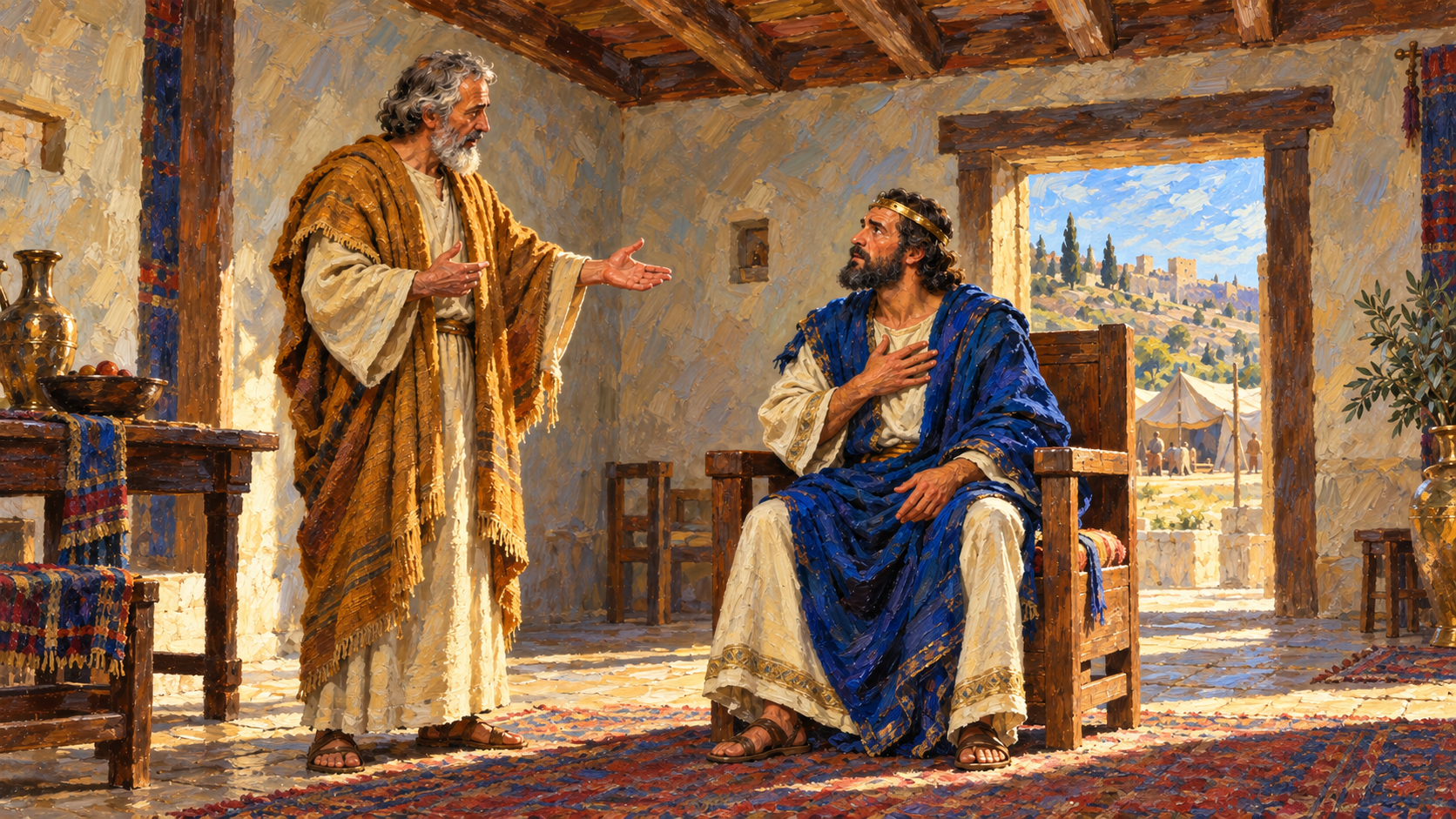
What exactly did God promise David in 2 Samuel 7? David wanted to build a house for the LORD, but God promised to build David an enduring royal house. That promise began to unfold through Solomon and remained even when David’s earthly throne collapsed. Its final fulfillment is in Jesus Christ, the Son of David whose kingdom will never end.
God Promised to Build David a House
The Davidic Covenant came after the promises to Abraham and the covenant at Sinai. God had already promised worldwide blessing through Abraham’s seed and formed Israel as a nation. By placing the royal promise in David’s line, He identified the dynasty from which the Messiah would come. The promised King would be the Son of David.
When people in the Gospels called Jesus the Son of David, they were drawing on this covenant. It helps us understand both the New Testament’s opening description of Jesus and Gabriel’s words to Mary about David’s throne. We are reading more than an old political agreement: the promise concerns Jesus, who is exalted now and will return bodily to reign as King.
I want to keep Solomon’s part in the promise clear without expecting him to fulfill all of it. He came from David’s body and built the temple, and later kings continued David’s line. God disciplined those kings when they sinned. But none of these ordinary descendants could establish a throne forever, so the covenant ultimately requires Christ.
In 2 Samuel 7, God had already raised David from shepherd to king and given him rest from many enemies. David had brought the ark to Jerusalem. When he looked at his cedar house and compared it with the tent where the ark remained, he wanted to build a temple for the LORD.
Nathan first encouraged David, but the word of the LORD came that night. God had not asked David to build Him a house.
“Go and tell My servant David, ‘Thus says the LORD: “Would you build a house for Me to dwell in?”‘”
God reminded David that He had taken him from the sheepfold and made him ruler over Israel. He had cut off David’s enemies and made his name great. Before David offered to build anything, the LORD had already shown him grace. I see the same order in the covenant: its foundation was what God promised to do for David, not what David offered to do for Him.
Notice how God used the word “house.” David had a temple in mind, but God was speaking of a dynasty, a royal family whose line would endure. David’s proposed building could not compare with the gift the LORD was promising him.
Also the LORD tells you that He will make you a house.
When your days are fulfilled and you rest with your fathers, I will set up your seed after you, who will come from your body, and I will establish his kingdom.
He shall build a house for My name, and I will establish the throne of his kingdom forever.
David would die and rest with his fathers, but God would raise up his seed to continue the royal line. A temple would be built for God’s name, and God would establish the kingdom. Yet the promise did not stop with that next generation. The throne was to stand forever.
House, Seed, Kingdom, and Throne
The words in this promise describe different parts of the same royal covenant. “House” refers to David’s dynasty, and “Seed” identifies a descendant from his own body, with both a near and an ultimate fulfillment. The word “Kingdom” describes royal rule, while “throne” refers to the authority of kingship. God’s repeated use of “forever” prevents me from limiting the promise to a short line of ancient rulers.
And your house and your kingdom shall be established forever before you. Your throne shall be established forever.
God made the covenant personally with David, but its reach extended through his descendants. That is what makes it dynastic. It is also royal and messianic because God promised an actual kingdom and throne whose final fulfillment would require the Messiah. He was promising far more than a family name that people would remember.
God did not promise that every king in David’s line would be righteous or that the kingdom would always enjoy uninterrupted glory. Those men could break His commandments, but the future of David’s throne rested on His faithfulness. Their failures would not bring His covenant to an end.
Understanding the Hebrew helps us read this exchange accurately, though a word’s definition cannot settle the argument on its own. “House” is בַּיִת (bayith), which can mean a building, a household, or a dynasty depending on context. Here David wanted to build a physical house for the LORD, while the LORD promised to establish David’s royal family.
Likewise, the word for “seed” is זֶרַע (zera), which can refer to offspring as a group or focus on a representative descendant. In this promise, Solomon and David’s royal line are included, but the final focus is Christ. The promised “Throne” is כִּסֵּא (kisse) in Hebrew and refers to the seat of royal authority. The promise concerns real kingship, not simply the good influence David’s family might have.
The Davidic Covenant also belongs to a longer sequence of promises. After the fall, God spoke of the woman’s Seed who would bruise the serpent’s head. Later He promised Abraham that all nations would be blessed in his seed.
In your seed all the nations of the earth shall be blessed, because you have obeyed My voice.
As the promises unfolded, God identified the Redeemer more specifically: from humanity to Abraham’s family, then through Israel to David’s royal house. David’s covenant focused the earlier promises without replacing them. The coming Redeemer would be human and connected to Abraham, and He would also be a King from David’s line. Calling Him “Son of David” therefore speaks of His messianic kingship, not just His family ancestry.
The New Testament brings the blessing promised to Abraham and the royal line promised to David together in Christ. This helps me see why Jesus cannot be treated as an emergency answer to the collapse of Israel’s monarchy. He is the promised Seed toward whom both covenants were moving, bringing blessing to the nations as the King from David’s line.
Scripture gives the Noahic, Abrahamic, and Mosaic covenants outward signs, but it does not command one for the Davidic Covenant. I would not supply a sign where Scripture has not given one. David’s line and throne publicly testified to God’s oath, yet Psalm 89 does not give the throne the covenant-sign function assigned to the rainbow, circumcision, or Sabbath.
I have made a covenant with My chosen, I have sworn to My servant David:
Your seed I will establish forever, And build up your throne to all generations.
Solomon Was a Near Fulfillment, Not the Final King
We can see part of the promise fulfilled in Solomon, David’s son, who occupied his father’s throne and built the temple. 1 Chronicles 17 records the covenant in that same setting of kingship and temple building. Looking ahead to Christ should not cause us to overlook what God actually fulfilled in Solomon before the New Testament.
Solomon’s sin and the division of the kingdom after his death show why we cannot stop with him. Later kings also failed until the monarchy fell under God’s judgment. During the exile, David’s throne looked broken, even though God’s promise remained. For that throne to last forever, there had to be a greater Son of David whose righteousness and kingdom could never collapse.
I need to account for both Solomon’s fulfillment and its limits. The temple and historical throne were real fulfillments in David’s line, so the covenant cannot be treated as merely symbolic. Their weakness also showed the need for a greater King. Only Christ’s sinless life, resurrection, and everlasting rule fulfill what the covenant finally requires.
God’s words to David included both discipline and mercy. Individual descendants could be chastened for iniquity, and the later history of the kings showed how serious that warning was.
I will be his Father, and he shall be My son. If he commits iniquity, I will chasten him with the rod of men and with the blows of the sons of men.
But My mercy shall not depart from him, as I took it from Saul, whom I removed from before you.
God removed Saul’s dynasty, but He would not withdraw His mercy from David’s line in that same way. That difference helps me understand how severe judgment could fall on the monarchy without annulling the covenant. Every king was accountable for his own obedience, while the final fulfillment rested on God’s oath rather than on all those kings living flawlessly.
The Prophets Kept David’s Hope Alive
Judah’s exile may have made the covenant seem impossible from a human point of view, yet the prophets continued to speak of its fulfillment. They described a righteous Branch from David, the coming King who would reign in justice and peace.
“Behold, the days are coming,” says the LORD, “That I will raise to David a Branch of righteousness; A King shall reign and prosper, And execute judgment and righteousness in the earth.”
Isaiah connected David’s throne with government and peace that would never end. That promise certainly offers comfort, but it cannot be confined to what someone feels privately. Isaiah described a real kingdom governed in righteousness.
Of the increase of His government and peace There will be no end, Upon the throne of David and over His kingdom, To order it and establish it with judgment and justice From that time forward, even forever.
Psalm 89 celebrates God’s oath even while grieving the visible collapse of Davidic glory. Jerusalem’s fall was painful, and the psalm does not cover up that loss. Instead, it brings the apparent contradiction between the ruined monarchy and the promised throne back to what God had sworn.
What I appreciate here is the honesty of that grief. Faith did not require anyone to pretend the ruined crown was an illusion or that exile raised no hard questions. The psalm faced the loss without accusing God of breaking His word. It waited for an answer that would account for the painful history and still uphold His sworn covenant.
My covenant I will not break, Nor alter the word that has gone out of My lips.
Once I have sworn by My holiness; I will not lie to David:
His seed shall endure forever, And his throne as the sun before Me.
Faith did not require denying the trouble, and God’s final answer was greater than a quick return to ordinary monarchy. His answer is the risen Son of David. Exile and enemy power cannot defeat His throne, nor can human failure or death bring His reign to an end.
Jesus Is David’s Son and David’s Lord
Psalm 110 helps us understand who this promised King is. David calls the Messiah “my Lord,” and Jesus uses that passage to show that the Christ is more than an ordinary descendant. According to the covenant, He is David’s Son, yet He is also David’s Lord.
The LORD said to my Lord, “Sit at My right hand, Till I make Your enemies Your footstool.”
I cannot leave out either part of Christ’s identity here. Jesus is truly man, descended from David according to the flesh, and He is also the eternal Son of God, fully divine. The promise calls for a human King from David’s line. Its everlasting fulfillment requires the divine Messiah whose reign can never end.
Gabriel used this covenant language when he announced Jesus’ birth to Mary.
He will be great, and will be called the Son of the Highest; and the Lord God will give Him the throne of His father David.
And He will reign over the house of Jacob forever, and of His kingdom there will be no end.
Matthew opens by naming Jesus Christ as the Son of David and the Son of Abraham, then traces the legal royal line through Joseph, Mary’s husband. That legal connection does not make Joseph Jesus’ biological father. Jesus was conceived by the Holy Spirit and born of Mary, so we must understand His royal lineage alongside the virgin conception. His kingship did not depend on ordinary human generation.
Paul also states the Davidic connection directly. Jesus came from David’s seed according to the flesh, and His resurrection declares Him to be the Son of God with power.
Concerning His Son Jesus Christ our Lord, who was born of the seed of David according to the flesh,
and declared to be the Son of God with power according to the Spirit of holiness, by the resurrection from the dead.
Jesus is not merely a symbolic David. He is truly connected to David’s line, and the resurrection proves that the promised King lives forever.
The King Suffered and Will Return to Reign
Jesus is exalted now at the Father’s right hand, and believers already belong to His kingdom. But the Davidic Covenant reaches beyond an invisible reign in the heart. Scripture teaches that He will return bodily to reign in a future, visible fulfillment of this promise. The Son of David will rule righteously, and His kingdom will never be handed to another.
When I look forward to Christ’s return, I am not waiting for Him to become Lord. He already has that authority, even though the world does not yet display the open righteousness promised for His kingdom. His bodily return will make the living King’s rule visible in the way the prophets anticipated. It will reveal His present authority rather than replace it.
Our hope rests on God’s oath and the fact that the King lives, which gives us more than ordinary optimism. The world may mock Christ and governments may rage against Him. Even when circumstances look nothing like the glory promised to David’s line, the unshakable kingdom still belongs to Christ.
At the cross, the accusation above Jesus’ head identified Him as King of the Jews. Men meant the title as mockery, but it told the truth about the One who was suffering.
And they put up over His head the accusation written against Him: THIS IS JESUS THE KING OF THE JEWS.
The King suffering on that cross was making atonement for us. Jesus physically bore the punishment for our sins in His innocent body as He shed His blood and died. He then rose bodily from the dead. His resurrection does not cancel the Davidic promise; it guarantees that the promised King is alive forever.
Jesus is the Root and the Offspring of David, both David’s Son and David’s Lord. As Israel’s Messiah, He is also the Savior of the world. The eternal Son became fully man without ceasing to be fully God. He was conceived by the Holy Spirit and born of the virgin Mary. He lived without sin and fulfilled God’s promises.
After His betrayal, Jesus endured mockery and beatings. He was scourged and crucified, shedding His blood and dying as He bore the punishment for our sins. He was buried and rose bodily on the third day. We receive salvation through repentance and faith in Jesus Christ, not through royal lineage or national heritage. Neither keeping the Law nor admiring fulfilled prophecy can earn it for us.
That if you confess with your mouth the Lord Jesus and believe in your heart that God has raised Him from the dead, you will be saved.
For with the heart one believes unto righteousness, and with the mouth confession is made unto salvation.
For “whoever calls on the name of the LORD shall be saved.”
Because God has promised this King, believers can remain steady when rulers and nations fail. History does not finally rest in human hands. As we wait for the Son of David to reign openly in righteousness and peace, we can already submit to Him and trust Him as the Savior God promised. His gospel is ours to proclaim to the nations now.
For related studies, see A Complete Bible Study on the Life of King David, A Bible Study on “The Lord Said to My Lord” in Psalm 110, A Complete Bible Study on the Root of Jesse, and A Complete Bible Study on The Kingdom of Heaven vs. The Kingdom of God.
My Final Thoughts
The Davidic Covenant shows me that God’s royal promise does not rise and fall with human rulers. Solomon came first, but later kings failed, and exile made the throne appear lost. Through all of it, the LORD’s oath stood firm until the promised Son of David came. Jesus suffered for our sins and shed His blood, then rose bodily and now lives forever as David’s Lord and King. He is exalted now, and He will return bodily to reign in righteousness. I want that promise to steady my faith when earthly rulers fail and history seems out of control, because the living King has not surrendered His throne or forgotten His word.