
Are the kingdom of heaven and the kingdom of God two different kingdoms? The wording can make us pause because Matthew usually uses the first phrase while Mark and Luke usually use the second. I want to compare the passages themselves before deciding whether Jesus was announcing two kingdoms or two ways of speaking about the same reign.
Before comparing the phrases, we need to understand what a kingdom includes. We may picture territory on a map, but these passages also speak of a king’s authority and his active rule over his people and realm. The question, then, concerns God’s royal rule rather than rival territories belonging to heaven and God. Does Matthew describe that rule with another expression or introduce another kingdom?
Why Matthew Says Kingdom of Heaven
Matthew uses kingdom of heaven far more than the other Gospel writers, which fits his Gospel’s strong Jewish and Old Testament setting. He begins by identifying Jesus as the Son of David and the Son of Abraham. I don’t want to hurry past those names, because each connects Jesus to a promise. God promised Abraham descendants and blessing for the nations, while His promise to David concerned an enduring royal house and throne. Matthew presents Jesus as the Messiah who fulfills those promises, so we need to keep His identity in mind when we read His kingdom preaching.
In Jewish speech, people sometimes referred to heaven as a reverent way of speaking about God or His authority. They weren’t replacing God with an impersonal place. We can see this use of the word in the prodigal son’s planned confession to his father.
I will arise and go to my father, and will say to him, "Father, I have sinned against heaven and before you,
The son was admitting that he had offended God, not the sky or a created place. That helps me understand how Scripture can use heaven with reference to God’s authority. The kingdom of heaven likewise belongs to the God of heaven and comes from Him, and He rules it through His Messiah. Matthew’s wording doesn’t remove God from the kingdom or describe a rival realm alongside the kingdom of God.
Matthew 4:17 places the kingdom announcement near the beginning of Jesus’ public ministry. He had been baptized and tempted, then moved into Galilee, where He preached repentance because the kingdom of heaven was at hand. The phrase at hand means that the kingdom has drawn near. The King was personally present, confronting Israel with God’s royal authority through His words and works. That nearness does not mean every promised feature of His future reign had already appeared.
From that time Jesus began to preach and to say, "Repent, for the kingdom of heaven is at hand."
The Greek verb metanoeō means to repent or change the mind in response to the truth. Understanding that word helps us follow what Jesus was asking of His hearers: they must abandon their resistance and believe the good news of the King whose promised rule had drawn near. They could not simply admire His teaching while holding on to their rebellion. Yet this turning was not payment for sin, as though improved conduct could earn entrance into His kingdom.
Mark summarizes Jesus’ preaching with the phrase kingdom of God, but the message has the same substance. The appointed time had been fulfilled because the kingdom had drawn near, so Jesus called His hearers to repent and believe the gospel.
and saying, "The time is fulfilled, and the kingdom of God is at hand. Repent, and believe in the gospel."
Matthew himself also uses kingdom of God. In Matthew 12, Jesus answered the accusation that His power to cast out demons was demonic. He said that if He cast them out by the Spirit of God, then the kingdom of God had come upon His hearers. They were witnessing God break Satan’s hold on people through the Messiah, so the kingdom was more than an abstract doctrine in that encounter.
But if I cast out demons by the Spirit of God, surely the kingdom of God has come upon you.
I can’t conclude that there are two kingdoms simply from Matthew’s preferred phrase, kingdom of heaven, when Matthew himself also says kingdom of God. He is not confused when he uses both. Either expression can describe the same divine reign.
The Same Kingdom in Parallel Passages
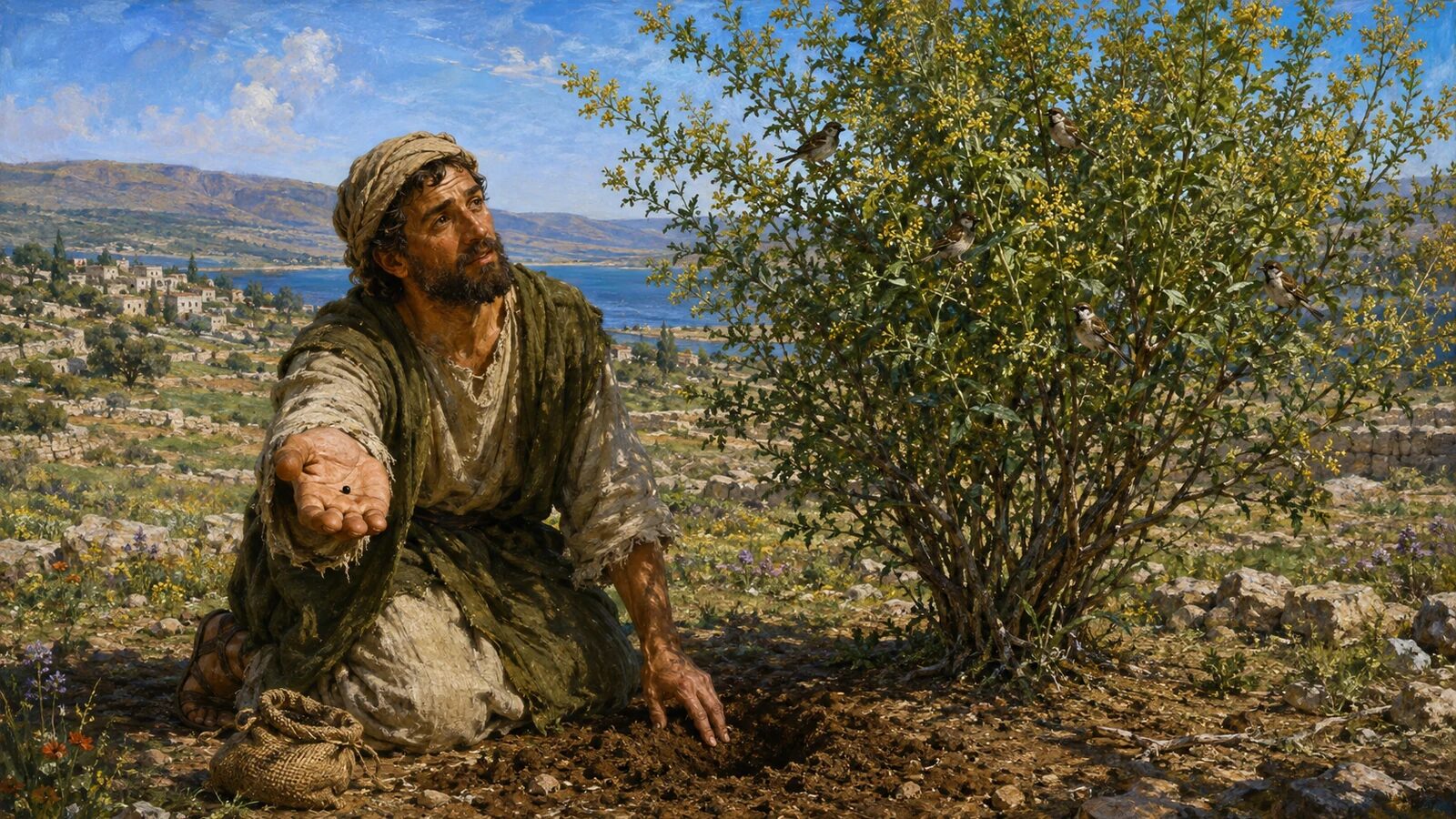
We can test the two-kingdom idea further by comparing parallel passages. Matthew introduces the mustard seed parable as a description of the kingdom of heaven, while Luke records the same teaching about the kingdom of God. In both accounts, the kingdom begins in a way that looks small and then grows beyond what people expect.
Another parable He put forth to them, saying: "The kingdom of heaven is like a mustard seed, which a man took and sowed in his field,
Then He said, "What is the kingdom of God like? And to what shall I compare it? It is like a mustard seed, which a man took and put in his garden;
Both writers describe the same seed and use its growth to teach the same lesson. I see no change in the meaning of the parable when one says heaven and the other says God. The different phrases describe the same reign.
Matthew 19 gives us an even clearer comparison because both phrases appear in one teaching about the danger of riches. Jesus first said it was hard for a rich man to enter the kingdom of heaven. He then restated the warning: it was easier for a camel to pass through the eye of a needle than for a rich man to enter the kingdom of God.
Then Jesus said to His disciples, "Assuredly, I say to you that it is hard for a rich man to enter the kingdom of heaven. And again I say to you, it is easier for a camel to go through the eye of a needle than for a rich man to enter the kingdom of God."
If Jesus meant separate kingdoms with separate entrances, I would have trouble following His warning here. He was warning about the self-sufficiency that riches can encourage, not changing the subject halfway through. We cannot enter God’s reign while clinging to pride or trusting wealth to secure our place, and human strength cannot get us in either.
Matthew 13 helps us understand how the kingdom could be present in the King’s ministry while still awaiting its open and purified display. Jesus taught these mysteries of the kingdom of heaven in parables. The parables describe people who hear His message and bear fruit, as well as others who reject it. Still others appear to belong for a time before their true condition is exposed.
He answered and said to them, "Because it has been given to you to know the mysteries of the kingdom of heaven, but to them it has not been given."
In the parable of the wheat and tares, Jesus explained that the field is the world. The good seed represents the sons of the kingdom, and the tares represent the sons of the wicked one. They remain together in the world until the harvest at the end of the age, when the appointed judgment comes. That keeps me from expecting a fully purified world before the King returns. It doesn’t give a local church permission to refuse biblical discipline or call evil good, because the field Jesus identified was the world.
We should also distinguish the church from the whole kingdom and preserve God’s promises to Israel. Matthew describes God’s reign with particular attention to how people receive or resist the King before His open return. The kingdom has drawn near in Christ, and believers already submit to Him, but the world still awaits His judgment of evil and removal of every rival. As Messiah, Jesus will restore Israel and display His righteous rule over the nations.
The Greek word basileia can mean kingdom, reign, or royal rule. Understanding its range helps us read these passages accurately, because the context may emphasize the King’s active authority or the realm under that authority. We shouldn’t reduce the word to geography or to an inward feeling. It can describe both the rule present in the King and the realm that will openly submit when He returns.
The Promised King and His One Reign
Taken together, these passages convince me that kingdom of heaven and kingdom of God refer to the same kingdom. The second names God directly as King, while Matthew’s preferred expression points to the authority of heaven as its source. Neither phrase means that the kingdom must stay in heaven. Daniel describes the God of heaven establishing a kingdom that acts upon the kingdoms of earth.
Daniel 2 records the dream God gave Nebuchadnezzar and the interpretation He revealed to Daniel. The human empires in that dream rise and fall, but their control of history does not last forever. In the final stage represented by those kingdoms, the God of heaven establishes His own kingdom. It breaks the rebellious kingdoms and stands forever, never to be destroyed or handed over to another people. A kingdom can therefore come from heaven and still rule over the earth, just as Matthew’s wording allows.
And in the days of these kings the God of heaven will set up a kingdom which shall never be destroyed; and the kingdom shall not be left to other people; it shall break in pieces and consume all these kingdoms, and it shall stand forever.
The kingdom Jesus announced continues the promises of the Old Testament. In 2 Samuel 7, God promised David an enduring royal house with a throne and kingdom. David’s descendants belong to the immediate history of that promise, but its lasting fulfillment is in the Messiah whose reign cannot end. The prophets looked ahead to this righteous Davidic King who would rule justly and deliver His people. Matthew’s opening identification of Jesus as the Son of David tells us who has the covenant right to rule.
Gabriel told Mary that Jesus would receive the throne of His father David and reign over the house of Jacob forever. His kingdom would have no end. Those promises name a throne and a people, so I can’t understand them as merely a vague moral influence. They describe God fulfilling His covenant through the Messiah.
He will be great, and will be called the Son of the Highest; and the Lord God will give Him the throne of His father David. And He will reign over the house of Jacob forever, and of His kingdom there will be no end.
Christ changes hearts and rules His people now, but He is also the promised Son of David who will reign over the house of Jacob. I need to take those promises as seriously as His present work in the church. That work does not cancel the covenants or turn Israel into a metaphor, and the kingdom cannot be reduced to a private feeling. The same kingdom reaches the nations through the gospel and will be displayed openly when the Messiah judges rebellion and fulfills the promises attached to His throne.
At the cross, the King willingly bore the punishment for our sins in His innocent body as wicked men tortured and crucified Him. He shed His blood and died, then rose bodily from the grave and ascended to His exalted place at the Father’s right hand. When He returns, His reign will be displayed openly over the earth. The authority we recognize by faith now will become visible then. These are different stages of one kingdom under the same King.
We can see why the kingdom is already present by looking at what Jesus has done. His teaching carried divine authority, and His miracles displayed the kingdom’s power, particularly when He delivered people from demons. Through His death and bodily resurrection He accomplished redemption, and His ascension confirmed His exaltation. God’s reign entered history through Him. That is why He could tell His hearers in Matthew 12 that the kingdom of God had come upon them.
In Luke 17, the Pharisees asked Jesus when the kingdom of God would come. They were looking for observable signs, but He said it would not come in the manner they demanded. The NKJV records His words as “within you.” The Greek expression can mean within or in one’s midst, so I need to consider whom Jesus was addressing. These were hostile Pharisees, not born-again disciples who had received His rule inwardly. I therefore understand Him to be referring to the King standing among them. They were asking when the kingdom would appear while failing to recognize the Messiah in their presence.
Now when He was asked by the Pharisees when the kingdom of God would come, He answered them and said, "The kingdom of God does not come with observation; nor will they say, ‘See here!’ or ‘See there!’ For indeed, the kingdom of God is within you."
Jesus then immediately taught His disciples about the future days of the Son of Man. Luke 17 moves from the King’s presence among them to His future revelation, so His present nearness does not fulfill every kingdom promise. He will return bodily to judge rebellion and restore the rule God promised. His reign over the earth will continue until every rival authority is brought under Him. We cannot fit all of that into private spirituality.
Then the seventh angel sounded: And there were loud voices in heaven, saying, "The kingdoms of this world have become the kingdoms of our Lord and of His Christ, and He shall reign forever and ever!"
Revelation 20 repeatedly describes Christ’s thousand-year reign. During that period Satan is bound and cannot deceive the nations, while those who share in the first resurrection reign with Christ. John still describes nations, which points to a real order of life under the returned King rather than a symbol for the present church age. I don’t see the church gradually producing this kingdom by improving the world. Christ will display His reign in history as God promised, before the final judgment and the new heaven and new earth. The larger sequence is traced in The End Times Timeline.
Entering and Seeking the Kingdom
Jesus told Nicodemus that he must be born again to see the kingdom of God. Nicodemus was a respected teacher of Israel, yet neither his ancestry nor his religious office and knowledge could give him life. That brings the question of entrance closer to each of us. The kingdom is more than a political hope for the nation, and respectable people cannot enter by becoming better people. Every person needs the new birth that comes through the Spirit’s work and is received through faith in Christ.
Jesus answered and said to him, "Most assuredly, I say to you, unless one is born again, he cannot see the kingdom of God."
Salvation is by grace through faith in Jesus Christ, so no one can earn kingdom entrance through works. Our hope rests in the King who physically bore the punishment for our sins in His innocent body. He shed His blood and died, then rose bodily from the grave. We enter through repentance and faith, not by trying to purchase a place through religious effort. The related study of salvation explains this gospel foundation more fully.
That does not make a shallow claim to faith enough when a person still refuses the King’s authority. Christ changes His people, and works are the fruit of their new life rather than its price. If I claim to belong to Christ while refusing His rule, I need to examine whether I have truly bowed to Him.
When Jesus told His disciples to seek first the kingdom of God and His righteousness, He was addressing their worry about daily needs. Food and clothing can occupy our thoughts, but His answer was not to abandon our responsibilities. He called His people to trust the Father who knows what they need, instead of letting anxiety master them.
But seek first the kingdom of God and His righteousness, and all these things shall be added to you.
When we pray, “Your kingdom come,” we ask for God’s reign to be displayed fully and for His will to be done on earth as it is in heaven. The Lord’s Prayer directs our hope toward the future kingdom while teaching us to submit to Him now.
In this manner, therefore, pray: Our Father in heaven, Hallowed be Your name. Your kingdom come. Your will be done On earth as it is in heaven.
I cannot honestly pray for God’s kingdom to come while insisting that my own wishes remain beyond His reach. My use of time and money must come under His rule, and so must the plans or reputation I might be tempted to protect at any cost. The way I speak to others belongs under His authority as much as my worship does. Even ordinary habits need to reflect the submission this prayer expresses. A fuller treatment belongs to the study on prayer.
Errors the Text Does Not Allow
Some teachers distinguish an earthly Jewish kingdom of heaven from a spiritual kingdom of God entered by Christians. They recognize genuine differences between Israel and the church, and between Christ’s present work and His future earthly reign. I want to preserve those differences without making these two phrases say more than they do. Matthew and Luke use them for the same mustard-seed teaching, and Matthew 19:23-24 uses both in one warning about one entrance. The distinction between the phrases cannot support rival kingdoms or different gospels. Scripture describes different stages and aspects of one Messiah’s reign.
Others understand kingdom language almost entirely as God’s inward rule in a believer’s heart. They rightly insist that no one enters without new birth and that believers must submit to Christ now, but Luke 1 also promises Jesus David’s throne and rule over the house of Jacob. Daniel 2 describes God’s kingdom replacing human empires, and Revelation 20 specifies a thousand-year reign with Satan bound from deceiving the nations. We should affirm the change Christ brings to individual hearts while also expecting His public reign as the returned King.
Jesus demands repentance and warns that an empty profession cannot substitute for doing the Father’s will. We should take those warnings seriously without treating obedience as a way to earn entrance. They expose false confidence while leaving the gospel of grace intact. Nicodemus needed to be born from above, not merely improve his religious record. Christ saves sinners through His blood, death, and bodily resurrection. Those who repent and believe receive life, and obedience grows from that new birth rather than buying it.
I could affirm a literal future kingdom and still approach it only as material for charts or speculation and debate. Jesus’ teaching requires more of me. The prayer that asks for His kingdom to come also asks for His will to be done now, so waiting for Him should lead us to seek His righteousness and serve faithfully. We resist sin and proclaim the gospel under the authority of the King who will return. If learning about His future reign never affects how we live, we have gathered information without submitting to His authority.
My Final Thoughts
I believe the kingdom of heaven and the kingdom of God describe the same reign of God through Jesus Christ. Matthew’s wording fits his Jewish setting and points to the God of heaven, while the parallel passages show that it does not introduce another kingdom. The King has come, and we enter His kingdom through repentance and faith. We belong under His authority now even as we wait for Him to return, fulfill the promises attached to David’s throne, and reign openly over the earth. Understanding the two phrases should bring us to something more personal than a choice of wording: trusting the King and living under His authority while we wait for Him.