
When studying the end times, I want to understand the order Scripture gives rather than start with a chart and fit every headline into it. Christ is the One we are waiting for, and following what He has revealed should steady our hope. It should also keep us close to the gospel and help us see why faithfulness now belongs with that future.
All of history belongs to the Son, so prophecy concerns more than solving an isolated puzzle. His return will bring judgment before He openly establishes His kingdom. Resurrection will take place in God’s order as His plan moves toward final restoration. These promises should lead us to comfort one another and endure faithfully. If they instead make us arrogant or frantic with speculation, we have lost the purpose Scripture gives them.
The Last Days and the Gathering of the Church
Paul opens Hebrews by reminding us that the God who spoke in many ways through the prophets has now spoken in His Son. That helps me understand where a study of prophecy should begin. God’s clearest and final revelation is the eternal Son Himself, through whom the worlds were made and to whom they rightfully belong. He is fully God and fully man, born of a virgin and completely sinless. Having completed His saving work, He ascended to heaven and will return.
That saving work must remain concrete even in a study about future events. Wicked men physically tortured, punished, and killed Jesus. He willingly bore that real punishment for our sins in His innocent body and shed His blood. He died, was buried, and rose bodily. The Father did not punish, curse, abandon, strike, bruise, or pour wrath on Jesus. The returning King is the same crucified and risen Savior who now offers life to the whole world.
God, who at various times and in various ways spoke in time past to the fathers by the prophets, has in these last days spoken to us by His Son, whom He has appointed heir of all things, through whom also He made the worlds;
We often use last days to mean only the final stretch before Christ returns publicly, but Hebrews uses the phrase for the time when God has spoken in His Son. At Pentecost, Peter also connected the outpouring of the Spirit with those days by quoting Joel. The last days therefore began with Christ’s first coming. His death and bodily resurrection were followed by His ascension, and the Holy Spirit was then given to the church during this gospel age.
But this is what was spoken by the prophet Joel: "And it shall come to pass in the last days, says God, That I will pour out of My Spirit on all flesh;
Prophecy already concerns us because we live in the era that followed the Son’s coming. That does not make every crisis a sign that the final seven years before His public return have begun. The New Testament calls us to watchfulness without giving us permission to set dates.
The Old Testament prophets spoke truly of the Messiah’s suffering and Israel’s restoration, as well as divine judgment and the coming kingdom. They were not always shown the full interval between those events. Now that Christ has come, we can see their order more clearly: the suffering Servant is the risen Lord who will gather His church before the future Tribulation. He will restore the kingdom and finally bring the new creation. I don’t see the Son setting aside the prophets, but giving their promises their center and proper order.
The church lives between Christ’s ascension and His return, and its next major prophetic event can happen without warning. We are waiting for the Lord Himself, without first needing the world to become safe or human civilization to solve sin.
Watchfulness does not require us to match every news report to a prophetic event. Jesus did not authorize anyone to name the day or hour. A servant who expects his Master to return keeps serving, so Christian readiness can remain steady even when the world feels unstable. It rests on His promise, not discovery of a secret date.
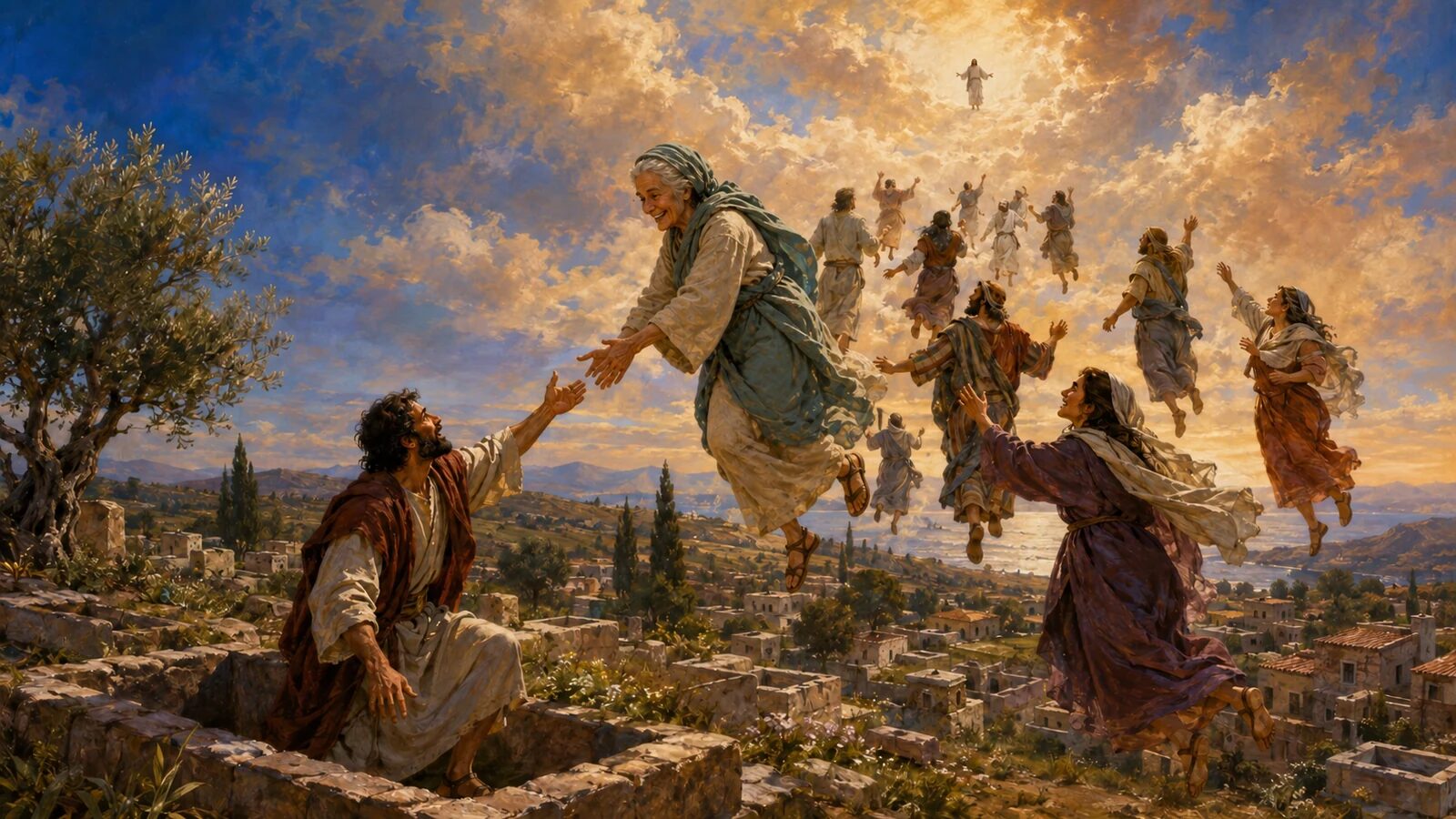
Paul wrote 1 Thessalonians 4 to believers grieving those who had died in Christ. He comforted them by explaining that the Lord will descend from heaven and the dead in Christ will rise first. Living believers will then be caught up with them to meet Him in the air. All of them will be with the Lord forever.
For the Lord Himself will descend from heaven with a shout, with the voice of an archangel, and with the trumpet of God. And the dead in Christ will rise first. Then we who are alive and remain shall be caught up together with them in the clouds to meet the Lord in the air. And thus we shall always be with the Lord. Therefore comfort one another with these words.
The expression caught up describes a decisive seizing away. Paul uses it to assure believers that Christ will gather them, whether they have died or are still alive when He comes. His concern is certainty, not satisfying our curiosity about how it will happen. Death will not permanently separate the saints, which is why he tells us to comfort one another with these words.
I don’t want to use this passage for prophecy arguments and miss the comfort Paul meant to give. The Christians those believers had buried were not lost and would not miss the Lord’s coming. Their hope was reunion in His presence, where every believer will remain with Him forever.
In John 14, Jesus promised to come again and receive His disciples to Himself. He prepares a place for His people and will bring them to be where He is. That makes the promise personal: we are waiting to be with Him.
And if I go and prepare a place for you, I will come again and receive you to Myself; that where I am, there you may be also.
Other passages focus on His public return to earth, where He appears as the King who judges rebellion and makes war in righteousness. Scripture therefore speaks about Christ coming for His people and later returning publicly to rule. These events belong to the same Lord and the same ultimate hope, but the passages do not use the same setting or emphasis. At the gathering, Christ receives resurrected and transformed believers in the air and brings them to be with Him. At the public return, heaven opens and Christ comes to earth as Judge and King. Collapsing the passages into one event obscures the movement each text describes. The evidence for this distinction is examined more fully in The Pre-Tribulation Rapture.
Jesus promised His followers tribulation in this world, and Paul taught that believers endure affliction. We should not soften that expectation of suffering. But Scripture also describes a coming hour of worldwide trial and divine wrath, distinct from ordinary Christian suffering, to which the church is not appointed.
Because you have kept My command to persevere, I also will keep you from the hour of trial which shall come upon the whole world, to test those who dwell on the earth.
For God did not appoint us to wrath, but to obtain salvation through our Lord Jesus Christ,
Revelation 3:10 promises to keep believers from the hour of trial coming upon the whole world. I understand that wording to fit the gathering of the church before the Tribulation. It comforts us with the Lord’s ability to rescue His own before that hour of wrath, while calling us to watchfulness and purity rather than laziness.
A Christian can face persecution from the world or attacks from the devil now without being in that future period of divine judgments. Promised deliverance from the Tribulation does not erase present affliction. We need to distinguish the wrath God will bring on the world from the suffering His people already endure.
After the church is gathered to Christ, believers will appear before His judgment seat in heaven. This concerns the quality of our service, not whether someone truly born again remains saved. The believer is a new creation, indwelt and sealed by the Holy Spirit, and eternally secure. That security never excuses lawlessness, and a superficial profession does not prove new birth. At His judgment seat, Christ does not reopen our justification, our standing as righteous before God. He evaluates our work and grants rewards according to His righteous assessment.
For we must all appear before the judgment seat of Christ, that each one may receive the things done in the body, according to what he has done, whether good or bad.
Revelation 19 speaks of the marriage supper of the Lamb before Christ appears in visible judgment. The bride is granted fine linen, identified with the righteous acts of the saints. The Lamb is at the center of this holy joy.
Let us be glad and rejoice and give Him glory, for the marriage of the Lamb has come, and His wife has made herself ready.
I can rest in Christ’s blood and righteousness for salvation while taking seriously His coming assessment of my service. Those truths should encourage us without making us careless. What He has placed in our hands calls for faithfulness.
That faithfulness belongs in ordinary life. A life of prayer belongs with a willingness to repent when God’s word exposes sin. We also serve Him in caring for our families and taking part in the local church. Our daily work belongs before Him too. If studying prophecy becomes entertainment that distracts me from those responsibilities, I have missed its purpose. Christ’s judgment seat reminds us that our choices matter, even though our security rests in Him rather than our performance.
The Seven-Year Tribulation
After the church is gathered, Scripture describes a defined period of intense trouble on earth. Jeremiah calls the coming distress the time of Jacob’s trouble, connecting it particularly with Israel. Revelation shows that its judgments will also affect the whole world.
We need to keep Israel and the church distinct here. Daniel’s seventy weeks concern his people and holy city, and Jeremiah names the period after Jacob. The church shares salvation through Christ, but that does not cancel the national setting of these prophecies. God will remain faithful to His promises to Israel as the final week unfolds.
Alas! For that day is great, So that none is like it; And it is the time of Jacob’s trouble, But he shall be saved out of it.
Gabriel’s prophecy in Daniel 9 gives seventy “weeks” for Daniel’s people and holy city. Each week in this setting represents seven years, not seven ordinary days. The first sixty-nine lead to Messiah the Prince and His being cut off, followed by the destruction of Jerusalem and the sanctuary. Roman forces destroyed the city and temple in AD 70, after Christ’s death. The prophecy’s sequence still leaves one final seven-year unit.
Then he shall confirm a covenant with many for one week; But in the middle of the week He shall bring an end to sacrifice and offering. And on the wing of abominations shall be one who makes desolate, Even until the consummation, which is determined, Is poured out on the desolate.
I understand the “he” in verse 27 as the coming ruler connected with the people who destroyed the city. He confirms a covenant with many for that final week. At its midpoint, after three and one-half years, he ends sacrifice and offering and brings the abomination connected with desolation. In His teaching, Jesus treats Daniel’s abomination as a future and recognizable event. This confirms that the Roman destruction did not exhaust the prophecy.
Revelation describes the Lamb opening the seals, followed by the trumpet judgments and then the bowls that bring the sequence to its climax. The world will be brought to account through judgments under God’s authority. This is not history slipping out of His control.
As the judgments become more severe, Revelation repeatedly describes people refusing to repent. That response shows how deeply rebellion has hardened the human heart. The evidence is before them, yet they remain opposed to God.
Jesus warned those in Judea to flee when they see Daniel’s abomination of desolation standing in the holy place. His warning concerns an actual event in an identifiable location, and the reference to the holy place implies a temple setting. He then described unparalleled distress. This open desecration marks the midpoint of the seven years, after which the trouble intensifies. The whole period is the Tribulation, while its second half is often called the Great Tribulation.
Therefore when you see the "abomination of desolation," spoken of by Daniel the prophet, standing in the holy place (whoever reads, let him understand), then let those who are in Judea flee to the mountains.
Revelation 13 describes the beast and the false prophet who promotes worship of him. People will be unable to buy or sell without the mark, making it an instrument of economic control. It is not a harmless administrative requirement, because accepting it expresses allegiance to a system demanding the worship owed to God alone. Refusing it will carry a terrible cost.
He causes all, both small and great, rich and poor, free and slave, to receive a mark on their right hand or on their foreheads, and that no one may buy or sell except one who has the mark or the name of the beast, or the number of his name.
The connection to worship is why I would be careful about identifying every technology or political development with this passage. Revelation 13 gives a specific warning. We can weaken its force by surrounding it with fearful guesses instead of helping people discern what Scripture actually says.
Calling each new payment system or identification method “the mark” can train people to dismiss the warning after repeated false alarms. Revelation places the mark under the beast’s rule and connects it with conscious allegiance. We should teach that setting clearly rather than turn every development into evidence that the final midpoint has arrived.
Christ’s Visible Return and Thousand-Year Reign
In Revelation 19, heaven opens to reveal the Rider called Faithful and True. Christ appears publicly as the rightful King and Judge, judging human rebellion in righteousness and making war against His enemies. The beast and false prophet are defeated because they cannot withstand Him.
Now I saw heaven opened, and behold, a white horse. And He who sat on him was called Faithful and True, and in righteousness He judges and makes war.
The setting differs from 1 Thessalonians 4, where believers meet the Lord in the air and are comforted by that promise. Revelation 19 describes His return to earth in judgment and victory. The same Lord who gathers His church will later return bodily to defeat His enemies and establish His reign.
The beast’s rule will end when Christ returns, and the conflict will never be a contest between equal powers. The Lord will judge by the authority of His word and completely conquer His enemies’ rebellion. Armageddon is dreadful, but there is no uncertainty about the King’s victory. Revelation’s imagery involving the opening of heaven is explored further in Doors in Heaven, while the study on Apollyon and the Destroyer Angel examines another figure within these judgments.
Revelation 20 repeatedly describes a thousand years in which Satan is bound so he cannot deceive the nations and those who share in the first resurrection reign with Christ. That restriction on Satan is one reason I cannot identify the millennium with the present age. The nations have never known a world free from his deception in the way this passage describes. We need to take those repeated details seriously.
He laid hold of the dragon, that serpent of old, who is the Devil and Satan, and bound him for a thousand years; and he cast him into the bottomless pit, and shut him up, and set a seal on him, so that he should deceive the nations no more till the thousand years were finished.
Blessed and holy is he who has part in the first resurrection. Over such the second death has no power, but they shall be priests of God and of Christ, and shall reign with Him a thousand years.
During the millennium, resurrected saints will reign with Christ, while survivors of the Tribulation will enter His earthly kingdom in natural bodies. Their descendants will populate the nations He rules. That explains where the people who join Satan’s final rebellion will come from when he is released after the thousand years. Christ’s righteous reign will also expose the human heart: perfect government and freedom from satanic deception do not create a new heart. Each person still needs to submit truly to the Lord.
I find it sobering that people will live under the righteous King’s open rule, yet some will still choose to join Satan when he is released. Rebellion cannot ultimately be explained by bad government or an unhealthy environment. Outward peace cannot replace personal faith in Christ, because only God can give new life.
God will crush that final rebellion and cast Satan into the lake of fire. Revelation 20:10 uniquely says the devil will be tormented forever with the beast and false prophet. We should preserve that specific statement rather than apply it indiscriminately to the later judgment of human beings.
Final Judgment
After the final rebellion, Revelation 20 describes the Great White Throne judgment, where unbelievers are raised to stand before God. This is not another judgment of the church. The sea, death, and Hades give up their dead, and books recording their deeds are opened. The Book of Life is opened separately as God judges each person according to what is written.
Then I saw a great white throne and Him who sat on it, from whose face the earth and the heaven fled away. And there was found no place for them. And I saw the dead, small and great, standing before God, and books were opened. And another book was opened, which is the Book of Life.
The record of deeds shows the sins committed and why God’s verdict is just; it does not teach salvation by works. Salvation comes by grace through faith in Christ. Every person begins written in the Book of Life, but those who finally reject the Messiah are blotted out. Believers remain because their sins have been blotted out through Christ’s blood. Anyone whose name is absent from the Book of Life at this judgment is cast into the lake of fire.
And anyone not found written in the Book of Life was cast into the lake of fire.
Revelation calls the lake of fire the second death. Human souls are not inherently immortal, so we should not redefine death as endless life. Jesus warned that God can destroy both soul and body in Gehenna, or hell, and Paul described everlasting destruction from the Lord’s presence. Lost human beings face a terrible and irreversible judgment ending in the destruction of both body and soul under God’s righteous judgment. I therefore reject both universalism, which says everyone will be saved, and eternal conscious torment for human beings. This does not mean I accept soul sleep, the view that the dead are unconscious between death and resurrection. Scripture presents them as consciously present in that intermediate state while awaiting bodily resurrection and final judgment.
And do not fear those who kill the body but cannot kill the soul. But rather fear Him who is able to destroy both soul and body in hell.
These shall be punished with everlasting destruction from the presence of the Lord and from the glory of His power,
I cannot treat final judgment as an argument to win and overlook the people it warns. It is dreadful, and it gives us reason to preach Christ while there is time. Revelation 20:10 specifies endless torment for the devil, beast, and false prophet; we should not transfer that statement to lost humanity against the chapter’s language of second death. The Bible that warns of final destruction also points sinners to the Lamb who shed His blood for them.
Knowing a timeline does not answer the question of how we have responded to Jesus Christ. His offer is genuine and can be resisted, but no one needs to remain outside Him. While mercy is offered, we should repent and believe. Everyone who receives Christ is forgiven and made new, and the Holy Spirit seals that believer for the day of redemption.
The New Creation
Revelation 21 and 22 take us to the new heaven and new earth, after God has judged evil and removed death forever. He will wipe away His people’s tears and dwell with them. Our hope reaches beyond escaping disaster to living with God in His renewed creation.
And I heard a loud voice from heaven saying, "Behold, the tabernacle of God is with men, and He will dwell with them, and they shall be His people. God Himself will be with them and be their God."
And God will wipe away every tear from their eyes; there shall be no more death, nor sorrow, nor crying. There shall be no more pain, for the former things have passed away.
Those promises give me hope rather than a reason to become absorbed in speculation. The God who spoke through the prophets has spoken in His Son, and the Son who made the worlds will inherit all things. Our Savior died and rose, and He will bring His people safely into the world to come.
The new creation helps us understand where the earlier judgments lead. God will remove death itself and dwell with His redeemed people, bringing an end to sorrow and pain rather than merely stopping a series of disasters. We will live in His presence, where the former curse no longer governs our experience.
My Final Thoughts
I believe this sequence gives us reason for hope and faithful service, not panic, pride, or endless arguments about headlines. Christ will gather His church before the coming hour of worldwide trial, then later return bodily as King and reign for a literal thousand years. After final judgment, He will bring His redeemed people into the new creation. We can comfort grieving believers with that hope and remain watchful without setting dates. We should also serve Him in holiness and faithfulness while there is still time to proclaim the gospel. If you are outside Christ, His offer of mercy is genuine: repent and believe in the Savior who shed His blood, died, and rose for you.