
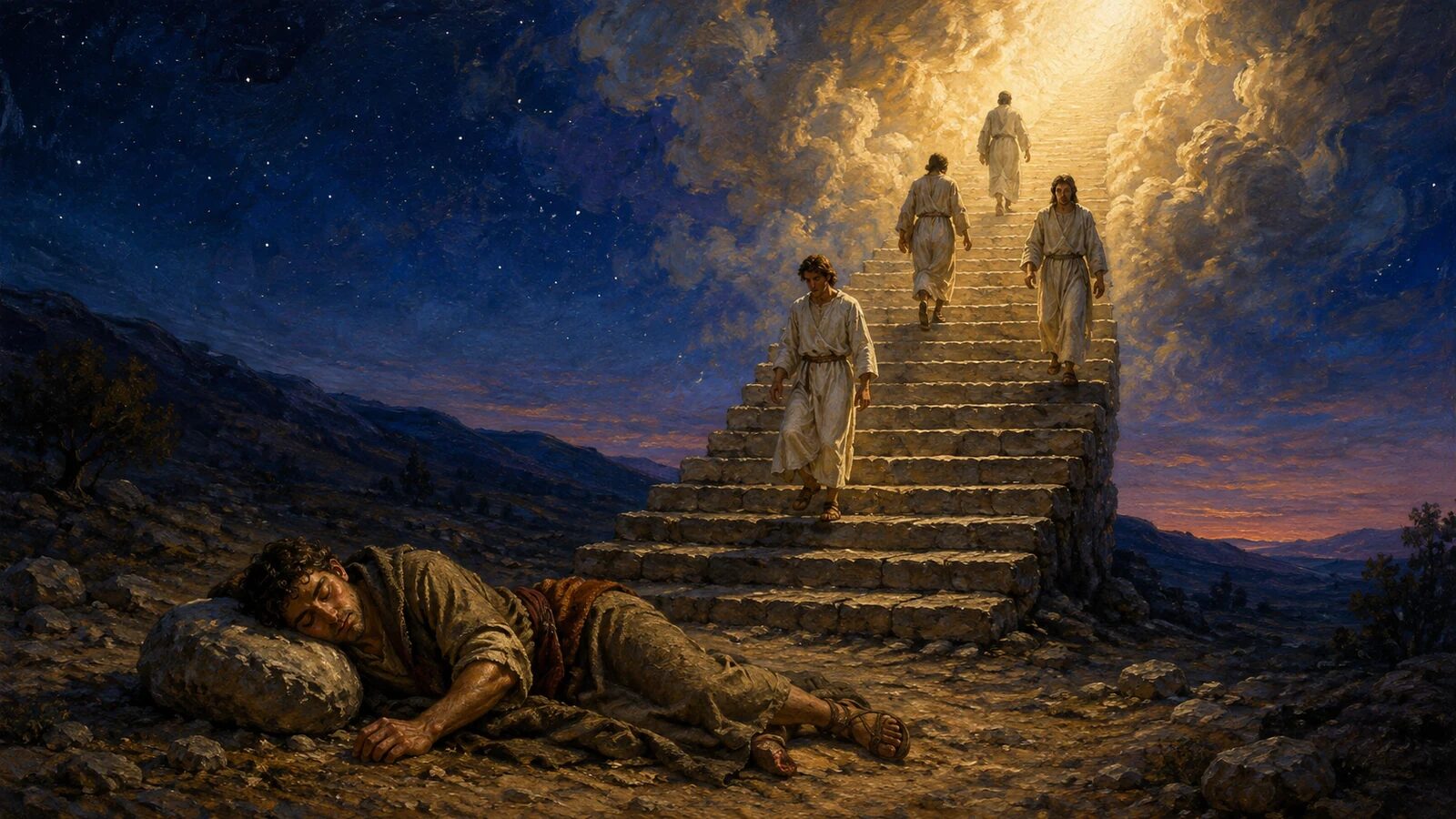
What does the Bible mean when it speaks of heaven opening or calls a place the gate of heaven? I want to understand what God was showing Jacob in his dream and John in his vision, along with the other passages that describe heaven opened. They give us much to consider about heaven and earth, but none teaches us to find a portal or force our way into the unseen world.
Jacob’s Dream and the Gate of Heaven
In Genesis 28, Jacob was leaving home after his deception of Isaac had angered Esau. He spent the night alone beside the road with a stone for a pillow. Nothing about his conduct had earned him a vision from God. The LORD met a weak and undeserving man, so we need to understand what followed as an act of grace.
Jacob lay down in an ordinary place along his journey. No tabernacle or priest awaited him, and no congregation had gathered there. I notice that God did not need any of those things to speak to him. The LORD could meet a frightened man on a lonely road and give him His covenant promise.
Then he dreamed, and behold, a ladder was set up on the earth, and its top reached to heaven; and there the angels of God were ascending and descending on it.
The dream is often called Jacob’s ladder. The rare Hebrew word sullam can describe a ladder or stairway, and some picture it as a ramp. That range helps us avoid insisting on a shape the passage does not specify. What Genesis does tell us is that it stood on earth and reached heaven. Jacob had not built it, nor was he shown climbing it. God revealed the connection as His angels moved at His command.
The angels were real servants carrying out God’s will, though Genesis does not tell us their individual assignments. Their movement showed Jacob that God was at work beyond what he could normally see. They were not the center of worship in the vision. Even if Jacob felt alone on the ground, the LORD was present and His purposes continued.
God then identified Himself as the God of Abraham and Isaac and repeated His promises about the land and Jacob’s descendants. The blessing would extend through this family by God’s initiative. He was the One who gave the vision and the promise that followed.
Behold, I am with you and will keep you wherever you go, and will bring you back to this land; for I will not leave you until I have done what I have spoken to you.
Jacob’s sin had not canceled God’s covenant. The LORD would deal with his character over time, but first He gave Jacob the certainty of His own word. Jacob did not need to see every way God was working in order to trust Him. He needed to rely on the God who had promised to keep him.
When Jacob woke, he realized that the LORD had been present without his knowing it. His fear was more than panic over a strange dream. God had made Himself known, and Jacob responded with awe.
And he was afraid and said, “How awesome is this place! This is none other than the house of God, and this is the gate of heaven!”
Jacob called the place the gate of heaven because of what God had revealed there. He had not discovered a permanent doorway for others to use. The encounter did not depend on finding the right coordinates. God had graciously drawn near and spoken to him, showing that He was faithfully ruling over circumstances Jacob could not see.
I don’t see anything in Jacob’s encounter that gives us control over meeting with God. Searching for a special location or trusting an object cannot supply that control, and neither can a ritual or method said to open the unseen realm. God opened Jacob’s eyes and spoke His promise. Jacob responded in reverent worship to what the LORD had chosen to reveal.
Jacob was running from trouble his own deception had helped create when God met him with a promise. If we overlook that weakness, we may start treating the dream as a reward for spiritual achievement. Bethel was set apart by the LORD revealing Himself, not by some power in the ground that Jacob could control. God drew near to preserve His covenant purpose.
When Scripture Shows Heaven Opened
Genesis 28 is one of several passages in which God allowed someone to see what is normally unseen. Isaiah saw the Lord seated on a throne, high and lifted up. The seraphim declared in Isaiah 6:3 that the LORD of hosts is holy. As the doorposts shook and smoke filled the house, Isaiah became painfully aware of his own uncleanness. His response was not the excitement of an explorer gaining secret access. He cried, “Woe is me, for I am undone!” (Isaiah 6:5).
Isaiah’s response makes me consider what these visions were meant to produce. God’s holiness humbled him rather than giving him something to boast about. He did not ask how to enter the throne room again. Once God had cleansed him, he was ready to hear His call and obey. That is very different from seeking an unusual experience to make ourselves feel important.
Ezekiel saw the heavens opened while living among the captives beside the River Chebar. He was far from Jerusalem and the visible center of temple worship.
Now it came to pass in the thirtieth year, in the fourth month, on the fifth day of the month, as I was among the captives by the River Chebar, that the heavens were opened and I saw visions of God.
God chose to reveal Himself to Ezekiel among the exiles. Babylon had not put Him beyond their reach, and His glory was not confined to Jerusalem. The vision was strange and majestic, but Ezekiel had not found a doorway beside the river. The opened heavens showed mercy to people under judgment by revealing that the Lord still ruled and was still at work.
In Acts 7, Stephen saw heaven opened while hostile leaders were preparing to kill him. He had testified about Israel’s history and confronted their resistance to the Holy Spirit. God then let him see His glory beyond the angry crowd.
But he, being full of the Holy Spirit, gazed into heaven and saw the glory of God, and Jesus standing at the right hand of God, and said, “Look! I see the heavens opened and the Son of Man standing at the right hand of God!”
The leaders’ verdict against Stephen could not change what was true in heaven. Jesus stood in glory, and the vision both testified to Him and comforted His rejected servant. I see heavenly vindication here, not entertainment before Stephen’s death. Christ saw him in his suffering, just as He sees His people when the world rages against them.
God also addressed a particular need in each vision. Isaiah needed to be humbled by His holiness before being sent. The exiles needed to know that He still ruled beyond Jerusalem, and Stephen was shown that Jesus received him when earthly judges rejected his witness. These revelations called God’s servants to trust Him and respond faithfully to their circumstances, rather than simply satisfy curiosity.
Jacob, Isaiah, Ezekiel, and Stephen received different visions in different circumstances. God gave each revelation for His own purpose, whether to bring comfort or conviction or prepare a servant to speak. None of these men used a technique to open heaven. They responded to what God had done.
The Open Door and the Throne in Revelation
Revelation 4 speaks most directly of a door in heaven. John saw it already standing open, then heard a voice like a trumpet telling him to come up and see what must take place afterward.
This followed Christ’s messages to the seven churches and began the next scene in John’s prophetic vision. The invitation “Come up here” was addressed to John so he could see and record what followed. I believe the broader witness of prophecy teaches the pre-Tribulation gathering of the church, but I cannot say that Revelation 4:1 explicitly describes that gathering. Even when a doctrine is true, I should not claim that a verse says more than it does.
Revelation is an apocalypse, meaning an unveiling. Through it, Jesus Christ reveals God’s plan and warns His readers. He also comforts the suffering churches and calls them to overcome, because judgment will not have the last word. The book leads them toward the Lamb’s victory. John received that revelation from God; he was not demonstrating an exercise others could repeat.
After seeing the open door, John saw a throne set in heaven and One sitting on it. That tells me where the open door was directing his attention. He was brought before the throne, not given a map of portals. If I become more interested in the doorway than in the Lord seated there, I am missing what the passage shows.
Heaven is God’s throne room, where He rules as the holy and sovereign One and is worshiped as worthy. It is not a place for us to collect spiritual experiences. John did not claim to have opened the door or give instructions for reproducing the vision. God had chosen to show His servant what would come next.
The throne and the events God revealed from it need to remain central as we read Revelation. The churches faced real pressure and received serious warnings, but the Lamb would have the final victory. John recorded what he saw so believers would hear Christ’s message. Trying to repeat his experience would miss the purpose of what he wrote.
Jesus Is the True Access
In John 1:51, Jesus explains Jacob’s vision by applying its imagery to Himself. Nathanael had confessed Him as the Son of God and the King of Israel. Jesus answered by referring to the movement between heaven and earth that Jacob had seen in Genesis 28.
And He said to him, “Most assuredly, I say to you, hereafter you shall see heaven open, and the angels of God ascending and descending upon the Son of Man.”
The angels in Jacob’s dream moved up and down the stairway, but Jesus placed Himself at the center of that movement. By placing Himself there, the Son of Man revealed that He is the true meeting place between God and humanity. We do not gain access by locating something near Bethel or learning to climb a structure. We come through Christ.
This agrees with the rest of the New Testament. Jesus is the only Mediator between God and man, the One who brings us to the Father. He is the way, the truth, and the life, and no one comes to the Father except through Him. He does not point sinners toward a ladder they can climb by mystical effort. He gives Himself as the way to the Father.
Ephesians 2:18 says, “For through Him we both have access by one Spirit to the Father.” The Greek word translated access, prosagoge, can mean access or being brought near for an introduction. In this passage, it describes believers brought to the Father through Christ’s reconciling work, with the Holy Spirit giving that access. Understanding the word helps me see why neither secret knowledge nor supposed spiritual travel can bring us closer. An encounter with an angel adds nothing, and even the strongest emotion cannot bring a sinner to God.
Sin separated humanity from God, so our need was for a Savior rather than a hidden door in the sky. Jesus Christ is the eternal Son, fully God and fully man, and He is completely sinless. Wicked men physically tortured and punished His innocent body. They shed His blood and killed Him, while Jesus willingly bore that punishment for our sins. The Father did not punish or curse His beloved Son. He did not abandon Jesus, strike or bruise Him, or pour wrath upon Him. Jesus was buried and rose bodily from the dead.
Christ died for the whole world, and people may resist God’s genuine offer. Everyone who repents and believes is forgiven and born again. The Holy Spirit indwells and seals the believer, who is eternally secure. Through Christ, that person is reconciled to God and brought near to the Father by the Spirit. A mystical experience cannot improve upon the access God has already given in His Son.
Knowing how God has brought us near gives me confidence in ordinary prayer. I don’t need a special location or an angel to take me closer to Him. We come to the Father through the Son because the Spirit has already brought us near. Christ’s finished work gives us that confidence, even when our feelings are quiet and nothing unusual happens. A simple prayer offered through faith in Jesus does not give us lesser access to God.
Angels Serve God, and Believers Follow His Word
Jacob’s vision shows real angels moving between heaven and earth. Scripture does not tell believers to seek contact with them. They serve God in ways we often cannot see. We should receive what Scripture tells us about them without making them the center of Christian faith or going beyond what God has revealed.
Are they not all ministering spirits sent forth to minister for those who will inherit salvation?
Angels are sent by God, so no technique can put them under our command. Scripture shows them delivering messages and protecting people according to His will. It also records them carrying out judgment or strengthening a servant. Whatever the assignment, faithful angels remain under the Lord’s authority and never seek worship for themselves.
The Angel of the LORD in key Old Testament passages is a Christophany, an appearance of the Son before He became man. That does not identify every angel as Jesus. Genesis 28 speaks of angels in the plural who served under the LORD. We need to distinguish those servants from the Son.
Some modern religious teachers speak of portals, open heavens, “thin places,” or gates supposedly used by angels. They may promise special access to the unseen realm through certain locations or practices. I need to test those claims against the passages they use. Borrowing biblical language does not make a teaching true, especially when the meaning has been taken out of context.
God initiated each of these encounters. Jacob did not open heaven, and neither Isaiah nor Ezekiel produced the vision he received. Stephen had no method for arranging what he saw as he faced death. John entered the prophetic revelation by God’s invitation. These men responded with reverence and obedience and testified to what God showed them, even when that witness brought suffering.
The search for unusual experiences can distract us from obedience God has already made clear. I could spend years seeking an open-heaven experience while neglecting the Bible in front of me. God calls us to hear His Word and pray, and to gather with the church in love for one another. Spiritual experiences should not become a way to make ourselves important. We also need to flee sin and test what teachers say. When suffering comes, our calling is still to trust Christ and bear witness to Him. This may sound less sensational than pursuing portals, but it is the life Scripture commands.
Heaven is real, and these passages call for reverence toward the God who rules there. They also direct us to Christ. Jacob’s stairway points to Jesus as the way sinners come to God. Jacob on the road and Ezekiel in exile help me remember that God’s rule does not stop when His work is hidden from us. He remains active even when our circumstances give us no visible sign of it.
We are free to wonder about what Scripture shows us, but we must not build doctrine from what it leaves unsaid. God has revealed enough for us to trust Him without pretending we know everything about the unseen realm. For related studies, see The Angel of the Lord, Christophanies in the Old Testament, and A Complete Bible Study on Prayer.
My Final Thoughts
I don’t find an invitation in these passages to search for portals or manufacture access to heaven. God met people according to His purpose, giving Jacob a covenant promise and bringing Isaiah before His holiness. Ezekiel saw that exile had not put God far away, while Stephen saw Christ’s glory when earthly judges rejected him. John looked through the open door to the throne. Jesus applied Jacob’s stairway imagery to Himself, and that is where my confidence rests. The Son brings believers to the Father by the Spirit, so we can trust God’s rule over the unseen world and keep walking faithfully with Christ.