
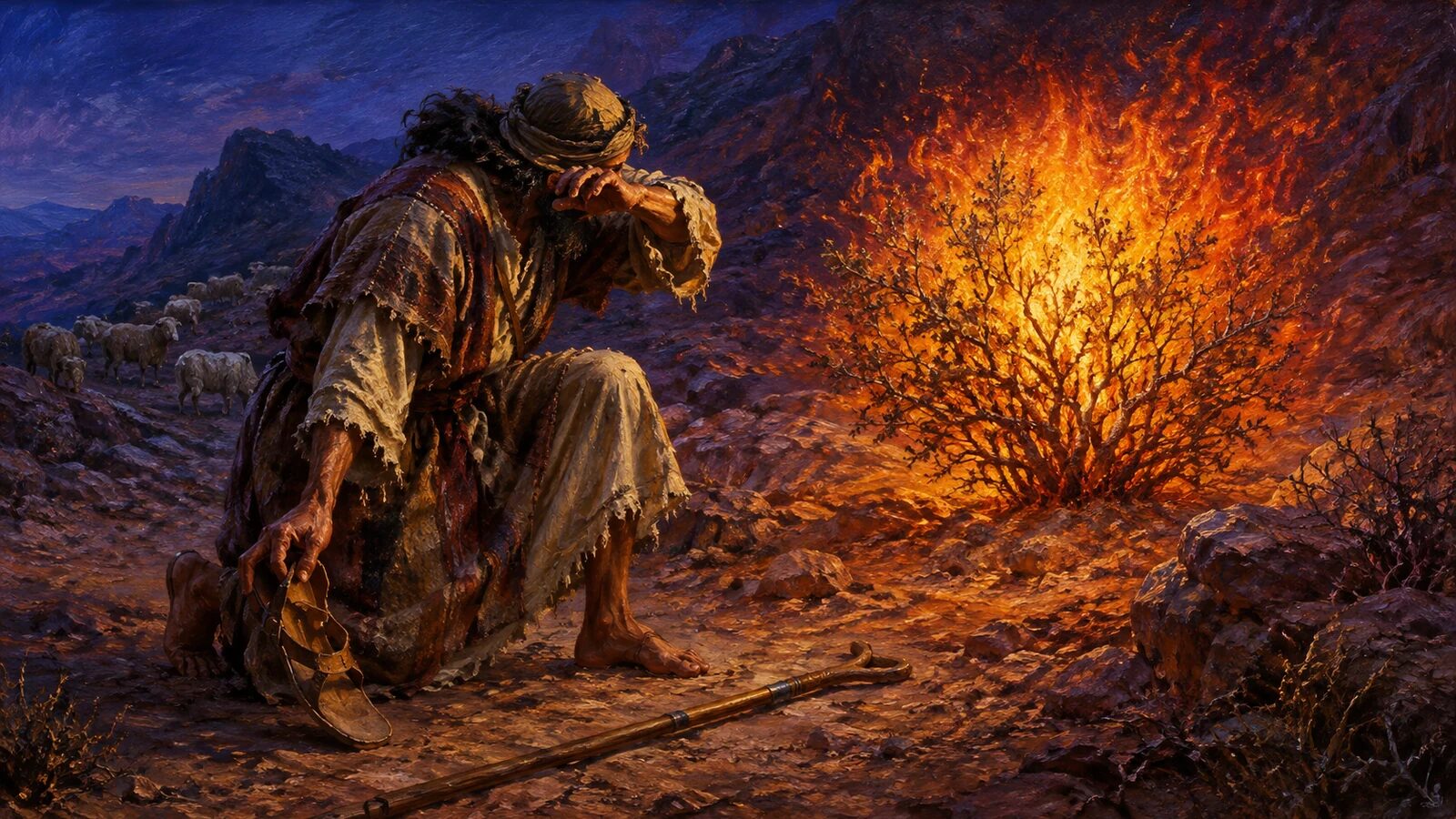
When Moses approached the burning bush, the One who appeared was called the Angel of the LORD. A few verses later, He identified Himself as the God of Abraham, Isaac, and Jacob. Moses hid his face because he was afraid to look at God. That leaves us with a question we need to answer carefully: was this a created angel carrying God’s message, or was God Himself appearing as His own Messenger?
I believe the distinctive Angel of the LORD in these passages is the eternal Son before He became man. The Old Testament does not explicitly call Him Jesus Christ, so we need to explain how we reach that conclusion. Several accounts identify this Messenger with God, while others distinguish Him personally from the LORD He addresses. The New Testament’s revelation of the Son helps us understand both descriptions without dismissing either one.
The Messenger Who Speaks as the LORD
The Hebrew word translated “angel” is mal’ak, and its basic meaning is “messenger” or “envoy.” It may refer to a human messenger or to a created angel from heaven. The word describes someone’s mission; by itself, it does not tell us that person’s nature. A prophet may serve as God’s messenger without being an angelic creature. In the same way, the eternal Son can be sent by the Father without becoming a created being.
We also know that a messenger can repeat God’s words in the first person. A prophet saying what the Lord has said does not thereby become God. So I need more than a sentence beginning with “I” to identify the Speaker. I look at how the account names Him, the authority He exercises, and whether the encounter treats Him as a servant or as the Lord Himself.
Created angels give us a useful comparison. When John fell before an angel in Revelation 22:8-9, the angel stopped him, explained that he was a fellow servant, and told him to worship God. Revelation 19:10 records the same correction. Those angels faithfully carried out their assignments without accepting the worship due to their Creator.
In Genesis 16, the Angel of the LORD found Hagar beside a spring after she fled from Sarai. Abram and Sarai had tried to obtain the promised child through her, and Sarai then treated her harshly. Hagar was pregnant and alone in the wilderness when the Messenger spoke about her son and his descendants.
Then the Angel of the LORD said to her, “I will multiply your descendants exceedingly, so that they shall not be counted for multitude.”
Genesis 16:10, NKJV
He promised, “I will multiply your descendants,” then told her to name the child Ishmael and described his future. Hagar could not secure that future for her child, and a created angel could not promise it on his own authority. We also have more than her impression of whom she met: Genesis itself names the One speaking to her.
Genesis 16:13 says that she “called the name of the LORD who spoke to her, You-Are-the-God-Who-Sees.” Hagar recognized Him as the God who saw her, and the account records no correction of that recognition. More than that, Genesis itself calls the One speaking to her the LORD. That is why I read this as more than a created angel delivering a message.
Hagar was not the mother of the promised Seed, but that did not make her distress unworthy of His attention. She had been mistreated in the very household through which God was working out His covenant promises. We should not overlook that while studying who the Messenger is. If someone is mistreated among God’s people, defending the reputation of the group does not make the mistreatment acceptable. The Lord saw Hagar when the people who should have treated her properly had failed to do so.
Genesis 22 places the Messenger within another encounter involving God’s promise. God tested Abraham by commanding him to offer Isaac, the son through whom the covenant line would continue. As Abraham reached for the knife, the Angel of the LORD called from heaven and stopped him. God provided a ram, and the Angel spoke again.
“By Myself I have sworn, says the LORD, because you have done this thing, and have not withheld your son, your only son.”
Genesis 22:16, NKJV
“By Myself I have sworn” is God’s own oath. Hebrews 6:13 explains that God swore by Himself because there was no one greater by whom He could swear. The Angel is not offering a separate guarantee alongside God’s promise; the words He speaks are the Lord’s commitment to Abraham.
Earlier, in Genesis 22:12, He had said that Abraham had not withheld his son “from Me.” The obedience God required is described as obedience owed to this Messenger. He then promises to multiply Abraham’s descendants and bring blessing to the nations through his Seed. Galatians 3:16 identifies Christ as the ultimate fulfillment of that promise.
We can see God’s provision here without forcing every person and object into a complete explanation of the cross. Abraham is not a representation of the Father in everything he does, and Isaac is not Jesus in every detail. God spared Isaac and preserved the family through whom the promised Deliverer would come. The oath therefore reaches beyond that day’s rescue to the blessing of the nations through Christ.
The command to Abraham was also unique, and God Himself stopped the sacrifice. Scripture condemns human sacrifice. No one can use this account to justify harming a child because he claims to have received a private instruction from God. Such a claim must be judged by God’s written Word.
Holy Ground and Covenant Authority
Exodus 3 gives us an especially direct identification. Moses was tending Jethro’s flock when he noticed a bush burning without being consumed. The passage first names the Angel of the LORD, then calls the Speaker the LORD and God.
And the Angel of the LORD appeared to him in a flame of fire from the midst of a bush… So when the LORD saw that he turned aside to look, God called to him from the midst of the bush.
Exodus 3:2, 4, NKJV
Nothing in the account suggests that the Angel withdrew and a different Speaker took over. The One in the bush called Himself the God of Abraham, Isaac, and Jacob. He told Moses to remove his sandals because the ground was holy, and Moses hid his face because he was afraid to look upon God.
The ground was holy because God was present there. Moses had not made it holy by feeling something unusual or deciding that this was a meaningful place. He was required to treat God’s presence with reverence. We should be just as careful about distinguishing what God has set apart from what we personally find moving.
The Lord had heard Israel’s groaning and remained faithful to His covenant through generations of oppression. He revealed His covenant name and sent Moses back to Egypt. Moses’ objections did not surprise Him, and the deliverance was not going to depend on Moses being naturally persuasive. The God who made the promise was committing Himself to bring His people out.
Later, the LORD promised to send His Angel before Israel on the journey to the land. He warned them about how they must respond to Him.
“Beware of Him and obey His voice; do not provoke Him, for He will not pardon your transgressions; for My name is in Him.”
Exodus 23:21, NKJV
“My name is in Him” connects the Angel with God’s own identity and authority. Israel was to obey His voice and take the warning about rebellion seriously. Calling Him a Messenger did not mean they could disregard Him as though He were merely expressing a servant’s opinion.
The warning says He will not pardon their transgressions, rather than that He lacks the ability to forgive. It concerns Israel’s defiance of God under the covenant. They could not demand the benefits of His presence while treating His commands as optional. His warning required Israel to respond to the Angel with the obedience they owed to God Himself.
After Israel entered the land, and before the attack on Jericho, Joshua met a Man standing with a drawn sword. Joshua asked whether He was for Israel or its enemies. He answered, “No, but as Commander of the army of the LORD I have now come” (Joshua 5:14).
This passage does not use the title Angel of the LORD, but it gives us a related encounter. Joshua fell on his face in worship and asked what his Lord had to say to His servant. The Commander told him to remove his sandal because the ground was holy (Joshua 5:15). Worship was not refused, and the command about holy ground recalls the One who spoke to Moses from the bush. Those details are why I understand the Commander as divine.
Joshua had asked whose side the Commander was on. He then found himself receiving orders. I need to approach Christ with that willingness too. If I have already made up my mind and only want Him to endorse it, I am asking for approval while resisting His authority. Bowing before Him means being prepared to do what He says, including when His answer requires changing my plans. The study on Christophanies in the Old Testament considers other appearances before the incarnation.
Judges 2 records the Angel confronting Israel after the people had compromised in the land. His rebuke looks back to the promises and deliverance we have just followed.
“I led you up from Egypt and brought you to the land of which I swore to your fathers; and I said, ‘I will never break My covenant with you.’”
Judges 2:1, NKJV
He calls the exodus His work and the covenant His own. The people were answerable to Him for disobeying the instructions He had given about the inhabitants of the land and their altars. They wept when He rebuked them. The One who had kept His promise to their fathers had also seen what they were doing with the inheritance they received.
I cannot separate His compassion from His right to correct His people. Israel needed His mercy, but they were also responsible for listening to Him. His faithfulness had never meant that He would overlook idolatry simply because the people committing it belonged to the covenant nation.
Gideon and Manoah Encounter the LORD
Judges 6 brings us to Gideon threshing wheat where the Midianites would not see it. The Angel greeted him as a mighty man of valor, then commissioned him to deliver Israel. Gideon’s circumstances hardly suggested that he was ready to confront the enemy, but the commission included the Lord’s promise to be with him.
During their conversation, Judges 6:14 says, “The LORD turned to him and said.” Later, Gideon brought an offering, and the Angel touched it with the end of His staff. Fire rose from the rock before He departed. Gideon then said, “Alas, O Lord GOD! For I have seen the Angel of the LORD face to face” (Judges 6:22).
The LORD answered, “Peace be with you; do not fear, you shall not die” (Judges 6:23). He did not correct Gideon for mistaking a creature for God. He reassured him that the encounter would not kill him. Gideon needed that mercy as well as the command he had received, and the Lord supplied both.
In Judges 13, the Angel appeared to Manoah’s wife and announced Samson’s birth. Manoah later asked His name, which He described as wonderful, beyond ordinary understanding. When Manoah offered food, the Angel declined it and directed him to offer a burnt offering to the LORD. As the flame rose, He ascended in it. Manoah and his wife fell on their faces.
And Manoah said to his wife, “We shall surely die, because we have seen God!”
Judges 13:22, NKJV
His wife did not tell him that he was wrong to recognize an encounter with God. She challenged his conclusion that they must die. If the LORD intended to kill them, why had He accepted their offering and disclosed what He intended for their child?
I appreciate how she reasoned from what they had actually been told. Manoah had seen something extraordinary and was terrified, but she remembered that God had made a promise about their son’s life. Reverence did not require her to forget that promise. We can take God’s holiness seriously without treating His mercy as though it has suddenly become unreliable.
Distinction, Mercy, and the Removal of Guilt
So far, the passages have repeatedly identified the Messenger with God. Zechariah gives us another part of the explanation. In Zechariah 1:12, the Angel of the LORD asks the LORD of hosts how long mercy will be withheld from Jerusalem and Judah. One Person addresses another. I therefore do not understand these appearances as the Father simply taking a different name.
Zechariah 3 then shows Joshua the high priest standing before the Angel in filthy garments, with Satan there to accuse him. This is not Joshua who led Israel into Canaan. The filthy garments represent defilement. The LORD answers the accuser rather than leaving the high priest to defend himself:
“The LORD rebuke you, Satan! The LORD who has chosen Jerusalem rebuke you! Is this not a brand plucked from the fire?”
Zechariah 3:2, NKJV
As the filthy garments are removed, Joshua hears, “See, I have removed your iniquity from you, and I will clothe you with rich robes” (Zechariah 3:4). God answers the accuser by dealing with the guilt itself. Joshua receives cleansing and clothing he has not provided.
This anticipates Christ’s work as our righteous Advocate, the One who speaks on our behalf before God. He shed His blood for sinners and lives to intercede for us. The vision does not give a complete New Testament explanation of atonement, but Joshua’s need is familiar. If I have sinned, arguing that I am better than someone else will not remove my guilt. I need the cleansing God provides through Christ. The study on Melchizedek examines His superior priesthood through another Old Testament account.
The Eternal Son Makes the Father Known
How can this Messenger be divine and yet address the LORD? Scripture reveals one God in three personally distinct, coequal, and coeternal Persons: the Father, Son, and Holy Spirit. Being sent by the Father does not require the Son to be a created being. It describes His mission and relationship to the Father, rather than the beginning of His existence.
John 1:18 says, “No one has seen God at any time. The only begotten Son, who is in the bosom of the Father, He has declared Him.” Jesus also says of the Father in John 5:37, “You have neither heard His voice at any time, nor seen His form.” I read these words alongside the Old Testament accounts. Those people truly encountered God, and the Son is the One who makes the Father known.
John 1:1 says the Word was with God and was God. Verse 3 says that everything made came into being through Him. If everything created came through the Word, He cannot be one of the things that were created. He is the eternal Creator, personally with the Father and fully divine. The study on the Word of the LORD in the Old Testament considers that language and its connection with Christ more fully.
That is also why His incarnation must be distinguished from these earlier appearances. When John 1:14 says the Word became flesh, it describes the Son taking on a true human nature. He did not begin to exist at Bethlehem. Jesus expresses His eternal identity in John 8:58: “Most assuredly, I say to you, before Abraham was, I AM.” A Christophany is an appearance of Christ before that incarnation; it is not an earlier birth or another incarnation.
Colossians 1:15-17 calls Him the image of the invisible God and says all things were created through Him. He is before all things, and creation holds together in Him. Paul likewise describes the Son in Hebrews 1:1-3 as the One through whom God made the worlds, the brightness of His glory, and the express image of His person. These passages explain why the Son can reveal the Father perfectly. He has eternally been with the Father and shares His divine nature. His knowledge of the Father is not something a creature acquired through instruction.
Some readers understand the Angel passages as a created angel speaking under delegated authority. That explains how a messenger could repeat God’s words, and we should acknowledge that much. It does not, in my judgment, adequately explain why the narratives also identify the Messenger as the LORD, place God’s name in Him, and describe the covenant as His own. The worship and holy-ground encounters add to the difficulty. My conclusion rests on those details together, rather than on treating every first-person statement as proof of deity.
Others agree that God appeared but hesitate to identify the Person as the Son. Although the Old Testament does not explicitly say that this Messenger is Christ, I believe we can make a reasonable inference from the evidence. The accounts call Him the LORD and yet show Him addressing the LORD. When I read that alongside John’s explanation that the Son makes the Father known, identifying Him as the eternal Son accounts for both descriptions. I am drawing that conclusion from Scripture as a whole, rather than quoting an identification made in a single verse.
This does not identify every angelic appearance as Christ. Scripture records many created angels, including messengers called an angel of the Lord in Matthew and Acts. The context and wording of each passage need to be considered. Daniel 6, for example, does not identify the messenger who shut the lions’ mouths as the Angel of the LORD, and it does not give enough information to establish that He was Christ. We should be firm about the evidence we have without supplying an identity where it has not been given.
The One who revealed the Father before Bethlehem is also the Savior who later came in the flesh. Jesus is fully God and fully man, virgin-born and sinless. Wicked men tortured and punished Him, then put Him to death. He willingly endured that suffering in His innocent body for our sins. His shed blood and death accomplished our redemption; He was buried and rose bodily from the dead. The Father did not punish, curse, abandon, strike, bruise, or pour wrath on Jesus. Father and Son remained united in saving us.
Christ died for the whole world, and God’s offer of salvation is genuine even though people can resist and reject it. Everyone who repents and trusts Christ is born again, indwelt and sealed by the Holy Spirit, and eternally secure. When I speak of new birth, I mean someone God has actually made new, rather than someone who merely calls himself a Christian. Obedience is evidence of that life, not a payment that keeps salvation in force. His mercy gives us assurance and a reason to turn from sin; it gives no license to defend it.
My Final Thoughts
I believe these encounters reveal the eternal Son acting as the LORD’s Messenger before His incarnation. His dealings with Hagar, Israel, and the people He called give us reason to trust both His compassion and His authority. The question is not finished when we have identified Him correctly. If He is the Lord, we need to receive His correction as willingly as we seek His help. He has made the Father known and provided salvation for sinners, and He is the One we are called to trust and obey.