
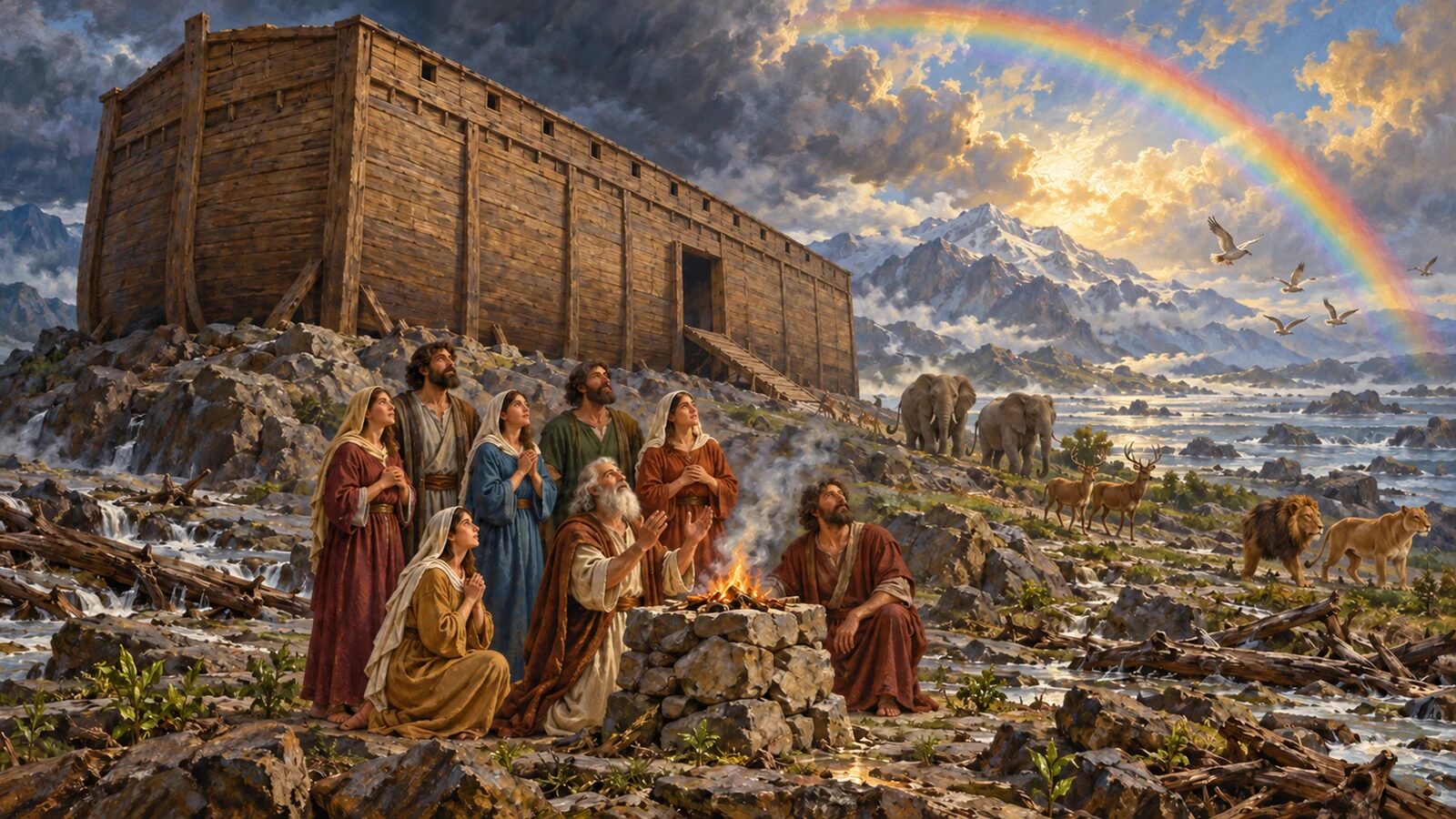
When we think of Noah, the ark can occupy so much of our attention that we overlook why he needed it. God saw a world corrupted by sin and warned its people before judgment came. He showed grace to Noah and provided one appointed refuge. I want to follow that connection between judgment and mercy, including how the ark points us toward Christ.
Scripture describes Noah’s generation as deeply wicked, with the thoughts of the human heart continually evil. The earth was corrupt and filled with violence, yet in that setting Noah found grace in the eyes of the LORD. He was not sinless and could not save himself by being good. He received God’s grace and believed His warning, and that faith led him to obey.
Noah’s place in Genesis becomes clearer when we read what comes before Genesis 6. Genesis 5 traces the family line from Adam through Seth and ends by naming Noah and his sons. Enoch had walked with God in that same line. Lamech named Noah while longing for comfort from the ground the LORD had cursed. This family history brings both the consequences of Adam’s sin and the hope of God’s promise into Noah’s generation. We are reading about a real family in the long history between creation and the Flood.
Genesis 6 through 9 gives us the account that Jesus, Hebrews, Peter, and Jude later draw upon. Some details, including the sons of God and the Nephilim, leave questions Scripture does not fully answer. We can examine those carefully while keeping the clearly revealed events in view. The Flood brought real judgment, the ark displayed God’s mercy, and the rainbow became His covenant sign. Together, this pattern directs us toward Christ as God’s appointed refuge.
I need to hold judgment and grace together as I read. The world was truly corrupt, so God’s judgment was righteous. Noah’s deliverance nevertheless began with grace, and his obedience made his faith visible. Separating those truths could leave us portraying God as harsh or Noah as his own savior. It could also leave us calling something faith when it never leads to action.
Noah Before the Ark
Genesis 6:9 describes Noah as a just man who was perfect in his generations and walked with God. It does not call him sinless. It describes the faithful direction of his life and the integrity he showed among a crooked generation.
This is the genealogy of Noah. Noah was a just man, perfect in his generations. Noah walked with God.
The word “perfect” translates the Hebrew tamim, which can describe what is whole or sound, complete or without blemish. In Noah’s case, it describes integrity rather than absolute sinlessness. His loyalty was undivided and his life was directed toward God. Understanding the word in that setting helps us appreciate Noah’s faithfulness without claiming that he never sinned.
Genesis uses the same language about Noah walking with God that it previously used of Enoch in Genesis 5:24. Noah’s trust was evident in the ordinary course of his life as he listened to God and obeyed, even while the culture around him went the other way. I notice that building the ark did not begin his relationship with God. It revealed that relationship when God’s warning put his faith to a public test.
Noah found grace in Genesis 6:8 before the next verse described him as just and sound in his generation. Hebrews later identifies him as an heir of righteousness according to faith. That order keeps me from crediting his construction work with earning God’s favor. He prepared the refuge exactly as commanded because he believed the God who warned him. Scripture praises that obedience without teaching salvation by works.
Noah’s obedience also affected the household entrusted to him as a husband and father. His wife entered the ark with him, along with his three sons and their wives. Their presence does not mean that a parent’s faith automatically saves an unbelieving child. It shows that Noah’s faith shaped years of work and brought his household under God’s appointed protection. What he believed could not remain a private opinion with no effect on those in his care.
Why Judgment Came
Genesis explains why the Flood came by showing us what God saw. Mankind was morally ruined from within, with evil directing the heart rather than appearing only in a few outward crimes. Judgment was God’s response to that corruption, not a sudden overreaction.
Then the LORD saw that the wickedness of man was great in the earth, and that every intent of the thoughts of his heart was only evil continually.
The earth’s violence showed that corruption could not remain private. People who reject God eventually begin treating others as tools for their own use. A neighbor may become an obstacle to remove or someone to prey upon. Seeing that connection helps me understand the severity of the Flood. God saw the evil clearly and judged it righteously, rather than bringing random destruction.
Genesis says the LORD was sorry He had made man on the earth and was grieved in His heart. We should take His grief seriously without concluding that He discovered a mistake or lacked foreknowledge. Nor does it mean He changed from holiness to instability. God was responding to creatures who had corrupted His good world. His unchanging character does not make Him indifferent to violence; He judges in keeping with the holiness He has always possessed.
Genesis 6:3 says God’s Spirit would not strive with man forever and gives 120 years. I understand this as a countdown to the Flood rather than a new maximum human lifespan, since people continued living beyond 120 for a time afterward. God was giving time, but His patience did not grant permission to keep sinning. As 2 Peter 3:9 explains, patience allows people to repent rather than promising that judgment will never come.
2 Peter calls Noah a preacher of righteousness, and 1 Peter says God’s longsuffering continued while the ark was being prepared. We are not given Noah’s sermons or told how many people heard him. I would not fill those gaps with invented speeches or claim that Scripture describes a crowd at an open ark door. We do know that God warned people and allowed time, with a righteous witness present before judgment came.
And the LORD said, “My Spirit shall not strive with man forever, for he is indeed flesh; yet his days shall be one hundred and twenty years.”
Sons of God and Nephilim
Faithful readers have debated Genesis 6:1-4 because it describes an unusual event. I believe the strongest reading identifies the “sons of God” as heavenly beings who crossed a boundary God had set. The phrase’s use in Job supports that reading, as does the New Testament connection between angelic sin and Noah’s world. We need to face those details without using them as permission to speculate.
that the sons of God saw the daughters of men, that they were beautiful; and they took wives for themselves of all whom they chose.
The Hebrew phrase means “sons of God.” In Job, the same expression is used for heavenly beings presenting themselves before the LORD, which supports the angelic reading in Genesis 6.
The Sethite view identifies the sons of God as men from Seth’s godly line who married women from Cain’s ungodly line. It avoids the difficulty of angelic rebellion, but Genesis does not call these men “sons of Seth.” It also leaves the unusual result harder to explain. Another view sees powerful human rulers, sometimes called royal tyrants, behind the phrase. That may explain the arrogance and oppression, but I do not think it fits the wording in Job as naturally as the angelic reading.
2 Peter places angelic sin beside the ancient world and Noah, while Jude describes angels who left their proper domain. Those connections strengthen the angelic reading without explaining how it happened. They tell us that rebellion crossed boundaries God had set and that He judged it. I need to stop there rather than turn an unexplained mechanism into a fantasy.
And the angels who did not keep their proper domain, but left their own abode, He has reserved in everlasting chains under darkness for the judgment of the great day.
The Nephilim belong to the picture presented in Genesis 6, but Scripture does not explain every mechanism involved. Modern theories cannot supply binding doctrine. Hidden-bloodline speculation should also be rejected, and the Book of Enoch must never be treated as inspired Scripture.
Genesis does not identify the Nephilim as the only reason for the Flood. After mentioning them, Genesis emphasizes mankind’s wickedness and the evil direction of the human heart, with corruption and violence throughout the earth. That setting leaves human beings accountable even as it includes the unusual rebellion. The phrase “and also afterward” does not establish survivors outside the ark or a secret line through Noah’s family. We need to read the passages about later giant peoples on their own terms.
Grace, the Ark, and the Flood
Genesis 6:8 brings us back to Noah finding grace in the eyes of the LORD while the world faced judgment. His integrity was real, but he still needed mercy. I want to remember that as we consider the work God gave him to do. His obedience never made him his own savior.
But Noah found grace in the eyes of the LORD.
God supplied the ark’s design, so Noah was building the refuge God appointed rather than inventing his own. The Hebrew word tevah names both Noah’s ark and the basket that carried Moses on the Nile. In both accounts, God directed events so that a vessel preserved life through dangerous waters.
God commanded Noah to cover the ark inside and out with pitch to seal it against the water. The Hebrew verb for covering belongs to a word family later associated with atonement, but the immediate instruction in Genesis 6 is practical. I would not make that word carry every later doctrine about atonement. The broader pattern is still suggestive: safety in judgment is found under the covering God provides.
Genesis says the LORD shut Noah in. Noah entered by faith, but God Himself sealed the refuge He had commanded and provided. I see God’s care in that detail because the safety of those inside rested on His power to keep them.
God designed the ark as a large, practical vessel to carry its occupants and provisions through the Flood, rather than as a ship for navigation. He specified its length, width, and height, along with rooms and three levels. There was an opening above and a door in the side. Its proportions and divisions show an ordered structure, though any modern measurement must remain an estimate because ancient cubits varied.
Noah had to gather food for his household and the animals. The animals came according to their kinds as male and female, with additional clean animals and birds that would later supply sacrifice. We should not equate those created kinds with every modern species label. Genesis says the animals would come to Noah, so it does not require him to have searched the world and captured them all himself. I can appreciate the work God assigned him while recognizing how much depended on God’s governing what Noah could never accomplish alone.
Twice the construction account says Noah did all that God commanded. His faith went beyond agreeing that a flood was possible. He built the ark and gathered what God required, then entered when God told him to and waited. God’s warning concerned something unseen, yet Noah trusted it enough to organize his life around it.
So those that entered, male and female of all flesh, went in as God had commanded him; and the LORD shut him in.
The Flood as Judgment
Genesis gives dates that let us follow the Flood’s stages and tells us where the water came from. It presents history, not legend. Its broad language describes worldwide judgment and is followed by God’s covenant with the earth. I cannot fit all those details into a small local flood.
on that day all the fountains of the great deep were broken up, and the windows of heaven were opened.
The forty days and forty nights of rain were only part of the Flood’s duration. The waters prevailed on the earth for 150 days, and Noah’s family stayed in the ark a little over a year. Keeping that full span in view helps us see a comprehensive judgment and preservation, rather than a storm that quickly passed.
And the waters prevailed on the earth one hundred and fifty days.
The fountains of the great deep and the windows of heaven describe judgment from below and above. The Creator who ordered the waters in Genesis 1 has authority to judge the world when wickedness reaches its full measure. The Flood’s severity reflects the severity of sin. God’s patience never meant He was indifferent to it.
Genesis describes waters covering the high hills under the whole heaven. Every dry-land creature outside the ark died, while Noah and those with him lived. Afterward, God promised never again to cut off all flesh by floodwaters. If this were only a local disaster, why would Noah need the ark and representatives of land animals, followed by a worldwide covenant sign? Those details belong to the comprehensive judgment Genesis describes.
Genesis 8 says God remembered Noah and every living thing with him. He had not forgotten where they were. Biblical remembrance here means He turned His covenant attention toward them and acted to preserve them. He sent wind over the earth and restrained the water’s sources. In time, the ark rested in the mountains of Ararat. That names a region without requiring us to identify the exact modern peak called Mount Ararat.
Noah sent out a raven and later a dove while observing the receding waters. Even when the ground appeared dry, he waited for God to tell him to leave. I notice that his obedience continued through the long confinement, not only at the dramatic moment of entering the ark. The faith that brought him in at God’s word also kept him waiting for God’s direction to come out.
Worship and Covenant
Noah’s first recorded act after leaving the ark was to build an altar and offer burnt offerings to the LORD. He worshiped the God who had saved him instead of treating the cleansed world as his own possession.
Then Noah built an altar to the LORD, and took of every clean animal and of every clean bird, and offered burnt offerings on the altar.
God promised that the earth’s rhythms would continue for as long as the earth remains. Seedtime and harvest would continue, along with cold and heat through winter and summer. Day and night would not cease. Though the world after the Flood was still sinful, God committed Himself to sustaining the creation in which His redemptive promise would unfold.
While the earth remains, Seedtime and harvest, Cold and heat, Winter and summer, And day and night Shall not cease.
God gave the rainbow as the sign of His promise that floodwaters would never again destroy all flesh. I should see more in it than a vague expression of human sentiment. It recalls real judgment while bearing witness to God’s mercy and His faithfulness to keep His covenant.
I set My rainbow in the cloud, and it shall be for the sign of the covenant between Me and the earth.
The covenant is made with Noah, his descendants, and every living creature for perpetual generations. Its central promise is specific: God will never again destroy all flesh by a flood. It does not say that no region will ever experience flooding, and it does not cancel the final judgment described elsewhere in Scripture. It guarantees the continuing order of the world while God’s redemptive purpose moves toward Christ and the completion of history.
God also gave responsibilities for life after the Flood. Humanity was again told to be fruitful and fill the earth. He permitted meat for food but forbade consuming blood, reminding people that life was not theirs to treat casually. Because every person bears God’s image, human bloodshed brings solemn accountability. Genesis 9:6 establishes human government’s responsibility to punish murder rather than giving private individuals permission to take vengeance.
Genesis 9 also records Noah’s later failure. He planted a vineyard, became drunk, and lay uncovered in his tent. Ham saw his father’s nakedness and told his brothers, while Shem and Japheth walked backward and covered Noah without looking. The account exposes shame and contrasting responses to it. Scripture does not excuse Noah’s drunkenness simply because he had previously walked with God.
When Noah awoke, his curse fell on Canaan, Ham’s son, not upon Ham as an entire racial category. The passage has been wickedly misused to defend racial slavery and mistreatment of whole peoples. Nothing in Genesis authorizes that reading. All humanity descends from Noah’s family, all people bear God’s image, and the text’s later historical focus concerns Canaan’s line. The episode must not be turned into a license for prejudice.
Noah’s failure after deliverance shows that the floodwater had not given the human heart new spiritual life. A changed landscape and a fresh beginning could not remove inherited sin. He still needed grace, and humanity still needed the promised Seed to deal with sin at the root. I appreciate that Scripture lets us honor Noah’s faith without asking us to hide his failure.
Noah in the New Testament
Hebrews treats Noah as a real man who acted in history after God warned him of events no one had yet seen. His faith expressed itself in godly fear as he prepared the ark. Through that faith, he became an heir of the righteousness that comes by faith.
By faith Noah, being divinely warned of things not yet seen, moved with godly fear, prepared an ark for the saving of his household.
Jesus used Noah’s generation to warn about His return. People kept eating and drinking, and marriages were planned and celebrated until Noah entered the ark. None of those ordinary activities was sinful in itself. The warning makes me consider whether I can become so occupied with ordinary life that I act as though God’s words can be ignored forever.
But as the days of Noah were, so also will the coming of the Son of Man be.
Peter connects Noah’s account with baptism, but he does not say the water itself saves the soul. He distinguishes removing filth from the flesh from the answer of a good conscience toward God through Jesus Christ’s resurrection. The water brought judgment in Noah’s day, while the ark provided refuge. Baptism points us to salvation in Christ without replacing the new birth.
In 1 Peter 3:19-20, Christ preached to spirits in prison who had been disobedient in Noah’s days. Some understand this as the Spirit of Christ preaching through Noah to his generation. I believe the stronger reading is that the risen Christ proclaimed His victory to imprisoned spirits. Peter calls them spirits and describes their imprisonment, then ends the passage with angels and authorities subject to Christ. This was a proclamation of triumph rather than another offer of salvation after death. We should not turn the difficult details into an elaborate journey Scripture never describes. Peter plainly emphasizes God’s patience while eight people were preserved through the waters, and Christ’s resurrection as the saving reality to which baptism points.
I need to keep the roles of the water and ark clear when reading this comparison. The Flood judged the unbelieving world, while God’s refuge carried Noah’s family safely through it. Christian baptism publicly identifies someone already saved with the crucified and risen Christ. It neither washes sin from the soul nor repeats His sacrifice, and it does not cause the new birth.
not the removal of the filth of the flesh, but the answer of a good conscience toward God.
Peter’s point is not water salvation. He anchors the saving reality in the resurrection of Jesus Christ and distinguishes it from outward washing.
The Refuge in Christ
God warned Noah and provided one refuge, which Noah entered by faith. God shut him in before judgment fell and preserved those inside. That gives us a clear pattern for speaking about Christ, even though the comparison does not fit perfectly in every detail.
We can follow that pattern without finding a secret doctrine in every plank or room. The dimensions, animals, and days do not each need a hidden meaning either. Noah was a saved sinner inside the ark; Jesus is the sinless Savior. The ark carried eight people through one historical judgment, while Christ gives eternal life to everyone who truly believes. The comparison helps us understand His work, but He is greater than the shadow.
Jesus is the refuge God has provided for sinners. He is the eternal Son who is fully God and fully man. He remained completely sinless. On the cross, He physically bore the punishment for our sins in His innocent body through real torture, the shedding of His blood, and death. Wicked men inflicted that punishment, and He willingly remained on the cross to finish the saving work. The Father did not punish, curse, or abandon His beloved Son. Jesus died and then rose bodily from the grave. Salvation is given by grace through faith in Him. It cannot be earned through works or ceremonies. Neither family heritage nor religious effort can provide it.
God’s offer is genuine because Christ died for the whole world. People can still resist and reject Him. However, everyone who truly repents and believes is received by God and born again. The Holy Spirit indwells every genuine believer and seals him for the promised inheritance. God keeps His children forever. Jesus says in John 10:9, “I am the door.” The door of salvation stands open now, but Noah’s generation warns us that divine patience has a limit.
The Flood also points forward to God’s righteous judgment of the world through Jesus Christ. For unbelieving humanity, that judgment ends in the second death, the irreversible destruction of body and soul in the Lake of Fire. Those in Christ have had their guilt answered through His blood. The God who shut Noah in the ark also keeps His redeemed people.
My Final Thoughts
Noah’s account calls me to take God’s warning seriously while trusting the refuge He provides. God faced genuine evil and warned patiently, giving Noah grace before he ever built the ark. Noah obeyed because he believed Him, not because he could save himself. The difficult details deserve careful study without secret bloodlines or extra-biblical fantasies, and Peter’s use of the Flood does not teach salvation by water. God appointed the ark for that judgment, and He has provided the greater refuge for sinners in Jesus Christ. My confidence rests in Christ’s blood, death, and bodily resurrection, received by faith.