
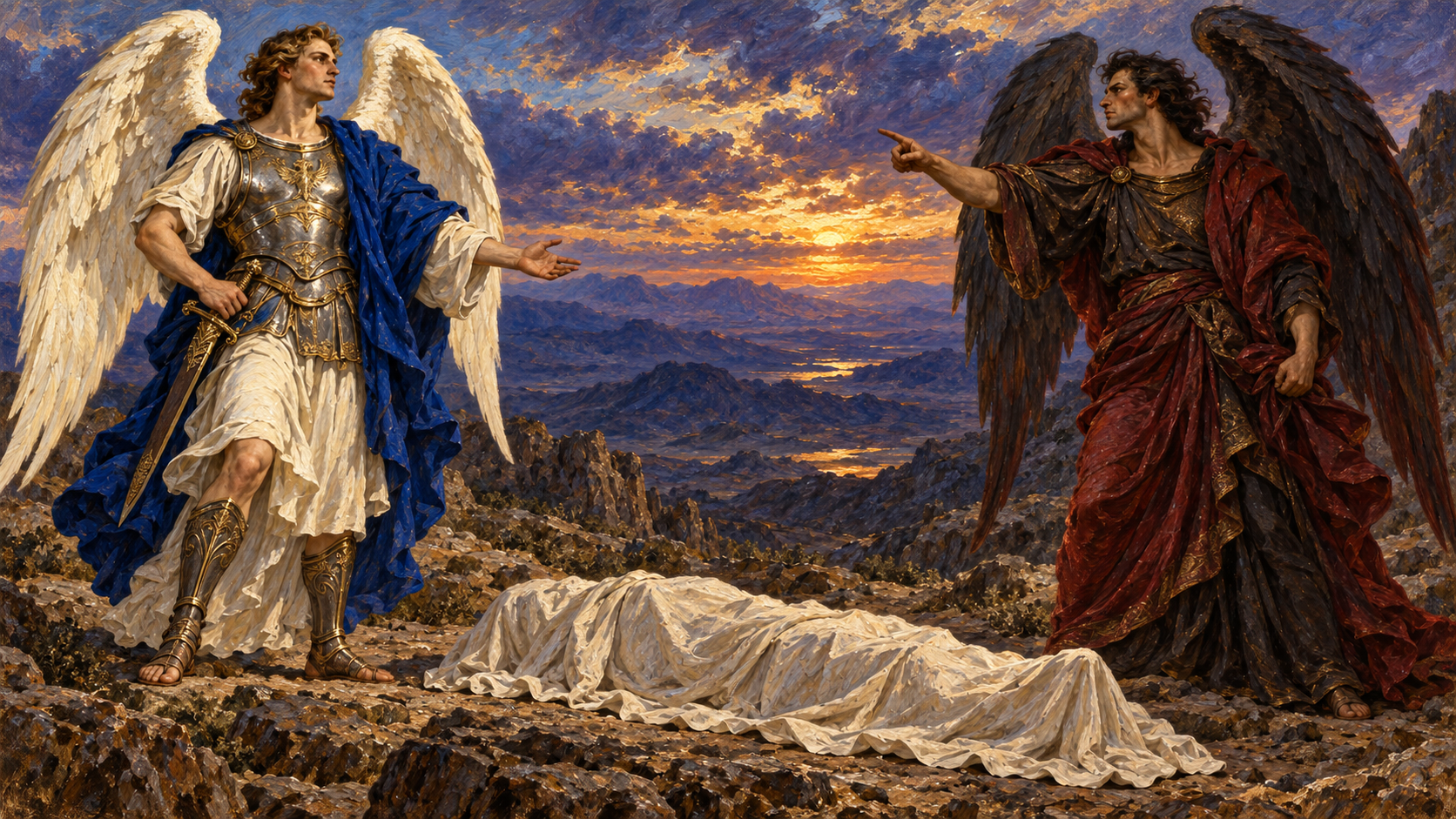
Michael appears by name only a few times in Scripture, yet those passages tell us a great deal about unseen spiritual conflict. What catches my attention is how much authority he has without ever taking the Lord’s place. I want to understand what Scripture reveals about this powerful angel while keeping that distinction clear.
What Scripture Tells Us About Michael
God created Michael and gave him his place among the angels, so even his great strength remains under God’s command. He is a servant, not a lesser god or someone Christians should approach as a mediator in prayer. I can appreciate Michael’s service without giving him the honor that belongs to the Lord he serves.
We also need to distinguish what Scripture says from what familiar artwork shows. The featured image on this page pictures Michael as a warrior, but the Bible never describes his appearance or clothing. It doesn’t say whether he has wings or name a weapon he carries. Art can remind us of a biblical theme, provided we don’t use the artist’s choices to decide what we believe.
Some groups, including Jehovah’s Witnesses, identify Michael as Jesus. I don’t believe that identification fits what Scripture says about them. Michael is one of the chief princes and an archangel, while Jesus is the eternal Son who created every angel and receives their worship. The passages about Michael also have something to teach us about prayer when answers seem delayed, and they keep Israel within God’s prophetic purpose. We can learn from all of this without confusing a powerful servant with his Lord.
Only five verses in the Bible name Michael directly. Three are in Daniel, with one in Jude and the final reference in Revelation’s account of war in heaven. With so little recorded about him, I want to pay attention to each passage rather than fill out his life with details from later tradition.
Those references are Daniel 10:13, Daniel 10:21, Daniel 12:1, Jude 1:9, and Revelation 12:7. Daniel first identifies Michael as one of the chief princes and then as Daniel’s prince. In Daniel 12, he is the great prince who stands watch over Daniel’s people. Jude calls him the archangel, and Revelation shows him leading his angels against the dragon. There is also a possible connection in 1 Thessalonians 4:16, which speaks of the voice of an archangel. Michael is the only archangel named in Scripture, but that verse doesn’t identify the speaker.
Michael’s Hebrew name, Mikha’el, is commonly understood as the question, “Who is like God?” The expected answer is no one, which helps me keep Michael’s greatness in perspective. Daniel calls him a sar, the Hebrew word for a ruler or prince, while Jude uses archangelos, meaning a chief angel. These titles describe his authority as a servant. Neither his name nor his rank puts him on the level of the God he serves.
Jude calls him “Michael the archangel,” a title Scripture gives to no one else by name. That lets us identify Michael with confidence, but it doesn’t tell us how many archangels God created. Being the only one named is different from being the only one who exists.
The word angel means messenger and often draws attention to an assignment. Although the passages about Michael show him engaged in conflict more than carrying messages, he still belongs to the created angelic order. No rank makes a created angel divine.
Michael in Daniel’s Visions
Daniel 10 took place in the third year of Cyrus, king of Persia. Cyrus had already permitted Jewish exiles to return to Jerusalem, though the restoration remained difficult and incomplete. Daniel was still under Persian rule when he received a revelation about a great conflict. For three full weeks he mourned, setting aside pleasant food and anointing oil. His fasting expressed grief and a humble desire to understand what God was revealing. It didn’t purchase an answer or give him control over angels.
When a heavenly messenger appeared, Daniel learned that his words had been heard from the very first day. The prince of Persia had resisted the messenger until Michael came to help. Daniel could not have discovered that by watching earthly events. God was showing him that a real conflict among spiritual beings existed alongside the activity of the empires he could see.
But the prince of the kingdom of Persia withstood me twenty-one days; and behold, Michael, one of the chief princes, came to help me, for I had been left alone there with the kings of Persia.
“One of the chief princes” tells us both that Michael held a prominent position and that others shared that rank. He wasn’t the only heavenly ruler, nor was he the source of the message Daniel received. He came to help a fellow servant carry out an assignment from God.
The word prince can refer to a human ruler, so I need to look at what this prince was doing before deciding who he was. Here the prince of Persia resisted a heavenly messenger for twenty-one days, and Michael came into that same unseen conflict. A disagreement among visible officials would not account for what Daniel describes. Still, “one of the chief princes” tells us only that Michael held high authority given by God. It doesn’t supply a complete chart of angelic ranks.
The opposition the messenger faced for twenty-one days also keeps us from treating angels as decorative symbols of comfort. These are intelligent, personal servants engaged in serious conflict. Their work involves opposition that Scripture asks us to take seriously.
That opposition never put God Himself in danger. Daniel received the revelation, and the future would unfold according to the Scripture of Truth. The God who revealed the outcome before it happened remains sovereign over the conflict. Hostile powers cannot cancel what He has decreed.
Daniel 10 speaks of a prince of Persia and a coming prince of Greece. These cannot be reduced to the visible kings because they resist and interact with the heavenly messenger. The text reveals spiritual powers connected with earthly empires.
This helps me understand Paul’s later explanation that the Christian struggle reaches beyond flesh and blood. He speaks of principalities and powers, then of rulers of darkness and spiritual hosts of wickedness. Scripture lets us see that unseen influence without relieving human rulers or their people of responsibility for the choices they make in political events.
I also need to stop where Daniel stops. He gives us no list of spirits assigned to every nation or method for discovering their names. Nothing here commands believers to address those spirits in prayer. Daniel wasn’t told to fight the prince of Persia himself. He prayed to God while God’s servants did the work assigned to them.
A hostile power may deceive or influence a king, but the king still answers for his choices. Daniel’s visions judge arrogant kingdoms as human empires even while revealing their part in a wider spiritual rebellion. We cannot use the unseen conflict to excuse the human sin those visions condemn.
The messenger told Daniel that his words had been heard from the first day he set his heart to understand and humble himself. I find comfort in knowing that Daniel had endured silence without being ignored by God.
God wasn’t spending those twenty-one days trying to decide what to do. He already knew Daniel’s need and had heard his prayer. The messenger encountered resistance. God was the One who sent him and revealed the outcome. His sovereignty includes the genuine actions of His created servants as well as those who rebel against Him.
Daniel kept mourning and seeking God before he knew any of that. He didn’t try to command Michael or invent a formula for spiritual warfare. His humble persistence shows us a man who was not measuring God’s faithfulness by how quickly relief arrived.
We should be careful about using Daniel’s experience to explain every delayed answer to prayer. A request may fall outside God’s will, or the answer may await His timing. Sometimes He uses waiting to produce growth in the person praying. Ordinary providence or another person’s actions may also be involved, and sometimes we simply aren’t told the reason. Daniel 10 reveals that unseen resistance can occur. It doesn’t tell me that such resistance explains every delay I encounter.
Even without knowing the reason for a delay, we can keep praying humbly and obeying what God has already made clear. We can leave the hidden part with Him. An answer that hasn’t come yet is not necessarily a denial, and waiting never proves that Satan has overpowered the Lord.
What I take from Daniel’s persistence is the call to be faithful before I can see what God is doing. Daniel knew nothing about the prince of Persia while he was mourning, so his example cannot become a technique for making prayer work. If an answer seems slow, I can bring my request to God again without inventing a dramatic explanation for the wait. The delay has not taken Him by surprise.
The messenger called Michael “your prince” in Daniel 10:21. Daniel was receiving revelation about his own people and their future, including the kingdoms that would affect them. In that setting, the messenger’s words connect Michael’s assignment particularly with Israel.
Daniel 12 makes that connection even clearer by calling Michael “the great prince who stands watch over the sons of your people.” God gave him a protective role in His covenant plan, but that role does not make Michael Israel’s god or savior. The LORD Himself fulfills the promises.
I don’t see a basis here for erasing Israel’s future or treating the church as the recipient of every national promise. The passage preserves Israel’s distinct place in God’s purpose. He will preserve the nation through the future Tribulation and fulfill His promises under the returning Messiah.
God can work through a created servant without surrendering any of His glory. He may send an angel, raise up a human leader, or restrain an enemy. Whatever means He chooses, those servants and circumstances have a real part in what happens. Our praise belongs to the Lord who commands them.
Daniel 12 moves from angelic conflict into the climax of prophecy. Michael stands up during a time of trouble unlike any previous national distress.
“At that time Michael shall stand up, The great prince who stands watch over the sons of your people; And there shall be a time of trouble, Such as never was since there was a nation, Even to that time. And at that time your people shall be delivered, Every one who is found written in the book.
Jesus echoes this language in Matthew 24 when He describes an unparalleled tribulation. I understand Daniel’s prophecy as describing a literal, future seven-year Tribulation. Israel will face particular pressure during that period, yet God will preserve the nation as history moves toward Messiah’s kingdom.
When Daniel says Michael will “stand up,” he is describing action in an appointed role, not suggesting that Michael has been asleep or indifferent. At the time God has fixed, Michael will act on behalf of Daniel’s people as that unprecedented trouble unfolds.
The promise of deliverance is for those found written in the book, so national identity does not take the place of personal faith. Scripture teaches that every person begins written in the Book of Life and that those who finally reject Messiah are blotted out. Believers remain because Christ has blotted out their sins through His blood.
The next verses move beyond the nation’s survival to bodily resurrection and each person’s destiny before God. Some rise to everlasting life, while others rise to shame. Michael has a role in God’s plan, but he cannot decide whose names remain in the book. Giving life and raising the dead are beyond his power.
Israel’s hope therefore rests in God, who wrote the book and promised deliverance. He also appointed the resurrection and revealed the coming kingdom. Michael serves within that purpose without becoming the center of it.
Michael’s Restraint Before the Devil
Jude’s single verse identifies Michael as the archangel and records a dispute with the devil concerning Moses’ body.
Yet Michael the archangel, in contending with the devil, when he disputed about the body of Moses, dared not bring against him a reviling accusation, but said, “The Lord rebuke you!”
Jude doesn’t tell us why Satan wanted Moses’ body. Some readers suggest that he intended to make it a relic, while others wonder whether he was accusing Moses because of his sin. Another view connects the dispute with resurrection. I can consider those suggestions as possible explanations, but none is stated in Jude’s words.
Deuteronomy 34 says Moses died in Moab and that “He buried him.” No one knew where the grave was. In context, the LORD is the natural subject of that singular burial verb, so I understand God to be the One who buried Moses. Hiding the location prevented human access, though the passage does not explain why God chose to do that.
Jude’s purpose in mentioning the dispute is clearer than Satan’s motive. The false teachers spoke evil of dignities and of things they didn’t understand. Michael had greater knowledge and power than those teachers, yet even when facing a truly evil opponent he refused to issue a reviling judgment.
The preceding study on Satan and Moses’ body considers the possible explanations and literary background in more detail. Here I want to keep our attention on how Michael acted. He contended with the devil without presuming to take God’s place, leaving the rebuke to the Lord whose authority he served.
Michael’s words resemble Zechariah 3:2, where Satan accused Joshua the high priest and the LORD answered, “The LORD rebuke you, Satan!” I see the same recognition in Michael’s response: the final rebuke belongs to God.
A “reviling accusation” is a judgment expressed through abusive or slanderous speech. Michael’s restraint did not show sympathy for Satan or uncertainty about his evil. The devil is evil and condemned, but Michael still would not speak as though the Lord’s independent judicial authority belonged to him.
That should make me careful about confusing spiritual authority with how forcefully someone speaks. Taunting Satan or speaking about him with loud contempt doesn’t create power. Jude shows a chief angel refusing that kind of bravado because his strength depends on the Lord. Reverence belongs with confidence in God.
“The Lord rebuke you” is not a magical sentence Christians must repeat. We are commanded to pray directly to God and submit to Him, resisting the devil by standing in the truth and using His Word. Our confidence belongs in the Lord’s power, not in getting a formula right.
Michael in Revelation and 1 Thessalonians
Revelation 12 describes a woman giving birth to the male Child destined to rule the nations. The Child is Christ, and the woman represents Israel in this prophecy. In the vision, the dragon seeks to destroy the Child and later persecutes the woman.
And war broke out in heaven: Michael and his angels fought with the dragon; and the dragon and his angels fought, but they did not prevail, nor was a place found for them in heaven any longer.
Michael leads angels in this battle against the dragon, whom the passage identifies as the serpent of old, the Devil and Satan. The dragon loses his place in heaven and is cast down to earth. Knowing that his time is short, he responds with great wrath.
I understand this conflict as belonging to the future Tribulation, when Satan’s persecution intensifies. His earthly fury follows a real defeat in heaven. Revelation makes that connection plain without giving us a calendar date precise enough to settle every debate about the sequence of events.
The song surrounding the battle gives the victory to God, speaking of His salvation and Christ’s authority. The saints overcome the accuser because of the Lamb’s blood, holding to their testimony even when faithfulness costs them their lives. Michael’s battle serves that victory. It does not make him a rival to the Lamb.
The words “Michael and his angels” show that he leads others in this conflict. They do not establish that he is the “commander of all heaven” in every setting. I want to give him the honor Scripture gives him without enlarging his authority beyond what it says.
1 Thessalonians comforts grieving believers with the bodily return of Jesus and the resurrection of those who died in Christ.
For the Lord Himself will descend from heaven with a shout, with the voice of an archangel, and with the trumpet of God. And the dead in Christ will rise first.
The verse doesn’t name Michael, though many readers reasonably connect the voice with the only archangel Scripture names. I can recognize that possibility without calling it a fact.
Nor does the grammar make Jesus an archangel, any more than it makes Him the trumpet of God. The Lord descends with a commanding shout, accompanied by an archangelic voice and God’s trumpet. The event displays His royal command with heaven attending Him.
This passage describes the pre-Tribulation gathering of the church. Christ returns in the air, and believers who have died rise bodily before living believers are caught up with them. All remain with the Lord. That is where I find the comfort of this promise: Jesus will return and raise His people. Identifying the unnamed angel cannot add to that assurance.
Michael Is Not Jesus Christ
To answer whether Michael could be Jesus, I come back to the difference between the Creator and everything He made. Colossians says the Son created every order of beings, visible and invisible.
For by Him all things were created that are in heaven and that are on earth, visible and invisible, whether thrones or dominions or principalities or powers. All things were created through Him and for Him.
Michael belongs to the invisible order Christ created. Daniel calls him one of the chief princes, and Jude shows him appealing to the Lord. Jesus, however, is before all things and holds the whole creation together. Those descriptions do not put them in the same position.
In Hebrews 1, Paul asks which angel God ever called His Son and records God’s command that all the angels worship the Son. His readers needed to understand that Jesus is far more than another heavenly messenger. The angel offering worship cannot be the eternal Son receiving it. Jesus is the brightness of God’s glory and the express image of His person.
The incarnation was not an angel becoming a man. The eternal Word Himself became flesh, conceived by the Holy Spirit and born of the virgin Mary. Jesus remained fully God while becoming fully man, and He lived without sin.
When Jesus went to the cross, wicked men physically tortured and punished Him until they killed Him. The Father did not personally punish His Son, curse Him, or abandon Him. Christ willingly bore in His innocent body the real punishment those men inflicted for our sins. He shed His blood for the sins of the whole world and rose bodily after His death. No work of Michael could accomplish that redemption. Jesus Christ alone is the divine-human Mediator we need.
God genuinely offers that salvation to every person, though His grace can be resisted and His Son rejected. Whoever repents and believes in Jesus is forgiven and born again, with the Holy Spirit dwelling in him and sealing him in Christ. That security gives no excuse for lawlessness, and a shallow profession without new life does not prove that someone has been saved. I have no reason to look to an angel for what Christ supplies. No angel can give the new birth, add to His blood, or keep a believer secure in Him.
The things Scripture leaves unsaid should also shape how we speak about Michael. We have no description of his face or height. His clothing is not described, and we aren’t told whether he has wings. Scripture names no armor or weapon. We aren’t told about his creation or earliest assignment, and his activity outside the named events remains unrevealed. Those omissions leave room for an artist’s imagination, not for additional doctrine.
Scripture never calls Michael a saint in the later devotional sense or prescribes a feast day for him. Nor does it give us a prayer asking for his defense. Before I could ask him to protect me, I would need a biblical basis for believing that he hears prayers across the world or mediates God’s protection. Scripture gives us none.
The same restraint applies to his rank. Scripture neither proves that he is the only archangel nor names him as the one heard in 1 Thessalonians 4:16. Daniel also gives us no reason to assign one corresponding angelic prince to every nation. We have too little revealed information to map an angelic hierarchy in detail.
Keeping those limits helps me hold my attention where it belongs. We learn about angels from the written Word, and what we learn should not give a servant the attention that belongs to Christ.
Scripture shows Michael’s power and faithful service in events that reach from Daniel’s day into the future. That is enough for us to honor his service without supplying an imagined life for him. Private visions cannot authorize the rankings or prayers Scripture never gives us. Where the Bible is silent, I would rather stay with what it has made plain: Michael serves the Lord, and the Lord alone deserves our trust and worship.
When John fell before an angel in Revelation, the angel called himself a fellow servant and told him, “Worship God.” Faithful angels refuse the worship that belongs to their Lord. Michael would do the same, since both his name and his conduct exalt God.
The New Testament identifies one Mediator between God and men, the Man Christ Jesus. Through Him we pray to God without needing an angel to carry our requests or gain us access. I don’t need Michael to make God more willing to hear me. Christ already provides the way to the Father.
I need to be careful that curiosity about angels doesn’t take the place of obedience. Collecting accounts of angels and dreams or drawing charts of their ranks can absorb time that belongs to Scripture and prayer. If fellowship with the church fades and love becomes an afterthought, that curiosity is doing us no good. Biblical teaching about angels should deepen our worship of God and confidence in Christ. Taking spiritual conflict seriously should also make us more willing to serve humbly.
An impressive experience is not enough to establish that an angelic message comes from God. We must test the claim by Scripture, since no message can revise the gospel or add another mediator. Neither can it deny Christ’s deity or excuse sin. Paul says that even an angel from heaven must be rejected if he preaches another gospel, so private revelation must never be allowed to govern the church.
What Michael’s Service Teaches Us
The passages about Michael leave no doubt that spiritual warfare is real. They do not tell Christians to copy his assignments. Daniel prayed directly to God. Jude tells the church to contend for the faith, while Revelation points the saints to the Lamb’s blood and a faithful testimony.
Therefore submit to God. Resist the devil and he will flee from you.
James puts submission to God before resistance to the devil. We resist by living in the truth He has given and turning from sin. The gospel prepares us to stand, while faith and the assurance of salvation steady us when the conflict is hard. As we pray and follow Scripture, we continue in repentance and watchfulness. We depend on the armor God supplies rather than inventing our own way to fight.
Michael’s restraint should also affect how I speak about evil. I can name wrongdoing and refute lies without inventing motives or turning my words into a display of contempt. Final judgment belongs to the Lord, and confidence in His judgment should keep me from pretending that authority is mine.
Michael didn’t treat his rank as power he could use independently of God. He appealed to the Lord, and that helps me understand where our own confidence belongs. Jesus has saved us, and the Holy Spirit indwells and seals us. No hostile power we face has authority greater than God’s.
We can admire Michael without confusing him with Jesus or adding to what Scripture reveals about him. Christ created every angel and receives their worship. Michael remains the only archangel named in the Bible, though that doesn’t prove he is the only one. Daniel 10 also leaves room for reasons other than spiritual conflict when prayer seems delayed. None of these passages authorizes prayer to Michael, turns artwork into revelation, or makes loud speech a source of authority. Michael himself appealed to the Lord.
My Final Thoughts
I come away from these passages with respect for Michael and greater confidence in the Lord he serves. Daniel connects him with Israel and unseen conflict. Jude lets us see his restraint before the devil, and Revelation shows him leading angels when Satan is cast down. All of his work is assigned by God, and he receives neither prayer nor worship. He cannot be Jesus, because the eternal Son created every angel before becoming man for our sake. Jesus shed His blood for the world and rose bodily from death. Knowing who our Savior is gives me confidence to take unseen conflict seriously without becoming absorbed by it. We can pray directly to God and keep our worship fixed on Christ above every power.