
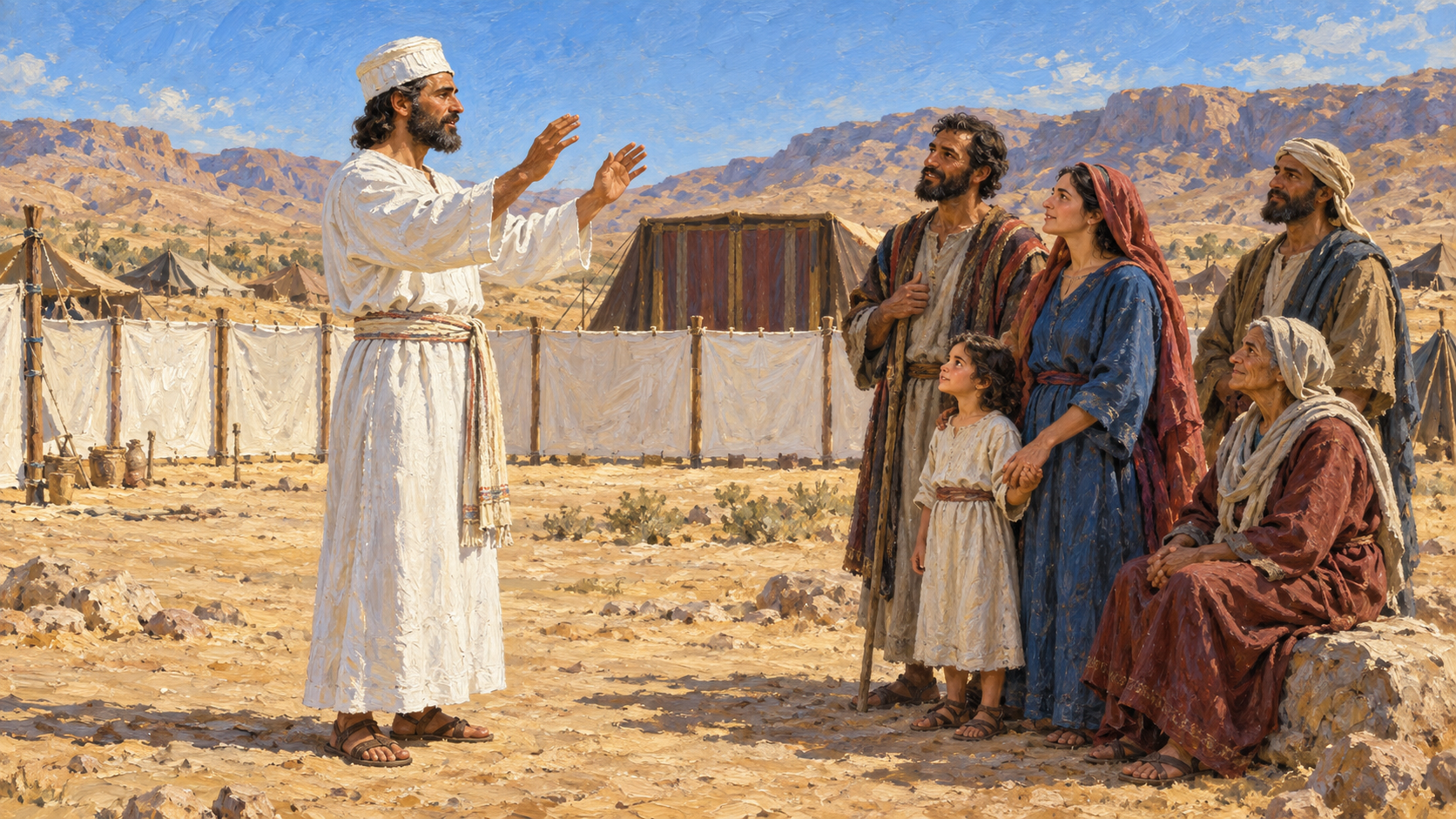
“The LORD bless you and keep you” asks for far more than pleasant circumstances. God first gave these words to Aaron and his sons to speak over Israel. When Christians pray or sing them, we need to understand that original setting and the good God promises. I want to receive this blessing with confidence in Him, without turning its words into a way of controlling what happens.
God Supplied the Words and Promised to Bless
The passage is also called the Aaronic Blessing because God assigned it to Aaron’s priestly family. A blessing spoken at the close of worship is often called a benediction, which means speaking good over someone. In Numbers 6, the priests did not invent the good they wished to announce. The Lord gave Moses the words they were to speak:
And the LORD spoke to Moses, saying: "Speak to Aaron and his sons, saying, 'This is the way you shall bless the children of Israel. Say to them: "The LORD bless you and keep you; The LORD make His face shine upon you, And be gracious to you; The LORD lift up His countenance upon you, And give you peace."' "So they shall put My name on the children of Israel, and I will bless them."
The instruction passed from the Lord to Moses, then to Aaron and his sons, who were to bless the children of Israel. Verse 27 takes us beyond “the priests will bless them,” to God’s promise, “I will bless them.” The priests had a real commission to fulfill, but God remained the One who gave what they declared. Their office made them servants of His word, rather than owners of His favor.
Aaron’s sons were to speak faithfully, rather than manipulate God through a technique. A louder voice, a moving song, or a particular posture could not force His hand. Neither can a preacher sell His favor or make it depend on personal loyalty. A donation does not activate a blessing. The minister’s work directs people to the Lord who gives what agrees with His character and covenant.
Numbers places the blessing among instructions ordering Israel’s life around the tabernacle. The tribes are counted and assigned their places, the Levites receive their duties, and the book addresses uncleanness and restitution for wrongdoing. A Nazirite’s special vow of dedication appears immediately before the blessing, and the leaders’ offerings follow in chapter 7. These were a redeemed people learning to worship and live before the God who had brought them out of Egypt.
Putting God’s name on Israel declared that the people belonged to Him. His name identified the God who had revealed Himself, carrying His authority and reputation. Bearing it before the nations was a privilege that required them to represent Him truthfully. Yet national covenant membership did not mean every Israelite trusted Him or automatically possessed eternal life. Rebellious people could bear the nation’s covenant name while refusing the Lord whose name it was.
The Hebrew addresses Israel with singular forms of “you.” The nation is addressed as one people, and each hearer receives the blessing within that community. I appreciate the personal care expressed in these words without separating the individual from the people God had gathered. Belonging to the crowd did not make anyone invisible to Him or remove the need for a faithful response.
In English, the three lines begin with “the LORD.” In Hebrew, each begins with a verb and names the Lord as the One who acts. The lines expand from three Hebrew words to five and then seven, a pattern noted in the NET Bible’s translation notes. God’s name appears in each line, anchoring the petitions. We can appreciate the memorable progression without assigning a secret meaning to the numbers.
The first request is that the Lord bless His people. The Hebrew verb barakh speaks broadly of blessing, so its setting tells us what good is in view. Scripture calls children and fruitful harvests blessings, and also speaks of gifts such as strength and wisdom. Protection and covenant privilege belong to God’s generosity too. His gifts are real, but fellowship and spiritual life with Him exceed the material things He provides.
Nothing here promises uninterrupted health or wealth. Israel’s covenant included discipline for rebellion, and faithful people also endured hunger, persecution, bereavement, and exile. Christians cannot turn these words into a guarantee of prosperity. The Lord gives daily bread and every good gift while pursuing good that reaches beyond comfort, including reconciliation to Himself and making His people more like His Son.
Keeping, Grace, God’s Face, and Peace
The next request asks the Lord to keep His people. The Hebrew verb shamar means to keep, watch, or guard. Psalm 121 repeatedly uses that language for the Lord’s care:
I will lift up my eyes to the hills– From whence comes my help? My help comes from the LORD, Who made heaven and earth. He will not allow your foot to be moved; He who keeps you will not slumber. Behold, He who keeps Israel Shall neither slumber nor sleep. The LORD is your keeper; The LORD is your shade at your right hand. The sun shall not strike you by day, Nor the moon by night. The LORD shall preserve you from all evil; He shall preserve your soul. The LORD shall preserve your going out and your coming in From this time forth, and even forevermore.
The pilgrim’s help comes from the Maker of heaven and earth. Israel’s Keeper neither slumbers nor sleeps, and His watchfulness extends over going out and coming in. The psalm directs a vulnerable traveler to the Lord’s continuing care. It does not give us reason to deny the suffering and martyrdom Scripture records among His faithful people.
Enemies can kill a believer’s body, but cannot cancel the resurrection God has promised or remove His child from His keeping. The person genuinely born again and sealed by the Holy Spirit is eternally secure. God holds His people through trial and brings them to their promised inheritance. That assurance also leaves room for ordinary prudence: fleeing persecution does not mean I have stopped trusting Him. His care does not require me to expose myself needlessly to danger.
The second line asks the Lord to make His face shine and be gracious. A human face can express welcome, attention, grief, or anger, and Scripture uses language we understand to describe God’s dealings with people. It does not make the invisible God a creature with a physical face like ours. His shining face expresses favorable presence; a hidden face can express withheld favor or judgment.
This is covenant language about the Lord’s gracious attention, rather than worship of the sun or a wish for positive energy. Israel needed Him to guide, forgive, and restore His people. Moses had pleaded for that presence after they sinned by worshiping the golden calf:
Then Moses said to the LORD, "See, You say to me, 'Bring up this people.' But You have not let me know whom You will send with me. Yet You have said, 'I know you by name, and you have also found grace in My sight.' Now therefore, I pray, if I have found grace in Your sight, show me now Your way, that I may know You and that I may find grace in Your sight. And consider that this nation is Your people." And He said, "My Presence will go with you, and I will give you rest." Then he said to Him, "If Your Presence does not go with us, do not bring us up from here. For how then will it be known that Your people and I have found grace in Your sight, except You go with us? So we shall be separate, Your people and I, from all the people who are upon the face of the earth." So the LORD said to Moses, "I will also do this thing that you have spoken; for you have found grace in My sight, and I know you by name." And he said, "Please, show me Your glory." Then He said, "I will make all My goodness pass before you, and I will proclaim the name of the LORD before you. I will be gracious to whom I will be gracious, and I will have compassion on whom I will have compassion." But He said, "You cannot see My face; for no man shall see Me, and live." And the LORD said, "Here is a place by Me, and you shall stand on the rock. So it shall be, while My glory passes by, that I will put you in the cleft of the rock, and will cover you with My hand while I pass by. Then I will take away My hand, and you shall see My back; but My face shall not be seen."
Moses asked to know God’s ways and insisted that the people should not go forward without His presence. The Lord knew Moses by name and promised to go with him. When Moses asked to see His glory, God promised to reveal His goodness while protecting him from what he could not survive. He would be gracious according to His own will, rather than because Israel had earned His favor.
Grace is God’s generosity toward people who cannot put Him in their debt. The blessing in Numbers asks for that favor from the very Lord whose name Israel bore. His mercy did not make the golden calf harmless. God judged the idolatry, Moses interceded, and the people needed to return to obedience. Graciously restoring covenant fellowship did not require Him to call their evil good. I need to approach Him with the same dependence on mercy, rather than pronounce the blessing as though He owed me the outcome I prefer.
The third line asks Him to lift up His countenance, another word for face. The picture is of the Lord turning toward His people with attentive regard. In Psalm 4, David asks for that favor while facing falsehood and distress:
Hear me when I call, O God of my righteousness! You have relieved me in my distress; Have mercy on me, and hear my prayer. How long, O you sons of men, Will you turn my glory to shame? How long will you love worthlessness And seek falsehood? Selah But know that the LORD has set apart for Himself him who is godly; The LORD will hear when I call to Him. Be angry, and do not sin. Meditate within your heart on your bed, and be still. Selah Offer the sacrifices of righteousness, And put your trust in the LORD. There are many who say, "Who will show us any good?" LORD, lift up the light of Your countenance upon us. You have put gladness in my heart, More than in the season that their grain and wine increased. I will both lie down in peace, and sleep; For You alone, O LORD, make me dwell in safety.
David asked the Lord to hear him while others pursued worthlessness and falsehood. God’s favor gave him greater gladness than an abundant harvest, and he could lie down in peace because the Lord made him dwell safely. The same psalm calls its hearers to stop sinning, offer righteous sacrifices, and trust Him, so David’s appeal for God’s favor cannot be used to excuse the falsehood he confronts.
The blessing ends by asking for peace. The Hebrew word shalom can describe peace, soundness, welfare, or well-being. The request reaches beyond a pause in conflict, though the word does not promise that every circumstance will immediately become ideal. Isaiah describes trust and peace within a prophecy that still includes enemies and judgment:
In that day this song will be sung in the land of Judah: "We have a strong city; God will appoint salvation for walls and bulwarks. Open the gates, That the righteous nation which keeps the truth may enter in. You will keep him in perfect peace, Whose mind is stayed on You, Because he trusts in You. Trust in the LORD forever, For in Yah, the LORD, is everlasting strength. For He brings down those who dwell on high, The lofty city; He lays it low, He lays it low to the ground, He brings it down to the dust. The foot shall tread it down– The feet of the poor And the steps of the needy." The way of the just is uprightness; O Most Upright, You weigh the path of the just. Yes, in the way of Your judgments, O LORD, we have waited for You; The desire of our soul is for Your name And for the remembrance of You. With my soul I have desired You in the night, Yes, by my spirit within me I will seek You early; For when Your judgments are in the earth, The inhabitants of the world will learn righteousness.
Isaiah speaks of salvation for Judah and the Lord’s judgment against the proud city. Within that setting, the person whose mind stays on the Lord is kept in peace because he trusts Him. God’s people wait for Him and desire His name while judgment and danger remain around them. Faithful trust can therefore sustain a person before the trouble is resolved.
That peace does not require a grieving believer to pretend he feels no sorrow or a threatened person to pretend the situation is safe. It steadies us to speak truth, obey God, and act wisely while we bring our distress to Him. The study on The Peace of God develops that relationship between trust and trouble.
Peace is a fitting conclusion to the blessing because the Lord who gives and guards also brings His people into fellowship with Himself. His gracious attention should affect how they treat one another. Final, unbroken peace awaits the Messiah’s righteous reign and the completion of God’s purposes.
Israel’s Priestly Ministry Pointed Beyond Itself
Leviticus places Aaron’s blessing within the sacrificial ministry God appointed for Israel:
Then Aaron lifted his hand toward the people, blessed them, and came down from offering the sin offering, the burnt offering, and peace offerings. And Moses and Aaron went into the tabernacle of meeting, and came out and blessed the people. Then the glory of the LORD appeared to all the people, and fire came out from before the LORD and consumed the burnt offering and the fat on the altar. When all the people saw it, they shouted and fell on their faces.
Aaron offered the required sacrifices and lifted his hand toward the people to bless them. Moses and Aaron then entered the tabernacle and came out to bless them again. When the Lord’s glory appeared and fire consumed the offering, the people shouted and fell on their faces. The blessing belonged within God’s appointed way of approaching Him; pleasant words could not distract Him from guilt.
Moses also explained the tribe of Levi’s place in that ministry:
At that time the LORD separated the tribe of Levi to bear the ark of the covenant of the LORD, to stand before the LORD to minister to Him and to bless in His name, to this day. Therefore Levi has no portion nor inheritance with his brethren; the LORD is his inheritance, just as the LORD your God promised him.) "As at the first time, I stayed in the mountain forty days and forty nights; the LORD also heard me at that time, and the LORD chose not to destroy you. Then the LORD said to me, 'Arise, begin your journey before the people, that they may go in and possess the land which I swore to their fathers to give them.'
The Lord set Levi apart to carry the ark, minister before Him, and bless in His name. Within the tribe, Aaron and his sons held the priestly office, while the other Levites had their appointed service. Their authority came from God’s commission. A forceful personality could not claim that office simply by using His name, and those appointed remained accountable to His order.
Israel’s blessing also had a purpose reaching beyond the nation. Psalm 67 echoes the language of God’s shining face and joins it to His saving way becoming known among all peoples:
God be merciful to us and bless us, And cause His face to shine upon us, Selah That Your way may be known on earth, Your salvation among all nations. Let the peoples praise You, O God; Let all the peoples praise You. Oh, let the nations be glad and sing for joy! For You shall judge the people righteously, And govern the nations on earth. Selah Let the peoples praise You, O God; Let all the peoples praise You. Then the earth shall yield her increase; God, our own God, shall bless us. God shall bless us, And all the ends of the earth shall fear Him.
The people ask for mercy and blessing so that God’s way will be known on earth and His salvation among the nations. His promise to Abraham had already included blessing for all the families of the earth. Israel’s worship and fruitfulness were meant to display His goodness, while His righteous rule gives the nations reason to be glad.
The repeated invitation for all peoples to praise God rules out treating His favor as permission for proud isolation. Yet welcoming the nations does not erase Israel from the psalm. Israel’s own worship and fruitfulness belong within God’s wider purpose. Receiving His generosity should lead His people to want others to know Him, rather than congratulate themselves as morally superior.
Aaron’s priesthood pointed beyond what it could accomplish. Christians do not gain access to God by continuing Aaron’s family line. Scripture brings us to the risen Christ, whose priesthood rests on an endless life.
Jesus Brings His People Into Saving Blessing
The risen Jesus spoke peace and blessed His disciples. Luke records the bodily reality of the Lord who gave that blessing:
Now as they said these things, Jesus Himself stood in the midst of them, and said to them, "Peace to you." But they were terrified and frightened, and supposed they had seen a spirit. And He said to them, "Why are you troubled? And why do doubts arise in your hearts? Behold My hands and My feet, that it is I Myself. Handle Me and see, for a spirit does not have flesh and bones as you see I have." When He had said this, He showed them His hands and His feet. But while they still did not believe for joy, and marveled, He said to them, "Have you any food here?" So they gave Him a piece of a broiled fish and some honeycomb. And He took it and ate in their presence. Then He said to them, "These are the words which I spoke to you while I was still with you, that all things must be fulfilled which were written in the Law of Moses and the Prophets and the Psalms concerning Me." And He opened their understanding, that they might comprehend the Scriptures. Then He said to them, "Thus it is written, and thus it was necessary for the Christ to suffer and to rise from the dead the third day, and that repentance and remission of sins should be preached in His name to all nations, beginning at Jerusalem. And you are witnesses of these things. Behold, I send the Promise of My Father upon you; but tarry in the city of Jerusalem until you are endued with power from on high." And He led them out as far as Bethany, and He lifted up His hands and blessed them. Now it came to pass, while He blessed them, that He was parted from them and carried up into heaven. And they worshiped Him, and returned to Jerusalem with great joy, and were continually in the temple praising and blessing God. Amen.
Jesus said, “Peace to you.” He showed the frightened disciples His hands and feet, invited them to examine Him, and ate in their presence. The One who had suffered was bodily alive. He met their fear with evidence and explained the Scriptures, rather than asking them to preserve a comforting memory of a dead teacher. His peace rested on what had actually happened.
After opening their understanding, He commissioned them to proclaim repentance and forgiveness of sins to all nations, beginning at Jerusalem. Acts 1:3 clarifies that His appearances after the resurrection extended over forty days; the closing chapter of Luke gathers these events together. Luke ends his Gospel with Jesus lifting His hands to bless them near Bethany as He was carried into heaven. The disciples worshiped the risen Lord and returned to Jerusalem with joy.
Paul explains in Hebrews why this Lord’s priesthood surpasses Aaron’s:
Therefore, if perfection were through the Levitical priesthood (for under it the people received the law), what further need was there that another priest should rise according to the order of Melchizedek, and not be called according to the order of Aaron? For the priesthood being changed, of necessity there is also a change of the law. For He of whom these things are spoken belongs to another tribe, from which no man has officiated at the altar. For it is evident that our Lord arose from Judah, of which tribe Moses spoke nothing concerning priesthood. And it is yet far more evident if, in the likeness of Melchizedek, there arises another priest who has come, not according to the law of a fleshly commandment, but according to the power of an endless life. For He testifies: "You are a priest forever According to the order of Melchizedek." For on the one hand there is an annulling of the former commandment because of its weakness and unprofitableness, for the law made nothing perfect; on the other hand, there is the bringing in of a better hope, through which we draw near to God. And inasmuch as He was not made priest without an oath (for they have become priests without an oath, but He with an oath by Him who said to Him: "The LORD has sworn And will not relent, 'You are a priest forever According to the order of Melchizedek'"), by so much more Jesus has become a surety of a better covenant. Also there were many priests, because they were prevented by death from continuing. But He, because He continues forever, has an unchangeable priesthood. Therefore He is also able to save to the uttermost those who come to God through Him, since He always lives to make intercession for them. For such a High Priest was fitting for us, who is holy, harmless, undefiled, separate from sinners, and has become higher than the heavens; who does not need daily, as those high priests, to offer up sacrifices, first for His own sins and then for the people's, for this He did once for all when He offered up Himself. For the law appoints as high priests men who have weakness, but the word of the oath, which came after the law, appoints the Son who has been perfected forever.
The Levitical priesthood could not bring perfection. Another Priest was needed according to the order of Melchizedek, whom I understand to be an appearance of Christ before He became man. Hebrews sets that priesthood before us to explain the Son’s superiority and the endless life by which He holds His office.
Jesus came from Judah, so His priesthood was not inherited through Aaron’s family in Levi. The earlier priests died and needed successors. Jesus continues forever, with an unchangeable priesthood and no successor to replace Him. He saves completely those who come to God through Him because He always lives to intercede for them. We draw near through the better hope God has provided in His Son.
Our High Priest has no sin of His own requiring an offering. Jesus is the eternal Son, fully God and fully man, born of a virgin and completely sinless. He offered Himself once for all. Within God’s foreknown saving purpose, wicked men physically tortured and killed Him, and in His innocent body He willingly bore the punishment for our sins. He voluntarily shed His blood and died for the whole world. His saving work through that blood and death was complete before His burial and bodily resurrection.
The Father did not punish, curse, abandon, strike, bruise, or pour wrath on Jesus. The Son’s willing sacrifice accomplished what the repeated animal sacrifices could not, and it never needs to be offered again. I do not need an earthly priest to repeat His work before I can approach God. The Role of the High Priest considers that ministry and its fulfillment more fully.
Ephesians describes the blessings believers receive in this Christ:
Blessed be the God and Father of our Lord Jesus Christ, who has blessed us with every spiritual blessing in the heavenly places in Christ, just as He chose us in Him before the foundation of the world, that we should be holy and without blame before Him in love, having predestined us to adoption as sons by Jesus Christ to Himself, according to the good pleasure of His will, to the praise of the glory of His grace, by which He made us accepted in the Beloved. In Him we have redemption through His blood, the forgiveness of sins, according to the riches of His grace which He made to abound toward us in all wisdom and prudence, having made known to us the mystery of His will, according to His good pleasure which He purposed in Himself, that in the dispensation of the fullness of the times He might gather together in one all things in Christ, both which are in heaven and which are on earth–in Him. In Him also we have obtained an inheritance, being predestined according to the purpose of Him who works all things according to the counsel of His will, that we who first trusted in Christ should be to the praise of His glory. In Him you also trusted, after you heard the word of truth, the gospel of your salvation; in whom also, having believed, you were sealed with the Holy Spirit of promise, who is the guarantee of our inheritance until the redemption of the purchased possession, to the praise of His glory.
God’s purpose for His people in Christ includes holiness, adoption, redemption through His blood, forgiveness, and an inheritance. Paul says that these believers heard the gospel, believed, and were sealed with the Holy Spirit, who guarantees their inheritance. Our acceptance and future depend on Christ’s finished work and God’s promise, rather than on how accurately we pronounce a benediction.
The offer of salvation is genuine for every person, although people can resist God’s grace and reject Christ. Whoever repents and believes receives forgiveness and new birth. The Spirit indwells and seals the believer, whose salvation is eternally secure. That assurance gives no permission for lawlessness. A Christian label cannot substitute for new life, and the obedience that should grow from that life neither earns salvation nor keeps us saved.
These blessings do not promise equal health, wealth, or influence to every Christian. Paul himself endured imprisonment and suffering. Someone can have wealth and a good reputation while remaining separated from God, and a believer can lose property or freedom without losing the Lord’s gracious presence. God’s Providence and Provision examines His care through those changing circumstances.
Peter describes the people who come to Christ as a holy priesthood:
Coming to Him as to a living stone, rejected indeed by men, but chosen by God and precious, you also, as living stones, are being built up a spiritual house, a holy priesthood, to offer up spiritual sacrifices acceptable to God through Jesus Christ. Therefore it is also contained in the Scripture, "Behold, I lay in Zion A chief cornerstone, elect, precious, And he who believes on Him will by no means be put to shame." Therefore, to you who believe, He is precious; but to those who are disobedient, "The stone which the builders rejected Has become the chief cornerstone," and "A stone of stumbling And a rock of offense." They stumble, being disobedient to the word, to which they also were appointed. But you are a chosen generation, a royal priesthood, a holy nation, His own special people, that you may proclaim the praises of Him who called you out of darkness into His marvelous light; who once were not a people but are now the people of God, who had not obtained mercy but now have obtained mercy. Beloved, I beg you as sojourners and pilgrims, abstain from fleshly lusts which war against the soul, having your conduct honorable among the Gentiles, that when they speak against you as evildoers, they may, by your good works which they observe, glorify God in the day of visitation.
Christ is the living cornerstone, and believers are living stones being built into a spiritual house. They offer spiritual sacrifices acceptable to God through Jesus and proclaim the praises of the One who called them out of darkness. That priestly identity belongs to all believers. It concerns their worship, access to God, and service under Christ, rather than an inheritance of Aaron’s office.
Peter also calls them to honorable conduct among unbelievers. Their lives should support the praises they proclaim, so that others glorify God. Receiving mercy gives us a responsibility to represent Him faithfully, rather than a reason to feel self-important.
Christ remains our only Mediator, the One through whom we approach God, and our eternal High Priest. Shared access does not abolish the church’s ordered leadership. The office of elder or pastor and the church’s authoritative teaching are entrusted to biblically qualified men. Scripture’s qualifications for elders and deacons still govern their service. Believers pray and serve together under the chief cornerstone’s authority.
Speak the Blessing Without Turning It Into Magic
Christians can pray the Priestly Blessing, sing it as Scripture, and receive it as a biblical benediction. We should do so while remembering whom God first addressed. Speaking the words does not make the church national Israel or turn its minister into an Aaronic priest. We receive the good they express through the eternal High Priest to whom Scripture directs us.
Leviticus records Aaron lifting his hand, but Numbers 6 does not prescribe the split-finger gesture known from later Jewish tradition. That custom also has a familiar cultural connection. Leonard Nimoy explained that he adapted a priestly hand gesture he had seen in an Orthodox synagogue as a boy for Spock’s Vulcan salute. His own written recollection describes the childhood memory behind it. The connection is real, but “live long and prosper” is not a translation of Numbers 6, and the gesture does not confer God’s blessing.
Exact Hebrew pronunciation or an intense musical experience cannot make God act. Printing the passage on an object gives that object no protective power, and forwarding it online creates no spiritual contract. Nor do the words automatically save a family or guarantee freedom from illness and suffering. God has given His people words of dependence on Him, rather than a technique for making Him serve their wishes.
When I speak the blessing, I am asking the Lord to give what is truly good, guard His people, and sustain them with His gracious attention. I want His peace to govern how we live, while leaving the form and timing of His gifts with Him. I can ask for provision without insisting that the Giver follow my plans.
Our words of blessing must also agree with His character. Scripture calls us to bless those who persecute us instead of cursing them. We cannot use a benediction to control a spouse or child, make a congregation dependent on a minister’s approval, or pressure a donor. A cheerful blessing must not be used to silence someone who needs help or to make promises God has not made.
Trusting the Keeper leaves us free to do the work He has given us. I can seek counsel when I need wisdom, accept care when I am struggling, and help protect someone vulnerable. God’s peace calls us toward truthful action without panic or personal vengeance. His favorable presence should deepen our holiness and send us out as faithful witnesses to the Lord whose name we bear.
My Final Thoughts
God gave Israel these words through Aaron’s sons and promised to be the One who blessed His people. I can pray them with confidence in His wisdom, rather than confidence in a formula or a minister’s technique. In Christ we draw near to the eternal High Priest who forgives us and keeps us secure. His peace can sustain us while trouble continues, and His gifts should make us more grateful, faithful, and ready to help others know Him.