
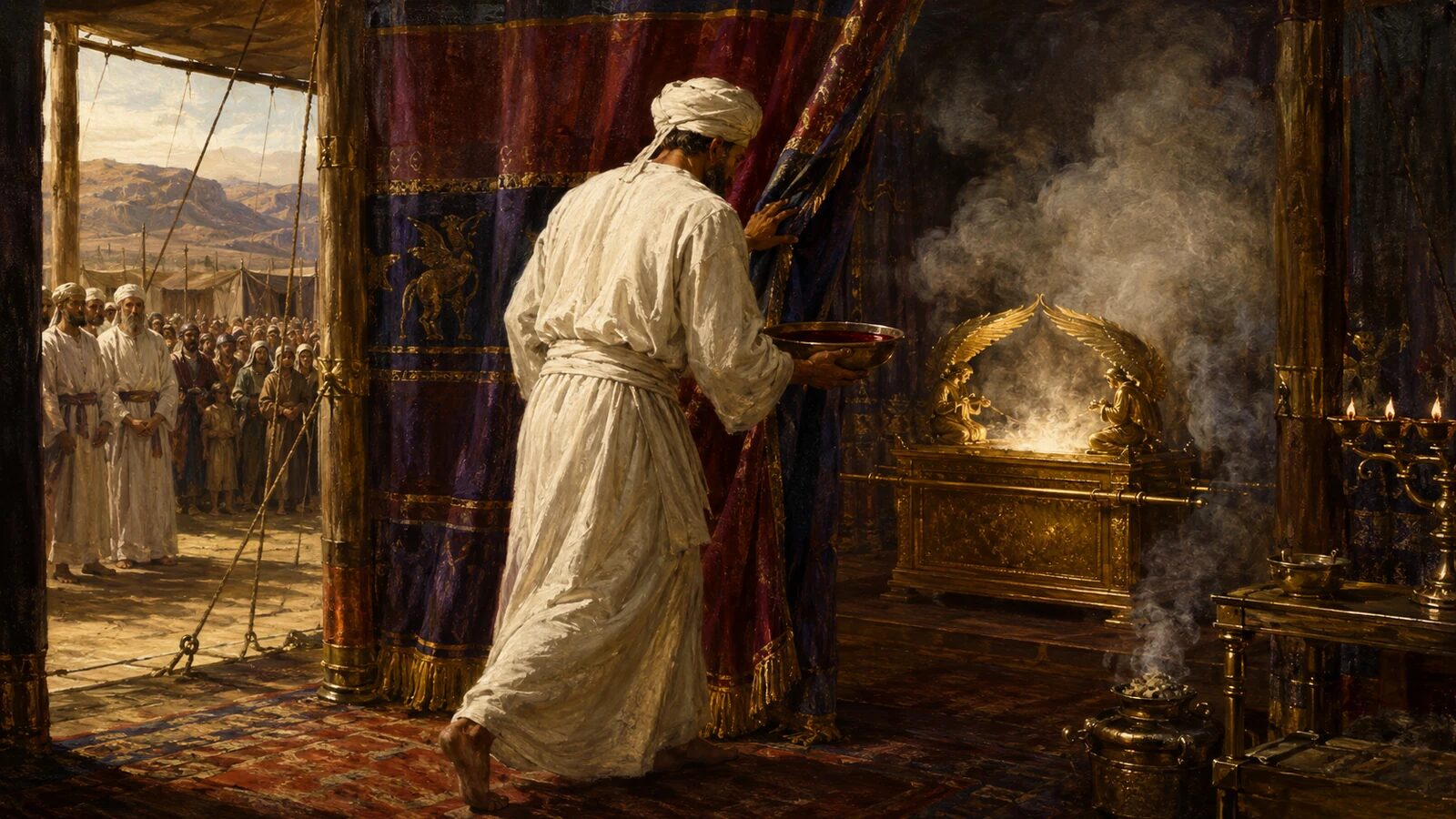
The high priest can seem like a figure from a world far removed from ours. Yet when I follow this office from Exodus into Hebrews, it explains why sinners cannot approach God on their own terms. It also shows how the old priesthood pointed toward Jesus, the only Mediator we need.
God Appointed the High Priest
Leviticus describes priests being set apart and clothed for service, then shows us their work at the altar. It explains the place of incense and blood in Israel’s worship, along with the veil that restricted access to God’s presence. Those details may seem distant from daily life, but I don’t want to dismiss what God was teaching through them. Sin is serious and His holiness is perfect. We can draw near only in the way He provides.
Israel had many priests, but one high priest at a time represented the whole nation. God appointed Aaron, Moses’ brother, as the first and set apart his sons to continue the priestly line. The other priests offered sacrifices and cared for the sanctuary, while the high priest alone could enter the Most Holy Place. Even he could enter only on the annual Day of Atonement, bringing the blood God required.
God assigned sanctuary service to Levi and chose Aaron’s family from within that tribe. Neither Aaron nor Moses invented this arrangement: Aaron did not seize the office, and Moses did not design it for him. The LORD appointed the priesthood, which makes clear from the beginning that sinners cannot create their own way into His presence.
And the LORD spoke to Moses, saying: “Take Aaron and his sons with him, and the garments, the anointing oil, a bull as the sin offering, two rams, and a basket of unleavened bread;”
Before Aaron could minister, God had supplied everything named in this command. He appointed the priest and provided what was needed to clothe and anoint him. He also specified the sacrifices and bread for Aaron’s consecration. I see the same provision carried forward in the gospel. God gives us both the Priest and the sacrifice in His Son, just as every part of Aaron’s approach began with His appointment.
Exodus uses the Hebrew verb qadash for hallowing the priests, meaning to set apart, hallow, or consecrate. Understanding that word helps us distinguish Aaron’s appointment from sinlessness. He was set apart for God’s service, but the sacrifices offered in that same ceremony showed that he still needed atonement.
“And this is what you shall do to them to hallow them for ministering to Me as priests: Take one young bull and two rams without blemish,”
The requirement for unblemished animals taught Israel that a polluted substitute could not deal with guilt. Sin deserves death, so the sacrifice God commanded had to be clean. These animals did not complete redemption, but they showed the seriousness of sin and the need for blood atonement. Aaron still needed that provision for himself, whereas Jesus is holy in Himself and entirely without sin.
Aaron’s family carried out a real and necessary ministry under the Mosaic Law, but it was not God’s final answer to sin. Paul explains in Hebrews that our great High Priest is Jesus Christ, the eternal Son of God. He became truly human without ceasing to be divine and remained sinless. His eternal priesthood follows the order of Melchizedek, so we should understand Him as more than an improved version of Aaron.
Instead of bringing an animal that could never perfect the conscience, Jesus offered Himself once for all. He entered the true heavenly sanctuary on the basis of His own blood and then sat down at God’s right hand. An Aaronic priest remained standing because another sacrifice would soon be needed. Christ sat down because no further sacrifice for sin remains.
The Tabernacle, the Garments, and Representation
Israel carried the tabernacle through the wilderness as a portable sanctuary. A worshiper could enter its outer court, but only priests served in the Holy Place, the first room. A heavy veil separated that room from the Most Holy Place within. As we follow that route, we can see access becoming more restricted toward the place of God’s special presence. The boundaries themselves taught Israel how to approach Him.
The veil did not mean God was cruel to His people. He had chosen to dwell among them, yet His nearness did not make sin harmless. They could not simply rush into His presence on their own terms.
The ark of the covenant stood behind the veil. It was a gold-covered chest that held the Testimony, including the covenant tablets given to Moses. The gold cover was called the mercy seat, and cherubim overshadowed it. God promised to meet with Israel’s representative there.
You shall put the mercy seat on top of the ark, and in the ark you shall put the Testimony that I will give you. And there I will meet with you, and I will speak with you from above the mercy seat, from between the two cherubim which are on the ark of the Testimony, about everything which I will give you in commandment to the children of Israel.
I need to understand the mercy seat and the veil together. The mercy seat showed God’s desire to dwell among His people and speak to them, while the veil showed the barrier sin created. His mercy did not cancel His holiness. He provided the atonement they needed to draw near.
Worship therefore involves more than feeling close to God. I cannot appeal to His kindness as a reason to ignore His holiness. Israel’s old covenant approach was genuine but temporary, and its boundaries taught that God determined the terms of access. The new covenant fulfills that access in Christ without making holiness any less serious.
Aaron’s garments showed that he entered the sanctuary on behalf of Israel, not simply as a private man. Their beauty and status were not their only purpose. God used them to explain the high priest’s responsibility to represent the nation before Him.
The garments expressed holiness and judgment as well as the beauty God appointed for worship. Their design directed attention to the ministry He had defined rather than to Aaron’s personality. The engraved names made that responsibility visible by identifying the people he represented.
The names of Israel’s tribes were engraved on two onyx stones attached to the shoulders of the priestly garment called the ephod.
“Then you shall take two onyx stones and engrave on them the names of the sons of Israel: six of their names on one stone and six names on the other stone, in order of their birth. With the work of an engraver in stone, like the engravings of a signet, you shall engrave the two stones with the names of the sons of Israel. You shall set them in settings of gold. And you shall put the two stones on the shoulders of the ephod as memorial stones for the sons of Israel. So Aaron shall bear their names before the LORD on his two shoulders as a memorial.”
Every tribe had a name on those stones, so Aaron bore a visible reminder of particular people rather than an anonymous crowd. He carried them before the LORD in the place God had commanded. The breastplate placed their names over his heart when he entered the holy place.
“So Aaron shall bear the names of the sons of Israel on the breastplate of judgment over his heart, when he goes into the holy place, as a memorial before the LORD continually.”
The shoulders suggest the weight of representing the people, while the heart shows personal care. But bearing their names into an earthly sanctuary could not enable Aaron to cleanse their consciences forever. Jesus represents His people through His finished work and perfect righteousness. His living intercession continues that care for them.
What encourages me is that Israel came before God by name through His appointed representative. Aaron could not save the tribes, but this picture helps me understand why Christ’s priestly care is neither distant nor anonymous. The One who opened the way knows the people who come through Him.
Blood and the Day of Atonement
The sacrificial system taught that sin deserves death. God did not tell Israel that sincerity or self-improvement could remove guilt. He gave blood on the altar to make atonement, a provision that required them to take sin seriously.
For the life of the flesh is in the blood, and I have given it to you upon the altar to make atonement for your souls; for it is the blood that makes atonement for the soul.
The words “I have given it to you” keep me from imagining Israel bribing God into mercy. He provided the blood atonement He required and accepted those sacrifices within their covenant setting. Yet animal blood could not finally remove sin, so the sacrifices directed Israel toward a greater provision.
The Hebrew verb kaphar can mean to cover or make atonement, but we need its setting in Leviticus to understand what that meant. God provided blood for guilt, with a substitute dying under His command because the life of the flesh was in the blood. He was not pretending that sin did not exist. That sacrificial setting helps us understand the language before we apply it to Christ’s greater atonement.
Leviticus 16 shows the high priest’s role most clearly on the Day of Atonement. It begins by recalling how Aaron’s sons Nadab and Abihu died after approaching the LORD in a way He had not commanded. Aaron could not enter the Most Holy Place whenever he wished either. He entered once a year on God’s exact terms, bringing sacrificial blood while incense formed a cloud over the mercy seat.
Aaron had to offer a sacrifice for himself and his household before acting for the nation, because he too was a sinner. He then took the people’s sin-offering blood behind the veil and sprinkled it as God commanded. The atonement included the sanctuary and altar as well as the priests and congregation. Even their worship needed cleansing from the uncleanness of a sinful people.
But into the second part the high priest went alone once a year, not without blood, which he offered for himself and for the people’s sins committed in ignorance;
Hebrews 9:7 brings those restrictions together. The high priest entered alone and only once a year, showing that the way into God’s presence had not yet been fully opened. He could not come without blood because sin required atonement, and he offered it for himself as well because the mediator also needed mercy.
Leviticus 16 describes two goats, one killed as a sin offering and the other sent into the wilderness. Together they pictured both atonement and removal. Sin had to be dealt with before God, and the goat sent away showed guilt being carried away from the people.
The Day of Atonement returned every year because those sacrifices had not perfected worshipers forever. If they had, there would have been no need to repeat them. I understand that repetition as part of God’s instruction, not a failure in it. The calendar itself reminded Israel that something better was still needed.
Christ’s blood was not poetic decoration. He physically bore the punishment for our sins in His innocent body. His suffering involved real torture and the shedding of His blood, and He truly died. The Father did not punish or curse Him, nor did He abandon Jesus. He did not strike or bruise Him or pour wrath on Him. Wicked men tortured and killed Jesus as He willingly gave Himself, and He rose bodily from the dead. The old sacrifices pointed toward Him, but His sacrifice obtained eternal redemption.
A fuller treatment of this subject appears in A Bible Study on Life Being in the Blood.
From Aaron to the Order of Melchizedek
The priesthood God appointed was holy, but its priests were still sinners. Death eventually removed them from office, so others had to take their place. In their earthly sanctuary they continued offering sacrifices that pointed toward cleansing without finally cleansing the conscience.
For the law, having a shadow of the good things to come, and not the very image of the things, can never with these same sacrifices, which they offer continually year by year, make those who approach perfect.
A shadow points to something real, and the Law’s priesthood taught Israel about the reality fulfilled in Christ. It was not meaningless ritual, but neither was it the fulfillment itself. I should not dismiss Leviticus as useless or return to its unfinished system as though Jesus’ sacrifice needed repeating. Christ is the substance to which it pointed.
No son of Aaron could stay in office forever, and no repeated offering brought final perfection. Christ answers both of those limitations. He lives forever, so no successor is needed, and His one offering will never need to be repeated.
Jesus did not come from Aaron’s line. He came from the tribe of Judah, and His priesthood belongs to a higher order announced in Psalm 110.
The LORD has sworn And will not relent, “You are a priest forever According to the order of Melchizedek.”
In Genesis 14, Melchizedek met Abram after the rescue of Lot. He was both priest of God Most High and king of Salem, later known as Jerusalem. He brought bread and wine, blessed Abram and received a tenth from him. Paul uses this encounter in Hebrews to show why Melchizedek’s priesthood is greater than Levi’s. In that covenant argument, Abraham represented Levi, his descendant, when he gave the tenth. The lesser person also received the blessing from the greater.
I understand Melchizedek as a Christophany, an appearance of Christ before He became human. Hebrews calls him king of righteousness and king of peace, while Scripture supplies no father or mother and no genealogy. It records neither the beginning of his days nor the end of his life, and says he was made like the Son of God. Those details lead me to the Christophany reading and to Christ’s eternal priesthood. They give us more to consider than an unusual figure whose identity simply excites curiosity. The evidence is examined more fully in A Complete Bible Study on Melchizedek.
For the priesthood being changed, of necessity there is also a change of the law.
Changing the priesthood also changes the law governing that office. We therefore cannot continue the Levitical system under new names. We come through the Priest God appointed forever. Death required many priests in Aaron’s order, but Jesus’ life never ends and His priesthood cannot change.
Aaron’s office passed through a family line and served an earthly sanctuary, with work repeated under the Mosaic Law. Christ’s priesthood is eternal and cannot pass to someone else. He fulfills what Aaron’s order anticipated rather than temporarily joining it, so we cannot blend the two orders together.
Jesus Christ, Our Great High Priest
Paul calls their High Priest “great” as he urges believers to hold fast. Jesus is greater than Aaron and his earthly sanctuary, and greater than every repeated sacrifice or human mediator. The first readers of Hebrews faced pressure to draw back. Paul directed them to the Priest who had already passed through the heavens, giving them a reason to hold fast beyond their own courage.
Seeing then that we have a great High Priest who has passed through the heavens, Jesus the Son of God, let us hold fast our confession.
An earthly high priest crossed a veil into a room made by human hands. Jesus passed through the heavens into God’s true presence. He can represent us and bring us to God because He is both truly human and truly divine: Jesus, the Son of God.
For there is one God and one Mediator between God and men, the Man Christ Jesus,
If my conscience is troubled, I need to remember that there is one Mediator. My access to God is not partly Christ’s work and partly my recent spiritual performance. I come entirely through Him, with no contribution from my own record.
Jesus can also sympathize with weakness. His sinlessness does not make Him cold or distant; it makes Him qualified to save. A fellow sinner cannot rescue sinners from sin, but the sinless Savior can.
For we do not have a High Priest who cannot sympathize with our weaknesses, but was in all points tempted as we are, yet without sin.
That sympathy leads to a direct invitation:
Let us therefore come boldly to the throne of grace, that we may obtain mercy and find grace to help in time of need.
Christ has opened the way, so we can come boldly without approaching God irreverently. Our confidence rests in the Priest He provided. Through Him we find mercy when we fail and grace when we are weak.
At the death of Jesus, the veil in the Jerusalem temple was torn from top to bottom. That direction shows that humanity did not climb into God’s presence or tear the boundary open from below. God opened the way through the death of His Son.
Then, behold, the veil of the temple was torn in two from top to bottom; and the earth quaked, and the rocks were split,
Hebrews explains that believers now have boldness to enter the Holiest by the blood of Jesus through a new and living way.
Therefore, brethren, having boldness to enter the Holiest by the blood of Jesus, by a new and living way which He consecrated for us, through the veil, that is, His flesh,
Hebrews calls this way new because Christ fulfilled the old order, and living because He rose from the dead. It identifies the veil with His flesh because He truly gave His body. His blood opens the way to God through an actual atonement, not merely an idea: Jesus died for sinners and rose again.
Paul therefore tells believers to draw near with full assurance of faith.
let us draw near with a true heart in full assurance of faith, having our hearts sprinkled from an evil conscience and our bodies washed with pure water.
I can have full assurance by taking God at His word about His Son without becoming proud. If I measure access to God by how well I behaved this week, I am looking away from the blood to which Hebrews directs my conscience. Jesus opened the veil by finishing His work. I do not have to reach a better spiritual mood before His provision is sufficient.
His Intercession and the Believer’s Priesthood
Christ’s sacrifice is finished, while His priestly care continues. He is able to save to the uttermost because He always lives to represent those who come to God through Him.
Therefore He is also able to save to the uttermost those who come to God through Him, since He always lives to make intercession for them.
Christ’s intercession is His continuing representation of His people on the basis of a completed sacrifice. He is not trying to persuade an unwilling Father to be kind. The Father sent Him, the Son willingly gave Himself, and the Holy Spirit applies that finished work. Their united purpose runs through the whole of salvation.
John describes this help through the related word Advocate. A believer who sins must face what happened, but need not hide in despair. Jesus Christ the righteous is his Advocate with the Father.
My little children, these things I write to you, so that you may not sin. And if anyone sins, we have an Advocate with the Father, Jesus Christ the righteous. And He Himself is the propitiation for our sins.
John wants believers to take sin seriously, but he does not tell them Christ must be offered again whenever they fail. Their righteous Advocate has already offered the sacrifice that is the propitiation for their sins. Propitiation means that His sacrifice satisfies God’s righteous judgment against sin. God deals with evil, and Jesus does not have to suffer repeatedly.
The rest of 1 John 2:2 makes clear that Christ’s provision is for the whole world. Jesus died for every person, and God genuinely offers salvation even though people can resist and finally reject Him. Those who repent and believe receive forgiveness and new birth. The Holy Spirit comes to live in them and seals them for the day of redemption. Christ saves every genuine believer to the uttermost, so that believer is eternally secure. This security permits no lawlessness, and a shallow profession without new life cannot prove that someone belongs to Him.
A fuller examination of salvation appears in Soteriology: The Study of Salvation.
The New Testament calls believers a holy priesthood. Having received mercy, they now offer worship and praise through Jesus Christ. Their prayers and daily obedience also come through Him. They do not offer sacrifices for sin, because His sin offering is finished.
you also, as living stones, are being built up a spiritual house, a holy priesthood, to offer up spiritual sacrifices acceptable to God through Jesus Christ.
I need to keep the words “through Jesus Christ” attached to everything said about our priesthood. We have no independent access based on personal worthiness. Christ brought us near and cleansed us, which is why we can come to God and serve Him.
Our spiritual sacrifices respond to mercy; they do not pay for guilt. We praise and pray through Christ, and our daily obedience comes through Him too. Service and generosity please God when offered through the Mediator who has already made us acceptable. None of those acts adds anything to His sin offering.
No earthly priest or pastor can repeat Christ’s sacrifice or become another mediator for sin, and no church or ritual can complete His atonement. Leaders serve by teaching and shepherding God’s people, and rightly pray for those in their care. Baptism is a precious act of obedience, while communion keeps Christ’s sacrifice before the church in remembrance. Neither repeats the cross, where Jesus offered Himself once for all.
The boundaries and sacrifices in Leviticus should teach me reverence rather than leave me bored with ceremony. Worship cannot be whatever self-expression I prefer. Yet Hebrews also gives everyone in Christ confidence to confess sin honestly and seek mercy. We need not remain outside the veil in fear.
The priestly garments and washings show how seriously God treats holiness. Our bold access should carry that same reverence, because opening the way for guilty people cost the blood of His Son. Confidence in Christ does not make approaching God a careless act.
Leviticus 17:11 says God gave blood on the altar for atonement, and Hebrews says Christ obtained eternal redemption through His own blood. Jesus did more than leave us an example of love. He truly bore our sins and gave His life, which calls for gratitude beyond vague religious admiration.
I do not have to deny failure in order to come confidently to the throne of grace. I come because I need mercy and help. Recent obedience did not open that way for me, and recent failure cannot close what Christ opened through His finished sacrifice.
Faithful ministry directs people to Jesus rather than claiming any part of His place as Mediator. Understanding the high priest’s role helps us recognize that distinction. No earthly priest or religious institution can do what Christ has already accomplished, and our worship responds to His completed offering instead of paying toward our guilt.
Christ has already brought us near, so our service responds to His work rather than helping finish it. Praise and prayer add nothing to atonement, and neither do generosity and obedience. Our guilt has been addressed and our Mediator lives forever. That gives us reason to worship through the whole of a grateful life.
My Final Thoughts
I can read about the high priest in Leviticus as a God-given lesson fulfilled in Jesus, just as Hebrews explains. Aaron bore Israel’s names and entered an earthly sanctuary with blood, yet he remained a sinner whose service needed repeating. Jesus is the sinless, eternal High Priest who offered Himself once for all and opened the way into God’s presence. I can draw near with reverence and confidence because my access rests on His blood rather than my recent performance. I need no additional mediator, and there is no unfinished sacrifice left for us to complete.