
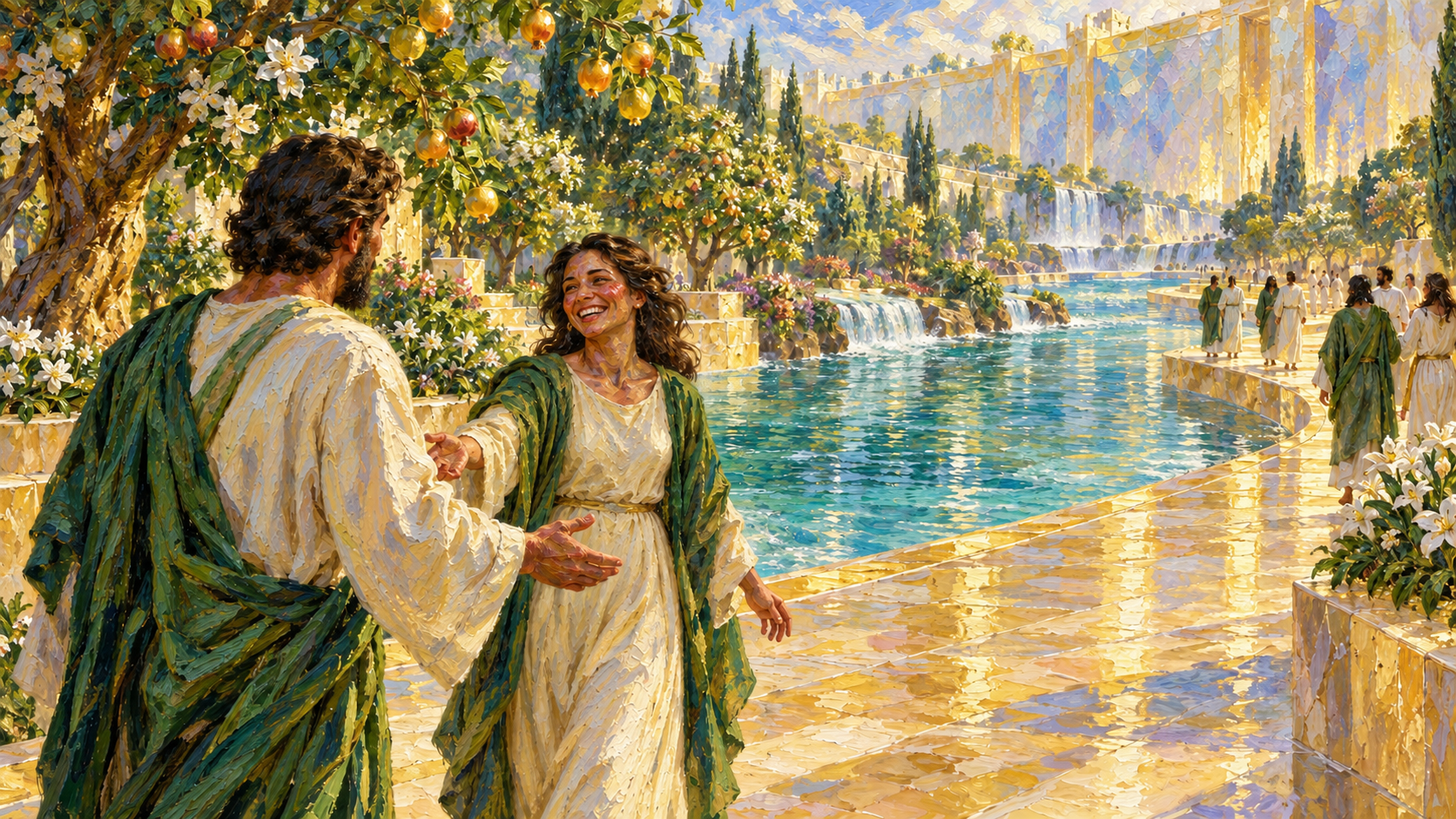
What exactly is the Heavenly Jerusalem, and when does it become the home of God’s people? Revelation describes a real city that comes down from God to the new earth. To understand that promise, we need to look back through Abraham and the tabernacle, all the way to Eden. The hope we find is more than a beautiful place to live: God will dwell with His redeemed people forever.
The City God Has Prepared
Long before John saw the New Jerusalem in Revelation, Abraham lived in tents while looking for a city that God Himself would build. He had received a promise about land, yet his hope reached beyond a temporary home and even beyond death. Hebrews connects his faith with resurrection and a better country because Abraham trusted the God who could fulfill every part of His promise.
For he waited for the city which has foundations, whose builder and maker is God.
But you have come to Mount Zion and to the city of the living God, the heavenly Jerusalem, to an innumerable company of angels.
Hebrews 12 speaks of believers as already having come to the heavenly Jerusalem. I do not believe that means the city has already descended to the new earth. Through Christ, we already belong to the heavenly assembly and have access to the God who prepared it. The city is therefore part of our inheritance and hope even while we wait for its future descent.
I notice that the city comes from heaven but has its final home on the new earth. Revelation shows it coming down from God to the new creation. We are not being promised an endless disembodied existence far away from creation. Scripture gives us the hope of bodily resurrection so that we can live with God in the new creation He has prepared.
Then I, John, saw the holy city, New Jerusalem, coming down out of heaven from God, prepared as a bride adorned for her husband.
And I heard a loud voice from heaven saying, “Behold, the tabernacle of God is with men, and He will dwell with them, and they shall be His people. God Himself will be with them and be their God.”
The city comes down as God’s prepared gift, rather than through humanity building a way up to Him. Its beauty is compared to a bride, which shows us the glory and purity of the redeemed. I don’t see a reason to make the city unreal because John uses that picture. He describes its gates and foundations and tells us that an angel measured it. He also sees its street and the river flowing from the throne beside the tree of life. We can recognize both the dwelling prepared for God’s people and the picture of those people in the glory He has prepared for them.
The voice from heaven tells us what all of this means for God’s people: He will dwell with them, and His tabernacle will be with humanity. Eden began with unbroken fellowship between God and man. Sin brought death and the curse, and humanity was exiled with access to the tree of life now guarded. Later, Israel’s tabernacle and temple provided a real but veiled pattern of God dwelling among His people. In the New Jerusalem, that promise reaches its fulfillment as the redeemed live in His presence with nothing to separate them from Him again.
A Measured City With Named Gates and Foundations
John describes an angel measuring the New Jerusalem with a reed, giving us dimensions for an actual city rather than a mood or a cloud of light. Its length, breadth, and height are equal at twelve thousand furlongs each. A furlong was an ancient measure of distance, and these dimensions are far beyond anything in ordinary human experience. The angel also measured the wall at one hundred forty-four cubits.
The city is laid out as a square; its length is as great as its breadth. And he measured the city with the reed: twelve thousand furlongs. Its length, breadth, and height are equal.
Then he measured its wall: one hundred and forty-four cubits, according to the measure of a man, that is, of an angel.
I don’t need to turn those measurements into an engineering chart to understand that God’s final dwelling is real and immense. The order John describes shows a completed city that God deliberately prepared. Twelve appears throughout the design, with twelve gates and twelve foundations, while one hundred forty-four is twelve times twelve. These details give us reason to trust that God will faithfully finish what He began.
Also she had a great and high wall with twelve gates, and twelve angels at the gates, and names written on them, which are the names of the twelve tribes of the children of Israel.
Now the wall of the city had twelve foundations, and on them were the names of the twelve apostles of the Lamb.
Notice whose names God places on the city. Israel’s tribes are named on the twelve gates, and the Lamb’s apostles are named on the twelve foundations. Neither group disappears into the other. God’s promises have their place in this city, as do the coming of the Messiah through Israel and the apostolic witness to Him. I see one coherent work of redemption under the glory of God and the Lamb, with each group retaining its place.
The measured walls and named foundations also keep the city from becoming a symbol that means whatever a reader wants it to mean. Revelation certainly uses pictures rich with meaning, but John is describing a future God has ordered. The wall, gates, and foundations belong together as parts of a prepared dwelling. I cannot tell you how every measurement will appear in the new creation, yet I believe the reality will be no less solid or glorious than the vision God gave John.
God’s Dwelling Without a Temple
The shape of the city takes us back to the tabernacle and temple. God told Moses to build a sanctuary because He desired to dwell among His people. Hebrews later explains that the priests served in a copy and shadow of heavenly things. The earthly sanctuary was real, but Moses had to make it according to the pattern God showed him because it pointed beyond itself.
And let them make Me a sanctuary, that I may dwell among them.
Who serve the copy and shadow of the heavenly things, as Moses was divinely instructed when he was about to make the tabernacle. For He said, “See that you make all things according to the pattern shown you on the mountain.”
We can see the connection in the shape of the Most Holy Place. When we compare the tabernacle’s dimensions, we find that its inner sanctuary had the form of a cube. Scripture is explicit about Solomon’s inner sanctuary: it was twenty cubits long, and its width and height were the same. Revelation describes the New Jerusalem with equal length, breadth, and height as well. The shape associated with the place of God’s immediate presence now describes the entire city.
The inner sanctuary was twenty cubits long, twenty cubits wide, and twenty cubits high. He overlaid it with pure gold, and overlaid the altar of cedar.
But I saw no temple in it, for the Lord God Almighty and the Lamb are its temple.
When John says he saw no temple, I don’t understand him to mean that something was missing. Under the old covenant, boundaries and a veil restricted access to the sanctuary, where priests served and sacrifice was required. In the New Jerusalem, the Lord God Almighty and the Lamb are the temple. The Lamb who shed His blood to redeem His people is present with them, and every redeemed servant lives in the holiness of God’s unveiled presence.
God’s glory also supplies the city’s light, so the sun and moon are not needed to illuminate it. I would not take that wording further and insist that the sun and moon can never exist in any sense. John tells us what lights the city: the Lamb Himself. His glory needs no created light to supplement it.
The city had no need of the sun or of the moon to shine in it, for the glory of God illuminated it. The Lamb is its light.
The sun shall no longer be your light by day, Nor for brightness shall the moon give light to you; But the LORD will be to you an everlasting light, And your God your glory.
Isaiah had already promised that the LORD would be an everlasting light. Revelation shows that promise fulfilled where God and the Lamb share the city’s throne and glory. We should recognize what that says about Jesus Christ: He is no created lamp added to God’s city. He is the crucified and risen Son whose divine glory lights the eternal home of the redeemed. His servants will worship before the throne and serve Him without sin or fear, rather than spend eternity in vague idleness.
The New Creation and the End of the Curse
To understand when the city descends, I need to follow the sequence John gives us. Revelation 20 describes the final rebellion and Satan’s defeat, followed by the Great White Throne and the judgment of the wicked in the Lake of Fire. Revelation 21 then opens with the new creation, after the first heaven and earth have passed away. This places the New Jerusalem in the eternal state after final judgment.
Now I saw a new heaven and a new earth, for the first heaven and the first earth had passed away. Also there was no more sea.
Nevertheless we, according to His promise, look for new heavens and a new earth in which righteousness dwells.
Peter describes a new creation where righteousness dwells, not a repaired version of this age with evil waiting to emerge again. God has judged evil and made all things new, so neither death nor the curse will return. I find hope in that permanence when I consider a world where wickedness can seem strong and righteousness is often mocked. The new earth will be the settled home of righteousness, secure because God Himself keeps it that way.
That sequence also distinguishes the eternal state from Christ’s millennial reign. The millennium is a real reign on earth that is still future, while Revelation 21 and 22 describe what follows the events of Revelation 20. The New Jerusalem does not replace the promised kingdom or make its promises unnecessary. Christ first reigns as promised, and after the final rebellion is put down, the wicked stand before the Great White Throne. Only then does the new creation appear. God keeps His promises in their proper order as He brings His whole work to its final glory.
Revelation 22 deliberately takes us back to the beginning of the Bible. In Genesis, God gave life in a garden where a river flowed and the tree of life stood. Humanity enjoyed fellowship with Him until sin brought death and the curse. Exiled from the garden, people could no longer approach the tree. Now John shows us the river of life flowing from the throne in the holy city, with the tree of life there again and the curse gone.
And he showed me a pure river of water of life, clear as crystal, proceeding from the throne of God and of the Lamb.
In the middle of its street, and on either side of the river, was the tree of life, which bore twelve fruits, each tree yielding its fruit every month. The leaves of the tree were for the healing of the nations.
And there shall be no more curse, but the throne of God and of the Lamb shall be in it, and His servants shall serve Him.
The tree is more than a decorative reminder of Eden. To me, it shows that God restores and even surpasses what sin ruined. The nations are healed, and God’s servants see His face with His name upon them. No more curse means there is no death, sorrow, crying, or pain. The devil and the wicked have already been judged, so the redeemed do not live under the threat of another fall. They belong to God and reign with Him forever.
I’m especially drawn to the promise that God’s servants will see His face and bear His name. They will have more than a perfect environment: they will enjoy secure fellowship with God Himself. They will serve without fear, with no weakness to frustrate their service and no temptation to corrupt it. The river and tree show the abundant life He provides, with the throne of God and of the Lamb at its center. God restores His people to fellowship with Himself rather than repairing the effects of sin while remaining distant from them.
Who Enters the City, and How Should We Live?
As beautiful as the city is, Revelation does not say that everyone will finally be saved and enter it. Nothing that defiles can come in. Its citizens are those whose names are written in the Lamb’s Book of Life, so we need to understand the promise together with that limit on who enters.
But there shall by no means enter it anything that defiles, or causes an abomination or a lie, but only those who are written in the Lamb’s Book of Life.
The Book of Life belongs to the Lamb, so our hope of entering the city rests in Him. Religious effort cannot earn a place there, nor can family ancestry or a good reputation secure it. Even admiring heaven does not save a person. Jesus Christ is the eternal Son of God who shed His blood and died for our sins. He rose bodily from the dead and gives eternal life to those who repent and believe. The people who enter are there because He has redeemed them.
Jesus promised in John 14 that He would prepare a dwelling and personally receive His people, which fits the hope we find here. I don’t need to match every detail of the Father’s house to every measurement in Revelation 21 to see their agreement. Christ prepares a place for those who belong to Him and will come again to receive them, so that they may be with Him.
In My Father’s house are many mansions; if it were not so, I would have told you. I go to prepare a place for you.
And if I go and prepare a place for you, I will come again and receive you to Myself; that where I am, there you may be also.
The coming city is also meant to shape the way we live now. Abraham lived as a pilgrim because he looked for what God would build. We still live in a world marked by sin, confusion, grief, and death, yet our citizenship is in heaven. We wait for Jesus Christ, who will transform the believer’s lowly body to be like His glorious body.
For our citizenship is in heaven, from which we also eagerly wait for the Savior, the Lord Jesus Christ.
Peter connects the coming judgment and new creation with holy conduct, so this hope gives us reason to obey God now. If the present world will pass away, why would I build my life around what cannot last? The promised city should help me hold possessions more loosely and endure suffering without surrendering hope. It also gives us reason to resist the sin that has no place in God’s future. Above all, our worship belongs to the Lamb who will be the city’s light.
Our future includes a real place where redeemed people will live, rather than a thin or ghostly existence. God’s servants will worship and serve Him in bodies raised to glory, surrounded by beauty and settled righteousness. We long to see justice and healing because this world has known so much wrong and pain. Our desire for purity and lasting peace will find its answer in the God who makes all things new. Readers who want to follow these connections further may also study Heaven, the Tree of Life, the Last Day and the First Resurrection, the Blessed Hope, and the Kingdom of Heaven and the Kingdom of God.
My Final Thoughts
When I follow this promise from Abraham through the sanctuary and into Revelation, I see a future far richer than simply escaping the present world. God will bring His city down to a new creation where the Lamb is the light, the curse is gone, and every redeemed servant lives before His face. Only those written in the Lamb’s Book of Life enter, so this beautiful hope keeps bringing us back to Jesus Christ and the redemption He purchased. Until the city comes, we can endure as pilgrims and live like citizens of heaven because the God who designed our eternal home will keep every promise.