
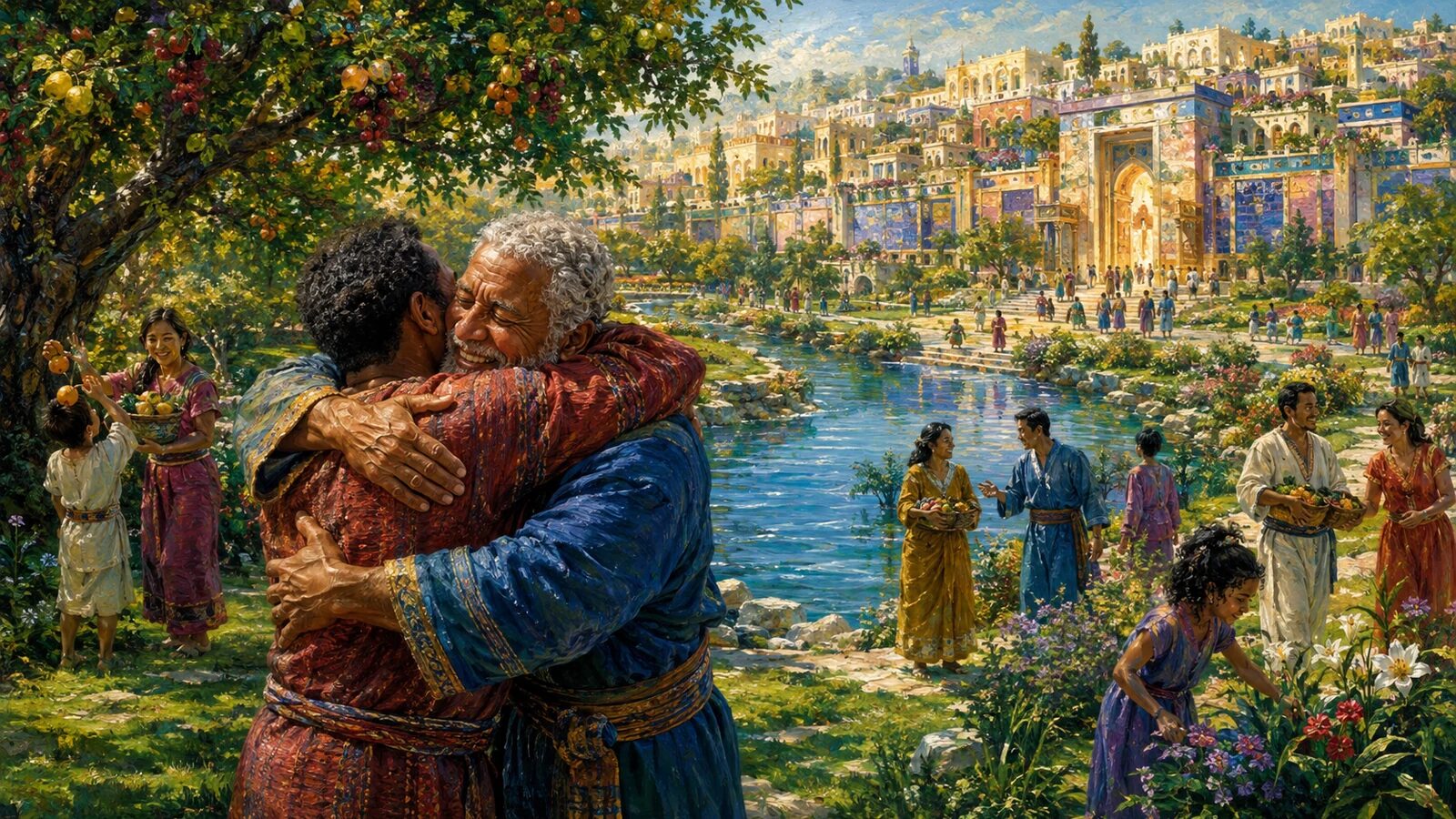
The Bible gives Christians good reason to face death with hope, but it never asks us to pretend that losing someone is painless. A believer who dies is with Christ. That person also awaits bodily resurrection, and God’s promise reaches beyond the present heaven to a new creation where He will dwell with His people. If I am going to offer comfort, I want to explain what He has actually promised.
What Heaven Means
We use the word heaven in several ways, and Scripture does too. It can describe the sky, the wider created heavens, or the realm of God’s throne and manifested presence. We have to read the surrounding words to know which meaning fits. Genesis gives us a straightforward example:
Then God said, “Let the waters abound with an abundance of living creatures, and let birds fly above the earth across the face of the firmament of the heavens.”
The birds are flying above the earth, so heaven here means the sky. The Hebrew word shamayim is plural in form and can carry the different senses just mentioned. We would misunderstand Genesis if we pictured the birds flying through Paradise. Likewise, we would misunderstand a passage about God’s heavenly throne if we assumed it referred only to the sky.
Genesis also uses raqia, translated firmament or expanse, for the ordered spread above the earth. Birds fly across the face of it, and God placed the lights that mark days and seasons in the heavens. I read this as a description of God’s ordered creation from the perspective of people beneath the sky, not a requirement to picture a solid dome over the earth.
The sun, moon, and stars also belong to the created heavens. Psalm 19 tells us what their splendor should lead us to recognize:
The heavens declare the glory of God; And the firmament shows His handiwork.
They testify to their Maker without possessing any deity of their own. Worshiping creation is wrong, but so is despising it as though God made a mistake by giving us a physical world. He made it good. Sin has corrupted His work, yet the promise of a new earth shows that His answer is not to discard everything physical forever.
God’s Throne and Presence
When Christians say someone is in heaven, they usually mean the realm of God’s throne and presence. God truly reveals His presence there, although He is not confined to that place:
Thus says the LORD: “Heaven is My throne, And earth is My footstool. Where is the house that you will build Me? And where is the place of My rest?”
God was not asking Israel to build a larger house. Solomon had already acknowledged at the temple’s dedication that even heaven and the heaven of heavens could not contain the Lord. His presence in the sanctuary did not restrict Him to its walls. In the same way, His heavenly throne expresses His rule over creation, not a boundary beyond which He cannot go.
Paul described being caught up to the third heaven:
such a one was caught up to the third heaven.
Readers have often understood this by distinguishing the sky, the starry heavens, and the realm of God’s manifested presence. Paul also calls it Paradise. He heard words he was not permitted to repeat, and he did not even claim to know whether the experience occurred in or out of his body. God knew. Paul’s testimony assures us that Paradise is real, but it supplies no detailed arrangement of heavenly realms. We should not turn the expression third heaven into more information than he gives us.
Jesus spoke more personally about the future of His disciples. On the night before His crucifixion, they faced His departure, and Peter had just been told he would deny Him. Jesus directed their troubled hearts toward the Father and promised that He would prepare a place for them:
And if I go and prepare a place for you, I will come again and receive you to Myself; that where I am, there you may be also.
His departure would not leave them abandoned. Jesus was taking responsibility for their future with Him, including preparing a place and returning to receive them. When I speak about heaven, I do not want questions about the surroundings to overshadow the Savior who has promised to bring His people there.
With Christ After Death
Paul explains what happens to a believer who dies before the Lord returns:
We are confident, yes, well pleased rather to be absent from the body and to be present with the Lord.
Being absent from the body means being present with the Lord. I understand this as conscious fellowship with Christ, not soul sleep or unconscious nonexistence. In Philippians, Paul weighed continuing his ministry against his desire to depart:
For I am hard-pressed between the two, having a desire to depart and be with Christ, which is far better.
Paul expected to be with Christ and called that far better. Death itself remains an enemy that entered through sin, so there is nothing faithless about missing someone we love. I would not reprimand a grieving believer as though tears contradicted his hope. When the person who died belonged to Christ, we can affirm that he is with the Savior without minimizing the pain of that separation.
Being with Christ after death does not mean that the body has already received everything God promised. Jesus Himself rose bodily from the tomb. He did not survive merely as an inspiring memory or as a spirit whose body remained dead:
But now Christ is risen from the dead, and has become the firstfruits of those who have fallen asleep.
Firstfruits refers to the beginning of a harvest, with more to follow. Christ’s resurrection guarantees that His people will be raised too. In 1 Corinthians 15:52, Paul says the dead will be raised incorruptible. Our bodies are not prisons we must escape forever; Christ will raise and transform them.
Paul connects that bodily hope with our citizenship in heaven:
For our citizenship is in heaven, from which we also eagerly wait for the Savior, the Lord Jesus Christ.
The next verse says the Savior will transform our lowly body to conform to His glorious body. We will remain human, with bodies made fit for everlasting life. Heaven’s promise therefore directs us toward the Lord who will come from there and complete what He has promised for us.
When we comfort someone who grieves, we do not have to choose between saying that a departed believer is with Christ now and saying that believer will be raised later. Both are true. Death has not separated him from the Savior, and it will not keep his body forever.
New Heavens and New Earth
I understand Scripture to teach that Christ will gather His church before the seven-year Tribulation. The dead in Christ will rise, and living believers will be caught up with them to meet the Lord. After the Tribulation, Jesus will return bodily to earth and reign for a literal thousand years. Revelation 20 places the final rebellion and Great White Throne judgment after that reign. The new heaven and new earth follow as the everlasting state:
Now I saw a new heaven and a new earth, for the first heaven and the first earth had passed away. Also there was no more sea.
God brings the old order to an end. John is not describing this present age gradually becoming a little better through religion or human progress. Death and the curse will no longer corrupt the world His people inhabit.
The Greek word kainos can describe what is new in quality or kind. That fits the difference between a world afflicted by sin and one free from it. The word alone does not tell us exactly how every feature of the new creation relates to what exists now. John does not describe all its geography or every detail of daily life, but he leaves no doubt that God will remove what has ruined His creation.
John then sees the holy city coming down from God:
Then I, John, saw the holy city, New Jerusalem, coming down out of heaven from God, prepared as a bride adorned for her husband.
God will dwell with His people in the world He has made new. In Eden He placed humanity in a good world in fellowship with Him, but sin brought shame, death, and exile. Later, He provided for His presence among His people through the tabernacle and temple. The sacrifices and priestly cleansing taught them that approaching Him required dealing with sin.
The Word became flesh in Jesus Christ and dwelt among us, and the Spirit now indwells the church. In the final state, death and the curse will no longer interfere with God’s dwelling among His people:
And I heard a loud voice from heaven saying, “Behold, the tabernacle of God is with men, and He will dwell with them, and they shall be His people.”
John records gates, foundations, and measurements, along with nations walking in the city’s light. A river flows from the throne of God and the Lamb, and the tree of life is there. I understand New Jerusalem to be a real city; the symbolic significance of some details does not make the place itself imaginary.
Paul writes in Hebrews 11:10 that Abraham waited for the city whose builder and maker is God. Abraham lived in tents in Canaan while trusting God’s promise of a permanent dwelling beyond what he could see. Revelation describes the fulfillment of that hope in the city God brings down from heaven.
The city has no temple because the Lord God Almighty and the Lamb are its temple. The earthly sanctuary taught sinners to approach God by His appointed way. In New Jerusalem, the redeemed will live in His direct and holy presence. The Lamb who shed His blood for them is their light, and nothing defiling will return to threaten their fellowship.
Peter describes the character of this promised world:
Nevertheless we, according to His promise, look for new heavens and a new earth in which righteousness dwells.
Peter connects that promise with the kind of people we ought to be now. If I claim to long for a world where righteousness dwells, I should not be indifferent to the sin I am excusing here. The future God promises gives me reason to obey Him today, rather than daydream about another world while neglecting my responsibilities in this one.
Who Enters the City
The holiness of New Jerusalem also prevents us from promising this future to everyone regardless of Christ:
But there shall by no means enter it anything that defiles, or causes an abomination or a lie, but only those who are written in the Lamb’s Book of Life.
I understand Scripture to teach that every person begins written in the Book of Life. Those who finally reject the Messiah are blotted out. Believers remain because their sins have been blotted out through His blood. Belonging to the right institution cannot provide that cleansing, nor can enough good deeds compensate for our guilt. We come to God through Jesus Christ.
Jesus is the eternal Son, fully God and fully man, born of a virgin and completely sinless. Wicked men subjected Him to torture and crucifixion. He willingly bore that real physical punishment for our sins in His innocent body. The Father did not punish, curse, abandon, strike, bruise, or pour wrath on Jesus. His saving work through His shed blood and death was complete before He was buried and rose bodily.
Christ died for the whole world, so the offer of salvation is genuine for every person, though people can resist and reject it. Whoever repents and believes in Him is forgiven and justified, meaning declared righteous before God. He is also genuinely born again as a new creation, indwelt and sealed by the Holy Spirit.
That believer is eternally secure because his salvation rests on Christ’s finished work and preserving power. It does not depend on his ability to keep himself saved. This gives no permission for lawlessness. New life should produce growing obedience, even though believers still stumble and need correction. Repeating religious words cannot establish that I have trusted Christ while I continue to reject Him.
Revelation 20 also describes the dead standing before God as the books are opened. Anyone no longer found in the Book of Life is cast into the Lake of Fire, which is the second death. Human souls are not inherently immortal; eternal life is God’s gift in Christ. Unbelieving humanity faces the irreversible destruction of body and soul. I do not understand Scripture to teach either universal salvation or endless conscious torment for human beings. Revelation 20:10 gives the distinct statement of endless torment for the devil with the beast and false prophet.
I should not speak about those facing judgment as though their future were merely an interesting theological question. These are people who need the gospel. Christ died for them and calls them to repent and believe while there is time to respond. We have no grounds to promise salvation apart from Him, and no reason to treat someone hearing His invitation as beyond the reach of His mercy.
Life in the World to Come
For those who belong to the Lamb, life will continue without the sorrow and death that afflict us now. Pain and crying will pass away, and there will be no curse:
And there shall be no more curse, but the throne of God and of the Lamb shall be in it, and His servants shall serve Him.
Eternity will not be endless idleness, and serving God will no longer be frustrated by pride, selfish ambition, corruption, or death. Human work belonged to His good creation before sin entered. Service also belongs to redeemed life, although John does not tell us the exact responsibilities each person will have.
John also describes how closely God’s servants will know Him:
They shall see His face, and His name shall be on their foreheads.
We now walk by faith and love the Savior we have not seen. In the city, we will see His face without sin and exile hindering our fellowship. We will not become divine or lose the distinction between Creator and creature. We will belong to Him without fear that death or defilement could separate us again.
This hope should also affect how we think about work that seems to accomplish little now. At the end of the resurrection chapter, Paul writes:
Therefore, my beloved brethren, be steadfast, immovable, always abounding in the work of the Lord, knowing that your labor is not in vain in the Lord.
If Christ will raise His people, death cannot make faithful labor in Him worthless. I may not see the result I hoped for, and obedience can be costly, but the immediate result is not the whole measure of that work. I can keep loving people and doing what God requires without demanding that this life provide every reward. His earthly gifts can be received with gratitude, while our lasting inheritance remains secure in Christ.
My Final Thoughts
I want the hope of heaven to shape more than the words I use at a funeral. The believer who dies is with Christ, and the Savior will raise His people bodily. He will bring us into the new creation where God dwells with His people and death is gone. These promises are secure because Jesus shed His blood for sinners, rose bodily, and will receive His own to Himself. We have reason to grieve with hope and to keep serving Him while we wait.