
God named Isaac before he was born and later preserved his life on Moriah. Yet much of Isaac’s life was spent facing the ordinary pressures of a household, where we see both his faithfulness and his weakness. I want to understand how God carried His covenant through this man, because His promise did not depend on Isaac having a dramatic personality or a flawless home.
Isaac and the Covenant Promise
Isaac’s life had fewer sudden turns than the lives of Abraham and Jacob, but that does not make him less important to the account in Genesis. He was the promised son through whom the covenant continued. In keeping His word to Isaac, God showed that His promise would continue beyond Abraham’s lifetime.
Genesis follows Isaac from the promise before his birth to the blessing of his sons and his burial by Esau and Jacob. Between those events, God spared him on Moriah and provided Rebekah as his wife. Marriage brought a long wait for children, and later their household was fractured by favoritism and deception. Isaac also faced famine and gave in to fear. Conflict over the wells his family needed brought further pressure. Hebrews returns to Moriah to explain how Abraham trusted God’s promise when Isaac was on the altar.
The Lord identified Himself as the God of Abraham, then included Isaac before Jacob in that same covenant confession. Isaac belonged in that line because God placed him there. I don’t want to hurry past him on the way from Abraham to Jacob, as though the promise were waiting to resume. God kept His word through Isaac’s life, including its faithful and painful years.
God’s Promise and the Birth of Isaac
God named Isaac before he was born. By Genesis 17, Ishmael was already part of Abraham’s household and appeared, from a human perspective, to have answered the need for an heir. But God distinguished the son born through human arrangements from the son He had promised.
Then God said: “No, Sarah your wife shall bear you a son, and you shall call his name Isaac; I will establish My covenant with him for an everlasting covenant, and with his descendants after him.”
God began His answer with “No.” Abraham had pleaded for Ishmael to live before Him, and the Lord did bless Ishmael. That blessing did not mean Abraham’s love for his son could redirect the covenant. Sarah would bear Isaac, and God would establish His covenant with him.
We should be able to recognize Isaac’s place in the covenant without treating Ishmael as worthless. Genesis tells us God heard and blessed Ishmael too. The distinction concerns how God would fulfill His promise, which did not depend on Abraham’s best effort or a culturally acceptable workaround. God chose the covenant line and named Isaac. He also set the time of his birth. He kept every part of His word.
Isaac’s name is tied to laughter. Abraham and Sarah both laughed in the surrounding account, and God built that reminder into the promised son’s name.
Genesis 21 repeatedly connects Isaac’s birth to what God had said. The LORD visited Sarah and did for her what He had promised, and she bore Abraham a son at the appointed time. The account leaves us in no doubt about whose faithfulness brought Isaac into the world.
And the LORD visited Sarah as He had said, and the LORD did for Sarah as He had spoken. For Sarah conceived and bore Abraham a son in his old age, at the set time of which God had spoken to him. And Abraham called the name of his son who was born to him, whom Sarah bore to him, Isaac.
I notice that Isaac was born “at the set time” God had named. Abraham and Sarah had not finally found a method that worked. God kept His word when He said He would, despite the long delay. Those years of waiting had not made His promise any less certain, and Isaac’s birth showed His power to fulfill it.
Ishmael was conceived through Abraham and Sarah’s attempt to obtain the promised heir through Hagar. Isaac was born through God’s promised action when Sarah was beyond the ordinary age of childbearing. Paul used those two births in Galatians 4 to explain the difference between trying to secure an inheritance through human effort and receiving God’s gift according to promise. His argument does not make Ishmael worthless. It shows why striving cannot produce the inheritance that only God can give.
Moriah, Provision, and the Substitute
Genesis 22 rightly directs our attention to Abraham’s test, but we also need to remember who was being placed on the altar. Isaac was the son through whom God had promised to continue the covenant. Genesis calls him a lad without giving his age, and he was able to carry the wood. We shouldn’t automatically picture a helpless small child. Whatever his age, I face the same question here: how could God keep His promise through Isaac if Isaac died?
Then He said, “Take now your son, your only son Isaac, whom you love, and go to the land of Moriah, and offer him there as a burnt offering on one of the mountains of which I shall tell you.”
God’s command emphasized Abraham’s love for Isaac. Calling him the only son identified his unique place in the covenant. Ishmael was still alive, but God had said the promise would continue specifically through Isaac. Abraham was being tested in his love for his son and in his confidence that God would keep that word.
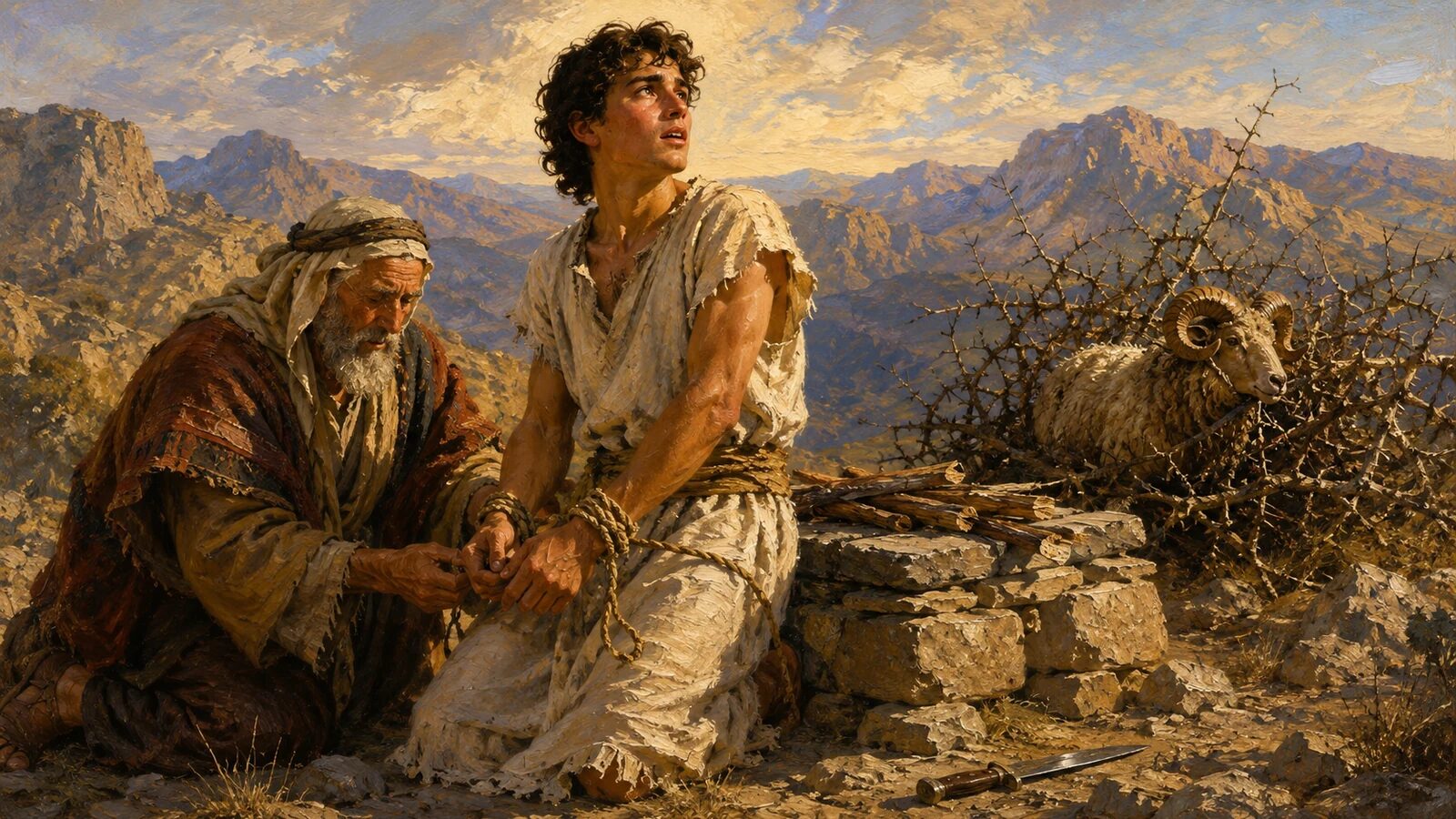
Isaac carried the wood while Abraham carried the fire and knife. When Isaac asked where the lamb was, Abraham told him God would provide the sacrifice for Himself. I wonder how much Isaac understood, but Genesis doesn’t tell us. It records no rebellion when Abraham bound him on the altar. His silence makes this a solemn moment to read.
But Isaac spoke to Abraham his father and said, “My father!” And he said, “Here I am, my son.” Then he said, “Look, the fire and the wood, but where is the lamb for a burnt offering?” And Abraham said, “My son, God will provide for Himself the lamb for a burnt offering.” So the two of them went together.
At the last moment, the Angel of the LORD stopped Abraham from killing Isaac. He spoke as God and received Abraham’s fear of God as directed toward Himself. In the verses that follow, He also swore by Himself. These are reasons I understand Him to be the eternal Son appearing before He became man, a Christophany, rather than an ordinary created angel relaying a message. Abraham then offered a ram instead of Isaac. The word “instead” explains the substitution: Isaac lived because another life was given in his place.
Then Abraham lifted his eyes and looked, and there behind him was a ram caught in a thicket by its horns. So Abraham went and took the ram, and offered it up for a burnt offering instead of his son.
I can see how this account prepares us to understand Christ’s sacrifice without making every detail identical. Isaac needed a substitute so that he would not die, whereas Jesus willingly gave Himself to save sinners. Isaac was not Jesus, and Abraham did not represent the Father in every respect. Nor can we learn the complete doctrine of atonement from the ram alone. What Genesis 22 gives us is a clear example of substitution: the ram died in Isaac’s place, and Isaac came down from the altar alive. We learn the fuller gospel from the passages that directly explain Christ’s death and resurrection.
Paul, the author of Hebrews, explains how Abraham reasoned through the promise. God had specifically said that his covenant seed would come through Isaac. If Isaac died, God could raise him, so even death could not prevent God from keeping His word. Abraham received Isaac back in a figurative sense. His son had been as good as dead in Abraham’s settled obedience, but he came down from the altar alive.
By faith Abraham, when he was tested, offered up Isaac, and he who had received the promises offered up his only begotten son, of whom it was said, “In Isaac your seed shall be called,” concluding that God was able to raise him up, even from the dead, from which he also received him in a figurative sense.
Ordinary Faithfulness Under Pressure
The search for Isaac’s wife takes up much of Genesis 24 because the future of the covenant family was involved. Sarah had died and Abraham was old, yet Isaac still had no wife through whom the promised descendants could come. Abraham sent his trusted servant to his extended family in Mesopotamia with a firm instruction: Isaac must not go back there. He was to remain in the land God had given, and his wife must not come from the Canaanite peoples living around them. The concern was the household’s worship and loyalty to God’s covenant, not ethnic pride.
At the well, Abraham’s servant asked the LORD for specific, practical guidance. He was seeking help with a task that concerned the future of the promised line. His prayer expressed that need rather than an attempt to manipulate God.
Then he said, “O LORD God of my master Abraham, please give me success this day, and show kindness to my master Abraham. Behold, here I stand by the well of water, and the daughters of the men of the city are coming out to draw water.”
Rebekah showed her generosity by willingly drawing water for the camels, which involved substantial work. Her hospitality was part of the way God guided these events. The servant recognized the Lord’s kindness in answering his prayer and worshiped Him.
Isaac received Rebekah as his wife and grew to love her. Genesis also tells us that through this marriage God comforted him after his mother’s death.
Then Isaac brought her into his mother Sarah’s tent; and he took Rebekah and she became his wife, and he loved her. So Isaac was comforted after his mother’s death.
I don’t want to overlook Isaac’s grief simply because he was the promised son. Sarah’s death hurt him, and his love for Rebekah brought comfort. Faith does not erase sorrow, but we can carry it under God’s care. The covenant was being fulfilled through people who needed that care in their own homes.
In Genesis 26, a famine brought another pressure on Isaac’s household, much as famine had earlier affected Abraham. Egypt offered the dependable water of the Nile, and God’s command not to go there suggests that it was a real option for Isaac. He was to remain in the land and live where God directed him. Trusting the Lord meant obeying that word even during the famine.
Then the LORD appeared to him and said: “Do not go down to Egypt; live in the land of which I shall tell you. Dwell in this land, and I will be with you and bless you; for to you and your descendants I give all these lands, and I will perform the oath which I swore to Abraham your father.”
The Lord spoke directly to Isaac and confirmed the promises He had made to Abraham. He would be with Isaac and bless him, and Isaac’s descendants would inherit the lands included in the oath to his father. Isaac had more than a family memory to rely on. God Himself had confirmed the covenant to him.
Even so, Isaac was afraid of the men where he lived and claimed Rebekah was his sister. He repeated his father’s earlier failure. Growing up around Abraham’s faith had not automatically given Isaac courage, and each generation must learn to trust God under the pressures it faces.
I can understand why Isaac was afraid without excusing his lie. Fear did not make deception righteous. The Lord protected the household and preserved His promise despite Isaac’s weakness, but His faithfulness gives us no reason to call that weakness wisdom.
The wells in Genesis 26 were essential to Isaac’s household. In that dry land, water kept the flocks alive and enabled the family to remain in one place. The Philistines stopped up Abraham’s wells and claimed the new ones Isaac dug. Those disputes threatened his ability to live in the very land God had promised.
Isaac reopened his father’s wells and kept digging despite the Philistines’ opposition. When a dispute arose, he moved elsewhere and continued working. I see restraint in that response, rather than weakness. He would not turn every quarrel into a war, and he kept going until the Lord made room for his household.
And he moved from there and dug another well, and they did not quarrel over it. So he called its name Rehoboth, because he said, “For now the LORD has made room for us, and we shall be fruitful in the land.”
Isaac credited the Lord with making room for them, rather than claiming he had finally outmaneuvered his opponents. His response makes me think about how I handle pressure. There are times when faith requires a fight and others when it requires patience. Isaac could keep digging the next well without becoming bitter toward those who had made the previous one difficult.
Later, Abimelech came with his adviser and army commander to seek a covenant with Isaac. Isaac asked why they had come after hating him and sending him away. They answered that they had seen the LORD with him. That does not tell us every opponent became a worshiper, or that Isaac’s restraint alone brought them back. It does show that God’s blessing was evident even though Isaac had refused to wage war.
But they said, “We have certainly seen that the LORD is with you. So we said, ‘Let there now be an oath between us, between you and us; and let us make a covenant with you.'”
Prayer, Family, and Covenant Preservation
Genesis 25 tells us Isaac was forty when he married Rebekah and sixty when the twins were born. That puts twenty years of waiting behind the brief account of his prayer. They knew the pain of barrenness as Abraham and Sarah had, but Genesis records no attempt by Isaac to obtain an heir through another woman. He pleaded with the LORD for his wife, and the LORD granted his plea.
Now Isaac pleaded with the LORD for his wife, because she was barren; and the LORD granted his plea, and Rebekah his wife conceived.
Isaac “pleaded” with the Lord, making an earnest request rather than a passing religious remark. He brought his household’s need for a child to the God who had promised descendants. I see a different response here from the impatience that caused such sorrow in Genesis 16. Isaac could neither open the womb nor force God’s timing, but he could ask the One who alone could answer.
Rebekah’s difficult pregnancy led her to seek the LORD. He told her that the twins would become two distinct nations. One people would be stronger than the other, and the older son would serve the younger.
And the LORD said to her: “Two nations are in your womb, Two peoples shall be separated from your body; One people shall be stronger than the other, And the older shall serve the younger.”
Before the twins were born, God had already said how their future would unfold. The firstborn’s usual prominence would not determine the covenant outcome. This oracle, or prophetic message, was given to Rebekah, and Genesis does not say when or how fully she told Isaac. It does tell us that the parents favored different sons. Isaac loved Esau because he enjoyed the game he brought home, while Rebekah loved Jacob. Those divided loyalties set the sons against each other and helped prepare the household for deception.
By Genesis 27, Isaac had grown old and could no longer see clearly. He intended to bless Esau, but Rebekah overheard his plan and enlisted Jacob in deceiving him. Esau’s rage when he discovered what had happened completed the family’s fracture. This is a painful account to read, and Scripture gives us no reason to excuse anyone involved.
Isaac was responsible for the secrecy and favoritism in his plan. He called Esau alone and tied the blessing to the savory food he loved. I wouldn’t accuse him of knowingly defying the message given before the twins’ birth, since we are not told what Rebekah had shared with him. He did know his sons’ conduct, including the grief Esau’s Canaanite marriages had caused. Rebekah was responsible for plotting against her husband, and Jacob for the lies he chose to tell. Esau had already despised his birthright and responded to losing the blessing with murderous intent. None of these actions was a righteous way to secure the outcome.
So Jacob went near to Isaac his father, and he felt him and said, “The voice is Jacob’s voice, but the hands are the hands of Esau.” And he did not recognize him, because his hands were hairy like his brother Esau’s hands; so he blessed him.
Isaac heard Jacob’s voice even though the hands felt like Esau’s. Jacob had also brought the meal surprisingly quickly, considering that Isaac had sent Esau out to hunt. He sensed something was wrong and still went ahead with the blessing. That makes me consider how a preferred outcome can dull my discernment. Wanting something to be true does not give me reason to ignore the evidence against it.
Isaac trembled exceedingly when Esau arrived and the truth came out. Genesis does not explain every emotion he felt, but his words show that he recognized the blessing still stood: “indeed he shall be blessed.” A patriarch’s blessing was a solemn pronouncement about inheritance and land, including rule within the family and its covenant future. It was neither casual praise nor a set of magic words. Isaac would make a further pronouncement over Esau, but he would not act as though Jacob’s blessing could simply be erased.
Then Isaac trembled exceedingly, and said, “Who? Where is the one who hunted game and brought it to me? I ate all of it before you came, and I have blessed him, and indeed he shall be blessed.”
God had said the older would serve the younger, so Jacob’s receiving the primary blessing did not surprise Him or force Him to devise a new covenant plan. Yet Jacob’s deception was still sin, as was Rebekah’s scheme. I need to acknowledge God’s sovereign care for His promise without using it to justify what they did. Nothing they obtained by lying was beyond His ability to give through obedience.
Later, Isaac blessed Jacob again and sent him to find a wife among their family rather than the daughters of Canaan. He was now acting in line with God’s revealed purpose instead of simply holding to his own preference.
Then Isaac called Jacob and blessed him, and charged him, and said to him: “You shall not take a wife from the daughters of Canaan. Arise, go to Padan Aram, to the house of Bethuel your mother’s father; and take yourself a wife from there of the daughters of Laban your mother’s brother.”
Genesis 35 records Isaac’s death as an old man full of days. Esau and Jacob came together to bury him. Their shared act did not erase what had happened between them, and God’s covenant continued beyond their father’s life.
So Isaac breathed his last and died, and was gathered to his people, being old and full of days. And his sons Esau and Jacob buried him.
What Isaac’s Life Teaches Us
God named Isaac before his birth and brought him into the world when He had promised. He then preserved him on Moriah and continued His covenant through him despite human weakness. That gives me reason to trust God’s provision instead of panicking over what seems impossible. Isaac came down from the altar because God supplied a substitute. The ram was not Jesus and could not redeem sinners, but its death in Isaac’s place helps us understand Christ’s greater saving work.
Much of Isaac’s faithfulness was lived out in marriage and prayer, with the work of digging wells so his household could remain where God had told him to live. He faced opposition there and pain within his own family. Many believers spend their lives facing ordinary pressures like these, and the Lord remains faithful in them. Yet Isaac also warns parents against making love seem like a reward for the child who best fits their preferences. His favoritism toward Esau helped fracture the home, just as fear had led him to lie about Rebekah. Grace does not make those sins harmless. God preserved Isaac despite them and led him to confirm Jacob’s covenant blessing in Genesis 28.
Moriah directs us beyond Isaac to the Savior. Wicked men physically tortured and punished Jesus before killing Him, and He willingly bore that real punishment for our sins in His innocent body. He shed His blood and died, then was buried and rose bodily. The Father did not punish, curse, abandon, strike, bruise, or pour wrath on Jesus. Christ died for the whole world, and God’s genuine offer can be resisted. Every person must repent and believe in Him. Those who truly believe are forgiven and justified, meaning declared righteous before God. They are born again and made new, with the Holy Spirit indwelling and sealing them. Their salvation is eternally secure, but that gives no permission for lawlessness. A superficial profession does not prove that someone has been born again.
My Final Thoughts
Isaac’s life leaves me with more confidence in God’s faithfulness than in Isaac’s strength. The God who kept the appointed time for his birth also provided the substitute on Moriah. He answered Isaac’s prayer and made room for his household during conflict, and even the family’s deep divisions did not overturn His covenant. Isaac’s failures should keep us humble about our own strength. God’s faithfulness gives us reason to trust Him in the ordinary pressures of our lives.