
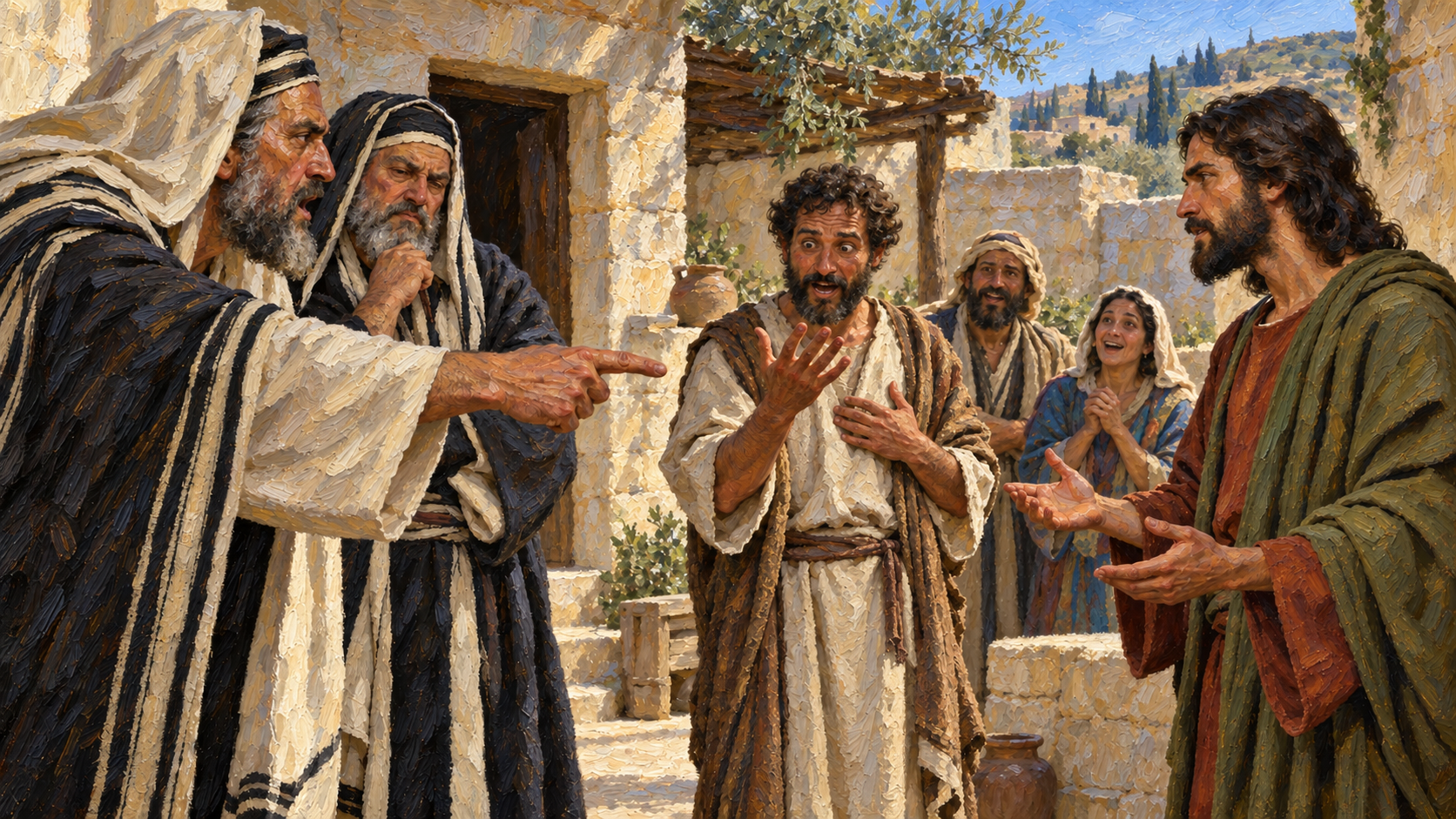
What did Jesus mean when He warned that blasphemy against the Holy Spirit will never be forgiven? Someone remembering an angry sentence or an unwanted thought may be frightened by that warning. Someone else may explain it so narrowly that it no longer warns anyone. I want to begin with what happened when Jesus spoke, because that encounter helps us understand the seriousness of the sin without turning a person seeking mercy away from Him.
The Warning Begins with What Jesus Did
Fear and presumption can both keep us from hearing what Jesus said. Fear can make every disturbing thought seem like proof of condemnation, while presumption can treat the warning as something that mattered only long ago. The Gospel setting gives us a reason to reject both conclusions: Jesus was answering a deliberate response to clear evidence about who He is.
The Gospel writers do not leave us to guess what happened. Jesus delivered a man from demonic oppression, and the crowd asked whether He might be the promised Son of David. Religious leaders answered by saying that His power came from Beelzebub. Jesus exposed the contradiction in their accusation and then warned about blasphemy against the Holy Spirit. Mark closes the account by stating the reason: they were saying that Jesus had an unclean spirit.
I do not want to weaken Jesus’ warning or add something He never said. Following His reasoning helps us distinguish the leaders’ hardened reviling from sins that Scripture describes differently. It also directs the person seeking mercy toward Christ, rather than toward endless self-examination in the hope of finding peace.
Then one was brought to Him who was demon-possessed, blind and mute; and He healed him, so that the blind and mute man both spoke and saw. And all the multitudes were amazed and said, "Could this be the Son of David?" Now when the Pharisees heard it they said, "This fellow does not cast out demons except by Beelzebub, the ruler of the demons." But Jesus knew their thoughts, and said to them: "Every kingdom divided against itself is brought to desolation, and every city or house divided against itself will not stand. If Satan casts out Satan, he is divided against himself. How then will his kingdom stand? And if I cast out demons by Beelzebub, by whom do your sons cast them out? Therefore they shall be your judges. But if I cast out demons by the Spirit of God, surely the kingdom of God has come upon you. Or how can one enter a strong man's house and plunder his goods, unless he first binds the strong man? And then he will plunder his house. He who is not with Me is against Me, and he who does not gather with Me scatters abroad. "Therefore I say to you, every sin and blasphemy will be forgiven men, but the blasphemy against the Spirit will not be forgiven men. Anyone who speaks a word against the Son of Man, it will be forgiven him; but whoever speaks against the Holy Spirit, it will not be forgiven him, either in this age or in the age to come. "Either make the tree good and its fruit good, or else make the tree bad and its fruit bad; for a tree is known by its fruit. Brood of vipers! How can you, being evil, speak good things? For out of the abundance of the heart the mouth speaks. A good man out of the good treasure of his heart brings forth good things, and an evil man out of the evil treasure brings forth evil things. But I say to you that for every idle word men may speak, they will give account of it in the day of judgment. For by your words you will be justified, and by your words you will be condemned."
Matthew describes a man who had been demon-possessed and could neither see nor speak. After Jesus healed him, he could do both. The amazed crowd asked, “Could this be the Son of David?” They were asking whether the royal descendant God had promised to David stood before them. Jesus’ authority had given them a reason to consider that promise.
The Pharisees answered the miracle with a hostile explanation instead of examining it honestly. They said Jesus cast out demons by Beelzebub, the ruler of the demons. I want us to notice how far that accusation went. They were calling the One who freed a tormented man an agent of the tormentor, and labeling the Spirit of God’s work satanic. They had reversed the meaning of what they saw.
Jesus knew their thoughts, so He answered the reasoning behind their public accusation. He did not treat it as an innocent misunderstanding. His reply exposed its contradiction and explained how His work showed that God’s kingdom had arrived. He also warned them that their words revealed the moral condition of their hearts.
If Satan were casting out Satan in this way, he would be dismantling his own rule. Jesus began there because a divided kingdom cannot stand. Freeing the man from captivity displayed authority over the enemy rather than strengthening demonic power. The Pharisees’ explanation could not account for what had happened.
Jesus then pressed the Pharisees' standard back upon them. Their own sons claimed to cast out demons, so why did the leaders reserve the Beelzebub explanation for Jesus? They were not applying a neutral rule consistently. They were designing an accusation that would let them reject Him.
Jesus then brought the argument to its conclusion. If He cast out demons by the Spirit of God, then God’s kingdom had come upon them. The miracle revealed both the King’s presence and the Spirit’s power. Jesus had entered the strong man’s domain and bound him in order to plunder his house. Satan was not empowering Him; He was overthrowing Satan’s work.
The Pharisees could not explain away that deliverance as demonic activity and still claim to be neutral observers. Jesus said that whoever was not with Him was against Him, and whoever did not gather with Him scattered. Their accusation placed them against the Messiah whose works they had witnessed, however respected they might have been.
That is the accusation Jesus was addressing when He gave the warning. He was not announcing that a particular arrangement of words could doom someone who was otherwise repentant. These leaders had received exceptional light, yet they used their authority to call the Spirit’s witness evil. I need to keep their response to Him in view when I read what follows.
Then the multitude came together again, so that they could not so much as eat bread. But when His own people heard about this, they went out to lay hold of Him, for they said, "He is out of His mind." And the scribes who came down from Jerusalem said, "He has Beelzebub," and, "By the ruler of the demons He casts out demons." So He called them to Himself and said to them in parables: "How can Satan cast out Satan? If a kingdom is divided against itself, that kingdom cannot stand. And if a house is divided against itself, that house cannot stand. And if Satan has risen up against himself, and is divided, he cannot stand, but has an end. No one can enter a strong man's house and plunder his goods, unless he first binds the strong man. And then he will plunder his house. "Assuredly, I say to you, all sins will be forgiven the sons of men, and whatever blasphemies they may utter; but he who blasphemes against the Holy Spirit never has forgiveness, but is subject to eternal condemnation"– because they said, "He has an unclean spirit."
Mark tells us that the scribes had come from Jerusalem, the center of religious authority. They were trained teachers who had heard and seen enough of Jesus’ ministry to pronounce an official-sounding judgment that He had Beelzebub. This was not a distant reaction to a rumor. They interpreted the authority before them as demonic.
Jesus called them to Himself and reasoned with them through parables. A divided kingdom or household could not stand, and a robber could not plunder a strong man’s possessions without first binding him. His deliverances showed that a stronger King had entered the enemy’s domain.
Mark then records the solemn words “never has forgiveness” and “subject to eternal condemnation.” The received text does not permit us to weaken the warning into temporary discipline. Immediately afterward, Mark tells the reader why Jesus said it: “because they said, 'He has an unclean spirit.'” That final explanation anchors the meaning in the leaders' actual accusation.
The imperfect form translated “they said” helps us understand the accusation as ongoing. Mark was not describing a startled syllable that escaped once, but speech that expressed a chosen opposition to Jesus and the Spirit’s work through Him. I would not turn a grammatical form into a mechanical checklist for identifying this sin. Still, we need to hear the sustained hostility in the charge.
The Greek noun blasphemia describes speech that slanders, reviles, or injures. Related forms can refer to speech against people as well as against God, so understanding the word also requires us to ask who is being spoken against and in what setting. Here Jesus specifically names the Holy Spirit. The leaders were reviling the divine Person whose holy work testified through the Son.
The way Scripture speaks about the Holy Spirit also prevents me from treating Him as an impersonal power or a religious feeling. People can address Him and resist His work. Scripture says they can lie to Him, grieve Him, and insult Him, all of which are ways of responding to a Person. He is fully God, distinct from the Father and the Son within the one triune God.
We cannot separate those spoken words from the heart behind them. Jesus went on to explain that the mouth speaks from the abundance of the heart. Our words reveal what we have embraced and help carry it forward, which makes them morally serious. The Pharisees’ accusation revealed their determination to reject the evidence instead of submitting to the One it identified.
I find the phrase “unforgivable sin” useful only if it takes us back to what Jesus actually said. It can mislead us if we picture a hidden act someone might commit without realizing it. The Gospels describe informed religious opponents calling the Spirit’s clear testimony through Christ satanic. They do not describe a sincere follower accidentally crossing an invisible line.
Jesus distinguishes between a word spoken against the Son of Man, which can be forgiven, and speaking against the Holy Spirit, which will not be forgiven. I do not understand that as a distinction in their deity. Jesus is the eternal Son, fully God and fully man. We cannot use this sentence to deny what the whole Bible teaches about who He is.
“Son of Man” is a messianic title, and the Gospels use it for Christ in His humbled earthly appearance. Someone could misunderstand the carpenter from Nazareth or stumble over His lowliness, then repent when the truth became clear. His own brothers initially did not believe in Him. Peter denied knowing Him, and Paul persecuted His people while rejecting who He was. All of them received mercy; their earlier opposition had not placed them beyond its reach.
The Pharisees in Matthew 12 had more before them than an unimpressive outward appearance. A suffering man had been freed, and the Spirit’s work was attesting to who Jesus was. Instead of reconsidering their opposition, they called that holy work demonic. Jesus was distinguishing forgivable ignorance and opposition from this hardened reversal of good and evil.
That distinction gives no one permission to insult Jesus as though doing so were harmless. Every idle word comes under judgment, and persistent rejection of the Son is spiritually fatal. Jesus was showing how grave it is to repudiate the Spirit’s clear testimony. He was not making dishonor toward Himself acceptable.
Matthew says the blasphemy will not be forgiven “either in this age or in the age to come.” Mark states the force directly: the person “never has forgiveness” and is subject to eternal condemnation. The two accounts interpret one another.
Jesus’ words do not establish a category of sins that can be forgiven after death. They do not support purgatory or repentance after death, nor do they promise a second opportunity for salvation after judgment. He excludes forgiveness in either age, taking the warning far beyond temporary consequences.
Christ truly receives sinners who come to Him, and I do not want fear of this passage to obscure God’s abundant mercy. Yet Jesus is equally clear that this blasphemy never has forgiveness. We must not imagine Him rejecting a repentant seeker, but we must also not invent repentance in the hardened rejection of the Spirit’s testimony He describes. Both His welcome and His warning must stand.
The Spirit bears truthful witness to the only Savior, so rejecting that witness means rejecting the only sacrifice for sins. Forgiveness is found in Christ alone. There is no second redeemer to turn to after knowingly condemning Him as evil, and no other path opens up in His place.
Why the Spirit's Witness Makes the Warning So Serious
"Also I say to you, whoever confesses Me before men, him the Son of Man also will confess before the angels of God. But he who denies Me before men will be denied before the angels of God. "And anyone who speaks a word against the Son of Man, it will be forgiven him; but to him who blasphemes against the Holy Spirit, it will not be forgiven. "Now when they bring you to the synagogues and magistrates and authorities, do not worry about how or what you should answer, or what you should say. For the Holy Spirit will teach you in that very hour what you ought to say."
Luke records a related saying as Jesus prepared His disciples to answer before synagogues and civil authorities, including magistrates. Under that pressure, they were to confess Him before men and depend on the Holy Spirit to teach them what to say.
Luke’s setting helps me see an emphasis I would miss if I treated these passages as simple duplicates. Matthew and Mark describe the confrontation over Beelzebub. Luke places the warning alongside the disciples’ public witness and the Spirit’s help during persecution. They could be spoken against and threatened as they answered powerful people, but the Spirit remained the divine witness whom Christ’s enemies must not revile.
The distinction between speaking against the Son of Man and blaspheming the Spirit remains in Luke. But I do not read it as a declaration that one frightened failure before the authorities must be unforgivable. Peter denied Jesus and was restored. The warning concerns grave rejection of the Spirit’s witness, while the promise beside it encourages disciples to rely on Him when obedience is costly.
"But when the Helper comes, whom I shall send to you from the Father, the Spirit of truth who proceeds from the Father, He will testify of Me. And you also will bear witness, because you have been with Me from the beginning.
Jesus calls Him the Spirit of truth and says that He bears witness to the Son. The apostles would also testify because they had been with Jesus from the beginning. The Spirit’s work reveals and confirms who the true Son is, bringing glory to Him. There is no competition between His ministry and Christ.
Nevertheless I tell you the truth. It is to your advantage that I go away; for if I do not go away, the Helper will not come to you; but if I depart, I will send Him to you. And when He has come, He will convict the world of sin, and of righteousness, and of judgment: of sin, because they do not believe in Me; of righteousness, because I go to My Father and you see Me no more; of judgment, because the ruler of this world is judged.
Jesus says the Spirit convicts the world of sin, righteousness, and judgment, then explains each part. He addresses unbelief with the words “because they do not believe in Me.” The Spirit also establishes Christ’s righteousness and announces judgment upon the ruler of this world. His witness confronts people with the truth about Jesus.
That work is genuine even when people resist it. God does not force every hearer to believe, and the proper response when the Spirit presses Christ’s truth upon the conscience is repentance and faith. I should not treat repeated resistance as harmless. It can harden a person, especially when religious pride protects that resistance and public teaching spreads it to others.
Paul’s example keeps me from concluding that every unbeliever has already committed the specific blasphemy in Mark 3. He was an unbelieving blasphemer and persecutor, yet he received mercy. We need to keep the accusation in the Gospel account as the controlling example. Final rejection of the Spirit’s witness explains why there is no forgiveness apart from Christ, but that does not make every act of unbelief this particular sin.
And I thank Christ Jesus our Lord who has enabled me, because He counted me faithful, putting me into the ministry, although I was formerly a blasphemer, a persecutor, and an insolent man; but I obtained mercy because I did it ignorantly in unbelief. And the grace of our Lord was exceedingly abundant, with faith and love which are in Christ Jesus. This is a faithful saying and worthy of all acceptance, that Christ Jesus came into the world to save sinners, of whom I am chief. However, for this reason I obtained mercy, that in me first Jesus Christ might show all longsuffering, as a pattern to those who are going to believe on Him for everlasting life.
Paul had blasphemed and persecuted believers with such violent arrogance that Christians feared him. Yet Christ saved him and appointed him to ministry. We cannot call all blasphemy unforgivable when Paul gives us this testimony of mercy.
Paul says he obtained mercy because he acted ignorantly in unbelief, but ignorance did not make him innocent. He still needed mercy and described himself as foremost among sinners. His former opposition was different from what Jesus confronted in the leaders who knowingly labeled the Spirit’s work unclean.
Christ also made Paul’s conversion a pattern of His patience for people who would later believe. He saved someone who had been His enemy. If you have a blasphemous past, that example gives you reason to come to Him instead of concluding that your words are stronger than His blood. Will you continue defending your rebellion, or turn to the living Lord in repentance and faith?
Peter's history points in the same direction. He denied Jesus three times, even strengthening the denial when questioned, but the risen Christ restored him. The condemned man crucified beside Jesus had joined the public abuse against Him, yet later turned to Christ and received His promise of Paradise. At Pentecost, Peter then offered the gospel to people implicated in Jesus' crucifixion. Scripture does not minimize grievous sin; it magnifies the Savior who forgives those who turn to Him.
Keep Different Sins Against the Spirit Distinct
Scripture describes several ways people can sin against the Holy Spirit, and we need to take each one seriously. Their seriousness does not make them identical, though. We have no permission to rename every one of them blasphemy against the Spirit.
Acts says resistant hearers opposed the Spirit as their fathers had done. Stephen's sermon shows that resistance can accompany religious privilege and lead to violent rejection of God's witness.
"You stiff-necked and uncircumcised in heart and ears! You always resist the Holy Spirit; as your fathers did, so do you. Which of the prophets did your fathers not persecute? And they killed those who foretold the coming of the Just One, of whom you now have become the betrayers and murderers, who have received the law by the direction of angels and have not kept it." When they heard these things they were cut to the heart, and they gnashed at him with their teeth. But he, being full of the Holy Spirit, gazed into heaven and saw the glory of God, and Jesus standing at the right hand of God, and said, "Look! I see the heavens opened and the Son of Man standing at the right hand of God!" Then they cried out with a loud voice, stopped their ears, and ran at him with one accord; and they cast him out of the city and stoned him. And the witnesses laid down their clothes at the feet of a young man named Saul. And they stoned Stephen as he was calling on God and saying, "Lord Jesus, receive my spirit." Then he knelt down and cried out with a loud voice, "Lord, do not charge them with this sin." And when he had said this, he fell asleep.
Stephen’s hearers were cut to the heart, but instead of repenting they gnashed their teeth and killed him. That was real resistance to the Spirit. Yet the passage does not identify every earlier act of resistance as the unforgivable sin. Stephen continued to speak truth to them before they silenced him.
Paul tells believers not to grieve the Holy Spirit while correcting the way they speak and treat one another. He addresses bitterness and anger, along with theft and refusal to forgive. Corrupt speech also belongs among these sins, which damage fellowship with the divine Person who indwells believers.
Therefore, putting away lying, "Let each one of you speak truth with his neighbor," for we are members of one another. "Be angry, and do not sin": do not let the sun go down on your wrath, nor give place to the devil. Let him who stole steal no longer, but rather let him labor, working with his hands what is good, that he may have something to give him who has need. Let no corrupt word proceed out of your mouth, but what is good for necessary edification, that it may impart grace to the hearers. And do not grieve the Holy Spirit of God, by whom you were sealed for the day of redemption. Let all bitterness, wrath, anger, clamor, and evil speaking be put away from you, with all malice. And be kind to one another, tenderhearted, forgiving one another, even as God in Christ forgave you.
I notice that Paul warns believers against grieving the very Spirit who sealed them for the day of redemption. The warning and the assurance appear together. Grieving Him calls for confession and changed conduct, but Paul does not say His seal has broken. Nor does he identify every sinful word from a Christian as blasphemy against the Spirit.
In 1 Thessalonians, the instruction not to quench the Spirit appears beside the command not to despise prophecies. Paul also tells believers to test all things and hold fast what is good. We should receive those instructions together. Refusing a claimed revelation is not automatically quenching the Spirit, because the Spirit of truth never requires us to abandon discernment.
Rejoice always, pray without ceasing, in everything give thanks; for this is the will of God in Christ Jesus for you. Do not quench the Spirit. Do not despise prophecies. Test all things; hold fast what is good. Abstain from every form of evil.
Acts 5 describes Ananias and Sapphira lying to the Holy Spirit, while Hebrews 10 speaks of insulting the Spirit of grace. I want to compare those passages without making them say the same thing. Each grave description belongs to a particular setting, and careful interpretation allows each passage to say what God intended.
Hebrews Warns People Surrounded by Great Light
For it is impossible for those who were once enlightened, and have tasted the heavenly gift, and have become partakers of the Holy Spirit, and have tasted the good word of God and the powers of the age to come, if they fall away, to renew them again to repentance, since they crucify again for themselves the Son of God, and put Him to an open shame. For the earth which drinks in the rain that often comes upon it, and bears herbs useful for those by whom it is cultivated, receives blessing from God; but if it bears thorns and briers, it is rejected and near to being cursed, whose end is to be burned. But, beloved, we are confident of better things concerning you, yes, things that accompany salvation, though we speak in this manner.
The people described in Hebrews had received extraordinary privileges. They had been enlightened and had tasted the heavenly gift and the good Word of God. They had participated in the life of the covenant community and witnessed powers of the age to come. Turning from Christ after receiving so much light is fearful, like a field that receives rain but grows thorns and faces judgment.
Those privileges must not be confused with the Spirit’s saving indwelling. Someone can understand Christian doctrine and feel conviction, see God’s work and share fellowship with believers, yet still refuse the Savior. The passage does not say that a person was born again, sealed by the Spirit, and made a new creation, only to become unborn later.
Verse 9 helps me understand why that distinction is necessary. The author expects better things concerning his readers, “things that accompany salvation.” I therefore would not use the preceding privileges as a technical list proving that someone has been born again. The warning asks professing Christians to distinguish being close to Christian life from actually trusting Christ.
For if we sin willfully after we have received the knowledge of the truth, there no longer remains a sacrifice for sins, but a certain fearful expectation of judgment, and fiery indignation which will devour the adversaries. Anyone who has rejected Moses' law dies without mercy on the testimony of two or three witnesses. Of how much worse punishment, do you suppose, will he be thought worthy who has trampled the Son of God underfoot, counted the blood of the covenant by which he was sanctified a common thing, and insulted the Spirit of grace? For we know Him who said, "Vengeance is Mine, I will repay," says the Lord. And again, "The LORD will judge His people." It is a fearful thing to fall into the hands of the living God.
Hebrews 10 describes willful rejection after someone has received knowledge of the truth. That person repudiates the Son of God and treats His covenant blood as common, insulting the Spirit of grace. In doing so, he rejects the only sacrifice for sins. There is no rival offering to turn to after rejecting Christ.
I see a connection with the informed, hardened rejection in the Gospel warning, but Hebrews does not call it “blasphemy against the Holy Spirit” here. We should not claim that the text explicitly identifies the two. The theological connection is that greater light brings greater responsibility. A person who finally rejects Christ has no other Savior to turn to.
These warnings awaken careless hearers and expose false professions without overturning Christ’s promises to keep His own. Being surrounded by Christian truth is a reason to cling to Christ Himself, not to presume that proximity has saved us. Eternal security belongs to people who are truly born again. A past claim to faith does not establish new birth when someone has settled into rejection of Christ.
Christ's Promise Answers the Fearful Conscience
In Him you also trusted, after you heard the word of truth, the gospel of your salvation; in whom also, having believed, you were sealed with the Holy Spirit of promise, who is the guarantee of our inheritance until the redemption of the purchased possession, to the praise of His glory.
Every person who hears the gospel and truly believes in Christ is sealed with the Holy Spirit of promise. He guarantees the believer's inheritance until the redemption of the purchased possession. The new birth makes that person a new creation, and the Spirit comes to dwell within him. The believer is eternally secure because God keeps those He saves.
A believer indwelt by the Spirit does not occupy the Pharisees’ position of knowingly calling Him an unclean spirit in order to reject Christ. That does not mean Christians never speak foolishly or fall into serious sin. We can grieve the Spirit and neglect discernment, and we may go through painful doubt. Such failures require repentance and may bring severe consequences. They do not undo the new birth or cancel God’s seal.
Knowing that God keeps us should give us confidence to confess sin honestly, not make us careless about speech or obedience. Jesus warns that we will give account for idle words. Paul likewise commands people already sealed by the Spirit to put away corrupt speech and malice. Our security never makes those sins harmless or gives us permission for lawlessness.
We must also be careful about assuring someone solely because he once repeated a prayer or claimed a spiritual experience. Church membership does not prove the new birth either. Judas lived near Jesus without believing, and Hebrews warns people who had received covenant privileges. Christ keeps every true believer, but being outwardly close to Christian life is not the same as being born again.
And Jesus said to them, "I am the bread of life. He who comes to Me shall never hunger, and he who believes in Me shall never thirst. But I said to you that you have seen Me and yet do not believe. All that the Father gives Me will come to Me, and the one who comes to Me I will by no means cast out. For I have come down from heaven, not to do My own will, but the will of Him who sent Me. This is the will of the Father who sent Me, that of all He has given Me I should lose nothing, but should raise it up at the last day. And this is the will of Him who sent Me, that everyone who sees the Son and believes in Him may have everlasting life; and I will raise him up at the last day."
Jesus promises that He will never cast out the person who comes to Him. That gives me something more dependable than my ability to remember every thought or measure my own sorrow. A fearful person does not have to prove that his anxiety is sincere enough before trusting Christ. Assurance rests in the Son’s will and promise to give eternal life and raise His people at the last day.
Some readers experience unwanted sacrilegious words or images that enter the mind precisely because they hate them. Others feel compelled to review old conversations, repeat confessions, or ask for reassurance again and again. The distress can be intense, but distressing mental content is not the same moral act as trained leaders deliberately teaching that the Holy Spirit's work through Jesus came from Satan.
A thought can arrive without invitation, and being tempted is different from consenting to it. Sin involves the heart welcoming evil, cultivating it, or acting on it. Even then, ordinary sin is not automatically the specific blasphemy described in Mark 3. We should confess known sin plainly and receive Christ’s forgiveness, then turn toward obedience instead of interrogating every event in our minds.
An angry outburst against God is serious, as is wicked speech passed off as humor. We also need to deal honestly with seasons of doubt and hard questions, without confusing either with the accusation in Mark 3. Paul received forgiveness for blasphemy, and Peter received forgiveness for a terrible spoken denial. Their examples give us reason to bring sin to the Savior whose mercy is greater, while still calling the sin what it is.
Persistent fear deserves patient care when it begins to consume hours or disrupt worship. If it damages sleep or drives compulsive checking, speak with a mature pastor who understands grace and refuses manipulation. Qualified mental-health care may also be appropriate when obsessive fear is persistent or disabling. A person does not have to choose between prayerful pastoral care and responsible clinical help.
This is the message which we have heard from Him and declare to you, that God is light and in Him is no darkness at all. If we say that we have fellowship with Him, and walk in darkness, we lie and do not practice the truth. But if we walk in the light as He is in the light, we have fellowship with one another, and the blood of Jesus Christ His Son cleanses us from all sin. If we say that we have no sin, we deceive ourselves, and the truth is not in us. If we confess our sins, He is faithful and just to forgive us our sins and to cleanse us from all unrighteousness. If we say that we have not sinned, we make Him a liar, and His word is not in us.
John calls believers to walk in the light without pretending they have become sinless. They must not deny their sin, because it is Christ’s blood that cleanses them. When they confess, God is faithful and just to forgive them and cleanse them.
My little children, these things I write to you, so that you may not sin. And if anyone sins, we have an Advocate with the Father, Jesus Christ the righteous. And He Himself is the propitiation for our sins, and not for ours only but also for the whole world.
John writes to keep believers from sinning, yet he immediately tells them where to turn when they do sin: Jesus Christ the righteous is their Advocate. He is the propitiation for their sins and for the sins of the whole world. That directs me toward Him when I am afraid, instead of trying to conduct a private trial in which my anxious mind supplies its own evidence and accusation before deciding the verdict.
Christians often reassure a fearful person by saying, “If you are worried, you have not committed it.” There is wisdom behind that sentence. The person longing for mercy displays a very different posture from leaders who defended their accusation and used it to turn others from Christ.
I would not make concern an infallible test of someone’s spiritual condition, because feelings change. A tender believer can feel numb, while an unconverted person may fear the consequences of sin without repenting. If assurance rests on the amount of concern we feel, we can soon become preoccupied with whether it was strong enough or sincere enough, and whether we felt it at the right moment.
Jesus gives us a firmer answer in His promise never to cast out the person who comes to Him. He commands and welcomes you to come, so you need not wait until you can produce a perfect emotional state. Confess what you know to be sin and believe the gospel. You can rest in His promise.
The warning also speaks to a reader who feels little concern. Lack of fear is not proof that doom is fixed, but it is no reason for delay. Scripture says, “Today, if you will hear His voice, do not harden your hearts.” The proper response to light is present repentance, not a plan to resist until a more convenient season.
The Gospel setting keeps these distinctions from becoming guesses about a hidden offense. Mark describes a sustained, morally responsible accusation from leaders who had exceptional light, not an accidental phrase. Paul shows that other blasphemy can be forgiven. Jesus’ warning concerns the particular blasphemy whose object and expression the Gospel account identifies.
The other passages also need to keep their own wording and audience. Resisting or grieving the Spirit must not simply be renamed blasphemy, nor should quenching, lying to, or insulting Him lose their distinct settings. Each remains serious. Hebrews likewise warns against false confidence and urges hearers toward Christ without teaching that new birth can be lost or overturning His promise to keep His people.
For the anxious reader, that brings us back to a promise that does not change with our feelings. Concern may reflect a tender conscience, but measuring it endlessly cannot give lasting assurance. The person who comes to Christ will never be cast out.
The Spirit Points Us to the Only Savior
For to this you were called, because Christ also suffered for us, leaving us an example, that you should follow His steps: "Who committed no sin, Nor was deceit found in His mouth"; who, when He was reviled, did not revile in return; when He suffered, He did not threaten, but committed Himself to Him who judges righteously; who Himself bore our sins in His own body on the tree, that we, having died to sins, might live for righteousness–by whose stripes you were healed.
The warning cannot be understood apart from the Savior whom the Spirit glorifies. Jesus is the eternal Son, fully God and fully man, virgin-born and completely sinless. He committed no sin, and no deceit was found in His mouth.
Wicked men physically tortured, punished, and killed Jesus. He willingly bore that real punishment for our sins in His innocent body, shed His blood, died, was buried, and rose bodily. The Father did not punish, curse, abandon, strike, bruise, or pour wrath on Jesus.
Christ died for the whole world, and God’s offer of salvation is genuine even though people can resist and reject it. Whoever repents and believes in Jesus receives forgiveness and justification. He is born again as a new creation, indwelt and sealed by the Holy Spirit, and eternally secure. Good works follow as the fruit of salvation; they never purchase it.
Moreover, brethren, I declare to you the gospel which I preached to you, which also you received and in which you stand, by which also you are saved, if you hold fast that word which I preached to you–unless you believed in vain. For I delivered to you first of all that which I also received: that Christ died for our sins according to the Scriptures, and that He was buried, and that He rose again the third day according to the Scriptures,
Christ’s death for our sins, His burial, and His bodily resurrection on the third day were events God accomplished in history according to the Scriptures. The gospel rests on what He did. Because Jesus is alive, the Spirit directs sinners to Him, not toward vague spirituality or a religious technique intended to calm their fears.
But what does it say? "The word is near you, in your mouth and in your heart" (that is, the word of faith which we preach): that if you confess with your mouth the Lord Jesus and believe in your heart that God has raised Him from the dead, you will be saved. For with the heart one believes unto righteousness, and with the mouth confession is made unto salvation. For the Scripture says, "Whoever believes on Him will not be put to shame." For there is no distinction between Jew and Greek, for the same Lord over all is rich to all who call upon Him. For "whoever calls on the name of the LORD shall be saved."
The fearful seeker does not have to solve every hidden question about the past before coming to Christ. Scripture directs him to confess the risen Lord and believe. “Whoever calls on the name of the LORD shall be saved” gives the guilty person a reason to come and the anxious person a promise to trust.
Calling on Christ expresses faith in the One who saves by grace; it does not earn salvation. The person who has resisted for years should call on Him, and so should the believer troubled by an unwanted thought. Their pastoral needs may be different, but both need the same living Lord.
If you are defending unbelief, stop hardening yourself. The Pharisees explained away evidence that pointed to Christ, and we must not follow them in that. Read the Gospels honestly and consider what Jesus’ words and works establish. Consider His death and resurrection too, and repent as His Word addresses you today.
If you know you have spoken wickedly, confess it without excuses. Paul received mercy without pretending his former blasphemy was harmless. Confession means agreeing with God about our sin and turning toward our Advocate. Punishing ourselves cannot take His place.
A person trapped in repeated checking needs to place confidence in Christ's promise rather than replaying every thought until certainty appears. Read John 6:37 aloud and pray plainly. Ask a trustworthy pastor to help you remain anchored in the gospel, and seek qualified mental-health care when the fear becomes persistent or disabling.
If you are a believer grieving the Spirit, repent and obey. That includes putting away corrupt speech as well as bitterness and malice. Leave dishonesty behind too, and forgive as God in Christ forgave you. The Spirit’s seal assures us as we pursue holiness; it never gives us permission to continue grieving Him.
If you teach others, handle the warning with both courage and tenderness. A person settled in rebellion must not be reassured in it, but a frightened person must not be condemned over an intrusive thought. Explain the Gospel setting so people can hear the force of Jesus’ warning and the clarity of His welcome.
For related studies, see The Person of the Holy Spirit, Sin, and Apostasy in the Bible.
My Final Thoughts
I want to hear Jesus’ warning with all the seriousness He gave it, keeping in view the people He was confronting. The Pharisees answered the Spirit’s clear witness through Christ with hardened reviling. An unwanted thought, a sincere question, or a believer’s painful failure is not that chosen posture. That distinction should bring comfort without giving anyone an excuse to delay repentance, and it should keep a frightened person from treating the warning as proof that Christ will refuse him. The Spirit points us toward the sinless Son who shed His blood and died for the whole world, was buried, and rose bodily. Come to Him in faith, because Jesus will never cast out the person who comes.