
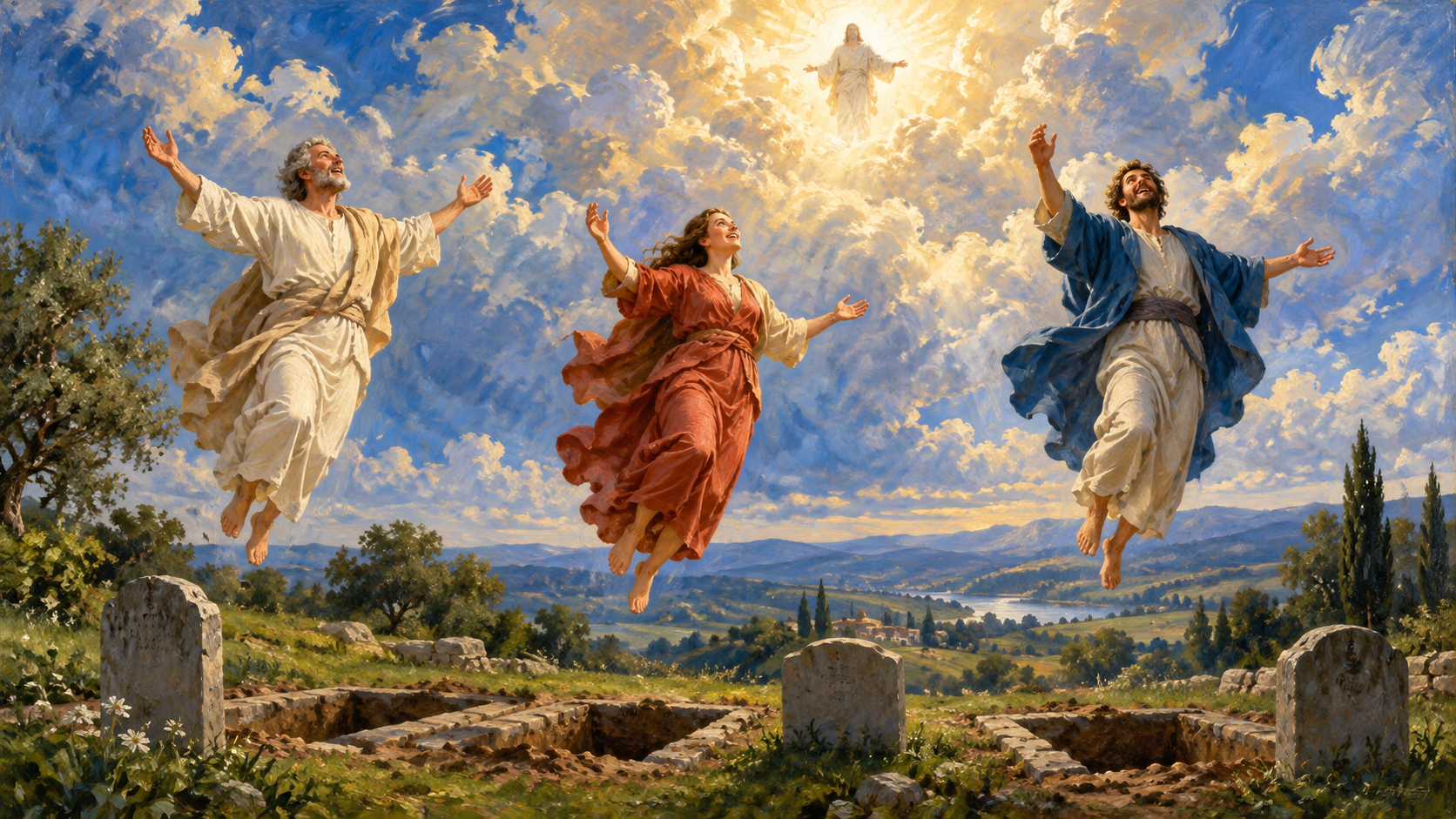
When Jesus says He will raise believers on “the last day,” what exactly does He mean? We already have life in Christ, yet we still wait for Him to raise our bodies and finally defeat death. I want to understand how that promise fits the sequence Scripture gives us.
Jesus Will Raise His People Bodily
In John 6, Jesus repeatedly promises to raise the believer on the last day. He speaks of everyone who sees the Son and believes in Him, of the one drawn by the Father, and of the one who feeds upon Christ by faith. I notice how personally He makes that promise. He will lose none of those the Father has given Him, so the believer can depend on Him to complete what He has promised.
“And this is the will of Him who sent Me, that everyone who sees the Son and believes in Him may have everlasting life; and I will raise him up at the last day.”
The phrase “last day” does not require every prophetic event to happen in the same instant. Scripture can use day for God’s climactic intervention and for the completion of an appointed order. I understand John 6 to give us certainty about Christ’s final victory over death. Revelation 20 then shows us more of the sequence: the saints are raised and reign with Christ before the later resurrection of the unredeemed.
John 5 connects spiritual life with bodily resurrection without making them the same thing. In John 5:24, Jesus says that the person who hears His word and believes the Father has everlasting life and will not come into condemnation. That person has already passed from death into life. Through faith in the Son, the believer has passed from spiritual death into spiritual life now, without having to wait until the end of history to find out whether Christ’s promise was true.
A few verses later in John 5, Jesus speaks of an hour when everyone in the graves will hear His voice and come forth. The Lord who gives spiritual life now will also raise the body, so I cannot reduce eternal life to an invisible experience with no bodily future. Nor is salvation merely a future possibility that we earn by persevering. Christ saves the whole person and will complete His work in resurrection.
When Jesus speaks of those who have done good and those who have done evil, we need to remember what John’s Gospel has already said about life and condemnation. Belief in the Son is the dividing line. Jesus is not replacing faith with a moral scorecard here. Good works are the fruit of a changed life, while evil deeds reveal continued rebellion. At the resurrection, the Judge who already knows every heart will openly reveal what is true of each person.
Jesus rose bodily from the grave, and those who belong to Him will be raised bodily too. That gives me a hope for life in a body rather than an escape from it. Paul calls Christ the firstfruits in 1 Corinthians 15, meaning that His resurrection guarantees the coming harvest of those who are His at His coming. The body sown in weakness will be raised in incorruption and glory.
This hope was already present in Daniel 12. Daniel prophesied unprecedented trouble for Israel and deliverance for the people whose names are written in the book. In that setting, he says that many who sleep in the dust will awake. Some will awake to everlasting life and others to shame and everlasting contempt. Bodily resurrection and moral judgment were part of the Old Testament’s teaching long before the New Testament was written.
Daniel gives us the certainty of resurrection and two final destinies, but he presents them in a compressed view. I would not use that compression to cancel the clearer sequence in Revelation 20. The prophets often placed related future events beside one another, with later Scripture giving more detail about their order. Revelation tells us that those in the first resurrection reign with Christ before the rest of the dead are raised for judgment.
The wise shine in Daniel’s vision because God has vindicated them. Their honor comes from Him, not from exalting themselves, and His grace is displayed in their faithfulness. That gives us reason to trust the same God with our service and suffering. He does not forget obedience offered in Christ, and suffering endured for His name is never wasted.
Our resurrection is secure because salvation rests in Christ rather than in personal achievement. He bore the punishment for sin in His innocent body and shed His blood in death, then rose bodily from the grave. Those who are truly born again are indwelt and sealed by the Holy Spirit. When God raises them, He will be faithfully completing the life He has already given them.
The Church Will Be Gathered Before the Tribulation
Paul wrote 1 Thessalonians 4 to comfort grieving believers. He explained that the dead in Christ would rise first, followed by the living believers being caught up together with them to meet the Lord in the air. He wanted the church to comfort one another with that promise. We wait for the Son from heaven with the blessed hope of the appearing of the glory of our great God and Savior Jesus Christ.
“For the Lord Himself will descend from heaven with a shout, with the voice of an archangel, and with the trumpet of God. And the dead in Christ will rise first. Then we who are alive and remain shall be caught up together with them in the clouds to meet the Lord in the air. And thus we shall always be with the Lord.”
I believe this gathering takes place before the literal seven-year Tribulation. The church is not appointed to wrath, and Christ’s coming for His people is presented as an imminent hope, something we can expect at any moment. Every true believer belongs to Him and will be changed. This is no secret salvation for a special class of Christians: the dead in Christ will rise, and the living saints will receive glorified bodies.
Paul calls this transformation a mystery in 1 Corinthians 15. Not every believer will sleep, but every believer will be changed in a moment as the perishable puts on incorruption. He is explaining how Christ overcomes death. I do not read his words as a coded timetable that overturns the comfort of 1 Thessalonians. The trumpet of God announces the church’s gathering to her Lord.
After the church is gathered, the Tribulation brings God’s judgment on a rebellious world and severe refining for Israel. Daniel’s seventieth week belongs to this future period, as do the judgments in Revelation. The beast will rise, and the final campaign will turn against Jerusalem. Yet God will still be at work, saving people and preserving a remnant. The church’s promised gathering will already have occurred.
At the end of the Tribulation, Jesus will return visibly in glory. Revelation 19 shows heaven opened and Christ coming as the faithful and true Judge. He will defeat the beast and the false prophet, judge the nations, and establish His reign. Matthew 24 places this public coming in the setting of the Tribulation, with cosmic signs and the gathering of the elect. That setting is why I would not simply identify every detail with the church’s earlier gathering.
Some readers understand the last trumpet in 1 Corinthians 15 as the same event as the trumpet of God in 1 Thessalonians 4 and the great trumpet in Matthew 24:31. I can see why they ask that question, since the passages share language about resurrection and gathering. But similar imagery alone cannot tell us that the events have the same timing or purpose, or that they address the same people.
Paul’s purpose in 1 Thessalonians is to comfort the church with the promise that believers will meet the Lord in the air. Matthew 24 describes the visible return after the Tribulation, when angels gather the elect from the four winds. Revelation’s seventh trumpet belongs within that book’s sequence of judgment. Each passage has its own setting, even though they all proclaim Christ’s authority to gather His people and defeat death. Their common theme does not erase the order Scripture gives us.
Christ may gather His church at any moment, and He will also openly vindicate His holy name before the world. Knowing that gives me reason to look forward to His coming without trying to assign dates to events God has promised. Scripture gives us solid hope, with no permission to speculate beyond what He has revealed. For a closer look at this part of the sequence, see the complete study on the Rapture.
The First Resurrection Leads Into Christ’s Thousand-Year Reign
Those who share in the first resurrection are called blessed and holy in Revelation 20, and the second death has no power over them. They will serve as priests of God and of Christ while reigning with Him for a thousand years. I see assurance in that description: they are being raised to life, not placed on trial to find out whether God has accepted them.
“Blessed and holy is he who has part in the first resurrection. Over such the second death has no power, but they shall be priests of God and of Christ, and shall reign with Him a thousand years.”
Christ Himself is the firstfruits, and the church is gathered at His coming. The Tribulation saints killed for their witness are also raised to share in the kingdom. Revelation’s language about the first resurrection is therefore not limited to one narrow group. It describes resurrection to life in the order Christ appoints, in contrast to the rest of the dead who do not live again until the thousand years are finished.
The second death has no power over the saints because their sins were answered at the cross. They will give an account of their service at the judgment seat of Christ, but they will never stand before the Great White Throne to find out whether grace was enough. I can take assurance from that distinction, because Christ has secured their life.
Every believer will appear before the judgment seat of Christ, where He evaluates the service of people who are already saved. Scripture describes the testing of what each person has built, with faithfulness rewarded and the possibility of losing reward. Being secure in Christ does not make that evaluation trivial. It should move us away from careless living and toward devoted service.
The judgment seat of Christ and the Great White Throne serve different purposes. Believers are not hoping their works will outweigh their sins, because the Savior dealt with their sin in His once-for-all sacrifice and the Holy Spirit has sealed them. I need to take the warning about my service seriously without turning it into uncertainty about my salvation. Our choices reveal whether we are serving faithfully, and Christ deserves our obedience. Yet our eternal security rests in His blood and righteousness, together with His resurrection and promise. The coming evaluation calls us to serve Him; it does not threaten a true child of God with the second death.
Revelation 20 says six times that Christ’s reign lasts a thousand years. During that period, the saints reign with Him and Satan is bound so that he cannot deceive the nations in the same way. Notice where the chapter places this reign. It follows Christ’s victory in Revelation 19 and precedes Satan’s final release. The Great White Throne and new creation come afterward. I believe we should receive that order as Scripture states it.
The prophets expected the Messiah to rule in righteousness from David’s throne, and the millennium fulfills that expectation. The church’s salvation does not cancel Israel’s promised restoration. Nor should we turn the nations’ submission to Christ and the peace of His righteous rule into empty figures. God is faithful to every word He has spoken. You can trace those promises further in the complete study on the Millennium.
At the close of the thousand years, Satan will be released and will deceive the nations once more before God finally defeats him. This last rebellion makes me consider how much more people need than improved outward conditions. Even after living under Christ’s righteous rule, they still need the saving grace found only in Him. Bad circumstances cannot be the only explanation for human rebellion.
The Unredeemed Will Be Raised for Final Judgment
The rest of the dead do not live again until the thousand years are finished. John then saw the Great White Throne, with the sea, Death, and Hades giving up their dead. Each person is judged according to what is written in the books, and another book is opened: the Book of Life.
Every person begins written in the Book of Life, and those who finally reject the Messiah are blotted out. The books of deeds establish their guilt and show that God’s judgment is righteous. Anyone whose name is not found in the Book of Life is cast into the Lake of Fire, which Scripture calls the second death. There is no reversal of this final judgment.
The second death is the final destruction of the human body and soul. Jesus warned that God can destroy both body and soul in Gehenna, so I do not understand this as eternal conscious torment for human beings or as a road to universal restoration. Revelation 20:10 speaks distinctly about endless torment for the devil, the beast, and the false prophet. We need to preserve that distinction rather than make the same claim about everyone facing judgment.
Knowing what the second death means helps me appreciate the promise of the first resurrection: everyone joined to Christ is forever beyond the reach of the second death. The later resurrection offers no further opportunity to choose salvation. It leads to final judgment at the Great White Throne, where God reveals His justice and closes the history of rebellion before the new creation. The studies on the Great White Throne and eternal conscious torment and final judgment examine these truths in greater detail.
Resurrection Hope Changes the Way We Live
When brothers and sisters in Christ die, we mourn, but we do not mourn as people who have no hope. The body laid in the ground belongs to Christ, and He will raise it. I do not have to deny the sorrow of loss to take comfort in that promise. Resurrection hope gives us something certain to hold onto while we grieve.
John says that everyone who has this hope purifies himself as Christ is pure. Since my body will be raised and Christ is coming, what I do now has lasting meaning. His grace does not excuse lawlessness. It gives me reason to obey gratefully, because the Savior has made me new.
The world needs more than encouragement about improving temporary circumstances. People need the risen Jesus, who forgives sin and gives eternal life. That gives us courage to speak plainly about Him and reason to serve others with patience. We can do so while confidently waiting for the day He completes His work.
Christ may gather His church at any moment, so we should live watchfully. That does not mean nervously calculating when He might come. Jesus warned against trying to seize information the Father has kept in His own authority. Every generation has seen predictions fail and leave those who trusted them disappointed and confused.
I understand biblical readiness as something we can practice in ordinary life. We trust Christ and remain in His word, responding with prompt repentance when He exposes sin. Caring for the saints and proclaiming the gospel are part of using our time wisely as we await Him. His coming gives meaning to that ordinary obedience. A faithful worker serves the returning King in daily responsibilities. The same is true of a parent, neighbor, or church member.
Jesus came to seek and save the lost, so readiness for His coming must include compassion for those who are far from God. I cannot treat prophecy as a reason to enjoy the prospect of their judgment. We should speak the truth courageously while showing real patience and sorrow for them. The door of mercy is open now, and the certainty of resurrection gives urgency to our sharing the gospel.
My Final Thoughts
Jesus will raise every believer, and that promise gives me a steady hope beyond the grave. The church will be gathered to Him before the Tribulation. He will return visibly to reign for a literal thousand years, after which the unredeemed will be raised for the Great White Throne. God carries out this whole sequence, so my confidence rests in His faithfulness. I want to serve the Savior who died and rose again while trusting Him for the day He defeats death and reigns forever.