
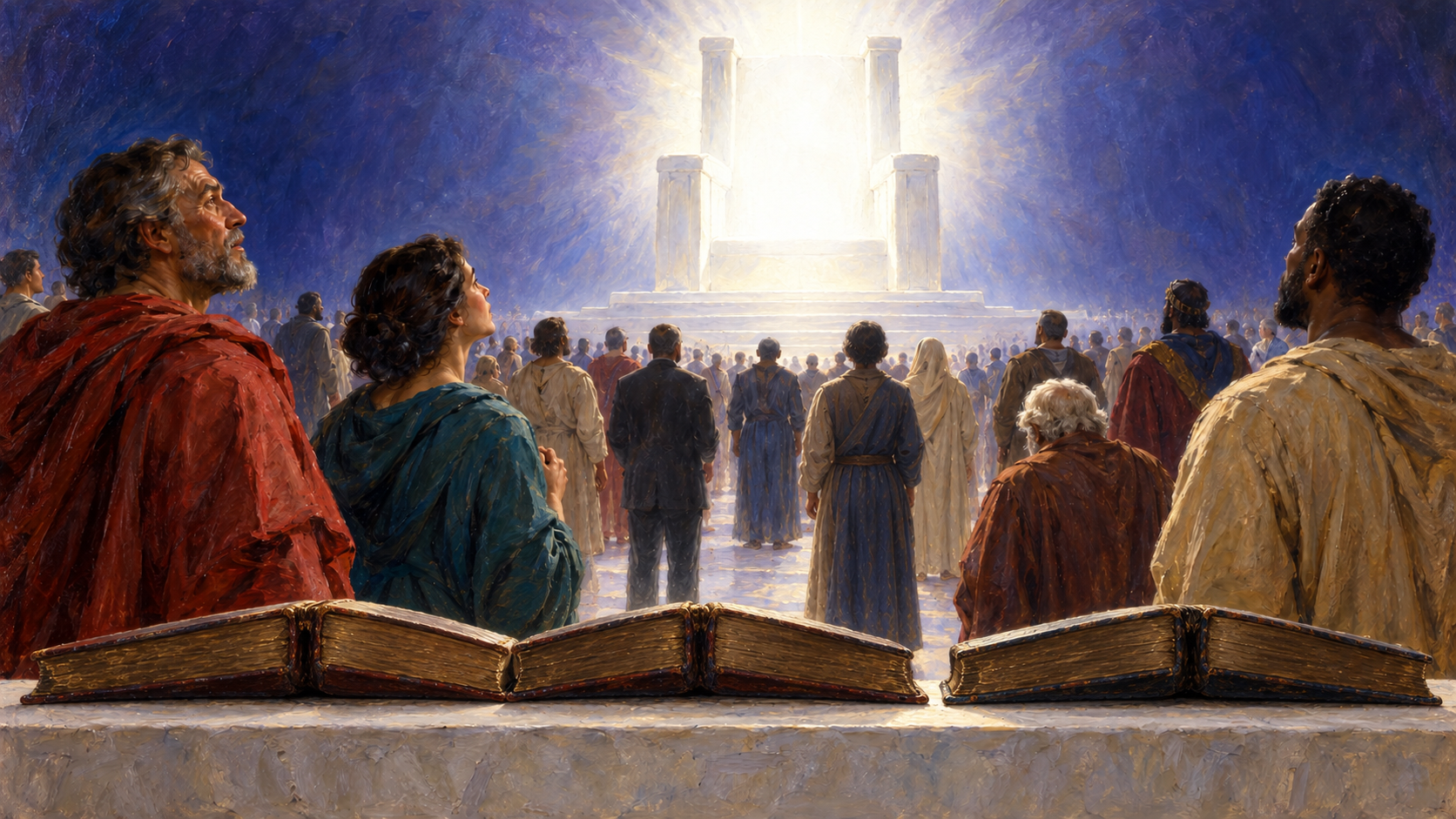
Who will stand before the Great White Throne, and what will happen there? Revelation 20 describes the books opened before God and the second death that follows His verdict. I want to understand who is being judged and why, while remembering that the Judge is offering us mercy now.
The Great White Throne at the End of Revelation’s Sequence
Revelation 20 places the Great White Throne after a definite series of events. Christ returns and Satan is bound. Those who belong to Christ are raised to reign with Him during His literal thousand-year rule. Satan is later released to deceive the nations one last time, but that rebellion is defeated. Only after these events does John see the great white throne and the One seated upon it (Revelation 20:11-15).
I understand Scripture to teach that Jesus will return bodily and gather His church before the Tribulation. He will deliver Israel and reign in a literal thousand-year kingdom, after which the Great White Throne judgment takes place. Keeping that order in view helps me distinguish this judgment from the church’s reward judgment before the millennium. John isn’t combining every judgment into one general picture.
The people involved also help me see the distinction. Those who share in the first resurrection are called blessed and holy, and the second death has no power over them (Revelation 20:4-6). The later judgment in verses 11-15 concerns the remaining dead, who are raised to stand before God. John describes different groups with different outcomes.
John describes a great white throne. Its greatness speaks of authority no creature can challenge, and its whiteness points to the purity of the judgment given there. Earth and heaven flee from the face of the One seated on it, with no place found for them (Revelation 20:11). I cannot read that scene and imagine that creation will provide a hiding place for anyone standing guilty before the holy Judge.
The vision shows us a public and final judgment carried out with perfect righteousness. Its purpose is far more serious than satisfying curiosity about what the throne looks like. No one can conceal the truth behind ancestry or social standing, and neither wealth nor religious performance will do so. Even crimes hidden from every human court are known to God. The small and great will answer to the same Judge.
Abraham once asked, “Shall not the Judge of all the earth do right?” Scripture answers that question with confidence: God knows every fact and judges without favoritism. He never confuses innocence with guilt. That comforts me when I think of what a human court may miss, but it also humbles me. Nothing concealed from a family, or even hidden from our own consciences, escapes His knowledge.
The Dead, the Books, and the Book of Life
John sees the dead, small and great, standing before God. The sea gives up its dead, while Death and Hades surrender those held in them (Revelation 20:12-13). No grave or ocean can keep God from raising a person. Someone lost in a disaster is still fully known to Him, and the passing of years does not make that life any less accountable.
These people are raised bodily. Jesus said that everyone in the graves will hear His voice and come out, some to life and others to judgment (John 5:28-29). Daniel 12:1-3 likewise describes people awakening from the dust, some to everlasting life and others to shame. Both passages prevent me from treating death as the end of our accountability to God.
The Great White Throne concerns the unredeemed dead. Believers have already been raised to life and belong to Christ’s kingdom, so they do not stand here hoping their good deeds will outweigh their sins. Their salvation rests on grace received through faith. Every genuine believer is indwelt and sealed by the Holy Spirit and remains eternally secure.
John says that books are opened, along with another book called the Book of Life. The dead are judged according to what the books record about their works (Revelation 20:12). I notice that their guilt is established from the record of what they have done. Each unredeemed person has actual sin recorded there, and the opened books make the justice of the sentence plain. No one is condemned because God overlooked a fact or mishandled the record.
The Book of Life serves a different purpose from the books of deeds. Scripture presents it as God’s record of those appointed to life. As I understand the biblical record, every person begins written there, and the names of those who finally reject the Messiah are blotted out. Believers remain because Christ’s blood blots out their sins. No one can use the books of deeds to justify himself, and believers do not depend on them for their place in the Book of Life.
Anyone not found written in the Book of Life is cast into the Lake of Fire (Revelation 20:15). I would not separate that outcome from a person’s response to God, as though the choice were arbitrary. Throughout the Bible, God calls people to repent and believe, and Christ died for the whole world. The offer of salvation is genuine even though a person can resist it and finally reject the Savior.
Jesus Christ Judges Every Life Righteously
The New Testament identifies Jesus as the final Judge. The Father has committed all judgment to the Son so that people will honor the Son just as they honor the Father (John 5:22-23). Acts 17:31 also tells us that God has appointed a day to judge the world in righteousness through the Man He ordained. He has given us assurance of that coming judgment by raising Jesus bodily from the dead.
The One who will judge is the same Jesus who first came in humility to save us. He is the eternal Son, fully God and fully man, who was born of a virgin and lived without sin. At the cross He physically bore the punishment for our sins in His innocent body. He suffered torture and shed His blood before He died and was buried. On the third day He rose bodily from the grave.
I don’t see a contradiction between the mercy Jesus offers and the justice He will carry out. His love is holy, just as His judgment is righteous. The Son’s willingness to give Himself for sinners shows how seriously God takes sin. That same cross reveals the depth of God’s love as He offers us reconciliation through Christ.
The dead are judged according to their works, with the truth of their lives open before God. His verdict does not rest on a vague impression or one isolated moment. That still gives no one a way to earn eternal life through good deeds, because all have sinned and fall short of God’s glory. No one is justified by works of the law. The books show why His verdict is just, rather than impulsive or excessive.
People are responsible for how they respond to the light God gives them. What they say and do reveals their choices, and the desires they continue to follow also reveal the choices they make. The record also exposes the truth they resisted. Christ does not need witnesses to supply missing information about a life He knows completely.
Romans 2 teaches that people who sin without the written law still perish apart from it, while those under the law are judged by that law. Jesus also spoke of stricter judgment for those who received greater light and refused it. I take that distinction seriously without using it to dismiss anyone’s guilt. God knows exactly what each person received and how that person responded.
Grace does not make our deeds meaningless. What a person does reveals whom or what that person loves and serves. Saving faith bears fruit because the Holy Spirit makes the believer new, rather than leaving the life untouched. At the Great White Throne, the deeds in the books publicly confirm the righteousness of the Judge’s sentence.
The Second Death and the Lake of Fire
After the dead are judged, Death and Hades are cast into the Lake of Fire. John then explains, “This is the second death” (Revelation 20:14). We experience the first death in this fallen world, but the second death is the final judgment from which no one returns.
Jesus warned us to fear God, who is able to destroy both body and soul in Gehenna (Matthew 10:28). I understand that destruction as the final loss of life and the ruin of the whole person. It does not make sin unimportant or turn judgment into temporary correction. Human souls are not naturally immortal; eternal life is God’s gift through Christ.
I am not describing soul sleep or a judgment that eventually restores everyone. Nor do I understand unredeemed human beings to remain consciously alive in torment forever. The Lake of Fire brings real judgment and final destruction. It is neither a purifying stage that leads to universal restoration nor a prison with the possibility of eventual release. God calls it the second death, and that death cannot be reversed.
Some Christians understand “everlasting punishment” in Matthew 25:46 to mean that the unredeemed remain consciously alive in torment forever. I understand the punishment to be everlasting because its result never ends. Scripture can name a judgment by its permanent consequence, just as eternal redemption never needs repeating and eternal judgment gives a verdict that never changes.
I want to let the Bible’s words destruction, perish, consume, death, and destroy carry their normal force. God destroys both body and soul in Gehenna, and Scripture pictures the wicked as chaff burned up. It also says the final fire consumes God’s enemies. Those descriptions don’t suggest a mild judgment to me. They describe a loss that is terrifying because it is final.
Revelation 20:10 uses different language for the devil, the beast, and the false prophet: these three will be tormented day and night forever in the Lake of Fire. I cannot set that statement aside to make every description sound the same. John distinguishes them from the human dead judged according to their works and cast into what he calls the second death. We need to retain both statements as written. Endless torment is stated for those three beings, while final destruction is stated for human body and soul.
The finality of that destruction makes the gospel urgent. There will be no second chance or later recovery, so we should not speak as though someone could put off receiving life in God’s Son without consequence. He offers that life now, before the day of judgment comes.
The Judgment Seat of Christ and Mercy Today
We must also distinguish the Great White Throne from the judgment seat of Christ. Believers will appear before Christ to receive what is due for what they did in the body (2 Corinthians 5:10). They are already saved when they face that judgment of accountability and reward, so it does not threaten them with the second death.
Our service will be tested, and eternal security gives me no reason to take faithfulness lightly. But we are saved by grace, not by a successful record of works, and our security rests in Christ’s blood and resurrection. The Great White Throne concerns the unredeemed dead whose names are not found in the Book of Life.
That judgment is still ahead of us. Today the gospel is being proclaimed and Jesus invites sinners to come to Him, having died for the whole world. Whoever believes in Him has everlasting life and will not come into judgment, having already passed from death into life (John 5:24).
No one should delay repentance by assuming another opportunity will come after death. Scripture says people die once and afterward face judgment. Come to Christ now, trusting His shed blood and bodily resurrection. He forgives completely and gives life that the second death cannot touch.
We do not repent by trying to repair our record before we approach God. Repentance means honestly turning away from sin to the One who has the right to judge it. Our faith rests in what Christ has already finished for us: He bore sin in His body and rose bodily from death.
We should speak of final judgment with tears and compassion, never pride. Paul knew the terror of the Lord and sought to persuade people, pleading with them to be reconciled to God through Christ’s sacrifice. I want that same concern to shape how I speak. Judgment gives our witness seriousness, while the forgiveness and life freely offered in the Savior make our message good news.
This teaching should move me to worship and humility, not to celebrate another person’s destruction. Jesus is the only Savior and the righteous Judge, so we need to speak truthfully and compassionately about Him. At the same time, John 5:24 gives believers real security: the person who hears Christ’s word and believes has passed from death into life. The second death has no authority over anyone who belongs to Him.
God’s Final Verdict and the World to Come
It can be hard to contemplate final judgment when the judgments we see people make are often incomplete. A court may lack evidence or hear a lying witness, and even sincere people can misunderstand what happened. I need to remember that Christ has none of those limitations. He knows every heart and every act, so His judgment perfectly joins truth with holiness and mercy.
Evil done in secret will not stay hidden forever, and God also knows every act of faithfulness the world has overlooked. At the Great White Throne, the Creator will disclose the truth and show that His judgment is right. With the full truth known, no accusation against His character will stand.
Peter tells us that the present heavens and earth face a coming fiery judgment, then directs believers toward new heavens and a new earth where righteousness dwells (2 Peter 3:7-13). That promise gives me a definite hope for the future. Christ will bring history to its appointed end. He will raise the dead and expose the truth. Righteousness will be vindicated and rebellion against God will end before the promised creation arrives. We are not waiting for an empty future or one governed by chance.
The related studies on the last day and first resurrection, eternal conscious torment, the Book of Life, and salvation examine those subjects more fully.
My Final Thoughts
Revelation 20 won’t let me treat sin as something God will simply forget, or death as a way to escape answering to Him. Christ will raise the unredeemed dead, and the opened books will establish their guilt before everyone. The Lake of Fire will bring the irreversible second death. Yet this Judge is the Savior who first came to shed His blood for the whole world and rise from the grave. He is offering mercy now, and I want us to hear that invitation with the seriousness it deserves. Receive Christ by faith, and the life He gives will remain forever beyond the reach of the second death.