
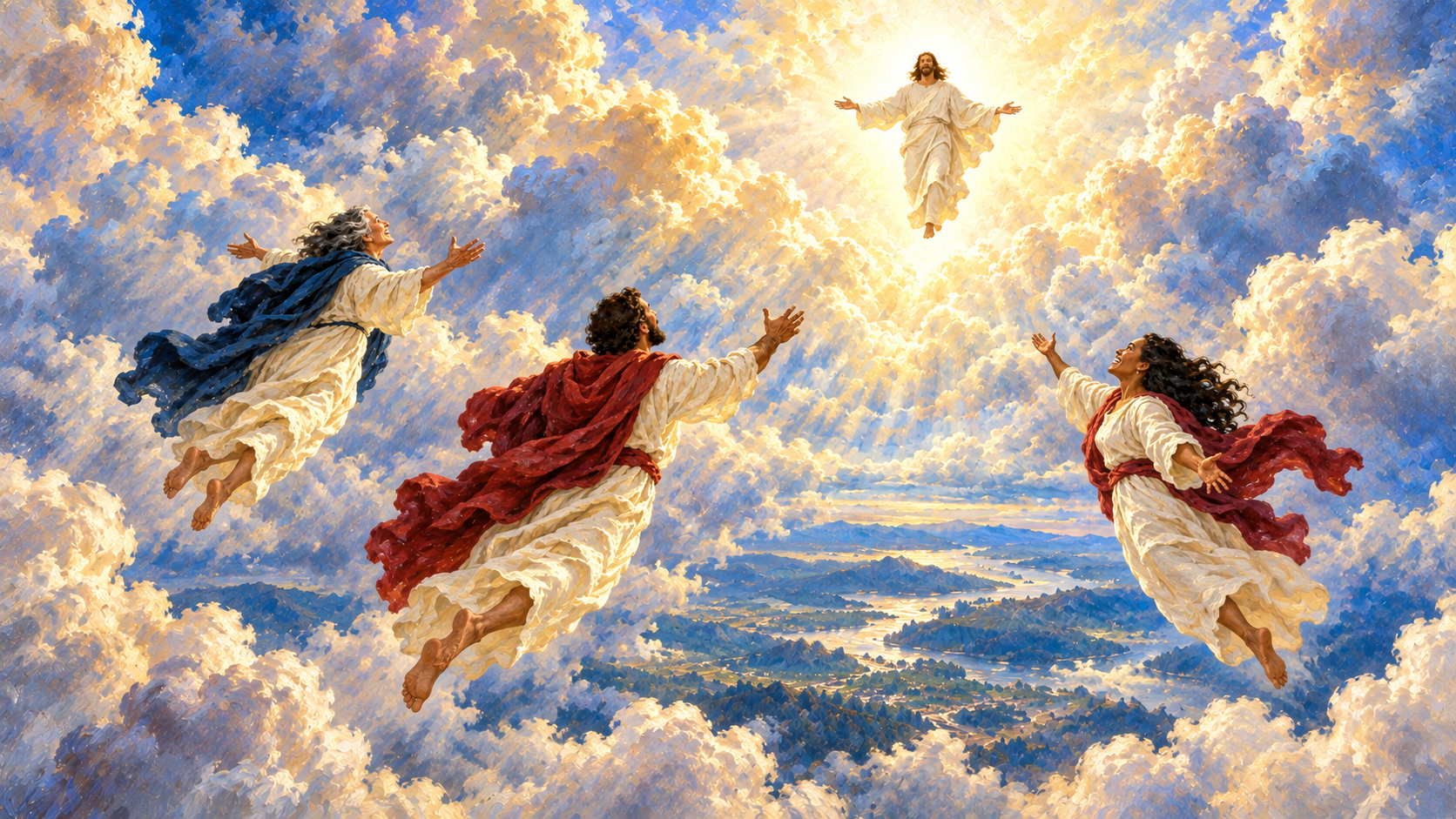
Paul says believers will be “caught up” to meet the Lord, but where does that gathering fit in the rest of prophecy? Christians who agree that Jesus will return bodily still differ about its timing. I want to examine the passages that place the gathering of His church in relation to the seven-year Tribulation. We are considering when this happens, not questioning whether Christ wins.
Christ Will Gather His Church
The event we call the rapture is described in the Bible even though that English word does not appear there. The term comes through the Latin translation of “caught up” in 1 Thessalonians 4:17. Paul describes the Lord Himself descending from heaven, followed by the resurrection of the dead in Christ. Believers who are still living will then be caught up with them to meet the Lord in the air.
Then we who are alive and remain shall be caught up together with them in the clouds to meet the Lord in the air. And thus we shall always be with the Lord.
Paul is promising a future gathering of Christ’s people, not describing an illustration or a spiritual feeling. The Greek verb behind “caught up” is harpazo, which can mean to seize or snatch someone, or to take someone suddenly. Scripture uses it for Philip being caught away by the Spirit in Acts 8:39 and for Paul being caught up to paradise in 2 Corinthians 12:2-4. It also describes the male child being caught up to God and His throne in Revelation 12:5. Understanding the word helps us see what Paul means by the gathering. Its Latin rendering gave English-speaking Christians the term rapture, while Scripture itself gives us the doctrine.
Paul wrote to Christians in Thessalonica who were grieving believers who had died. Those still living feared that the dead might miss Christ’s return, and Paul assured them that they would not. In fact, the dead in Christ rise first, and then the living join them. I find comfort in how personal and bodily that promise is. It is a reunion that lasts forever, because death cannot separate a Christian from the coming Lord.
Jesus had already comforted His disciples with a similar promise on the night before His crucifixion:
I go to prepare a place for you. And if I go and prepare a place for you, I will come again and receive you to Myself; that where I am, there you may be also
John 14 does not give us every detail of the prophetic calendar, and I don’t want to claim that it does. But I do see a natural connection with 1 Thessalonians 4. In both passages Christ comes for His people and receives them to Himself. He keeps them with Him. The emphasis differs from passages about His public coming in glory. Those describe every eye seeing Him as He judges the nations before establishing His kingdom on earth.
1 Corinthians 15 explains how believers will be transformed. Flesh and blood in their present condition cannot inherit the kingdom of God. As Paul says, “The dead will be raised incorruptible, and we shall be changed” (1 Corinthians 15:52). We are not looking for an escape from physical existence or for God to abandon His creation. The Rapture includes resurrection and glorification, when the same Jesus who rose bodily will transform His people to be like Him.
Delivered From the Coming Wrath
Believing in a pre-Tribulation Rapture does not mean expecting a painless Christian life. Jesus said, “In the world you will have tribulation” (John 16:33), and Paul warned that those who desire to live godly in Christ Jesus will suffer persecution (2 Timothy 3:12). Hostile rulers and false teachers have opposed the church from its beginning. Many believers have suffered rejection and poverty, and others have faced imprisonment or death.
Scripture distinguishes that persecution from God’s coming prophetic wrath. Paul praises the Thessalonians for waiting for God’s Son from heaven, the risen Jesus “who delivers us from the wrath to come” (1 Thessalonians 1:10). A few chapters later he writes:
For God did not appoint us to wrath, but to obtain salvation through our Lord Jesus Christ
Romans 5:9 also promises that those justified by Christ’s blood will be saved from wrath through Him. The Thessalonians had more to rest in than a general feeling that things would turn out well. God had promised to send His risen Son from heaven, and their hope was in Him.
The Tribulation involves more than ordinary hardship becoming worse. Revelation describes the Lamb opening the seals and heaven governing the judgments. People recognize “the wrath of the Lamb” (Revelation 6:16-17). God carries out the judgments of the Day of the Lord throughout this period, even as they grow more severe. That helps me distinguish the world’s hatred of the church now from God’s outpouring of wrath then. The church may suffer the world’s hatred now, but it is not appointed to that coming outpouring of divine wrath.
Christ gives the faithful church at Philadelphia a particular promise in Revelation 3:10. He will keep it “from the hour of trial which shall come upon the whole world, to test those who dwell on the earth.” A trial that reaches the whole world goes beyond a local difficulty. I would not use this verse by itself to prove when the Rapture happens. Read alongside the promises of deliverance from wrath and Scripture’s larger prophetic distinctions, though, it supports removal before that hour.
Israel, Daniel’s Week, and Christ’s Public Return
The seventy weeks in Daniel 9:24 were determined for Daniel’s people and his holy city, so the prophecy concerns Israel and Jerusalem. Messiah is cut off after sixty-nine weeks, leaving one final week. Daniel 9:26-27 describes a covenant during that week and an abomination that brings desolation. I understand the remaining week to be a literal seven-year Tribulation that is still ahead.
Romans 11 says God has not cast away Israel. The nation’s present hardening is partial and temporary. Believing Jews and Gentiles are united in one body through Christ, but that does not erase the Old Testament covenants concerning Israel’s future restoration. I cannot treat the revelation of the church as a cancellation of promises God made to Daniel’s people and city. Those promises still mean what He said.
During the final week God judges the world and deals with Israel as He prepares the way for Messiah’s public reign. That helps me understand why this period is not the church’s normal calling. Revelation 6-18 repeatedly speaks about saints and witnesses, as well as Israel, the nations, and judgment. Unlike Revelation 2-3, it does not use the word church for earthly assemblies. That observation cannot carry the entire argument, but it fits the broader conclusion that the church has already been gathered.
At the Rapture, believers meet Christ in the air and are received to be with Him. His public return has a different setting: He comes in power and great glory, and His feet stand on the Mount of Olives. He judges His enemies and establishes His kingdom (Matthew 24:29-31; Zechariah 14:1-9; Revelation 19:11-21). The pre-Tribulation view understands these as distinct phases of the one blessed return of Christ, with the Tribulation between them.
One difference I cannot easily set aside is the condition of the people entering the kingdom. 1 Thessalonians 4 comforts the church with resurrection and reunion, whereas Revelation 19 describes the King coming to make war in righteousness. Believers are caught up to Him at the gathering, and the saints come with Him at the glorious return. The church receives glorified bodies at the Rapture, but mortal survivors of the Tribulation enter the kingdom after His public return and have children. That distinction fits the millennial prophecies in Isaiah 65:20-23.
Differences between these passages do not give us reason to pull them apart as though they described unrelated hopes. They center on the same Lord Jesus. But putting everything into one instant leaves questions about the details Scripture gives. If every believer were glorified at Christ’s public return, who would enter the literal thousand-year kingdom in a natural body? The post-Tribulation view has difficulty accounting for those believers.
Timing Views and Major Objections
Faithful Christians who confess that Jesus will return bodily differ over when the Rapture occurs. A pre-Tribulation reading places it before the seven-year Tribulation, while a mid-Tribulation reading places it around the middle of Daniel’s final week. The latter often distinguishes the earlier trouble from the later wrath. A post-Tribulation reading understands the Rapture and Christ’s public return as one event after the Tribulation.
All three views affirm that Jesus will return bodily and raise believers, and all call Christians to be ready. The disagreement is over the order of events, not whether Christ wins or resurrection is real. My salvation rests in Christ’s blood, not in getting every prophetic interval right. Even so, the promises of deliverance from wrath and the expectation that Christ may come for His church lead me toward the pre-Tribulation view. Keeping Israel distinct from the church also lets Daniel’s final week remain focused on the people and city the prophecy names. Together with the details of Christ’s public kingdom, these passages make the most coherent sense to me within that view.
One objection identifies the “last trumpet” in 1 Corinthians 15 with Revelation’s seventh trumpet. We need to look at what happens in each passage before making that connection. In the first, believers are raised and transformed. Revelation’s seventh trumpet belongs to a sequence of angelic judgments in a different book and setting. Since Scripture uses trumpets in many contexts, the shared noun cannot establish that these are the same event. Each passage’s argument must decide that question.
Another objection concerns Jesus’ promise in John 6 to raise believers “at the last day.” I rejoice in the certainty of that promise, but I don’t understand the phrase to require every phase of righteous resurrection to happen at one instant. Revelation 20 describes righteous people who died during the Tribulation living and reigning with Christ before the wicked are raised for final judgment. There is also an order in 1 Corinthians 15: Christ is the firstfruits, followed by those who belong to Him at His coming. The pre-Tribulation view understands the first resurrection as taking place in that order, rather than as one event with no distinct phases.
Matthew 24 places Christ’s public appearing and a gathering of the elect after the Tribulation. Pre-Tribulation teaching affirms that gathering. What we need to determine is whether those elect must be the church that was gathered earlier. The chapter speaks prominently about Israel and Jerusalem, with references to Judea and the abomination of desolation as well as the nations. Within that setting, I understand the gathering to concern saints who lived through the period, including Israel’s faithful remnant, at Christ’s public return. I am reading Matthew 24 in its context, not setting its after-Tribulation gathering aside.
The charge of escapism deserves an honest answer. We cannot choose an interpretation simply because it is comforting, and Christians have always been called to endure persecution. But receiving rescue from divine wrath is not cowardice. God preserved Noah through the flood and removed Lot before fire fell. He also sheltered Israel when judgment struck Egypt. Those accounts show a pattern of God distinguishing His people while judging the wicked; they do not provide a separate proof of the Rapture. The central evidence remains His direct promise that believers are not appointed to wrath.
Some object that the pre-Tribulation view is a recent invention. I would not answer that by claiming that all earlier Christians taught a complete modern pre-Tribulation system. They wrote about Christ’s return and resurrection, and about tribulation and deliverance, but their sources do not give us one simple, unanimous system. Neither side should exaggerate that history. The doctrine must stand or fall by Scripture. Paul delivered the Rapture teaching “by the word of the Lord” (1 Thessalonians 4:15), which gives us the authority we need.
Resurrection, Kingdom, and Present Hope
Christ’s resurrection gives this hope its foundation. He is the firstfruits of those who have fallen asleep (1 Corinthians 15:20), and His body rose never to die again. Because He lives, everyone who belongs to Him will live. That promise includes both the dead in Christ rising at the Rapture and living church believers being transformed.
Revelation 20 describes people killed during the Tribulation for their witness to Jesus. They live and reign with Him for a thousand years as part of the first resurrection, the resurrection of the righteous. The rest of the dead do not live again until the thousand years are over, when the Great White Throne judgment takes place. Scripture therefore does not require every human being to rise at the same instant. Christ rises first, followed by His people. His kingdom comes before the wicked are raised for final judgment.
I believe Christ will reign for a literal thousand years in a real Millennial Kingdom, fulfilling His promises to Israel. He will govern the nations and openly establish righteousness. Gathering the church beforehand does not remove her from God’s plan. It brings her to her Lord, with whom she later returns in glory.
Jesus told His servants to watch and be ready while continuing their work. Prophecy should not leave us idle or fearful, and it gives us no reason to become obsessed with dates. Paul closes his Rapture teaching with the instruction, “Therefore comfort one another with these words” (1 Thessalonians 4:18). We can bring that promise to someone grieving a Christian’s death. It also gives believers steadiness as they face a difficult world.
Titus 2:11-13 connects our expectation of Christ with the way we live. God’s grace teaches us to deny ungodliness and worldly desires while we look for the blessed hope and glorious appearing of our great God and Savior Jesus Christ. If I expect to meet Him, that hope should make me more honest and prayerful. It should give me courage to obey and willingness to share both the gospel and what God has provided. The possibility that He may come at any time does not excuse abandoning ordinary responsibilities. It gives me reason to serve faithfully while remembering that this world is not my final home.
No one knows the day or hour, so we should reject date-setting and sensational claims. Our hope rests in Jesus Christ, who shed His blood for sinners and rose bodily from the grave. He will raise His people and judge evil. He will also restore what sin has broken and reign forever, just as He promised. We receive salvation by grace through faith in Him, not by mastering a prophetic chart.
Related Studies
Examining the Pre-Tribulation Rapture develops the biblical case for Christ gathering His church before the Tribulation.
The End Times Timeline traces the major events Scripture places around the Day of the Lord and Christ’s kingdom.
The Last Day examines resurrection language and the biblical use of the phrase “the last day.”
The Mark of the Beast explains the coming mark, loyalty to Christ, and the judgment described in Revelation.
My Final Thoughts
I believe Christ will gather His church before the literal seven-year Tribulation, then return publicly in glory to establish His kingdom. That conviction should make me faithful in the responsibilities I have now, not careless about present suffering or preoccupied with predicting dates. Jesus, who shed His blood and rose bodily to save us, has promised to receive us to Himself. I want that hope to shape holy living and steady service while we comfort one another with the certainty that He is coming for His people.