
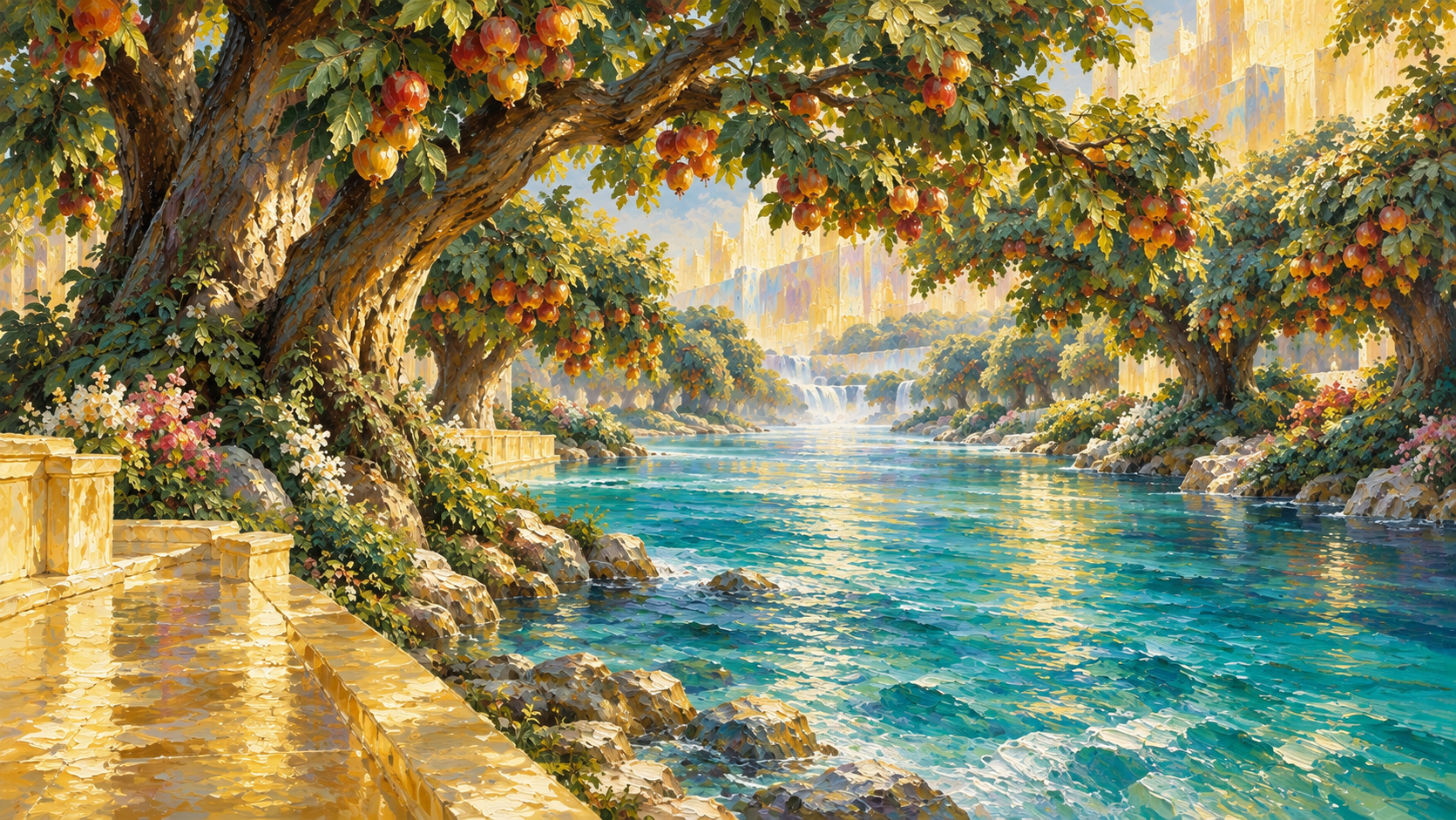
The Tree of Life appears near the beginning of the Bible and returns at the very end. I have often wondered how the real tree in Eden connects with the picture used in Proverbs and the tree John sees in New Jerusalem. We can understand those connections by reading each passage in its own setting before bringing them together.
The Tree of Life From Eden to New Jerusalem
Genesis places the tree in a real garden before humanity fell into sin. Revelation shows it beside the river of life in the future New Jerusalem after final judgment. Between those accounts, Proverbs uses the image to describe how God’s wisdom works in ordinary life. A righteous person’s influence can nourish others like fruit, and wholesome speech can refresh them. The same image describes the joy of seeing a worthy desire fulfilled.
The tree helps us follow what happened to humanity’s access to life. God provided that life at the beginning, but people rebelled against their Creator and were barred from the tree. By the end of the Bible, the curse has been removed. Redeemed nations live in the light of God’s throne with access to the Tree of Life once more. That is much more than a decorative symbol.
None of these passages treats the tree as an independent source of magic. God made it, and His word determines who has access to it. Even in Revelation, the river that nourishes it comes directly from the throne of God and of the Lamb. I don’t want to lose sight of the Giver while thinking about the tree: life remains His gift throughout.
We also need to recognize how each passage uses the image. Genesis and Revelation describe an actual tree, while Proverbs uses its name for things that nourish life. Treating all three as the same kind of language would either turn history into an allegory or make a proverb claim more than it does.
Historical Eden and the Two Trees
The LORD God planted a garden eastward in Eden, and there He put the man whom He had formed. And out of the ground the LORD God made every tree grow that is pleasant to the sight and good for food. The tree of life was also in the midst of the garden, and the tree of the knowledge of good and evil.
Genesis describes real land and names the rivers of Eden. Trees grew there for food, and God gave the man meaningful work. He also gave him a command with a stated consequence before creating the woman and bringing the two together. We are reading about Adam and Eve as real people in God’s good creation, not a myth about humanity gradually awakening.
Before we read any prohibition, we see the LORD making trees grow from the ground that are both pleasant and useful. His generosity supplied an abundance, and the Tree of Life was part of that provision.
The words “in the midst” give the Tree of Life a prominent place in the garden. Scripture then names the tree of the knowledge of good and evil. Both are brought to our attention, but I would not press the grammar into saying that they occupied the very same central point.
The Tree of Life is associated with continuing life, while the tree of knowledge is the one God forbade Adam to eat from. He could freely eat from every other tree in the garden. We should notice how much God gave him permission to enjoy around that one boundary.
The issue was not that God had created fruit that was evil in itself. Would people accept His definition of good and evil, or take what He had forbidden? The term moral autonomy describes wanting to decide right and wrong for ourselves. I find that easier to understand through the choices Genesis records. God gave a command, the serpent challenged it with deception, and the woman eventually took the fruit and ate.
The serpent attacked God’s character along with His word. The woman ate and gave some of the fruit to her husband, who ate too. Their eyes were opened, but shame came instead of enlightenment, and blame immediately entered their relationship. Death began to rule human life through this covenant rebellion. They had done far more than innocently seek information.
God’s command gave Adam a real boundary within a life of meaningful work and freely available food. Eating from the forbidden tree would bring death. His love and loyalty were tested by whether he would honor that command.
Adam depended on the God whose command he received. He had neither created himself nor planted the garden that fed him, and he had no right to redefine obedience to its Giver. That helps me see why human life is moral as well as dependent. We flourish by receiving God’s gifts under His word.
Adam remained physically alive for a time, but that did not make the serpent right. Death entered human experience immediately as the couple hid from God and turned against one another. Corruption spread, and they were expelled from the garden. When Adam eventually returned to the dust, physical death completed the sentence God had declared.
Then the LORD God said, "Behold, the man has become like one of Us, to know good and evil. And now, lest he put out his hand and take also of the tree of life, and eat, and live forever"– therefore the LORD God sent him out of the garden of Eden to till the ground from which he was taken. So He drove out the man; and He placed cherubim at the east of the garden of Eden, and a flaming sword which turned every way, to guard the way to the tree of life.
Notice that the tree did not disappear after the fall. God removed access to it so that fallen humanity could not eat and live forever. The wording makes the exclusion forceful: Adam was sent out of the garden and then driven from it.
Many teachers see mercy in that exclusion because living forever in a fallen condition would perpetuate corruption. I consider that a reasonable theological inference. Still, Genesis says God prevented access without explicitly naming mercy as His motive. We should distinguish what the passage states from what we understand may explain it.
This also shows why I do not treat eternal life as something the human soul already possesses. We are creatures whose lives depend on God. Immortality must be received as His gift, rather than assumed to be an indestructible possession of our own.
God placed cherubim at the entrance to Eden along with the turning flaming sword. These are real heavenly beings associated with His holy throne and presence, not the winged infants we see in later art. They guarded the way back to the garden.
Cherubim later appear over the mercy seat in the tabernacle. We don’t have to make every detail of Eden a hidden description of the tabernacle to recognize the connection. Sinful people cannot decide for themselves the terms on which they enter God’s holy presence.
No amount of personal effort can get humanity back to life beyond that guarded boundary. Philosophy and man-made religion cannot open it either. God Himself must provide the way, and the rest of Scripture unfolds His provision through promises and covenants. Sacrifice prepares the way for the Messiah, whose resurrection opens the way into the final new creation.
We are not told whether Adam and Eve had already eaten from the Tree of Life. Genesis tells us that after sin they could take its fruit and live forever unless God barred their access. I would not build a detailed sacramental system on what the passage leaves unsaid.
Nor are we told the tree’s species or given a description of magical chemistry in its fruit. The absence of those details doesn’t make the tree imaginary. Scripture affirms that it was real and tells us the function God gave it.
Genesis does not say that eating from the tree of knowledge gave Adam and Eve every moral fact at once. The new knowledge included shame and firsthand participation in rebellion, and we should be modest about claiming anything beyond what the account tells us.
The Tree of Life in Proverbs
Proverbs uses the phrase four times as a metaphor, beginning with wisdom that nourishes life like a tree. The comparison also describes the fruit of a righteous person’s life and the effect of wholesome speech. A fulfilled worthy desire brings the kind of refreshment pictured by the same image.
Length of days is in her right hand, In her left hand riches and honor. Her ways are ways of pleasantness, And all her paths are peace. She is a tree of life to those who take hold of her, And happy are all who retain her.
Biblical wisdom begins with fearing the LORD and accepting His order for life. Choosing to walk in His paths ordinarily brings consequences that sustain life. We should recognize that benefit without turning wisdom into a way to earn immortality. Proverbs is teaching us how God’s instruction nourishes a person’s life.
Those are wise principles to understand in context, not promises that work mechanically regardless of circumstances. Wisdom ordinarily protects life and strengthens relationships, but believers still face persecution and injustice in a fallen world. Illness has not disappeared, and every human life still ends in death unless Christ returns first.
The fruit of the righteous is a tree of life, And he who wins souls is wise.
The fruit of a righteous life reaches other people. Someone’s integrity gives others stability, and generosity meets needs that might otherwise go unanswered. A commitment to justice protects those easily exploited. Wise counsel and a faithful example can nourish a household and the wider community. That makes me consider what my own influence produces: does it support life in others, or spread corruption?
The Hebrew wording in the second line literally refers to taking or capturing lives. That helps us understand how “wins souls” can describe wise influence that gains people. I would not reduce it to a technical formula for modern evangelism. The verse connects the righteous person’s fruit with the profound effect wisdom can have on others.
Salvation remains God’s work through the gospel. A righteous person’s fruit can point others toward truth, but no human personality or technique regenerates a soul.
A wholesome tongue is a tree of life, But perverseness in it breaks the spirit.
The adjective translated “wholesome” carries the idea of healing or soundness, which helps us understand the effect of the tongue here. Truthful speech can clear up confusion. Gentle words at the right moment may restore a weary person’s courage or help reconcile a conflict. They can give someone strength to keep going.
Words can also do the opposite. Manipulation damages trust, while cruelty can crush a vulnerable person. Lies and twisted speech wear down the spirit over time. Proverbs treats our words as morally powerful because they affect relationships and shape what people do.
That does not mean pleasant words can give someone eternal life. The metaphor calls us to speak truth and grace under God’s authority. I need to consider whether I am using my tongue for that purpose.
Proverbs 13:12 describes deferred hope as making the heart sick and a fulfilled desire as a tree of life. It acknowledges how draining a long wait can be. Repeated delay may cloud someone’s thoughts and exhaust emotional strength, and the strain can even affect the body.
But the proverb doesn’t say that every desire is righteous or promise that every wish will come true. It describes how a good hope fulfilled can refresh a person. I should bring my desires under God’s word rather than use that verse to guarantee the outcome I want.
Across these four uses, God’s wisdom nourishes life while folly and perversity cause harm. Proverbs echoes Eden through those images without claiming that the literal Tree of Life exists in ordinary speech or conduct.
From Ezekiel’s River to Christ’s Promise
Ezekiel takes us from the comparisons in Proverbs to a prophetic vision. In Ezekiel 47, water flows from the future temple and grows deeper as it travels. It brings life wherever it goes, with trees on both banks bearing dependable fruit and useful leaves.
Along the bank of the river, on this side and that, will grow all kinds of trees used for food; their leaves will not wither, and their fruit will not fail. They will bear fruit every month, because their water flows from the sanctuary. Their fruit will be for food, and their leaves for medicine.
Ezekiel saw Israel’s restoration in the promised kingdom. Revelation later uses unmistakably related imagery for the final New Jerusalem. Both passages show life flowing from God’s presence, with abundant fruit on the trees and leaves associated with health.
The resemblance should not make us overlook their different settings. Ezekiel saw a temple, while Revelation describes a city without one. They belong to different points in God’s prophetic plan, even though the earlier vision helps prepare us to understand the later one.
He who has an ear, let him hear what the Spirit says to the churches. To him who overcomes I will give to eat from the tree of life, which is in the midst of the Paradise of God.
Jesus gave this promise to the real church in Ephesus, which had defended the truth but left its first love. He called the believers to remember where they had fallen and repent, returning to the works that once expressed their love for Him. I want to read the Tree of Life promise within that call to persevere faithfully in Christ.
Overcoming does not mean earning salvation by having stronger willpower than someone else. Revelation later identifies the Lamb’s blood as the basis of the believer’s victory. His people confess Him through the word of their testimony and stay faithful when obedience costs them. True faith endures because the One it trusts is the victorious Christ.
The phrase “Paradise of God” points us back to Eden and beyond the garden that was lost. What catches my attention is who grants access: Christ has authority to give what Genesis describes as guarded.
Revelation 21-22 describes what follows Christ’s bodily return and His literal thousand-year reign. After Satan’s final defeat comes judgment at the Great White Throne. John then sees the new heaven and new earth, with the holy city descending from God into that renewed creation.
Our final hope is to live bodily with God, rather than escape creation forever. Death and sorrow will pass away with the old order, along with the pain of the curse. Nothing that defiles will enter the city. God’s servants will worship Him there and reign in holiness.
The Tree of Life belongs to that real future. Revelation’s apocalyptic imagery carries rich meaning, but it describes things God will actually accomplish. We shouldn’t reduce it to a private feeling of spiritual well-being.
And he showed me a pure river of water of life, clear as crystal, proceeding from the throne of God and of the Lamb. In the middle of its street, and on either side of the river, was the tree of life, which bore twelve fruits, each tree yielding its fruit every month. The leaves of the tree were for the healing of the nations. And there shall be no more curse, but the throne of God and of the Lamb shall be in it, and His servants shall serve Him.
The river begins at the throne of God and of the Lamb, showing us that life comes from God’s presence and rule. The Father and Son share this one throne without ceasing to be distinct Persons. That fits fully with Christ’s deity.
The river is pure and clear, with nothing to corrupt life in the city. There is no guarded boundary like Eden’s after the fall and no polluted source like those in our fallen world.
John speaks of a single Tree of Life on either side of the river. Some readers picture a vast tree spanning the water, while others picture a line of trees sharing one life-giving identity. It may also be that this prophetic perspective cannot be fitted into an ordinary botanical diagram.
The text does not choose among those ways of picturing the scene, so I would not press the description further than John does. His central point is clear enough: access is abundant, and the people of the final city are not competing for one scarce piece of fruit.
John directs our attention to twelve kinds of fruit and a harvest every month. That number fits the city whose gates bear the names of Israel’s tribes and whose foundations bear the names of the Lamb’s apostles. Rather than inviting speculation about botany, the recurring harvest shows us an ordered and complete provision that will never fail.
God’s glory lights the city, so Revelation says it needs neither sun nor moon for illumination. I would not use the mention of months to construct a future lunar calendar. The point is that this tree never has a barren season.
Even with eternal life, the redeemed will still receive joyfully from God as His creatures. They will not become self-existent gods. Depending on His generosity forever is no defect in that life. It is part of the glory of belonging to Him as His creatures.
We need to understand “healing” in the light of what Revelation has already told us. Disease cannot continue forever when death and sorrow are gone and crying and pain have passed away. The next verse also says there will be no more curse.
These nations are redeemed peoples walking in the Lamb’s light. Once scarred by sin, they now enjoy the complete health and settled wholeness pictured by the leaves. Ezekiel’s vision of leaves used for medicine supplies the Old Testament background for this final well-being.
The leaves are not repairing ongoing rebellion or barely keeping mortality under control. The old order has passed away, and nothing defiling can enter the city.
By the end of the garden account in Genesis, the curse had brought pain and thorns. Death had entered human experience, and exile had cut off access to the tree. Revelation shows God dwelling with His people in answer to those losses. His servants will see His face and serve Him as they reign in life. With the curse gone and access restored, fruit and living water will be freely available.
We are being promised more than a return to Eden before humanity was tested. The Lamb has saved the redeemed, and God raises them beyond death’s reach. They will live in a city where rebellion will never return.
God’s servants will see His face as they worship Him, with no impurity in their worship and no frustration in their work. There will be no more hiding from His presence. They will enjoy fellowship with Him, and life itself will be free from death.
Access to Life Is God’s Gift
Blessed are those who do His commandments, that they may have the right to the tree of life, and may enter through the gates into the city.
The Textus Receptus and received Byzantine tradition read “those who do His commandments.” I retain that reading here rather than replacing it with the critical-text phrase about washing robes.
Keeping the commandments does not contradict salvation by grace. Revelation identifies the redeemed by the Lamb’s blood while repeatedly calling them to faithful obedience. Obedience marks the lives of those who belong to Christ. It is not something they can offer as payment for eternal life.
In the received text, verse 19 warns about removal from the Book of Life rather than the tree of life. I want to keep that wording and the two teachings distinct. Every person begins written in the Book of Life. Those who finally reject the Messiah are blotted out, while believers remain because Christ’s blood has blotted out their sins. Other judgment books record deeds and sins. The Tree of Life has a different function: it is God’s provision to sustain life in Eden and the final city.
The tree again directs us to God as the Giver of eternal life. Only He has life in Himself without depending on another. We are creatures, and sin brings death. Scripture promises immortality through resurrection rather than teaching that every human soul is naturally indestructible.
Believers receive eternal life through faith in Jesus Christ. Those who finally reject Him will also be raised, but to face judgment. Their sentence is the second death, the irreversible destruction of both body and soul. Universalism denies the permanence of that judgment and so misrepresents it. I also cannot reconcile endless conscious torment for human beings with Scripture’s description of the second death; the two contradict each other.
The Tree of Life shows us life that God both gives and sustains. It never competes with Christ, because He is the One who secures our access and resurrection.
Jesus calls Himself the bread of life, then the resurrection and the life. He also calls Himself the true vine, and John tells us life is found in Him. Yet Scripture never directly names Jesus “Tree of Life.” We may see a devotional connection, but we shouldn’t present it as an identification Scripture itself makes.
Christ made the tree and remains the One who gives it. As the Lamb, He shares the throne from which its river flows, and as Savior He grants overcomers access to it. Every sinner who enters that city enters through His finished work.
I don’t need to rename the tree to keep Christ at the center of this promise. Scripture already shows that all eternal life comes through the Son.
Set Eden beside New Jerusalem and we can see what God has restored. He planted the garden and placed the Tree of Life there, but humanity rebelled and hid in shame. They were driven out, and cherubim guarded the way back. In New Jerusalem the tree stands beside the river from God’s throne. The redeemed will enter and see His face, serving Him where the curse can never reach them again.
By then the Lamb has already completed His work and the redeemed have been raised bodily. Sin will never invade their city or send them into exile again, so their condition goes beyond humanity’s beginning. Yet we still depend on the same Giver of life. Human flourishing comes through fellowship under His word, not through making ourselves our own authority.
Living in the Light of the Promise
Eden should make me reconsider any idea that God’s word stands in the way of freedom. His authority is good. Self-rule promised to lift humanity up, but instead brought shame and exile, along with death. Wisdom begins with fearing the LORD and letting His word show us the path of life.
Proverbs brings that wisdom into our relationships now. Our conduct can nourish others, and healing speech can restore courage without concealing the truth. My words should protect vulnerable people and direct them toward Christ. When a worthy hope is delayed, we can endure without letting that desire become a god. The certainty of Christ’s final promise does not depend on how quickly we receive an answer now.
Most of all, we must come to Jesus for life. We cannot force our own way past the guarded boundary. He is the eternal Son, fully God and fully man, born of a virgin and completely sinless. Wicked men physically tortured and punished Jesus before killing Him, and He willingly bore that real punishment in His innocent body for our sins. He shed His blood and died, then rose bodily from the grave. The Father did not punish or curse Him, abandon Him, strike or bruise Him, or pour wrath upon Him.
Christ died for the whole world, and His genuine offer can be resisted. Every person must repent and believe. Whoever truly believes receives forgiveness and the new birth, and the Holy Spirit indwells and seals that believer, who is eternally secure. This gives no permission for lawlessness. A superficial profession does not prove that someone has been born again, but the believer will receive bodily resurrection life in God’s city.
My Final Thoughts
As I follow the Tree of Life through Scripture, I see how God brings His people from Eden’s guarded boundary to life with Him in New Jerusalem. Life was never ours to seize, yet His wisdom can nourish the people around us even now, as Proverbs shows. Revelation gives us the promised outcome: the curse is gone and the redeemed see God’s face as the Lamb grants the life for which we were made. The tree is real, and its promise keeps bringing me back to Christ. He is the Savior who gives us access to every good thing God has promised.