
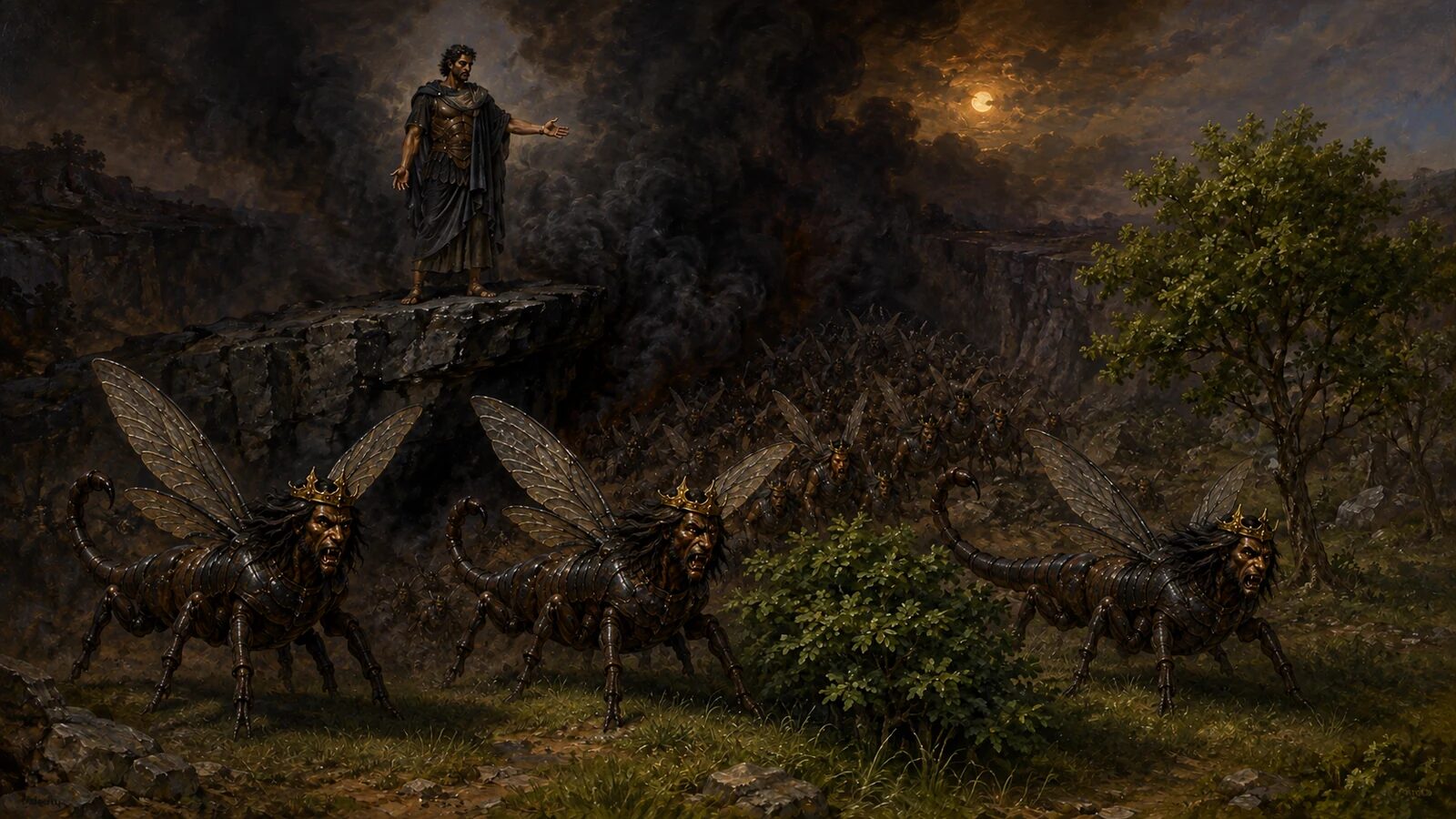
Who is Apollyon in Revelation 9, and why is he called the destroyer? I want to understand what the passage tells us about him without supplying details God has not revealed. The fifth trumpet is a dreadful scene, but as we follow it, we see that nothing happens outside God’s command.
Revelation reveals Jesus Christ and shows God judging rebellion, rather than giving the church terrifying creatures to speculate about. Before the abyss opens, a key must be given. The locust-like beings then receive commands limiting whom they can harm and how long they can act, and John names their king. Those details assure us that history remains under God’s control. The scene is dreadful because judgment is dreadful, not because He has lost command of it.
The Fifth Trumpet and the Abyss
The fifth trumpet follows the judgments that began when the Lamb opened the seals of the scroll in Revelation 6. The seventh seal leads into seven trumpets, the first four of which strike parts of the earth and sea, the fresh water and heavenly lights. An angel then announces three coming woes. The fifth trumpet begins those woes with judgment falling directly on unsealed human beings during the future seven-year Tribulation.
At the fifth trumpet, John saw a star already fallen from heaven to earth. The key was given “to him.” That wording treats the star as a person, and Scripture sometimes uses stars to picture angelic beings. But this figure is not named, and John describes him as already fallen rather than recording his fall at that moment. We can recognize a personal heavenly figure without deciding that he must be Satan or Apollyon.
After receiving the key, the figure opened the bottomless pit, and smoke rose until it darkened the sun and air. I want to keep that order in view: he could open the pit because authority had been given to him.
Then the fifth angel sounded: And I saw a star fallen from heaven to the earth. To him was given the key to the bottomless pit. And he opened the bottomless pit, and smoke arose out of the pit like the smoke of a great furnace. So the sun and the air were darkened because of the smoke of the pit.
A key allows its holder to open something or keep it shut, and Scripture uses that image for authority. Revelation has already shown Christ holding the keys of Hades and Death. I therefore cannot read the fifth trumpet as evil escaping heaven’s control. The abyss cannot open until someone receives the key, and God determines when that happens.
I am He who lives, and was dead, and behold, I am alive forevermore. Amen. And I have the keys of Hades and of Death.
The darkening smoke echoes Old Testament judgment imagery and recalls the plagues, while Revelation describes a future event in the Tribulation. This is an actual judgment, not a random disaster. It belongs to the Lamb’s response to a rebellious world.
The bottomless pit, also called the abyss, is a place of confinement rather than Satan’s throne room. Beings imprisoned there cannot leave until God permits it, and He has authority to confine them again.
Revelation 20 shows an angel descending from heaven with the key to that pit and a great chain. He will bind Satan and cast him into the abyss for a thousand years, preventing him from deceiving the nations during Christ’s kingdom reign.
Then I saw an angel coming down from heaven, having the key to the bottomless pit and a great chain in his hand. He laid hold of the dragon, that serpent of old, who is the Devil and Satan, and bound him for a thousand years;
Satan can himself be imprisoned in the abyss, so we should not imagine it as a realm he controls outside God’s authority. The darkness of the description should sober us, but the opening and closing of that prison remain subject to God’s permission.
When Jesus confronted the demons in the man from the country of the Gadarenes, they begged Him not to send them into the abyss. Their fear of confinement showed that they knew the Son had authority over the unseen realm. They were not free to act beyond His rule.
And they begged Him that He would not command them to go out into the abyss.
The Horde and Its Angelic King
Although John describes the released beings as locust-like, their instructions distinguish them from ordinary insects. Natural locusts devour vegetation, but these beings must leave the earth’s plants and trees unharmed. They may target only people without God’s seal on their foreheads. That reversal points to supernatural judgment rather than an agricultural plague.
John repeatedly uses the word like as he describes what he sees. The beings resemble horses prepared for battle, yet their faces look human. Their hair reminds him of women’s hair, while their teeth resemble those of lions. Their breastplates appear to be iron, and their wings sound like chariots rushing into battle. John is describing a vision that strains ordinary categories. We should receive the picture as God gave it without forcing every feature into a modern identification.
The horde is permitted to torment people for five months, but not to kill them. Those limits belong to a judgment that exposes human rebellion. People who refused to fear the Lord and lived as though sin had no consequences will face a dread they cannot control. Their torment is severe, yet its duration and extent are measured.
Knowing that the horde remains under orders changes how I read this scene. God can release a destructive force and still govern it precisely. Apollyon is its king, but the Lord sets every boundary. I should be attending to that authority rather than allowing curiosity about the darkness to take over.
Once the abyss has opened and the beings have been released, John names their king in both Hebrew and Greek. Both names connect him with destruction.
And they had as king over them the angel of the bottomless pit, whose name in Hebrew is Abaddon, but in Greek he has the name Apollyon.
The Hebrew name Abaddon carries the sense of destruction or ruin and appears in the Old Testament beside language about death and the grave. Apollyon is the corresponding Greek name and means “destroyer.” John includes both names to tell us what kind of figure rules the horde. The meaning fits his role as an angelic king associated with destruction during a measured judgment.
Calling Apollyon an angel identifies him as a messenger, but it does not by itself tell us whether he is faithful or fallen. We need the context for that, and Revelation 9 does not settle his moral history. What it does identify is his connection with the abyss and his rule over its beings. John presents a real angelic ruler, not an abstract symbol of destruction.
I keep the key-holder’s task separate from Apollyon’s role because John describes them separately. The figure who opened the abyss is unnamed; Apollyon is named later as king over the released beings. The text does not say that Apollyon received the key or opened the pit.
Nor do I identify Apollyon with Satan. Revelation names Satan plainly when speaking about him. In chapter 20, the dragon and serpent of old is called the Devil and Satan, then confined in the abyss. Apollyon’s role is different: he rules the horde released from that place.
He laid hold of the dragon, that serpent of old, who is the Devil and Satan, and bound him for a thousand years;
Nor should Apollyon be identified as the Angel of the LORD. In the relevant Old Testament passages, that distinctive figure is a Christophany, which is an appearance of the Son before He became human. Revelation 9 does not describe Apollyon this way. Apollyon is a destroyer associated with the abyss, not the preincarnate Son. Keeping these figures separate keeps us from serious confusion. A broader study of angels helps keep these biblical categories in place.
The Biblical Destroyer Pattern
Revelation 9 names Apollyon as destroyer, and other passages describe angelic destruction under God’s direction. Comparing that pattern helps us understand Revelation 9, but a shared work of judgment does not establish that every passage names the same angel. We should not invent an identification Scripture does not give.
At Passover, the LORD struck Egypt but kept the destroyer out of every house marked with blood. The destroyer could not cross that boundary or act independently of God. His destructive work remained under the LORD’s command.
For the LORD will pass through to strike the Egyptians; and when He sees the blood on the lintel and on the two doorposts, the LORD will pass over the door and not allow the destroyer to come into your houses to strike you.
Psalm 78 recalls the Exodus judgments as God sending angels of destruction among the Egyptians. They acted as His agents of judgment under His rule, not as independent powers.
He cast on them the fierceness of His anger, Wrath, indignation, and trouble, By sending angels of destruction among them.
Judgment followed David’s sinful census, and the Angel of the LORD carried it out until God commanded Him to stop. We see both judgment and restraint, but this figure should not be confused with Apollyon. The Angel of the LORD belongs to a distinct Old Testament category and, in passages marked by His divine identity and authority, is a Christophany.
And when the angel stretched out His hand over Jerusalem to destroy it, the LORD relented from the destruction, and said to the angel who was destroying the people, "It is enough; now restrain your hand."
Exodus 12, Psalm 78, and 2 Samuel 24 each show destructive agents acting within God’s authority. He determines when judgment begins and whom it reaches, as well as where it must stop. That pattern helps us understand the limits placed on the horde.
The locust-like beings in Revelation 9 likewise receive instructions about what to leave unharmed and whom they may target. God limits both their actions and their time. Their release brings judgment under His command, not uncontrolled chaos.
They were commanded not to harm the grass of the earth, or any green thing, or any tree, but only those men who do not have the seal of God on their foreheads. And they were not given authority to kill them, but to torment them for five months.
They were commanded, and they were not given authority to kill. Those words keep me from treating their terrifying appearance as unlimited power. The torment is severe but measured, and only people without God’s seal on their foreheads may be targeted.
Revelation 7 has already described 144,000 servants from Israel’s tribes being sealed before the destructive winds are released. The seal marks them as God’s own and protects them for the service He assigns. Revelation 9 recalls that distinction by excluding the sealed from this torment. We should not conclude that the 144,000 are the only people saved during the Tribulation, since the great multitude later in Revelation 7 comes from every nation and emerges from that trouble.
God knows exactly who belongs to Him, even in judgment. He distinguishes between people and commands the agents involved, setting limits they cannot cross. That helps me understand these dreadful events as His righteous answer to hardened rebellion, rather than uncontrolled outbreaks of evil.
From the giving of the key to the horde’s restricted activity, each major action in the fifth trumpet requires permission. The pit opens at God’s appointed time, and release does not free its beings from His limits. Apollyon’s authority over them never makes him sovereign over God.
The wider sequence gives me the same assurance when rebellion seems to be winning. The Lamb opens the seals before angels sound the trumpets, and the bowls are poured out under divine authority. Christ will defeat the beast when He returns, while Satan can be bound and released only at God’s appointed times before his final judgment. None of these powers can unsettle heaven or place a limit on the Lord. The larger prophetic sequence is traced in The End Times Timeline.
God’s control makes the judgments more serious, not less. These are not random tragedies with no further meaning. He is confronting a world hardened in sin, judging its idolatry and blasphemy as well as its bloodshed and deception. People continue refusing to repent, and He holds them accountable.
The Gospel Warning in the Destroyer Pattern
In Exodus 12, safety from the destroyer depended on the lamb’s blood being applied according to God’s word. The people were not spared because they were naturally better than the Egyptians. God provided a substitute and marked them off under its blood. That is why this passage points us toward the gospel.
Jesus Christ, the Lamb of God who takes away the sin of the world, fulfills that pattern. On the cross, He physically bore the punishment for our sins in His innocent body and shed His blood. He died and was buried, then rose bodily from the dead. Knowing the details of prophecy cannot make us safe from final judgment. We need to belong to Christ.
The Father did not punish, curse, abandon, strike, bruise, or pour wrath on Jesus. Wicked people carried out the real torture and death that He willingly endured for our sins. Christ died for the sins of the whole world, making God’s offer of salvation genuine for every person. People can resist that grace and reject the Savior, but everyone who repents and believes in Jesus is forgiven and born again.
And anyone not found written in the Book of Life was cast into the lake of fire.
Knowing who Apollyon is and what the abyss means would not itself make me right with God. A person can argue about the fifth trumpet and still remain lost. Revelation’s judgments call for repentance, not merely an informed opinion. The urgent question is whether you have received forgiveness through Christ’s blood and whether your name remains in the Book of Life.
Every person begins written in the Book of Life. Those who finally reject the Messiah are blotted out, while believers remain because their sins have been blotted out through Christ’s blood. The other books at the Great White Throne record deeds and sins. Those absent from the Book of Life will be raised and judged, then cast into the lake of fire, the second death. For human beings, that means the final and irreversible destruction of body and soul, not another opportunity or endless conscious torment.
The seal in Revelation 9 shows that God knows His people and that no darkness hides them from His sight. Judgment does not confuse Him, and a destructive angel cannot cross His boundary. I would not turn that into a promise that every believer will escape suffering in every age. It means that suffering cannot make God’s people cease to be His. Our safety rests in Christ rather than merely in being far from danger.
Everyone truly born again is a new creation, indwelt and sealed by the Holy Spirit, and eternally secure. That security gives no permission for lawlessness, and a shallow profession without new life does not prove salvation. Christ will gather His church before the Tribulation judgments begin. People who come to faith during that period will face fierce persecution, but no enemy can erase God’s ownership or overturn His promise of resurrection.
My Final Thoughts
I believe we should identify Apollyon only as far as Revelation 9 allows: he is the named angelic king over the abyss horde, not Satan or the unnamed key-holder. Scripture gives us no reason to identify him with the Angel of the LORD either. His destructive role fits the wider pattern of agents who act under God’s command and cannot cross His limits. We can take comfort in that without overlooking the severity of judgment. These warnings should move sinners toward Christ and lead believers to speak with compassion instead of superiority. Our hope belongs in the Lamb whose blood saves us from the coming judgment, rather than in fascination with the abyss.