
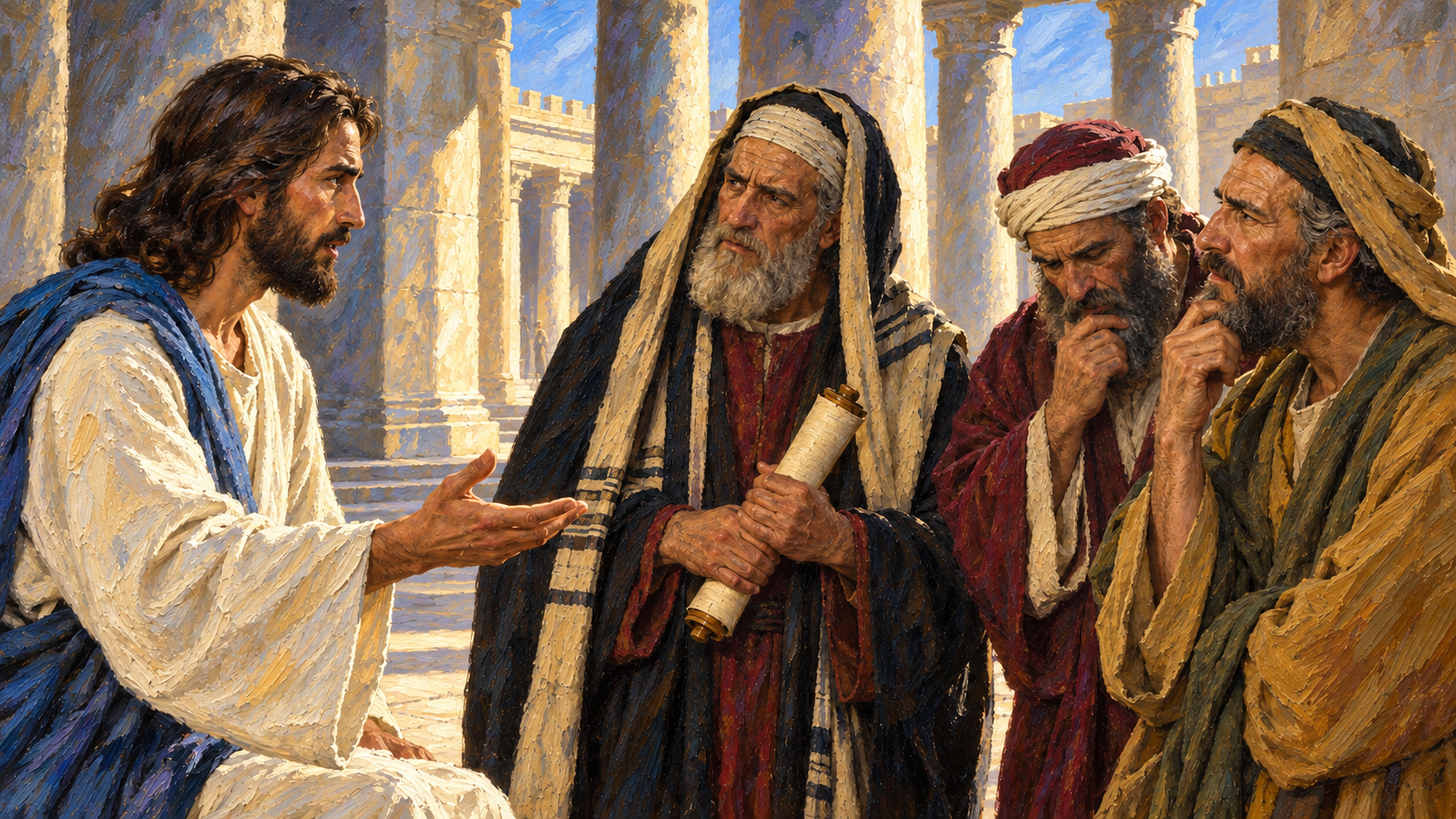
What did Jesus mean when He asked how the Messiah could be David’s Son if David called Him “my Lord”? Answering that question means looking closely at who Christ is and why He sits beside the Father. Psalm 110 gives us the words Jesus used, then shows us the Messiah as both King and Priest.
The Question Jesus Wanted His Hearers to Face
Psalm 110 opens with a central Messianic statement: “The LORD said to my Lord.” The Messiah’s descent from David is not in doubt. God promised David a royal house and an everlasting throne, and the prophets looked for a righteous Branch from his line. The New Testament opens by identifying Jesus Christ as the Son of David. Mary also heard from the angel that her Son would receive David’s throne and reign over the house of Jacob forever.
The LORD said to my Lord, “Sit at My right hand, Till I make Your enemies Your footstool.”
Jesus pressed the question further. If the Messiah is David’s Son, why does David, speaking by the Spirit, call Him “my Lord”? In the normal order of honor, David would not call one of his later descendants his lord. He was Israel’s great anointed king, yet in Psalm 110 he speaks of someone greater than himself. The Messiah would come from David according to the flesh, but He would not be merely another human ruler. He is the eternal Son who took on flesh. After dying for our sins, He rose bodily and sat down at the Father’s right hand.
Near the end of His public confrontations in Jerusalem, Jesus put this question directly to the Pharisees. Their first answer was correct, but it did not go far enough.
While the Pharisees were gathered together, Jesus asked them, saying, “What do you think about the Christ? Whose Son is He?” They said to Him, “The Son of David.”
He said to them, “How then does David in the Spirit call Him ‘Lord,’ saying: ‘The LORD said to my Lord, “Sit at My right hand, Till I make Your enemies Your footstool”‘? If David then calls Him ‘Lord,’ how is He his Son?”
Jesus accepted the promise that the Christ would be David’s Son. He then asked His hearers to account for David’s own words calling the Messiah his Lord. Matthew says no one could answer Him a word. Jesus was not seeking a clever debate response. Jesus was pressing them to recognize who stood before them: the Son of David was also the Lord David confessed.
I notice how closely Jesus attends to David’s words. His reasoning depends on who wrote the psalm and what he said under the Holy Spirit’s inspiration. Jesus receives Psalm 110 as precise testimony about the Messiah, rather than a religious poem whose meaning can be adjusted to suit the reader.
David’s Lord in Psalm 110
Psalm 110 is introduced as “A Psalm of David.” Jesus says David spoke “in the Spirit” when he wrote it, and the New Testament consistently receives David as the speaker. This is more than royal poetry. It is inspired prophecy.
The psalm begins with YHWH addressing David’s Lord and inviting Him to sit at His right hand. From there, it describes the rod of His strength going out from Zion as He rules among His enemies. His people offer themselves willingly, and He is a priest forever according to the order of Melchizedek. The closing judgment and victory belong to a King whose authority reaches far beyond David’s own reign.
David calls the person addressed “my Lord,” so he is speaking of someone above himself. He cannot be describing only his own position. Peter makes another distinction in Acts 2: David did not ascend into heaven. He never sat at God’s heavenly right hand as the apostles describe, but he prophesied about the risen Christ.
Psalm 110 presents the Messiah as a victorious, enthroned King and a priest greater than David. Jesus uses it as a central witness to who the Messiah is, and the apostles continue that reading. I cannot confine its promise to a single generation of Israel’s history. David’s inspired words reach to Christ’s resurrection and present rule, and then to the day when every enemy is finally subdued.
The two Hebrew expressions in the first verse need to be distinguished. English Bibles commonly print the covenant name YHWH as “LORD” in small capitals. The words translated “my Lord” are la’adoni, meaning “to my lord,” a form that can address someone with authority over the speaker. That second expression is not itself the covenant name. Understanding the Hebrew helps us read the verse honestly and accurately without asking either expression to mean something it does not.
I do not need to make the second expression another form of YHWH to defend Christ’s deity. The passage directs us to the identity of David’s Lord and the promises God makes to Him. He sits at YHWH’s right hand with royal authority over His enemies and is declared a priest forever. Jesus uses those words to challenge an incomplete understanding of the Messiah.
Psalm 110:1 belongs to a larger biblical argument. The Father speaks to the Son, who is distinct from Him yet shares divine honor and heavenly rule. Every enemy will be placed under the Son’s authority. This agrees with Scripture’s teaching about the Trinity: one God exists eternally in three distinct Persons, the Father, the Son, and the Holy Spirit. Readers who want to trace that teaching further can compare the related studies on the deity of Jesus and the Trinity.
The Son of David Is the Son of God
The Bible holds both parts of Jesus’ identity together. He truly is the Son of David, born into David’s line and fulfilling God’s promises about David’s throne. Gabriel said this plainly to Mary.
He will be great, and will be called the Son of the Highest; and the Lord God will give Him the throne of His father David.
And He will reign over the house of Jacob forever, and of His kingdom there will be no end.
Jesus’ birth into David’s family was not the beginning of His existence. He is the eternal Son of God, and the Word becoming flesh means He took on a real human nature. He lived without sin and physically bore the punishment for our sins in His body on the cross. He shed His blood and died, then rose bodily. As man, Jesus is David’s descendant. As the eternal Son, He is David’s Lord.
I need to keep both truths in view when reading Psalm 110. Jesus did not merely appear to be human, for the Messiah truly is David’s Son. Yet He is more than an earthly leader who teaches truth or speaks as a prophet. David calls Him Lord, and He sits at God’s right hand and reigns until every enemy is subdued. Hebrews identifies Him as the Son who is greater than the angels.
Scripture confesses Jesus as fully God and fully man. The promised King from David’s line is the eternal Son who shares His Father’s glory. Psalm 110 does not explain every part of that doctrine in a single verse. It gives us testimony that the New Testament returns to again and again.
The Exalted King the Apostles Preached
To sit at a king’s right hand is to occupy the place of highest honor and authority. Psalm 110 is not describing an inactive Messiah. He is enthroned while YHWH makes His enemies His footstool, and the rod of His strength goes out from Zion.
The LORD shall send the rod of Your strength out of Zion. Rule in the midst of Your enemies!
That is Christ’s position now, after His resurrection and ascension. He is seated at the Father’s right hand, and His kingdom is moving toward its appointed victory. He is not helplessly waiting for history to improve. The related study on post-resurrection Jesus and His ascension follows that event in more detail.
I also understand Psalm 110 alongside what I believe Scripture teaches about Christ’s bodily return. A future Tribulation will be followed by His literal thousand-year reign. In 1 Corinthians 15, Paul draws on this psalm to explain that Christ must reign until He has put every enemy under His feet. Death is the last enemy destroyed, so the promise extends to the final defeat of everything opposed to God. The crucified and risen Jesus saves individual believers and will bring all things into righteous order as King.
Peter preached Psalm 110 that way after Jesus rose. He did not treat it as a riddle with several possible fulfillments. He applied it to the Jesus whom God raised and exalted.
This Jesus God has raised up, of which we are all witnesses. Therefore being exalted to the right hand of God, and having received from the Father the promise of the Holy Spirit, He poured out this which you now see and hear.
For David did not ascend into the heavens, but he says himself: “The LORD said to my Lord, ‘Sit at My right hand, Till I make Your enemies Your footstool.'”
Peter’s reasoning is direct. David did not ascend to the heavenly right hand, so David was speaking of someone else. The risen Jesus has been exalted there. Peter therefore told the house of Israel to know assuredly that God had made this Jesus, whom they crucified, both Lord and Christ.
That exaltation did not make Jesus divine. He is the eternal Son. Acts describes His public vindication and enthronement as Messiah: the One people rejected and crucified has been raised and exalted. The title “Lord” is now preached openly of the risen Jesus, with Psalm 110 supplying the inspired words.
Peter also makes me keep the cross in view when I think about Christ’s exaltation. The Lord at the Father’s right hand is the same Jesus who shed His blood for sinners. He died and was buried before rising bodily, and now He reigns. We cannot separate Psalm 110 from the gospel. The enthroned Lord is the Savior whose hands and feet were pierced.
Hebrews repeatedly returns to this psalm. I believe Paul wrote Hebrews, and his use of Psalm 110 first draws our attention to Christ’s place above every created servant. The same psalm also helps him explain Christ’s enthronement and eternal priesthood. In Hebrews 1, the right-hand promise appears among Old Testament passages that distinguish the Son from the angels.
But to which of the angels has He ever said: “Sit at My right hand, Till I make Your enemies Your footstool”?
God never gave that promise to an angel. The Son is not a created angelic being, but the brightness of God’s glory and the express image of His person. After purging our sins, He sat down at the right hand of the Majesty on high. That is why Psalm 110 supports the honor and worship Scripture gives Him.
Hebrews also connects Christ’s seated position with His completed sacrifice. Priests under the old covenant stood repeatedly because their sacrifices could never finally take away sin. Jesus offered Himself once for all and then sat down. His place at the Father’s right hand announces His royal authority and the completeness of His sacrifice. His blood is sufficient, His priesthood continues forever, and His throne is secure.
A Priest Forever After the Order of Melchizedek
Psalm 110 does not stop with kingship. Verse 4 reveals that the Messiah is also a priest, but His priesthood does not come through Aaron.
The LORD has sworn And will not relent, “You are a priest forever According to the order of Melchizedek.”
This verse helps me connect Psalm 110 with the argument in Hebrews. Jesus came from Judah according to the flesh, not Levi, yet He is a priest. The psalm announces an order older and greater than the Levitical priesthood. Hebrews explains that Christ’s priesthood is eternal and fully effective because it rests on the power of an endless life.
I understand Melchizedek in Genesis 14 to be a Christophany, a pre-incarnate appearance of the eternal Son. I do not regard him as an otherwise unknown Canaanite priest. Psalm 110 places the Messiah’s priesthood in that enduring royal order, joined with righteousness and peace. Hebrews begins with the meaning of Melchizedek’s name and titles, then considers how he blessed Abraham and received tithes from him. The absence of a recorded genealogy in Genesis also serves the argument in Hebrews. The related study on Melchizedek works through that conclusion at length.
Christ’s eternal priesthood gives us more of the answer to Jesus’ question. David’s Lord is the King-Priest whose reign and priesthood endure forever, rather than a king whose greatness ends with one generation. He rules now and intercedes for His people. Those who come to God through Him are saved completely.
Reading Psalm 110 Carefully and Living Under Its King
Some readers limit the psalm to David or Solomon. The royal setting may help explain its language, but I cannot stop there when Jesus says David spoke by the Spirit and called the Christ Lord. Peter points out that David never ascended into heaven and applies the verse to the risen Jesus. Hebrews applies both the right-hand promise and the Melchizedek priesthood to Christ. The New Testament’s inspired use takes us beyond a local royal setting.
Others observe that the Hebrew behind “my Lord” can describe a superior who is not YHWH and conclude that the Messiah must be created or merely human. That takes one expression away from the rest of the psalm and the New Testament. Recognizing that it is not the covenant name does not settle who David’s Lord is. His place at God’s right hand and the authority He receives also belong to the explanation, along with Jesus’ interpretation and the apostles’ preaching after the resurrection.
In Psalm 110, I would be equally careful about claiming that the Hebrew word alone proves the second Lord is fully divine. Some defenders of Christ’s deity make that argument, but Scripture gives us a fuller witness. The Lord David described by the Spirit is exalted to God’s right hand and given rule over His enemies, with a priesthood that lasts forever. Jesus identifies Him as the Christ. Peter preaches Him as the risen Lord, and Hebrews presents Him as the Son above the angels. Christ’s deity rests on that whole scriptural witness, with Psalm 110 as one of its central passages.
Jesus’ use of this passage teaches me to read the Old Testament with care. He attended to authorship and wording because He believed David spoke by the Spirit. If our Lord took those details seriously, I should not handle them loosely.
That care keeps us from building doctrine on a convenient sound bite. We need to read the whole psalm and recognize David as its Spirit-inspired speaker. Jesus and the apostles show how those details point to Christ. Their use of Psalm 110 gives us confidence in the connection between the Old and New Testaments while preserving the distinctions within the text.
Psalm 110 should also deepen our worship of Christ. Jesus is not a lesser spiritual being or simply an inspiring teacher. He is David’s Lord, seated at the Father’s right hand. The Father and Son are distinct Persons, yet the Son receives divine honor without rivalry within the one Godhead. Worshiping Jesus does not take glory away from the Father; the Father is glorified in the Son.
When the world appears hostile to Christ, I need to remember where the psalm says He rules: in the midst of His enemies. Opposition does not mean He has lost His authority. People may deny Him or mock and resist Him, but the Father has spoken. Christ’s enemies will become His footstool. Our confidence belongs in the enthroned King rather than the visible strength of this world.
Finally, His throne should draw us toward His priesthood. The Lord who reigns is also the Priest who saves. He does not offer sacrifice again and again. He offered Himself once, shed His blood for sinners, and rose bodily. Because He lives forever, His people can come to God through Him with confidence. God’s promise to David and Christ’s everlasting reign are developed further in the study on the Davidic Covenant.
Jesus’ use of Psalm 110 strengthens our confidence in the inspiration and precision of Scripture. It also leaves us with a confession we cannot divide: He is truly David’s Son and truly David’s Lord. His present reign should shape the way we worship and give us courage. We can live as people whose King is already enthroned because the Spirit’s words are sure.
My Final Thoughts
When I follow Psalm 110 through Jesus’ teaching and Peter’s preaching, then see Hebrews return to it, I understand why this short statement carried so much weight. Jesus is truly descended from David, yet He is David’s eternal Lord. He died for our sins and rose bodily. Now He sits at the Father’s right hand, reigning in the midst of His enemies and serving forever as the Priest who brings us to God. The world’s resistance cannot remove Him from His throne. We can trust His finished work and worship Him as Lord, then live in obedience to the King whose kingdom will not fail.