
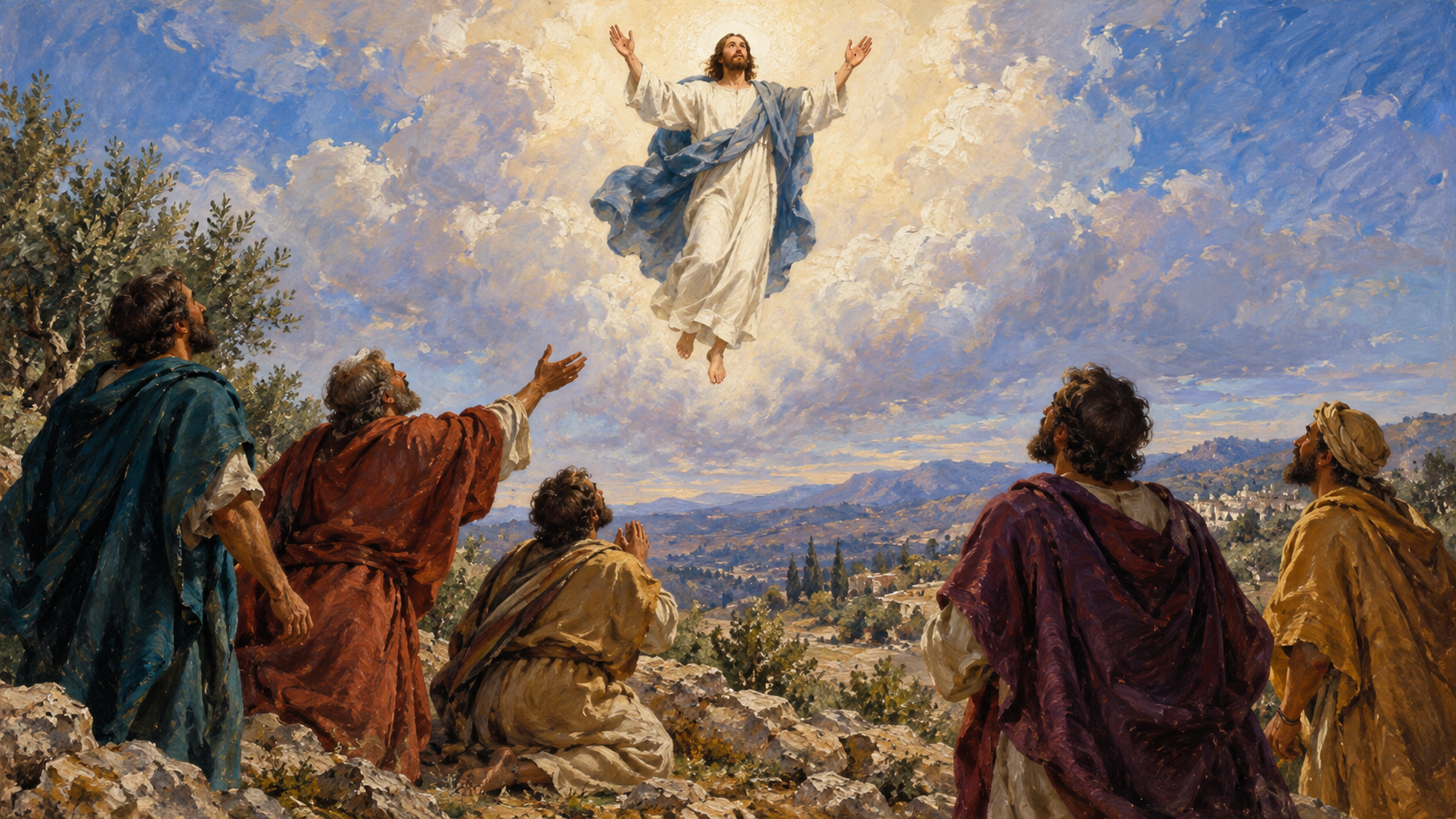
Jesus did not leave His disciples immediately after rising from the dead. He met with them repeatedly over forty days before they watched Him ascend into heaven. I want to understand why He gave them that time and what His ascension means for our mission and hope.
Jesus Gave Forty Days of Bodily Proof
The former account I made, O Theophilus, of all that Jesus began both to do and teach, until the day in which He was taken up, after He through the Holy Spirit had given commandments to the apostles whom He had chosen, to whom He also presented Himself alive after His suffering by many infallible proofs, being seen by them during forty days and speaking of the things pertaining to the kingdom of God. And being assembled together with them, He commanded them not to depart from Jerusalem, but to wait for the Promise of the Father, “which,” He said, “you have heard from Me; for John truly baptized with water, but you shall be baptized with the Holy Spirit not many days from now.” Therefore, when they had come together, they asked Him, saying, “Lord, will You at this time restore the kingdom to Israel?” And He said to them, “It is not for you to know times or seasons which the Father has put in His own authority. But you shall receive power when the Holy Spirit has come upon you; and you shall be witnesses to Me in Jerusalem, and in all Judea and Samaria, and to the end of the earth.” Now when He had spoken these things, while they watched, He was taken up, and a cloud received Him out of their sight. And while they looked steadfastly toward heaven as He went up, behold, two men stood by them in white apparel, who also said, “Men of Galilee, why do you stand gazing up into heaven? This same Jesus, who was taken up from you into heaven, will so come in like manner as you saw Him go into heaven.”
Luke tells us that Jesus presented Himself alive through many infallible proofs during forty days. The apostles saw Him repeatedly and heard Him speak about the kingdom of God. When they later bore witness to His resurrection, they were speaking from sustained encounters with Him, not trying to explain one brief impression.
These meetings established that the One who had been crucified was alive. Jesus used them to correct the disciples’ unbelief and help them understand Scripture. He also restored servants who had failed and prepared His witnesses for the Holy Spirit’s coming. The Gospels and 1 Corinthians give us selected appearances, so I would not try to turn them into a daily itinerary. We can follow a coherent order while admitting that Scripture leaves the precise time and location of some meetings unstated.
The tomb was empty because the body laid there had been raised. Jesus still bore the wounds by which the disciples could identify Him, and He allowed them to touch Him. He also ate in their presence. Those details rule out an apparition or a shared vision. The disciples were meeting their living Lord, not simply keeping His memory or spiritual influence alive.
The risen body of Jesus was physical and glorified. He appeared in locked rooms and was not always recognized immediately, but neither detail makes Him less bodily. We are seeing life transformed through resurrection, no longer subject to death.
John tells us Jesus stood among the disciples while the doors were shut, but he does not explain how He entered. I would not take that silence as evidence that His body passed through wood or that a glorified body is immaterial. John records His sovereign appearance, and the wounds and the disciples’ touch show that He was physically present.
Our hope includes that same bodily resurrection. Salvation does not end with an immortal soul escaping creation, because Christ will raise and transform His people. His risen humanity is the firstfruits, the beginning of the resurrection harvest. In Him we see the pattern of what His people will become.
The Risen Jesus Met Doubt With Witness and Scripture
Now after the Sabbath, as the first day of the week began to dawn, Mary Magdalene and the other Mary came to see the tomb. And behold, there was a great earthquake; for an angel of the Lord descended from heaven, and came and rolled back the stone from the door, and sat on it. His countenance was like lightning, and his clothing as white as snow. And the guards shook for fear of him, and became like dead men. But the angel answered and said to the women, “Do not be afraid, for I know that you seek Jesus who was crucified. He is not here; for He is risen, as He said. Come, see the place where the Lord lay. And go quickly and tell His disciples that He is risen from the dead, and indeed He is going before you into Galilee; there you will see Him. Behold, I have told you.” So they went out quickly from the tomb with fear and great joy, and ran to bring His disciples word. And as they went to tell His disciples, behold, Jesus met them, saying, “Rejoice!” So they came and held Him by the feet and worshiped Him. Then Jesus said to them, “Do not be afraid. Go and tell My brethren to go to Galilee, and there they will see Me.”
Matthew describes the women arriving at the tomb and hearing the angel announce that Jesus had risen. As they hurried to tell the disciples, He met them, and they held His feet and worshiped Him. I notice that their response confirms both His bodily presence and His acceptance of their worship.
Mark 16:9 in the received text says Jesus appeared first to Mary Magdalene. John describes her encounter in detail, while Matthew includes a group of women in another encounter. We do not need to make both accounts describe the same instant or expect each writer to name every participant in the same way.
The women faithfully carried the news to frightened disciples, and Scripture honors their indispensable place as eyewitnesses of the resurrection. I would distinguish that testimony from the authoritative teaching office of elder, which belongs to biblically qualified men.
Now the first day of the week Mary Magdalene went to the tomb early, while it was still dark, and saw that the stone had been taken away from the tomb. Then she ran and came to Simon Peter, and to the other disciple, whom Jesus loved, and said to them, “They have taken away the Lord out of the tomb, and we do not know where they have laid Him.” Peter therefore went out, and the other disciple, and were going to the tomb. So they both ran together, and the other disciple outran Peter and came to the tomb first. And he, stooping down and looking in, saw the linen cloths lying there; yet he did not go in. Then Simon Peter came, following him, and went into the tomb; and he saw the linen cloths lying there, and the handkerchief that had been around His head, not lying with the linen cloths, but folded together in a place by itself. Then the other disciple, who came to the tomb first, went in also; and he saw and believed. For as yet they did not know the Scripture, that He must rise again from the dead. Then the disciples went away again to their own homes. But Mary stood outside by the tomb weeping, and as she wept she stooped down and looked into the tomb. And she saw two angels in white sitting, one at the head and the other at the feet, where the body of Jesus had lain. Then they said to her, “Woman, why are you weeping?” She said to them, “Because they have taken away my Lord, and I do not know where they have laid Him.” Now when she had said this, she turned around and saw Jesus standing there, and did not know that it was Jesus. Jesus said to her, “Woman, why are you weeping? Whom are you seeking?” She, supposing Him to be the gardener, said to Him, “Sir, if You have carried Him away, tell me where You have laid Him, and I will take Him away.” Jesus said to her, “Mary!” She turned and said to Him, “Rabboni!” (which is to say, Teacher). Jesus said to her, “Do not cling to Me, for I have not yet ascended to My Father; but go to My brethren and say to them, ‘I am ascending to My Father and your Father, and to My God and your God.'” Mary Magdalene came and told the disciples that she had seen the Lord, and that He had spoken these things to her.
Mary first assumed that someone had moved the body. Only when Jesus called her name did she recognize Him, and she answered, “Rabboni,” which John explains means Teacher. Her grief gave way to meeting the living Lord Himself. His words, “Do not cling to Me,” cannot mean that no one was allowed to touch Him before the ascension. The women in Matthew held His feet, and He later invited Thomas to examine His wounds.
Jesus addressed the way Mary was holding Him and gave her something to do. He had not yet ascended, but He was going to the Father, and she was to tell His brethren. I do not hear Him ending His relationship with Mary. He was directing her forward because she could not keep Him beside the tomb as though nothing had changed.
Now behold, two of them were traveling that same day to a village called Emmaus, which was seven miles from Jerusalem. And they talked together of all these things which had happened. So it was, while they conversed and reasoned, that Jesus Himself drew near and went with them. But their eyes were restrained, so that they did not know Him. And He said to them, “What kind of conversation is this that you have with one another as you walk and are sad?” Then the one whose name was Cleopas answered and said to Him, “Are You the only stranger in Jerusalem, and have You not known the things which happened there in these days?” And He said to them, “What things?” So they said to Him, “The things concerning Jesus of Nazareth, who was a Prophet mighty in deed and word before God and all the people, and how the chief priests and our rulers delivered Him to be condemned to death, and crucified Him. But we were hoping that it was He who was going to redeem Israel. Indeed, besides all this, today is the third day since these things happened. Yes, and certain women of our company, who arrived at the tomb early, astonished us. When they did not find His body, they came saying that they had also seen a vision of angels who said He was alive. And certain of those who were with us went to the tomb and found it just as the women had said; but Him they did not see.” Then He said to them, “O foolish ones, and slow of heart to believe in all that the prophets have spoken! Ought not the Christ to have suffered these things and to enter into His glory?” And beginning at Moses and all the Prophets, He expounded to them in all the Scriptures the things concerning Himself. Then they drew near to the village where they were going, and He indicated that He would have gone farther. But they constrained Him, saying, “Abide with us, for it is toward evening, and the day is far spent.” And He went in to stay with them. Now it came to pass, as He sat at the table with them, that He took bread, blessed and broke it, and gave it to them. Then their eyes were opened and they knew Him; and He vanished from their sight. And they said to one another, “Did not our heart burn within us while He talked with us on the road, and while He opened the Scriptures to us?” So they rose up that very hour and returned to Jerusalem, and found the eleven and those who were with them gathered together, saying, “The Lord is risen indeed, and has appeared to Simon!” And they told about the things that had happened on the road, and how He was known to them in the breaking of bread.
Two disciples left Jerusalem troubled by the crucifixion and confused by the reports from the empty tomb. Jesus joined them on the road without being recognized. As He asked questions, they explained their disappointed hope that He would redeem Israel.
Jesus began with Moses and all the Prophets to explain the Scriptures concerning Himself. His suffering and entrance into glory were part of God’s plan all along. The disciples needed help understanding that plan from Scripture, rather than a Messiah reshaped to fit their political disappointment.
They recognized Jesus when He broke the bread, and then He vanished from their sight. Luke does not call the meal the Lord’s Supper, so I would not use it as proof for a sacramental claim. He tells us that they recognized the Lord and looked back on how their hearts had burned while He opened the Scriptures.
Now as they said these things, Jesus Himself stood in the midst of them, and said to them, “Peace to you.” But they were terrified and frightened, and supposed they had seen a spirit. And He said to them, “Why are you troubled? And why do doubts arise in your hearts? Behold My hands and My feet, that it is I Myself. Handle Me and see, for a spirit does not have flesh and bones as you see I have.” When He had said this, He showed them His hands and His feet. But while they still did not believe for joy, and marveled, He said to them, “Have you any food here?” So they gave Him a piece of a broiled fish and some honeycomb. And He took it and ate in their presence. Then He said to them, “These are the words which I spoke to you while I was still with you, that all things must be fulfilled which were written in the Law of Moses and the Prophets and the Psalms concerning Me.” And He opened their understanding, that they might comprehend the Scriptures. Then He said to them, “Thus it is written, and thus it was necessary for the Christ to suffer and to rise from the dead the third day, and that repentance and remission of sins should be preached in His name to all nations, beginning at Jerusalem. And you are witnesses of these things. Behold, I send the Promise of My Father upon you; but tarry in the city of Jerusalem until you are endued with power from on high.” And He led them out as far as Bethany, and He lifted up His hands and blessed them. Now it came to pass, while He blessed them, that He was parted from them and carried up into heaven. And they worshiped Him, and returned to Jerusalem with great joy, and were continually in the temple praising and blessing God. Amen.
When Jesus stood among the gathered disciples, they were frightened because they thought they were seeing a spirit. He showed them His hands and feet and invited them to handle Him. Then He ate broiled fish in front of them. Each part of His response helped them see that He had flesh and bones, as a spirit does not.
Jesus helped them understand what the Law of Moses, the Prophets, and the Psalms said about Him. The Christ had to suffer and rise on the third day, just as Scripture foretold. They were now to preach repentance and remission of sins in His name, starting in Jerusalem and carrying that message to every nation.
Luke 24 brings these events together by theme, whereas Acts explains that they took place over forty days. I read the two accounts as complementing each other. Luke closes his Gospel with the ascension, then opens Acts by giving more detail about the interval and the mission. He is not contradicting himself.
Then, the same day at evening, being the first day of the week, when the doors were shut where the disciples were assembled, for fear of the Jews, Jesus came and stood in the midst, and said to them, “Peace be with you.” When He had said this, He showed them His hands and His side. Then the disciples were glad when they saw the Lord. So Jesus said to them again, “Peace to you! As the Father has sent Me, I also send you.” And when He had said this, He breathed on them, and said to them, “Receive the Holy Spirit. If you forgive the sins of any, they are forgiven them; if you retain the sins of any, they are retained.” Now Thomas, called the Twin, one of the twelve, was not with them when Jesus came. The other disciples therefore said to him, “We have seen the Lord.” So he said to them, “Unless I see in His hands the print of the nails, and put my finger into the print of the nails, and put my hand into His side, I will not believe.” And after eight days His disciples were again inside, and Thomas with them. Jesus came, the doors being shut, and stood in the midst, and said, “Peace to you!” Then He said to Thomas, “Reach your finger here, and look at My hands; and reach your hand here, and put it into My side. Do not be unbelieving, but believing.” And Thomas answered and said to Him, “My Lord and my God!” Jesus said to him, “Thomas, because you have seen Me, you have believed. Blessed are those who have not seen and yet have believed.” And truly Jesus did many other signs in the presence of His disciples, which are not written in this book; but these are written that you may believe that Jesus is the Christ, the Son of God, and that believing you may have life in His name.
Thomas was absent when Jesus first appeared to the gathered disciples. He refused their testimony unless he could examine the wounds for himself. Eight days later, Jesus met that demand directly.
John does not tell us that Thomas touched Jesus or fell to his knees. What he records is Thomas’s confession, “My Lord and my God!” Jesus accepted that direct acknowledgment of His deity. I also notice that the blessing on those who have not seen Him bodily is not praise for believing without content or evidence. They believe the apostolic witness. John chose to record these signs so that readers could believe Jesus is the Christ, the Son of God, and receive life in His name.
Jesus Restored Peter and Appeared to Many Witnesses
After these things Jesus showed Himself again to the disciples at the Sea of Tiberias, and in this way He showed Himself: Simon Peter, Thomas called the Twin, Nathanael of Cana in Galilee, the sons of Zebedee, and two others of His disciples were together. Simon Peter said to them, “I am going fishing.” They said to him, “We are going with you also.” They went out and immediately got into the boat, and that night they caught nothing. But when the morning had now come, Jesus stood on the shore; yet the disciples did not know that it was Jesus. Then Jesus said to them, “Children, have you any food?” They answered Him, “No.” And He said to them, “Cast the net on the right side of the boat, and you will find some.” So they cast, and now they were not able to draw it in because of the multitude of fish. Therefore that disciple whom Jesus loved said to Peter, “It is the Lord!” Now when Simon Peter heard that it was the Lord, he put on his outer garment (for he had removed it), and plunged into the sea. But the other disciples came in the little boat (for they were not far from land, but about two hundred cubits), dragging the net with fish. Then, as soon as they had come to land, they saw a fire of coals there, and fish laid on it, and bread. Jesus said to them, “Bring some of the fish which you have just caught.” Simon Peter went up and dragged the net to land, full of large fish, one hundred and fifty-three; and although there were so many, the net was not broken. Jesus said to them, “Come and eat breakfast.” Yet none of the disciples dared ask Him, “Who are You?”–knowing that it was the Lord. Jesus then came and took the bread and gave it to them, and likewise the fish. This is now the third time Jesus showed Himself to His disciples after He was raised from the dead. So when they had eaten breakfast, Jesus said to Simon Peter, “Simon, son of Jonah, do you love Me more than these?” He said to Him, “Yes, Lord; You know that I love You.” He said to him, “Feed My lambs.” He said to him again a second time, “Simon, son of Jonah, do you love Me?” He said to Him, “Yes, Lord; You know that I love You.” He said to him, “Tend My sheep.” He said to him the third time, “Simon, son of Jonah, do you love Me?” Peter was grieved because He said to him the third time, “Do you love Me?” And he said to Him, “Lord, You know all things; You know that I love You.” Jesus said to him, “Feed My sheep. Most assuredly, I say to you, when you were younger, you girded yourself and walked where you wished; but when you are old, you will stretch out your hands, and another will gird you and carry you where you do not wish.” This He spoke, signifying by what death he would glorify God. And when He had spoken this, He said to him, “Follow Me.”
Seven disciples had fished all night at the Sea of Tiberias without catching anything. At Jesus’ direction, their net filled with 153 large fish and did not break. That exact number sounds to me like remembered eyewitness detail. Scripture gives us no reason to treat it as a hidden numerical code.
Jesus had breakfast waiting and gave the disciples bread and fish. I like seeing His ordinary care for these tired men alongside the miraculous catch. Before He addressed Peter’s unresolved failure, He fed them.
Jesus asked Peter about his love three times, each time telling him to tend or feed His sheep. That public restoration answered Peter’s three denials without turning the exchange into a ritual that mechanically canceled sin. Jesus also told him that faithful service would lead to a costly death. With that ahead of Peter, He called him again: “Follow Me.”
Moreover, brethren, I declare to you the gospel which I preached to you, which also you received and in which you stand, by which also you are saved, if you hold fast that word which I preached to you–unless you believed in vain. For I delivered to you first of all that which I also received: that Christ died for our sins according to the Scriptures, and that He was buried, and that He rose again the third day according to the Scriptures, and that He was seen by Cephas, then by the twelve. After that He was seen by over five hundred brethren at once, of whom the greater part remain to the present, but some have fallen asleep. After that He was seen by James, then by all the apostles. Then last of all He was seen by me also, as by one born out of due time.
Paul begins his gospel summary with Christ’s death for our sins according to Scripture. His burial was real, and He rose on the third day as Scripture had foretold. Paul then names those who saw Him alive. Cephas received an individual appearance before Jesus appeared to the Twelve as an established group.
More than five hundred believers saw Jesus at once, and most were still alive when Paul wrote. That detail catches my attention because his readers could ask living witnesses about what had happened. He was not placing the resurrection beyond investigation. Jesus also appeared to His brother James, who had not believed during the Lord’s earthly ministry but later led in Jerusalem. Another appearance included all the apostles.
Some Corinthians were denying bodily resurrection, so Paul warned them about a profession of faith that emptied the gospel of the very event it proclaimed. He was calling them back to the message they had received and in which they stood. His warning about believing in vain does not mean that someone genuinely born again can become unborn.
Paul finally includes the risen Christ’s later appearance to him. That encounter qualifies Paul’s distinct apostleship, but it does not make him the replacement for Judas among the Twelve.
The Risen Lord Taught the Kingdom and Commissioned His Church
The disciples needed more than opportunities to see Jesus alive. He showed them from Scripture why the Messiah had to suffer and how resurrection led into glory. He taught that repentance brings forgiveness through His name, and they were to carry that message throughout the world.
When the apostles asked whether He would now restore the kingdom to Israel, Jesus corrected their desire to know the timing. He did not deny Israel’s future restoration. I need to preserve that difference when reading His answer: the literal promises to Israel remain, but the disciples first had work to do as witnesses empowered by the Spirit.
Christ will establish His kingdom publicly. The church’s task is to announce the King and make disciples as God’s prophetic program moves forward. We neither replace Israel nor build the promised kingdom through political conquest.
Then the eleven disciples went away into Galilee, to the mountain which Jesus had appointed for them. When they saw Him, they worshiped Him; but some doubted. And Jesus came and spoke to them, saying, “All authority has been given to Me in heaven and on earth. Go therefore and make disciples of all the nations, baptizing them in the name of the Father and of the Son and of the Holy Spirit, teaching them to observe all things that I have commanded you; and lo, I am with you always, even to the end of the age.” Amen.
On the appointed mountain in Galilee, Jesus declared His authority over heaven and earth before giving the disciples their commission. Their mission rested on who He is. It did not arise from a desire for the church to acquire worldly power.
Matthew tells us that some doubted. The word can describe hesitation or wavering in the presence of an overwhelming event, so I would not assume it means there was a settled group of resurrection deniers among the apostles. Jesus came near and answered their uncertainty by grounding the commission in His universal authority.
Making disciples begins with taking the gospel to every nation, but it also involves the continuing life of those who believe. They are to be baptized and brought into the life of the church, where they learn to obey all that Christ commanded. We have not fulfilled His commission if we count decisions while neglecting sound doctrine and the Lord’s teaching.
Jesus promised to remain with His people through the end of the age. His ascension did not take that promise away. He reigns in heaven while continuing to work among His people through His Spirit and Word.
Later He appeared to the eleven as they sat at the table; and He rebuked their unbelief and hardness of heart, because they did not believe those who had seen Him after He had risen. And He said to them, “Go into all the world and preach the gospel to every creature. He who believes and is baptized will be saved; but he who does not believe will be condemned. And these signs will follow those who believe: In My name they will cast out demons; they will speak with new tongues; they will take up serpents; and if they drink anything deadly, it will by no means hurt them; they will lay hands on the sick, and they will recover.” So then, after the Lord had spoken to them, He was received up into heaven, and sat down at the right hand of God. And they went out and preached everywhere, the Lord working with them and confirming the word through the accompanying signs. Amen.
I receive Mark 16:9-20 as part of the Textus Receptus and the received Byzantine tradition. Here Jesus rebukes the disciples’ unbelief and commands them to preach the gospel to every creature. He speaks about belief and baptism before ascending to God’s right hand.
In Mark 16:16, belief and baptism belong together as inward faith and its expected public expression. The verse names unbelief as the ground of condemnation; it does not make water baptism the cause of salvation. I also need to read it alongside the thief who was saved beside Jesus without baptism and Scripture’s teaching that we are justified by faith apart from works.
God used the accompanying signs to confirm His word as the apostles carried the gospel outward. I do not read those descriptions as commands to handle snakes or drink poison. Nor do they tell churches to require a miracle before accepting someone’s profession of faith.
Jesus told the apostles to remain in Jerusalem for the Father’s promise. John baptized with water, but they would soon be baptized with the Holy Spirit and receive power to witness from Jerusalem to the end of the earth.
Pentecost fulfilled the promise in the public beginning of the church. The disciples did not produce it through a private technique, and no spiritual sensation can replace the content of the gospel. Every true believer is indwelt and sealed by the Holy Spirit at salvation. From there we should seek His filling as we obey His written Word, testing claims about spiritual gifts by Scripture. We do not need a second-stage experience to become saved or prove that we belong to Christ.
The Bodily Ascension Established Christ’s Present Ministry
Luke places the blessing and departure as far as Bethany, while Acts says the disciples returned from the mount called Olivet. Since Bethany lies on the eastern side of the Mount of Olives, the two descriptions fit together naturally.
Scripture does not identify a modern shrine or give us the exact footprint of the summit. What it gives us is an ascension the disciples witnessed. Jesus blessed them before a cloud received Him from their sight. Heavenly messengers then promised His return, and the disciples obeyed His instructions by going back to Jerusalem.
They worshiped Jesus and returned with joy, continuing together in prayer. I notice how different that response was from grieving another loss. Their joy fits what the ascension established: the risen Lord had been exalted, and His promises were moving forward.
Acts keeps our attention on the same Jesus throughout. The One who had eaten with the disciples and shown them His wounds was taken up while they watched. His ascension was an event they saw, not a metaphor for His reputation surviving or His spirit joining God.
The eternal Son did not become divine at His ascension. He always was and remains fully God, and He did not leave His humanity behind. The One who became incarnate was crucified and rose from the dead, then ascended as the God-man. He remains our one Mediator.
Jesus would now be present with His disciples in a different way, but He had not finished His work. From heaven He reigns and sends the Holy Spirit. As He builds His church, He intercedes for His people and supplies what they need to serve Him. The Lord who cares for them now is also preparing to return.
The cloud fits a scriptural pattern of divine presence. Clouds appear at Sinai and the tabernacle, while similar glory surrounds the temple and the Transfiguration. Daniel 7 presents the Son of Man coming with clouds to receive dominion.
Those connections help me understand why the cloud is fitting for the divine Son’s glory without trying to explain it as a vehicle. It hid Jesus from sight as He ascended. The disciples were not told to follow it or work out the geography of heaven. The messengers directed their attention to His promised return and the witness He had assigned them.
This Jesus God has raised up, of which we are all witnesses. Therefore being exalted to the right hand of God, and having received from the Father the promise of the Holy Spirit, He poured out this which you now see and hear. “For David did not ascend into the heavens, but he says himself: ‘The LORD said to my Lord, “Sit at My right hand, Till I make Your enemies Your footstool.”‘ “Therefore let all the house of Israel know assuredly that God has made this Jesus, whom you crucified, both Lord and Christ.”
At Pentecost, Peter announced that God had raised Jesus and exalted Him to His right hand. From there Christ poured out the promised Spirit. Peter used Psalm 110 to identify Him as the exalted Lord whose enemies would become His footstool.
The right hand speaks of supreme honor and authority. It communicates shared rule without making the Son less divine than the Father. The Persons remain distinct and co-equal within the one God.
When Peter says God “made” Jesus both Lord and Christ, he is not saying the eternal Son was created or became divine at Pentecost. God publicly installed and declared the crucified and risen Jesus in His promised messianic rule. I understand Peter to be speaking about His exaltation as the incarnate Mediator. The One who fills that role is the eternal Son who has always been God.
Jesus is Lord and Christ now, reigning at the Father’s right hand. That is what His present session means, and it assures the church that no hostile ruler occupies the throne. Death does not rule there, and neither do demonic powers.
Also there were many priests, because they were prevented by death from continuing. But He, because He continues forever, has an unchangeable priesthood. Therefore He is also able to save to the uttermost those who come to God through Him, since He always lives to make intercession for them. For such a High Priest was fitting for us, who is holy, harmless, undefiled, separate from sinners, and has become higher than the heavens; who does not need daily, as those high priests, to offer up sacrifices, first for His own sins and then for the people’s, for this He did once for all when He offered up Himself. For the law appoints as high priests men who have weakness, but the word of the oath, which came after the law, appoints the Son who has been perfected forever.
Paul, the author of Hebrews, explains that Jesus’ priesthood cannot change because He continues forever. He always lives to intercede for those who come to God through Him, so He is able to save them completely.
His intercession does not mean that the cross was insufficient or that He must keep offering a sacrifice in heaven. Jesus offered Himself once for all as our holy High Priest, harmless and undefiled. Our security rests in His completed sacrifice and His endless life.
We approach the Father through the one risen and ascended Son. No saint shares that unique work of mediation, and neither an earthly priest nor a religious institution can perform it.
The Ascended Jesus Will Gather His Church and Return to Rule
But I do not want you to be ignorant, brethren, concerning those who have fallen asleep, lest you sorrow as others who have no hope. For if we believe that Jesus died and rose again, even so God will bring with Him those who sleep in Jesus. For this we say to you by the word of the Lord, that we who are alive and remain until the coming of the Lord will by no means precede those who are asleep. For the Lord Himself will descend from heaven with a shout, with the voice of an archangel, and with the trumpet of God. And the dead in Christ will rise first. Then we who are alive and remain shall be caught up together with them in the clouds to meet the Lord in the air. And thus we shall always be with the Lord. Therefore comfort one another with these words.
The Lord Himself will descend from heaven and raise the dead in Christ first. Living believers will then be caught up together with them to meet Him in the air. We are expecting bodily resurrection and transformation, not an inward feeling that only the believer experiences.
Paul’s phrase “sleep in Jesus” refers to believers whose bodies have died. I do not understand him to teach soul sleep or the unconscious extinction of the person between death and resurrection. The believer is with Christ while awaiting the resurrection and transformation of the body.
I understand Scripture to place this gathering before the literal seven-year Tribulation. The church can take comfort in reunion and permanent presence with Christ. This gathering is distinct from the later visible return promised in Acts 1, even though the same bodily Lord is central to both. Scripture gives each event its own participants, setting, and purpose within the prophetic order.
Behold, He is coming with clouds, and every eye will see Him, even they who pierced Him. And all the tribes of the earth will mourn because of Him. Even so, Amen.
After the Tribulation, Jesus will return bodily and visibly with clouds. Every eye will see Him, and the nations will confront the pierced King as He overthrows rebellious power.
He will establish His literal thousand-year reign. The kingdom cannot be reduced to the influence of the church or to private spirituality. Neither is it merely a social-improvement program. The ascended King will rule publicly on earth.
Acts promises that Jesus will return in the same manner the disciples saw Him go. The same bodily Lord will come from heaven, which rules out reincarnation or a merely symbolic return. No institution invisibly takes His place.
The angels asked, “Why do you stand gazing?” because the witnesses needed to return to Jesus’ instructions. They were to wait for the Spirit and then testify. I don’t read the question as a rebuke for hoping in His return or studying prophecy carefully. It called them away from passive staring and back to obedience.
The church waits faithfully as we worship and pray together, growing in holiness through our shared life. We show mercy to hurting people and teach the truth clearly. As we carry the gospel to others, we also baptize those who believe. That ordinary obedience is where our attention belongs, rather than in setting dates or pursuing sensational claims about clouds.
The apostles went back together instead of scattering into private expectation. Their response helps me see that Christ’s mission forms a people who bear witness together, carrying the message outward from Jerusalem to the nations.
The One who gives this mission is the eternal Son, fully God and fully man. He was born of a virgin and lived without sin. His bodily resurrection vindicates His identity and proves that death did not defeat Him.
Wicked men physically tortured and punished Jesus before killing Him, and He willingly bore that real punishment for our sins in His innocent body. Jesus shed His blood and died, but after He was buried, He rose bodily. The Father did not punish or curse Jesus. He did not abandon Him, and Scripture does not say the Father struck or bruised His Son or poured wrath on Him.
Christ died for the whole world, and people can resist God’s genuine offer. Everyone who repents and believes is forgiven and justified, which means declared righteous before God. The believer is born again and made new. The Holy Spirit comes to live within and seals that person as eternally secure. Security does not excuse lawlessness, and a superficial profession is not proof of new birth. Baptism follows salvation and publicly identifies the believer with Christ’s death and resurrection.
My Final Thoughts
These forty days help me appreciate the patience Jesus showed His confused disciples. He met them in His risen body and opened the Scriptures so they could understand what had happened. He gave them trustworthy witnesses and a clear gospel to carry to others through the Holy Spirit’s power, rather than leaving them with a private feeling. That same Jesus ascended bodily and now reigns at the Father’s right hand as our one High Priest. He will gather His church before returning visibly to rule as the promised King. Until then, we can worship and serve faithfully with His church, carrying the gospel to others instead of staring passively or chasing dates. Our risen Lord remains with His people as we do the work He has given us.