
Keeping Israel’s kings straight can be difficult. Names repeat, the nation divides, and some rulers begin better than they end. As I work through the history, one question keeps it from becoming only a list of names: what happened when a king listened to God’s Word, and what happened when he placed his throne above it?
Israel’s King Was Always a Servant Under God’s Word
The books of Samuel introduce Israel’s monarchy, and Kings follows it from David’s last years through the fall of both kingdoms. Chronicles returns to much of that history with particular attention to David’s line and the temple in Judah. I find it helpful to remember that these books evaluate the rulers by God’s covenant Word. They do more than preserve palace records, because a king’s decisions reached into ordinary homes through changes in worship and justice or the outbreak of war.
We first need to know which kingdom a passage is describing. Saul, David, and Solomon belong to what we usually call the united kingdom, although David initially ruled only Judah while Saul’s son governed much of Israel. After Solomon the nation split into the northern kingdom, normally called Israel, and the southern kingdom of Judah. Both sometimes had kings with the same name, including Jehoram and Joash. Checking the kingdom and family line usually tells us which man is meant. A prophet or event in the surrounding passage can also settle the question.
“When you come to the land which the LORD your God is giving you, and possess it and dwell in it, and say, ‘I will set a king over me like all the nations that are around me,’ you shall surely set a king over you whom the LORD your God chooses; one from among your brethren you shall set as king over you; you may not set a foreigner over you, who is not your brother. But he shall not multiply horses for himself, nor cause the people to return to Egypt to multiply horses, for the LORD has said to you, ‘You shall not return that way again.’ Neither shall he multiply wives for himself, lest his heart turn away; nor shall he greatly multiply silver and gold for himself. “Also it shall be, when he sits on the throne of his kingdom, that he shall write for himself a copy of this law in a book, from the one before the priests, the Levites. And it shall be with him, and he shall read it all the days of his life, that he may learn to fear the LORD his God and be careful to observe all the words of this law and these statutes, that his heart may not be lifted above his brethren, that he may not turn aside from the commandment to the right hand or to the left, and that he may prolong his days in his kingdom, he and his children in the midst of Israel.
God had anticipated Israel’s monarchy before the people entered the land. The king had to be an Israelite chosen by the LORD, with explicit restraints on his power. The king could not multiply horses for himself or take the people back toward Egypt to obtain military supplies. Neither could he multiply wives or accumulate wealth without limit.
The king had to write his own copy of the Law from the authoritative text kept before the Levitical priests. He was then to keep it close and read it throughout his life, learning to fear the LORD and obey Him. I notice how directly that reading addressed the temptations of his office: it was meant to keep him humble toward his brothers and teach him to persevere. His throne never placed him above covenant accountability.
Then all the elders of Israel gathered together and came to Samuel at Ramah, and said to him, “Look, you are old, and your sons do not walk in your ways. Now make us a king to judge us like all the nations.” But the thing displeased Samuel when they said, “Give us a king to judge us.” So Samuel prayed to the LORD. And the LORD said to Samuel, “Heed the voice of the people in all that they say to you; for they have not rejected you, but they have rejected Me, that I should not reign over them. According to all the works which they have done since the day that I brought them up out of Egypt, even to this day–with which they have forsaken Me and served other gods–so they are doing to you also. Now therefore, heed their voice. However, you shall solemnly forewarn them, and show them the behavior of the king who will reign over them.”
Samuel’s sons had perverted justice, so the elders had a legitimate grievance when they came to him. But their proposed remedy revealed more than a desire to put that wrong right. They wanted a king to judge them like the surrounding nations. The LORD identified their demand as a rejection of His reign, continuing the pattern of forsaking Him for other gods.
I don’t see a contradiction between God’s instructions for a king in Deuteronomy and Samuel’s warning. God could sovereignly establish the monarchy while the people sinned in their reasons for wanting it and the model they preferred. Samuel warned that a king patterned after the nations would take their sons and daughters into his service. He would seize fields and servants, using their flocks and produce to strengthen his own power. When a ruler set aside God’s Word, he would begin using the people for himself.
Saul, David, and Solomon Revealed the Strength and Failure of the United Throne
And Samuel said to Saul, “You have done foolishly. You have not kept the commandment of the LORD your God, which He commanded you. For now the LORD would have established your kingdom over Israel forever. But now your kingdom shall not continue. The LORD has sought for Himself a man after His own heart, and the LORD has commanded him to be commander over His people, because you have not kept what the LORD commanded you.”
God chose Saul and anointed him for royal office, then equipped him for the work. His failure did not come from a lack of opportunity. Under pressure at Gilgal, he refused to wait as commanded and intruded into a sacrifice. Samuel announced that his dynasty would not continue and that the LORD would seek a man after His own heart.
So Samuel said: “Has the LORD as great delight in burnt offerings and sacrifices, As in obeying the voice of the LORD? Behold, to obey is better than sacrifice, And to heed than the fat of rams. For rebellion is as the sin of witchcraft, And stubbornness is as iniquity and idolatry. Because you have rejected the word of the LORD, He also has rejected you from being king.”
Saul later preserved what God had commanded him to destroy in the war against Amalek, then defended that partial obedience by talking about sacrifice. Samuel’s answer leaves no room for using a religious act to excuse refusing God’s Word. Saul admitted fearing the people, yet he kept defending himself and shifting blame. Even his confession included an effort to protect his public honor. I see a king trying to preserve his reputation when he needed to listen to the God who had appointed him.
Then all the tribes of Israel came to David at Hebron and spoke, saying, “Indeed we are your bone and your flesh. Also, in time past, when Saul was king over us, you were the one who led Israel out and brought them in; and the LORD said to you, ‘You shall shepherd My people Israel, and be ruler over Israel.'” Therefore all the elders of Israel came to the king at Hebron, and King David made a covenant with them at Hebron before the LORD. And they anointed David king over Israel. David was thirty years old when he began to reign, and he reigned forty years. In Hebron he reigned over Judah seven years and six months, and in Jerusalem he reigned thirty-three years over all Israel and Judah.
David’s accession after Saul’s death took years rather than happening all at once. He first ruled Judah from Hebron while Saul’s son Ishbosheth governed much of Israel under Abner’s influence. Only after years of conflict did Israel’s elders come to David. Remembering God’s promise that he would shepherd the people, they anointed him over the united nation.
David was the chosen man after God’s heart because he would do God’s will, not because he was sinless. His adultery led to an attempt to conceal the sin and then to his arranging Uriah’s death. Nathan confronted him directly, and David genuinely confessed and repented. Still, painful consequences tore through his household. I cannot read that repentance as though it made the harm disappear. Even Israel’s best king needed mercy and could not be its final King.
Therefore give to Your servant an understanding heart to judge Your people, that I may discern between good and evil. For who is able to judge this great people of Yours?” The speech pleased the LORD, that Solomon had asked this thing. Then God said to him: “Because you have asked this thing, and have not asked long life for yourself, nor have asked riches for yourself, nor have asked the life of your enemies, but have asked for yourself understanding to discern justice, behold, I have done according to your words; see, I have given you a wise and understanding heart, so that there has not been anyone like you before you, nor shall any like you arise after you. And I have also given you what you have not asked: both riches and honor, so that there shall not be anyone like you among the kings all your days. So if you walk in My ways, to keep My statutes and My commandments, as your father David walked, then I will lengthen your days.”
Solomon’s request for an understanding heart pleased the LORD because he wanted to judge God’s people well. God gave him extraordinary wisdom for that responsibility and added riches and honor. The promise of lengthened days, however, remained tied to obedience. Solomon’s discernment and administration showed his remarkable gifts, as did his writings and the temple he built. Jesus would later identify Himself as greater than Solomon.
But King Solomon loved many foreign women, as well as the daughter of Pharaoh: women of the Moabites, Ammonites, Edomites, Sidonians, and Hittites– from the nations of whom the LORD had said to the children of Israel, “You shall not intermarry with them, nor they with you. Surely they will turn away your hearts after their gods.” Solomon clung to these in love. And he had seven hundred wives, princesses, and three hundred concubines; and his wives turned away his heart. For it was so, when Solomon was old, that his wives turned his heart after other gods; and his heart was not loyal to the LORD his God, as was the heart of his father David. For Solomon went after Ashtoreth the goddess of the Sidonians, and after Milcom the abomination of the Ammonites. Solomon did evil in the sight of the LORD, and did not fully follow the LORD, as did his father David. Then Solomon built a high place for Chemosh the abomination of Moab, on the hill that is east of Jerusalem, and for Molech the abomination of the people of Ammon. And he did likewise for all his foreign wives, who burned incense and sacrificed to their gods. So the LORD became angry with Solomon, because his heart had turned from the LORD God of Israel, who had appeared to him twice, and had commanded him concerning this thing, that he should not go after other gods; but he did not keep what the LORD had commanded. Therefore the LORD said to Solomon, “Because you have done this, and have not kept My covenant and My statutes, which I have commanded you, I will surely tear the kingdom away from you and give it to your servant. Nevertheless I will not do it in your days, for the sake of your father David; I will tear it out of the hand of your son. However I will not tear away the whole kingdom; I will give one tribe to your son for the sake of My servant David, and for the sake of Jerusalem which I have chosen.”
Solomon’s splendor came with the very dangers Deuteronomy had named. Through his connection with Egypt, he multiplied his horses. He also accumulated enormous wealth and took many wives. Those foreign wives turned his heart toward other gods, for whom he built high places where they could worship. The division of the kingdom came as judgment on this covenant unfaithfulness. God still preserved David’s line according to His promise, even while judging Solomon’s sin.
When the older counselors urged Rehoboam to serve the people, he rejected their advice and answered the people’s burden with threats. The northern tribes broke from David’s house, fulfilling Ahijah’s prophecy of discipline upon Solomon. God’s sovereign word was fulfilled through these human decisions, but that does not make the decisions innocent. I would not use His purpose to excuse Rehoboam, Jeroboam, or the rebelling tribes.
After the division, “Israel” often names the northern kingdom and “Judah” the southern kingdom governed by David’s heirs. Elsewhere, Israel still refers to the whole covenant people. That is why I need to check the context each time rather than assume “Kings of Israel” always describes rulers of the same territory.
The Northern Kingdom Built Rebellion Into Its Rule and Worship
Jeroboam I founded the northern kingdom and its defining worship system. His son Nadab succeeded him, but Baasha killed Nadab and destroyed Jeroboam’s house. The throne passed to Baasha’s son Elah until Zimri assassinated him. Zimri lasted only seven days, burning the palace around himself as Omri’s forces closed in. Support then divided between Omri and Tibni until Omri prevailed. These changing family lines help explain why the northern succession can be hard to follow: conspiracy and civil conflict repeatedly interrupted it.
Omri founded the dynasty best known through his son Ahab. Ahab’s sons Ahaziah and Joram, also called Jehoram, followed him. Jehu killed Joram while carrying out judgment on Ahab’s house and began another dynasty. Jehu’s line continued through Jehoahaz, Joash, Jeroboam II, and Zechariah. These similar names require care because Judah also had rulers named Jehoram, Ahaziah, and Joash. The surrounding kingdom and family line identify which man the text means.
After Zechariah, northern stability collapsed rapidly. Shallum assassinated him but ruled only one month before Menahem killed him. Menahem’s son Pekahiah succeeded him, only to be assassinated by Pekah. Hoshea later killed Pekah and became the final northern king before Assyria captured Samaria. Coups and assassinations repeatedly moved the throne from one house to another.
No northern king receives Scripture’s commendation that he did right in the LORD’s sight. Some obeyed a particular command or reduced one form of idolatry, yet every reign remained caught in rebellion. As I read their evaluations, Jeroboam’s sin keeps appearing as the standard of comparison. His calf shrines had made the nation’s worship serve the security of its king.
Then Jeroboam built Shechem in the mountains of Ephraim, and dwelt there. Also he went out from there and built Penuel. And Jeroboam said in his heart, “Now the kingdom may return to the house of David: If these people go up to offer sacrifices in the house of the LORD at Jerusalem, then the heart of this people will turn back to their lord, Rehoboam king of Judah, and they will kill me and go back to Rehoboam king of Judah.” Therefore the king asked advice, made two calves of gold, and said to the people, “It is too much for you to go up to Jerusalem. Here are your gods, O Israel, which brought you up from the land of Egypt!” And he set up one in Bethel, and the other he put in Dan. Now this thing became a sin, for the people went to worship before the one as far as Dan. He made shrines on the high places, and made priests from every class of people, who were not of the sons of Levi. Jeroboam ordained a feast on the fifteenth day of the eighth month, like the feast that was in Judah, and offered sacrifices on the altar. So he did at Bethel, sacrificing to the calves that he had made. And at Bethel he installed the priests of the high places which he had made. So he made offerings on the altar which he had made at Bethel on the fifteenth day of the eighth month, in the month which he had devised in his own heart. And he ordained a feast for the children of Israel, and offered sacrifices on the altar and burned incense.
God had promised Jeroboam an enduring house if he obeyed, but once on the throne he feared losing the people’s loyalty to Rehoboam. Their journeys to worship in Jerusalem seemed to him a threat to his rule. So he placed golden calves at Bethel and Dan, repeating the language used for Sinai’s golden calf. He also appointed priests who were not Levites and devised a feast from his own heart. His attempt to secure the throne disregarded the promise God had already given him.
Making worship convenient did not make Jeroboam’s counterfeit holy. He heard prophetic warnings and saw the altar at Bethel split apart. God even restored his withered hand in answer to prayer, yet he refused to turn back. Later kings kept his system because it continued to serve their political interests. That helps me see how far one ruler’s unbelief could reach when he built it into the nation’s worship.
In the thirty-eighth year of Asa king of Judah, Ahab the son of Omri became king over Israel; and Ahab the son of Omri reigned over Israel in Samaria twenty-two years. Now Ahab the son of Omri did evil in the sight of the LORD, more than all who were before him. And it came to pass, as though it had been a trivial thing for him to walk in the sins of Jeroboam the son of Nebat, that he took as wife Jezebel the daughter of Ethbaal, king of the Sidonians; and he went and served Baal and worshiped him. Then he set up an altar for Baal in the temple of Baal, which he had built in Samaria. And Ahab made a wooden image. Ahab did more to provoke the LORD God of Israel to anger than all the kings of Israel who were before him.
After prevailing in the civil conflict, Omri purchased the hill of Samaria and founded a capital whose name endured in foreign records. Those were substantial political achievements, but Kings measures his rule by covenant faithfulness. On that measure he was worse than his predecessors. A stable administration did not compensate for leading people into idolatry.
Ahab married Jezebel, daughter of Ethbaal king of the Sidonians. Scripture does not call her a priestess of Baal, though it records her support for Baal’s prophets and persecution of the LORD’s prophets. Ahab built Baal’s temple and altar, and Jezebel arranged Naboth’s murder. When Elijah announced judgment, Ahab humbled himself and God delayed the disaster against his house. I want to give that mercy its proper place without treating one act of humbling as proof of a lasting conversion.
Elisha’s messenger anointed Jehu to strike Ahab’s house. Jehu killed Joram and oversaw Jezebel’s death, then destroyed Ahab’s descendants and eradicated organized Baal worship in a severe purge. In these actions he fulfilled the judgment God had already announced. The LORD promised four generations of his family a place on the throne.
Jehu nevertheless failed to walk in the Law with all his heart. He removed Baal worship but kept the shrines at Bethel and Dan, preserving the system that supported northern independence. His zeal challenges me to look beyond the evil a leader publicly opposes. A man can attack a conspicuous wrong while protecting another rebellion because it serves his interests.
For so it was that the children of Israel had sinned against the LORD their God, who had brought them up out of the land of Egypt, from under the hand of Pharaoh king of Egypt; and they had feared other gods, and had walked in the statutes of the nations whom the LORD had cast out from before the children of Israel, and of the kings of Israel, which they had made. Also the children of Israel secretly did against the LORD their God things that were not right, and they built for themselves high places in all their cities, from watchtower to fortified city. They set up for themselves sacred pillars and wooden images on every high hill and under every green tree. There they burned incense on all the high places, like the nations whom the LORD had carried away before them; and they did wicked things to provoke the LORD to anger, for they served idols, of which the LORD had said to them, “You shall not do this thing.” Yet the LORD testified against Israel and against Judah, by all of His prophets, every seer, saying, “Turn from your evil ways, and keep My commandments and My statutes, according to all the law which I commanded your fathers, and which I sent to you by My servants the prophets.” Nevertheless they would not hear, but stiffened their necks, like the necks of their fathers, who did not believe in the LORD their God. And they rejected His statutes and His covenant that He had made with their fathers, and His testimonies which He had testified against them; they followed idols, became idolaters, and went after the nations who were all around them, concerning whom the LORD had charged them that they should not do like them. So they left all the commandments of the LORD their God, made for themselves a molded image and two calves, made a wooden image and worshiped all the host of heaven, and served Baal. And they caused their sons and daughters to pass through the fire, practiced witchcraft and soothsaying, and sold themselves to do evil in the sight of the LORD, to provoke Him to anger. Therefore the LORD was very angry with Israel, and removed them from His sight; there was none left but the tribe of Judah alone.
Hoshea’s reign ended with Assyria’s capture of Samaria, an event commonly dated to about 722 or 721 BC. In explaining that fall, 2 Kings directs us to Israel’s relationship with the LORD. The people had feared other gods and imitated the surrounding nations instead of obeying His covenant testimony. Their idolatry went as far as sacrificing their own children, and they repeatedly refused the prophets’ calls to return to God.
Exile followed that accumulated rebellion; it was not God’s impulsive reaction to one weak king. Scattering made human tribal records more complicated, but it did not make the tribes unknown to God. Scripture continues to name Israel and its tribes after Assyria. I would not mistake our difficulty tracing people for a loss of God’s knowledge or His future prophetic purpose.
Judah Preserved David’s Line but Could Not Produce a Flawless King
Judah’s succession remained tied to David’s house. Solomon’s son Rehoboam began the divided kingdom and was followed by Abijah, also called Abijam, and then Asa and Jehoshaphat. Jehoshaphat’s son Jehoram married into Ahab’s house, and their son Ahaziah followed him. When Ahaziah died, his mother Athaliah tried to destroy the royal heirs and seized power. The infant Joash survived because he was hidden in the temple until Jehoiada brought him out and restored David’s line.
Joash was followed by Amaziah and then Uzziah, also called Azariah. Jotham succeeded Uzziah, with Ahaz and Hezekiah following in turn. Hezekiah’s son Manasseh reigned for fifty-five years, after which Amon ruled briefly before Josiah became king. There were genuine reforms during this succession, but we need to read each reformer’s whole record rather than stop with what went well.
Foreign empires gained increasing control of the throne after Josiah died. Egypt removed his son Jehoahaz after only three months. Jehoiakim followed, then Jehoiachin reigned briefly before Babylon exiled him. Babylon installed Zedekiah, the last king before Jerusalem and its temple were destroyed. If a list counts nineteen kings, it excludes Athaliah as a usurping queen. Including her among everyone who ruled brings the total to twenty.
Some of these kings were genuinely faithful, while others compromised or became openly wicked. The endurance of David’s line depended on God’s covenant, not the worthiness of every heir. Reading Kings alongside Chronicles helps me understand the record more fully. Chronicles sometimes includes repentance or temple details that Kings does not emphasize, while Kings keeps the approaching covenant judgment before us. We do not have to discard either account to learn from the other.
Asa began by removing idols and deposing his idolatrous grandmother from royal status. He led Judah in covenant renewal, but later relied on Syria instead of the LORD. When a prophet rebuked him, Asa imprisoned the messenger and began oppressing some of the people. He also failed to seek the LORD in his illness. Those later choices cannot be dismissed simply because he had been faithful for many years.
Jehoshaphat sought God and sent teachers throughout Judah carrying the Book of the Law. He appointed judges and trusted the LORD during a national crisis, yet entered both a marriage alliance and a military partnership with Ahab’s house. Jehu the prophet rebuked him for helping the wicked, and a later alliance with Ahaziah brought another prophetic judgment. His good work did not remove the danger of those alliances.
Jehoiada’s faithfulness had preserved Joash from Athaliah and brought him to the throne. While the priest guided him, Joash repaired the temple. But after Jehoiada died, he listened to idolatrous leaders and ordered the stoning of Jehoiada’s son Zechariah in the temple court. I find that reversal painful to consider. The child who had been rescued became a king who killed the man sent to rebuke him.
Amaziah did what was right without a loyal heart. He listened to a man of God and released the Israelite troops he had hired, yet later adopted the gods of defeated Edom and refused correction. His pride then led him to challenge Israel needlessly, bringing defeat on Jerusalem. We cannot use his earlier obedience to excuse that later apostasy.
Uzziah sought God and prospered in agriculture while strengthening Judah’s defenses and building a powerful military. As he grew strong, however, he became proud enough to enter the temple and burn incense. He refused the priests’ correction, and God struck him with leprosy. His royal authority had never entitled him to take over the work of the Aaronic priesthood.
Jotham did right and avoided his father’s intrusion into the sanctuary to perform priestly duties. Chronicles connects his growing strength with the way he prepared his conduct before the LORD. Yet the people continued to act corruptly. That helps me distinguish a faithful king’s influence on public order from the new heart that every person still needed.
Ahaz practiced idolatry and sacrificed his own son. After seeing an altar in Damascus, he ordered a copy and rearranged the temple furnishings around it. He also sought Assyria’s help instead of trusting the LORD. His dependence on a foreign power went together with false worship, and those policies brought Judah low.
Hezekiah reopened and cleansed the temple, then restored the Passover. He removed high places and destroyed the bronze serpent when the people made it an idol. He trusted God during Assyria’s invasion, but later became proud and showed his treasures to Babylonian envoys. Isaiah announced a future loss in response. Hezekiah truly recovered and humbled himself, so we should acknowledge that change while recognizing that even he was not the flawless king Israel needed.
Manasseh rebuilt the high places and worshiped the host of heaven, even placing an idolatrous image inside the temple. He practiced occult arts and sacrificed his son. He also shed a great amount of innocent blood. Eventually Assyrian captors carried him away with hooks. In that affliction he humbled himself greatly and prayed, and God brought him back to Jerusalem. Chronicles explicitly records his repentance and the reforms that followed.
God’s mercy to Manasseh gives me reason for hope without denying the damage he did. Kings connects Judah’s coming judgment to his provocations and bloodshed. Amon then imitated his father’s earlier evil rather than his repentance and was assassinated. We should recognize Manasseh’s personal restoration without assuming it reversed every public consequence of his reign.
Then the king sent and gathered all the elders of Judah and Jerusalem. The king went up to the house of the LORD, with all the men of Judah and the inhabitants of Jerusalem–the priests and the Levites, and all the people, great and small. And he read in their hearing all the words of the Book of the Covenant which had been found in the house of the LORD. Then the king stood in his place and made a covenant before the LORD, to follow the LORD, and to keep His commandments and His testimonies and His statutes with all his heart and all his soul, to perform the words of the covenant that were written in this book. And he made all who were present in Jerusalem and Benjamin take a stand. So the inhabitants of Jerusalem did according to the covenant of God, the God of their fathers. Thus Josiah removed all the abominations from all the country that belonged to the children of Israel, and made all who were present in Israel diligently serve the LORD their God. All his days they did not depart from following the LORD God of their fathers.
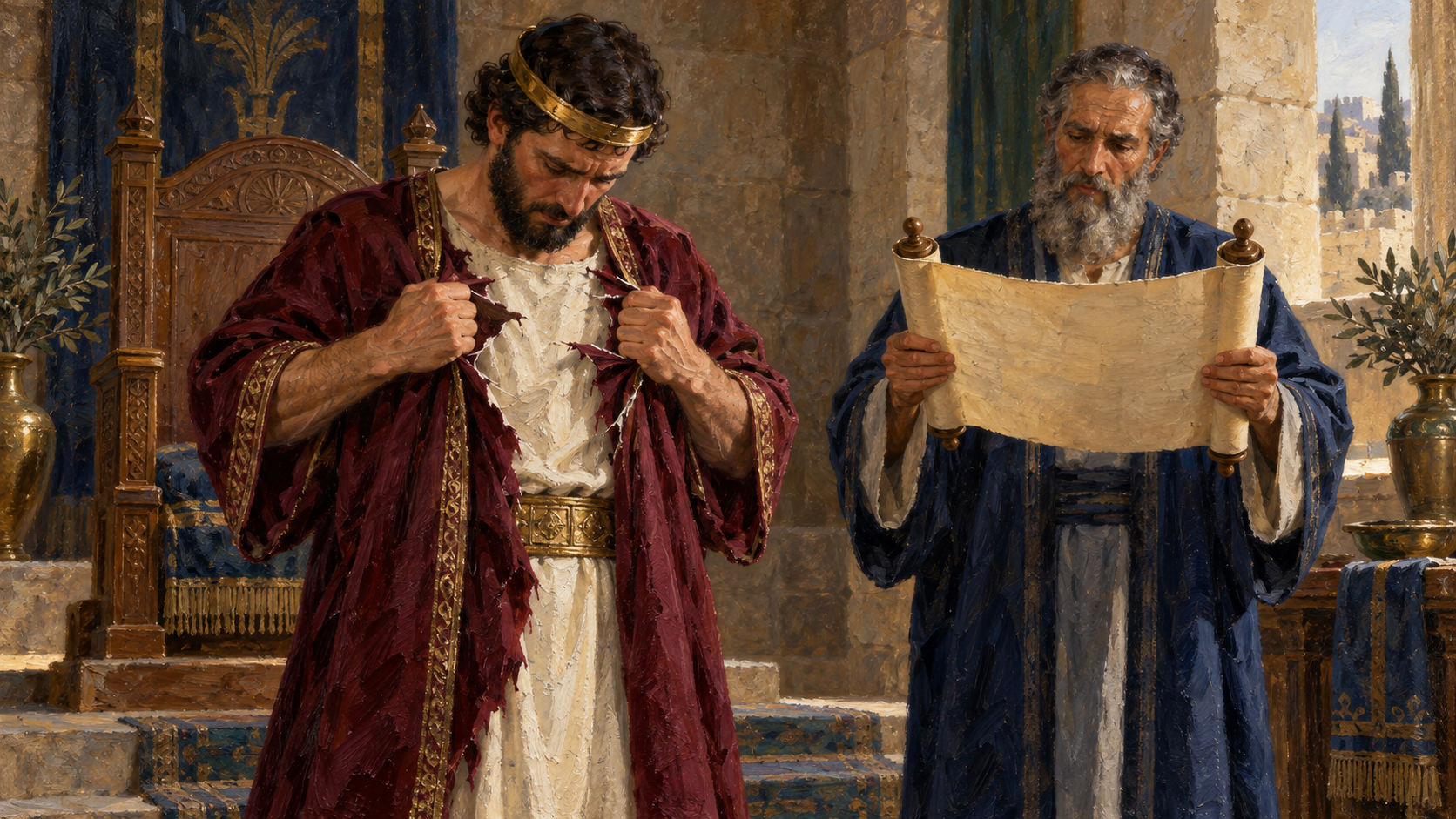
Josiah sought God while still young and began purging idolatry and repairing the temple. When the Book of the Law was recovered, he tore his clothes in response. He then read the covenant publicly and led the people in renewal. His destruction of Bethel’s altar fulfilled the prophecy against Jeroboam, and he later kept an extraordinary Passover.
Even Josiah, Judah’s final righteous king, could not cancel the judgment announced after generations of rebellion. His own death also warns us about failing to listen. Chronicles says Necho’s message came from God’s mouth, yet Josiah refused it and entered battle in disguise. He was mortally wounded. I don’t want his great work of reform to make me overlook that final failure or its consequences.
After Josiah’s death, Jehoahaz reigned for three months before Pharaoh Necho removed him. Jehoiakim then ruled under Egyptian pressure and later under Babylonian control. He burned Jeremiah’s scroll and resisted God’s warnings. Jehoiachin reigned only briefly before surrendering to Babylon. Years later, the Babylonian king gave him an honored place at the royal table.
Babylon appointed Zedekiah, but he rebelled despite Jeremiah’s counsel. Jerusalem fell after a long siege, and his sons were killed before his eyes. The Babylonians then blinded him and carried him away. That dreadful end shows how little political maneuvering could do to preserve a throne that repeatedly despised God’s Word.
Chronology and Prophetic Correction Keep the Royal Record Honest
Kings often dates a ruler’s reign by the year another king was reigning. Those dates become more complicated in cases of co-regency, when two rulers shared a throne for a time. Kingdoms also counted the year of accession differently: some counted it as the first year of the reign, and their calendars did not always begin the New Year together. Simply adding all the stated reign lengths without considering those differences can create an appearance of inconsistency. Alternate names for the same king make the comparison more demanding too.
I would approach those differences as historical accounting questions rather than reasons to dismiss Scripture. A careful timeline should explain how it counts the years and distinguish a sole reign from a co-rule wherever the evidence requires that distinction. The cross-dates in Kings, matching one ruler’s year with another’s reign, deserve patient comparison. Inventing dates or casually declaring a contradiction does not resolve the accounting.
God repeatedly sent prophets to confront royal power. Samuel rebuked Saul, and Nathan confronted David. Ahijah delivered God’s word to Jeroboam concerning Solomon’s kingdom. Elijah and Micaiah later opposed Ahab, while Elisha’s ministry reached several northern kings. Isaiah counseled Ahaz and Hezekiah. Jeremiah warned Judah’s final rulers, and Huldah delivered the word discovered during Josiah’s reign.
These prophets were not there to approve whatever the kings wanted. They brought the LORD’s covenant Word to rulers and people alike, genuinely calling them to repent and announcing judgment when they hardened themselves in rebellion. A king could imprison or even kill the messenger, but he could not undo what God had said.
Comparing these reigns keeps me from treating all their failures as identical. Saul repeatedly rejected God’s Word, whereas David repented after grave concealment and a prophet’s confrontation. Solomon still chose apostasy despite his wisdom. We also need to keep repeated claims about Jezebel distinct from the text, which never calls her a priestess. Ahab’s humbling delayed judgment without establishing a lifelong conversion, and Jehu’s zeal remained incomplete.
Scripture never gives a northern king the verdict that he did right, and even Judah’s best rulers seriously failed. But their responses also differed: Manasseh truly repented, while Josiah finally ignored a word from God. We need the same care with the historical details. Athaliah’s unusual reign explains differing totals, and a chronology should disclose its counting conventions instead of manufacturing certainty.
Every Failed Throne Points to Jesus, the True King
And behold, you will conceive in your womb and bring forth a Son, and shall call His name JESUS. He will be great, and will be called the Son of the Highest; and the Lord God will give Him the throne of His father David. And He will reign over the house of Jacob forever, and of His kingdom there will be no end.”
God’s covenant with David promised an enduring house and throne. In 2 Samuel 7, He also spoke of David’s offspring building the temple and receiving discipline if he sinned. Solomon fulfilled that nearer part by building the temple, but he sinned and died. Every later heir also proved mortal and imperfect. The discipline belongs to those sinful Davidic heirs. I would never transfer it to the completely sinless Christ.
Gabriel identifies Jesus as the Son who receives David’s throne and reigns over the house of Jacob forever. The promise does not dissolve Israel into a metaphor for the church. Jesus will return bodily as the rightful Son of David. During the literal thousand-year kingdom, He will sit upon that throne and rule the nations in righteousness.
Jesus never seized authority or manipulated worship for His own advantage. He did not multiply luxury for Himself, and He never needed correction for sin. He is the eternal Son, fully God and fully man, born of a virgin and completely sinless throughout His life of perfect obedience. He now reigns at the Father’s right hand and will openly establish a kingdom that neither rebellion nor death can end.
Wicked men physically tortured and punished Jesus before killing Him. He willingly bore that real punishment for our sins in His innocent body, shedding His blood and dying for us. He was buried and rose bodily. The Father did not punish or curse Jesus, nor did He abandon, strike, or bruise Him. He did not pour wrath on His Son. The slain and risen Son of David conquered without committing any of the sins that stained Israel’s rulers.
Christ died for the whole world, providing the salvation that no royal dynasty or national identity can give. Keeping the law and pursuing reform cannot save us, and political loyalty cannot cleanse our guilt. God’s offer is genuine even though people can resist and finally reject it. Everyone who repents and believes is forgiven and justified, receiving everlasting life from God through Christ’s blood.
Every truly born-again believer becomes a new creation, indwelt and sealed by the Holy Spirit. That salvation remains eternally secure, but security does not permit royal pride or private lawlessness. Nor does a shallow profession prove that someone has been born again. We gladly bow to Christ’s Word because our King gave Himself for us and now lives forever.
For a closer look at important parts of this history, see The Life of King David, the study of Jeroboam, and Israel’s Kings and the Word.
My Final Thoughts
After following these kings from Saul to the fall of Jerusalem, I keep coming back to the written Law beside the throne. Political strength and religious activity could never replace humble obedience to God’s Word. Even years of reform did not excuse later rebellion, and Israel’s rulers continued to need rebuke and mercy. Jesus alone never turned aside or used His authority for Himself. The Son of David gave His blood for sinners and rose bodily, and He will return to reign in righteousness. I want to bow to His Word now and trust the kingdom that no rebellion, empire, or even death can overthrow.