
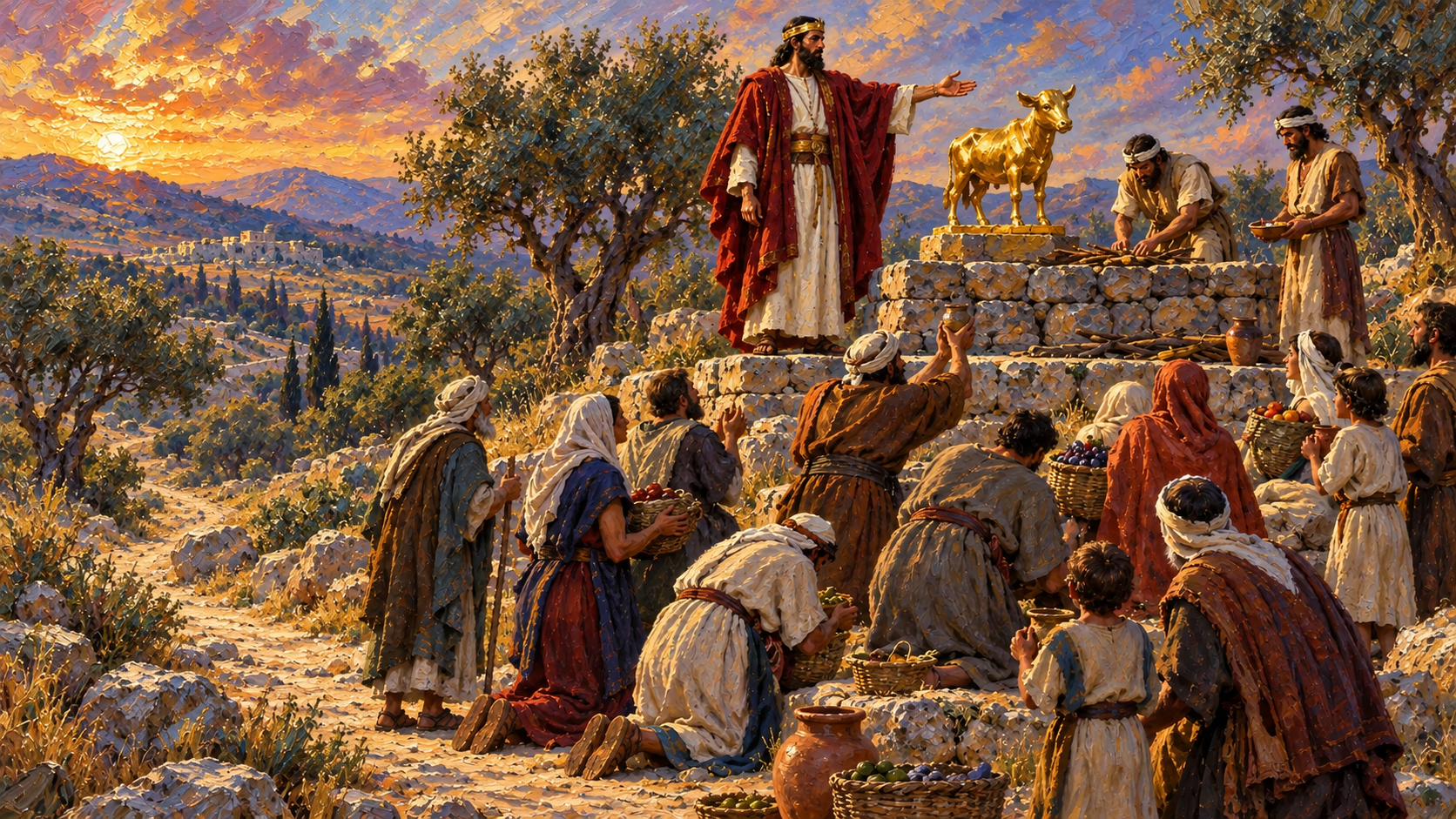
Why does Scripture keep returning to “the sins of Jeroboam” long after his death? God had opened the way for him to receive a kingdom, yet Jeroboam became afraid that obeying God would cost him what he had been given. He acted on that fear until his private unbelief became public policy. Israel was taught to accept false worship as a wise way to preserve the kingdom.
From Solomon’s Servant to Israel’s King
The Jeroboam in this study is the son of Nebat, often called Jeroboam I. He ruled when the kingdom first divided after Solomon. A much later northern king named Jeroboam II appears in 2 Kings 14 during the time of Amos and Jonah. When Kings repeatedly condemns rulers for walking in “the sins of Jeroboam,” it is pointing back to the first king and the worship system he established.
Kings repeatedly says that Jeroboam “made Israel sin.” He gave his unbelief public authority by making images central to worship, then building shrines and appointing his own priests. He even supplied a religious calendar. The crown taught Israel to accept this system, which later kings inherited and chose to continue. Scripture measures those kings against his example without excusing their own decisions.
Saul, David, and Solomon had each ruled a united Israel. After Solomon’s death, most of the northern tribes rejected his son Rehoboam and formed the kingdom commonly called Israel. The southern kingdom, centered in Jerusalem and ruled by David’s descendants, became known as Judah. Keeping those two kingdoms clear helps us follow the later books of Kings, where their rulers and reigns sometimes overlap.
The main account is in 1 Kings 11-14. To understand the worship Jeroboam introduced, we also need the golden-calf account in Exodus 32 and the commands for Israel’s worship and king in Deuteronomy 12 and 17. Then 2 Chronicles 11 and the later chapters of 2 Kings show what happened to the priesthood and the nation. The consequences extended far beyond one decision at Bethel, continuing until the northern kingdom fell.
Jeroboam began as Solomon’s servant rather than as a prince. 1 Kings 11:26 identifies him as an Ephraimite from Zereda and the son of Nebat. Solomon recognized his ability and placed him over the labor force of the house of Joseph, especially the tribes descended from Joseph’s sons Ephraim and Manasseh.
Jeroboam belonged to a tribe with longstanding influence in the north. Joshua had come from Ephraim, and Shiloh in its territory had been an early center of Israel’s worship. Through his work, Jeroboam also knew the burdens northern laborers carried. By the time the kingdom fractured, the people already knew him as someone they could rally around.
His ability and opportunity do not fully explain how he became king. God was disciplining Solomon for following foreign gods despite two appearances from the LORD and a clear warning. The political division came out of that judgment on corrupt worship.
So the LORD became angry with Solomon, because his heart had turned from the LORD God of Israel, who had appeared to him twice, and had commanded him concerning this thing, that he should not go after other gods; but he did not keep what the LORD had commanded.
Outside Jerusalem, Ahijah the Shilonite met Jeroboam with a new garment. He tore it into twelve pieces and gave Jeroboam ten, announcing a division of the kingdom and Jeroboam’s rule over the northern tribes. We should not reduce the later tribal situation to a simple ten-versus-two count, since Levites and other faithful Israelites moved south. The sign itself clearly announced that the kingdom would be divided.
God preserved a portion for David’s house because He remained faithful to His covenant and had chosen Jerusalem. Jeroboam’s future began with the LORD’s word as well. Political skill could not have opened the path God was giving him.
Knowing Jeroboam’s later failures, I could easily pass over how much God had done for him first. The LORD raised him from among the people and announced the kingdom before he received it. He did not gain the throne on his own and only afterward hear what God thought of his rule. When fear came, he had good reason to trust the very God who had made his rise possible.
A Real Promise and a Divided Kingdom
Giving Jeroboam authority did not give him permission to govern Israel however he pleased. The LORD required him to listen and follow His commands. He was responsible for ruling in God’s ways and doing what was right in His sight.
Then it shall be, if you heed all that I command you, walk in My ways, and do what is right in My sight, to keep My statutes and My commandments, as My servant David did, then I will be with you and build for you an enduring house, as I built for David, and will give Israel to you.
The Hebrew word behind “house” is bayit, which can mean a house, a household, or a dynasty. Here God offered Jeroboam an enduring family line if he obeyed. It was a genuine promise. That conditional promise was distinct from the unique messianic covenant He had given David.
I cannot read this promise as though Jeroboam had no choice but to rebel. God gave him instruction and a genuine opportunity for blessing. The LORD who could give ten tribes to Solomon’s servant could also keep him on the throne. Jeroboam did not need to invent another form of worship to protect what God had given.
At the same time, Solomon’s house was experiencing the consequences of idolatry. God’s faithfulness preserved David’s line without making Solomon’s sin harmless. Wisdom and glory had not excused a king who had been warned, so we should not treat the divided kingdom as a random political accident.
After Solomon died, Rehoboam traveled to Shechem, an important northern city, where Israel gathered to make him king. The people did not begin by demanding the end of David’s dynasty. They asked him to lighten the heavy service and yoke Solomon had placed upon them. Rehoboam requested three days to consider their request.
The older counselors advised him to serve the people and answer them kindly. The younger men who had grown up with him urged him to threaten even harsher rule. Rehoboam followed the counsel that fed his pride, and the northern tribes rejected his authority.
So the king did not listen to the people; for the turn of events was from the LORD, that He might fulfill His word, which the LORD had spoken by Ahijah the Shilonite to Jeroboam the son of Nebat.
The events fulfilled God’s word through Ahijah without removing anyone’s responsibility. Rehoboam had to answer for his foolish words, and the tribes for their rebellion. Jeroboam would answer for how he used the crown. I need to keep both truths in view: human choices cannot overthrow what God has spoken, but His sovereignty does not make disobedience innocent.
Jeroboam now had the kingdom God had promised, something no political maneuver could have secured for him. He also had God’s promise about his future. The question was whether he would act on that assurance and trust the LORD enough to obey.
The crisis began in Jeroboam’s own heart. He thought about the temple in Jerusalem and the feasts God required there. If his people kept traveling south to worship, he feared that their loyalty would return to Rehoboam and that they would kill him.
And Jeroboam said in his heart, “Now the kingdom may return to the house of David: If these people go up to offer sacrifices in the house of the LORD at Jerusalem, then the heart of this people will turn back to their lord, Rehoboam king of Judah, and they will kill me and go back to Rehoboam king of Judah.”
Jeroboam “said in his heart” that the people might turn against him. Scripture uses the heart to describe the inner person, where we trust and desire as well as fear. His public disobedience began with the private judgment that God’s promise could not preserve what God had given him. He distrusted the word before he openly broke the command.
Jeroboam makes me consider how easily fear can sound like practical wisdom. A leader may call compromise necessary and defend it as a way to make worship more accessible. Those explanations can conceal the fear directing his decisions. If the plan requires disobedience, it has already treated God’s Word as inadequate, whatever practical reasons are offered for it.
A king was supposed to lead the people in obedience to God’s Word. Jeroboam altered worship to keep them loyal to himself instead. He treated their journey to Jerusalem as a political threat and their devotion as something he needed to control. The outward forms of worship could remain while the king’s decisions replaced God’s authority.
Building a Counterfeit Worship System
He placed one golden calf at Bethel near the southern border and another at Dan in the far north. These visible religious centers offered a convenient alternative to traveling to Jerusalem. But the arrangement Jeroboam used to answer his fear violated the worship God had revealed.
The law given through Moses did not let Israel choose sacrificial centers simply for convenience. Deuteronomy 12 directed the people to bring offerings to the place the LORD chose, and by Jeroboam’s day His temple stood in Jerusalem, where He had placed His name. Deuteronomy 17 also required the king to keep his own copy of the law and read it throughout his life. That leaves me no room to put royal policy above Scripture. The king was to obey God’s Word, not revise it to secure his throne, as the study of Israel’s kings and the Word explains more fully.
Therefore the king asked advice, made two calves of gold, and said to the people, “It is too much for you to go up to Jerusalem. Here are your gods, O Israel, which brought you up from the land of Egypt!” And he set up one in Bethel, and the other he put in Dan. Now this thing became a sin, for the people went to worship before the one as far as Dan.
His words echo Exodus 32, when Aaron made the golden calf and the people spoke of gods who had brought them out of Egypt. Jeroboam may have claimed that his calves represented the LORD rather than openly calling Israel to forget Him. Even that claim would not excuse the images. God had already forbidden that form of worship.
By making this familiar rebellion royal policy, Jeroboam showed that idolatry involves more than choosing a god with another name. We also commit idolatry when we replace God’s revealed truth with an image or a worship system we have made ourselves.
At Bethel, I see a direct reversal of what Jacob had done. Jacob had received his dream there and later returned after leading his household to remove foreign gods. Jeroboam made that place of covenant revelation a center of false worship. The history of Jacob’s ladder could not make his disobedience holy.
The system soon grew beyond the images. Jeroboam made shrines on high places and appointed priests from every class of people rather than from the sons of Levi. He also established a feast in the eighth month, timed like the feast Judah kept but devised in his own heart.
He made shrines on the high places, and made priests from every class of people, who were not of the sons of Levi. Jeroboam ordained a feast on the fifteenth day of the eighth month, like the feast that was in Judah, and offered sacrifices on the altar.
Jeroboam kept forms of worship the people recognized. It borrowed language and patterns the people knew, and its symbols could stir national and religious feeling. That resemblance hid the fact that the king had substituted his own inventions for God’s commands. Popularity made the rebellion more dangerous because it taught people to accept disobedience as worship.
Neither convenience nor Bethel’s sacred past could make the calves acceptable. Wanting political stability gave Jeroboam no right to change worship either. Each defense put a human goal above a clear command from God. His arrangement appeared useful because it answered the danger he feared, but it trained Israel to disobey in the process.
Warnings, Judgment, and a Long National Shadow
God did not leave Jeroboam without warning. A man of God came from Judah and cried out against the altar at Bethel. He named a future king, Josiah, who would defile that altar. As a confirming sign, the altar would split and its ashes would pour out.
When Jeroboam stretched out his hand from the altar to order the prophet’s arrest, it withered so that he could not draw it back. The altar split as the man of God had said, and Jeroboam then asked him to pray for his recovery.
Then the king answered and said to the man of God, “Please entreat the favor of the LORD your God, and pray for me, that my hand may be restored to me.” So the man of God entreated the LORD, and the king’s hand was restored to him, and became as before.
God’s warning was both public and personal. The split altar confirmed the prophet’s word, while Jeroboam’s withered hand brought the judgment upon him. Yet God restored his hand when the prophet prayed. Such mercy should have led him to repent, but 1 Kings 13:33 tells us that he did not turn from his evil way.
Jeroboam wanted his hand restored without changing the worship that had brought judgment upon him. He saw the sign and received relief, yet kept the rebellious system in place. A miracle can remove pain while the person who benefits from it still refuses to surrender to God.
What troubles me is that Jeroboam trusted the prophet’s ability to call on the LORD for help but would not give up his false worship. He personally benefited from answered prayer. Knowing that God is real is not the same as trusting Him. Gratitude for temporary relief is not repentance if I intend to return to the same rebellion.
Jeroboam’s system continued for generations, but the word about Josiah showed that its future remained under God’s rule. In 2 Kings 23, Josiah defiled the Bethel altar just as the prophet had announced. The length of time the system survived could not overturn what the LORD had said.
In 1 Kings 14, Jeroboam’s son became sick, and the king sent his wife to Ahijah, the prophet who had announced his rise. He instructed her to disguise herself. He still knew where to seek God’s true word, but approached it with calculation instead of repentance.
Now the LORD had said to Ahijah, “Here is the wife of Jeroboam, coming to ask you something about her son, for he is sick. Thus and thus you shall say to her; for it will be, when she comes in, that she will pretend to be another woman.”
Although Ahijah’s eyes were dim with age, God had already told him who was coming. He identified Jeroboam’s wife before the disguise could conceal her. We cannot hide from God with a costume, a title, or a carefully managed appearance.
The LORD reminded Jeroboam of how He had raised him from among the people to rule Israel. He had torn the kingdom from David’s house and given it to him. Jeroboam responded by making gods and molded images for himself, provoking the LORD and casting Him behind his back. The severe judgment followed that rejection of God’s grace.
Casting the LORD behind his back meant more than making an unwise leadership decision. Jeroboam was treating God as someone to push out of sight, and his dynasty would be cut off. Yet God found something good toward Himself in the sick child within that same corrupt household. His judgment was not blind rage. He knew each person as he truly was.
The child’s death is painful to read, but I don’t want to pass over the good God found in him. The LORD did not treat the whole family as though everyone were inwardly the same. He knew what no political observer or grieving parent could measure. Even while pronouncing judgment on a corrupt household, He knew every person in it completely.
Jeroboam’s sin did not end with his death. Later kings kept walking in the path he had made. Jehu destroyed Baal worship in Israel, but he refused to remove the calves at Bethel and Dan.
However Jehu did not turn away from the sins of Jeroboam the son of Nebat, who had made Israel sin, that is, from the golden calves that were at Bethel and Dan.
Jehu could be zealous against Baal while preserving false worship that was still politically useful. Removing one form of idolatry did not make the calves acceptable. I need to remember that distinction when considering reform: removing one wrong while preserving another is no substitute for wholehearted obedience.
Chronicles tells us that priests and Levites left their lands for Judah and Jerusalem because Jeroboam and his sons rejected their service to the LORD. God’s requirements exposed what this new system was doing, so faithful people were pushed aside. False worship eventually excludes those who uphold the truth it has rejected.
For the Levites left their common-lands and their possessions and came to Judah and Jerusalem, for Jeroboam and his sons had rejected them from serving as priests to the LORD.
By the time 2 Kings 17 explains the northern kingdom’s fall, Jeroboam’s sin remains part of the indictment. Israel adopted the practices of surrounding nations and turned to idols. God sent prophets to warn the people, but generation after generation rejected His statutes and refused correction. At last Assyria captured Samaria and carried the northern kingdom into exile.
Israel’s exile cannot be explained simply by pointing to one frightened king long before it happened. God kept sending prophets, and later generations kept choosing not to listen. Jeroboam had used his authority to make rebellion normal, turning his private calculation into an institution that encouraged later sin. That influence was real, but it did not remove any later king’s or worshiper’s responsibility.
Jeroboam did not personally cause every later sin. His fear had become policy and then a national habit, but the later rulers still chose whether to maintain it. That is why the history of the kings of Israel repeatedly judges northern kings by whether they continued his pattern or departed from it.
Jesus Christ, the Faithful King
Jeroboam used the authority he had received to protect himself through worship. His failure helps me see our need for a righteous King. Jesus is that rightful King, and He refused every sinful shortcut. When Satan offered Him the world’s kingdoms in exchange for worship, He answered from Scripture.
Then Jesus said to him, “Away with you, Satan! For it is written, ‘You shall worship the LORD your God, and Him only you shall serve.'”
Jesus never manipulated worship for power or tried to preserve His life through disobedience. He is the eternal Son, fully God and fully man. He was born of a virgin and lived completely without sin. His obedience to the Father was perfect, even when it led Him willingly to the cross.
Wicked men tortured Jesus and inflicted real physical punishment upon Him. He bore the punishment for our sins in His innocent body and shed His blood for the whole world. He truly died and was buried before rising bodily from the dead. The Father did not punish, curse, abandon, strike, bruise, or pour wrath on Jesus.
The Son of David does not secure His kingdom through fear or support His rule with images. His rule requires neither an invented priesthood nor compromises made for political convenience. Jeroboam promised easier access while leading Israel away from God’s Word. Christ brings us to the Father through His own blood.
God genuinely offers salvation to everyone, although people can resist and reject Him. Every person who repents and believes in Jesus is forgiven and justified, meaning declared righteous before God. The believer is born again as a new creation. The Holy Spirit comes to dwell within and seals that person, who is eternally secure in Christ.
Eternal security does not excuse lawlessness, and a superficial profession does not establish that a person has been born again. We receive salvation by faith, not through ritual or family lineage. Keeping the law and remaining loyal to a religious system cannot produce it either. The gospel calls us away from trying to repair a counterfeit altar and directs us to the one Mediator God has provided.
My Final Thoughts
What stays with me about Jeroboam is how much God had already given him before he let fear govern his decisions. The LORD gave him authority and a clear, genuine path of blessing. Yet he treated obedience as a danger and control as the answer, building a system that harmed generations. That should make me question any appeal to convenience that asks me to set God’s Word aside, whether I am leading others or worshiping alongside them. Jesus Christ is the better King: He never changes worship to protect Himself, and His blood brings sinners safely to God.