
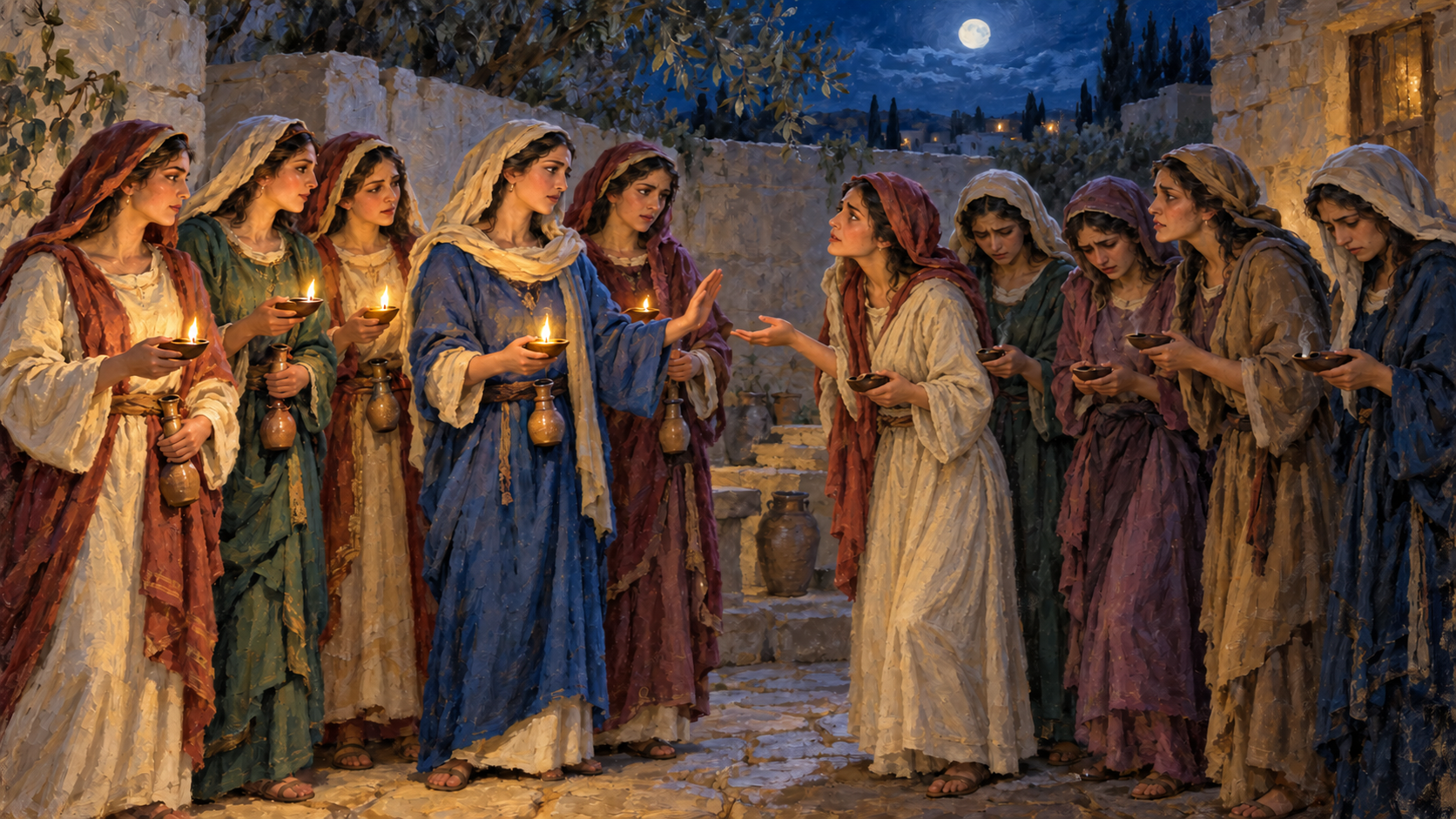
The ten women in this parable all expect the bridegroom to arrive. They carry lamps, wait through the delay, and get up when his arrival is announced. Yet five enter the wedding and five are shut outside. When I read that, I have to consider more than whether I look like someone waiting for Christ. It is possible to know Christian language and share in church life without having personally trusted the Savior everyone is talking about.
Matthew 24 Leads into the Wedding Scene
Jesus gave this parable in Matthew 25:1-13 while teaching His disciples on the Mount of Olives. They had asked about the temple’s destruction, His coming, and the end of the age. We commonly call this teaching the Olivet Discourse because of where He delivered it.
In Matthew 24, Jesus warned of deception and persecution, described the coming Tribulation, and spoke of His bodily return in glory. He assured the disciples that His words would be fulfilled without telling them the exact hour. Immediately before the wedding parable, He describes a faithful servant who continues his master’s work and an evil servant who uses the apparent delay as an excuse for cruelty and self-indulgence. Jesus continues to address readiness during the wait in the parable of the ten virgins.
I believe Christ will gather His church before the seven-year Tribulation and later return bodily in glory to reign. The study on the rapture explains the wider biblical grounds for that understanding. This parable does not, by itself, identify every prophetic group or establish every step in that sequence. It does warn us about real preparation for His coming. We could explain a prophetic chart correctly and still evade the question of whether we belong to Him.
The virgins are unmarried young women serving as wedding attendants. They go out to welcome the bridegroom, with lamps for the procession at night. Jesus does not describe them as enemies trying to disrupt the wedding. All ten have a place among those expecting him, and anyone watching them wait might assume they were equally prepared.
The call, “Behold, the bridegroom is coming; go out to meet him!” uses the Greek word apantesis for “meet.” It describes a meeting, and here the attendants are going out to welcome the bridegroom.
We do not need to reconstruct every detail of an ancient wedding to follow what Jesus says. The bridegroom’s arrival takes longer than expected, the attendants need light when he comes, and the door to the feast eventually closes. The promised joy of Christ’s people is considered further in the study on the marriage supper of the Lamb. Here, the celebration makes the exclusion especially dreadful: these women expected to enter, but their expectation alone did not admit them.
The Lamps Look Alike, but the Oil Reveals the Difference
Jesus calls five attendants wise and five foolish. Although all ten carry lamps, only the wise bring oil in vessels along with them. Before any midnight announcement, Jesus has already told us what will separate the two groups.
But the wise took oil in their vessels with their lamps. But while the bridegroom was delayed, they all slumbered and slept.
All ten grow drowsy and sleep, so physical sleep cannot be the failure that excludes the foolish women. The wise sleep too, without becoming unprepared, because they have already brought what they will need. Jesus is not asking us to live in constant agitation, afraid to grow tired or rest.
In Matthew 7:24, Jesus calls the person who hears His words and acts on them wise. He is speaking about obedience, not merely intelligence. The wise attendants had considered what welcoming the bridegroom would require and brought the oil their lamps needed. They had done more than assume that carrying a lamp would be enough.
I understand the lamps as picturing the profession other people can see. Two people may sit beside each other in church, sing the same words, and both speak comfortably about Christ’s return. That tells us what they profess, but it does not establish that both have been born again. We need to distinguish what someone says about belonging to Christ from the new life God actually gives.
The oil represents the readiness the foolish lack. Some interpreters identify it with prayer, good works, Bible knowledge, or church involvement. Those things have their proper place, but none can produce regeneration, which means being born again. A person can pray often while trusting his own religious effort, or learn Scripture while refusing to trust the Christ it reveals. Doing another religious task cannot substitute for receiving life from Him.
Elsewhere in Scripture, oil is associated with consecration, or being set apart for God, and with His enabling work. Zechariah’s lampstand vision includes this message for Zerubbabel: “Not by might nor by power, but by My Spirit,” says the LORD of hosts. Zerubbabel had laid the temple’s foundation, and God promised that he would finish the rebuilding. That promise of the Spirit’s help is one reason I connect the oil here with the spiritual life God supplies, though Jesus does not explicitly say that the oil is the Holy Spirit. Ephesians gives us a direct statement about the Spirit’s work in those who believe.
In Him you also trusted, after you heard the word of truth, the gospel of your salvation; in whom also, having believed, you were sealed with the Holy Spirit of promise, who is the guarantee of our inheritance until the redemption of the purchased possession, to the praise of His glory.
The believer hears the gospel, believes in Christ, and is sealed with the Holy Spirit. This is something God does within a person, not something supplied by his place in a religious gathering. I therefore understand the parable to expose a profession that lacks genuine new life, rather than describe a born-again person losing the Spirit. We should read the imagery alongside these clear statements about salvation, without turning every detail of a lamp into a separate doctrine.
The study on lamps being filled with oil examines that wider imagery. In this parable, the practical failure is already plain: the foolish have not brought what they will need when the bridegroom arrives.
The Delay Tests What the Attendants Possess
The bridegroom is delayed from the attendants’ point of view. Jesus is not suggesting that Christ has missed an appointment or lost control of His return. We are the ones who do not know how long the wait will be. The apparent delay gives no one permission to assume His promise has failed.
Someone may continue attending church because his family expects it or because his friends are there, without personally trusting Christ. Another person may point to a powerful past experience whenever the question of faith comes up. Those associations and experiences may persuade others that a person belongs to Christ, but neither a familiar routine nor a vivid memory proves that he has been made new. The delay does not create the lack Jesus is exposing; the foolish attendants were unprepared before the wait began.
At midnight, the waiting attendants are awakened by a cry. That hour brings surprise into the parable; it does not predict a date for Christ’s return or a coded stage of the Tribulation. They cannot choose a more convenient moment to get ready.
And at midnight a cry was heard: “Behold, the bridegroom is coming; go out to meet him!” Then all those virgins arose and trimmed their lamps.
When the announcement wakes them, all ten begin preparing their lamps. The foolish ask for oil because their lamps are going out, as Matthew 25:8 says. Unlike the wise, they have no supply to replenish their lamps.
Borrowed Oil Cannot Open a Shut Door
The wise women answer that dividing their oil could leave both groups without enough. We cannot use their refusal as permission to be selfish toward someone in need. Jesus is showing that the foolish have reached a moment when another person’s preparation cannot make up for their own neglect.
The foolish women leave to buy oil, but the bridegroom arrives while they are away. Those who are ready enter the wedding with him, and the door is shut before their companions return.
And while they went to buy, the bridegroom came, and those who were ready went in with him to the wedding; and the door was shut. Afterward the other virgins came also, saying, “Lord, Lord, open to us!” But he answered and said, “Assuredly, I say to you, I do not know you.”
The foolish know whom to address, call him “Lord,” and ask to enter. His answer, “I do not know you,” does not mean he is confused about who is standing outside. They expect him to welcome them as part of his company, but he refuses to recognize that claim. Knowing about the wedding and addressing him correctly cannot make them belong to him.
Matthew 7 contains a similar warning. People say, “Lord, Lord,” and point to impressive religious activity, yet Christ answers, “I never knew you.” His words do not describe people He once knew and then forgot. Luke 13 likewise describes people shut outside who appeal to having eaten and drunk in His presence and heard Him teach. In each passage, being near the Lord’s works and words has been mistaken for belonging to Him.
A Christian parent can teach a child Scripture and pray for him for years, but that parent cannot believe in Christ on the child’s behalf. A faithful husband or wife can be a strong witness without being able to give the other spouse new life. The church can proclaim the gospel, open Scripture with people, and urge them to respond. These are valuable gifts from God, but each person must personally trust the Savior to whom they point.
The wise attendants’ advice to go and buy oil does not mean that salvation can be purchased. Paul states plainly how we receive it.
For by grace you have been saved through faith, and that not of yourselves; it is the gift of God, not of works, lest anyone should boast.
Isaiah 55 also invites the thirsty to buy without money and without price. God supplies what sinners cannot earn. The foolish attendants are trying to obtain oil after the arrival has been announced. Jesus is not teaching us to purchase the Holy Spirit or earn a place at the feast through last-minute religious effort.
I find the closed door sobering because Jesus leaves no promise of another opportunity after it shuts. God’s patience must not be mistaken for permission to postpone repentance indefinitely. But we are hearing the warning before that final exclusion. Jesus tells us now so that we will come to Him, rather than rely on a religious reputation until it is too late.
Watchfulness Rests on Christ, Not Panic
Jesus ends with an instruction to watch because we do not know the day or hour.
Watch therefore, for you know neither the day nor the hour in which the Son of Man is coming.
The Greek verb gregoreo means to watch or remain alert. Since the wise attendants slept along with the foolish, the command cannot require literal sleeplessness. Jesus calls us to be prepared for His coming. Guessing dates or panicking at each alarming headline does not accomplish that.
The faithful servant in Matthew 24 keeps doing his master’s work. The wise attendants in Matthew 25 have brought their oil before the announcement comes. Neither example requires constant emotional intensity or sinless performance, but both challenge the assumption that a delay lets us disregard the Master. I am responsible for how I live today even when His return does not feel immediate.
That responsibility includes telling the truth and keeping my promises when it would be convenient not to. It includes forgiving someone instead of preserving my resentment, and serving the people God has already put before me. We keep listening to Scripture, confessing sin instead of hiding it, and gathering with believers who help us obey the Lord. These are expressions of genuine faith; they neither purchase salvation nor keep us saved.
Some readers worry that this parable means a true believer may lose salvation at the last moment. I do not understand it that way. The foolish attendants failed to bring the needed supply from the outset; the bridegroom is not described as taking it away from them. More directly, Jesus promises to keep those who truly belong to Him.
And I give them eternal life, and they shall never perish; neither shall anyone snatch them out of My hand.
His sheep receive eternal life, and He promises that they will never perish. In 1 Peter 1:5, Peter also says believers are kept by God’s power through faith, while Paul describes them as sealed with the Holy Spirit. My assurance rests on Christ and His promises, not on whether I can sustain a feeling of readiness every hour.
At the same time, Scripture warns about people whose place among believers concealed their rejection of Christ. John describes such a departure in his first letter.
They went out from us, but they were not of us; for if they had been of us, they would have continued with us; but they went out that they might be made manifest, that none of them were of us.
John is speaking about antichrists who deny Jesus as the Christ, not declaring that anyone who leaves a particular congregation was never saved. Their departure exposed a rejection of the Son that their former association had concealed. The warning applies to religious profession without genuine faith; it gives us no excuse to question someone’s salvation merely because he no longer attends our church.
So I need to examine what I am depending on. A Christian family, a moral reputation, and years of ministry cannot give us the new life Christ provides. Neither can a powerful emotion from the past. We should look for the fruit of new life in our conduct, but that fruit is evidence of His work, not the price of acceptance. A believer who grieves over sin and turns to Christ should not read this parable as a command to despair.
If the parable exposes an empty profession, come to the Savior now. Jesus is the eternal Son, fully God and fully man, who lived without sin. Wicked people tortured Him and put Him to death, but He willingly gave Himself to be slain as the sinless, perfect sacrifice for our sins. He completed that saving work through His shed blood and death before His burial and bodily resurrection. The Father did not punish, curse, abandon, strike, bruise, or pour wrath on Jesus. Father and Son acted in unity to save us.
Christ died for the whole world, and God’s offer of salvation is genuine for every person. His grace can be resisted, and people can finally reject Him. But everyone who repents and trusts in Jesus is forgiven and born again as a new creation. The Holy Spirit lives within that believer and seals him, and his salvation is eternally secure in Christ. That assurance never gives permission for lawlessness, and merely claiming it does not prove a person has been converted.
The answer to false assurance is to trust Christ Himself. He receives those who come to Him, and His warning calls us to respond while the opportunity remains.
My Final Thoughts
I do not want to become so familiar with Christian life that I stop considering whether my confidence is actually in Christ. The foolish attendants were near the wedding and expected to enter, but expectation did not supply what they had neglected. Jesus gives this warning while we can still respond to Him. Those who belong to Him can rest in His promise to keep them, without using that assurance to excuse disobedience. We do not know when He will come, but we can trust Him and take seriously what He has given us to do today.