
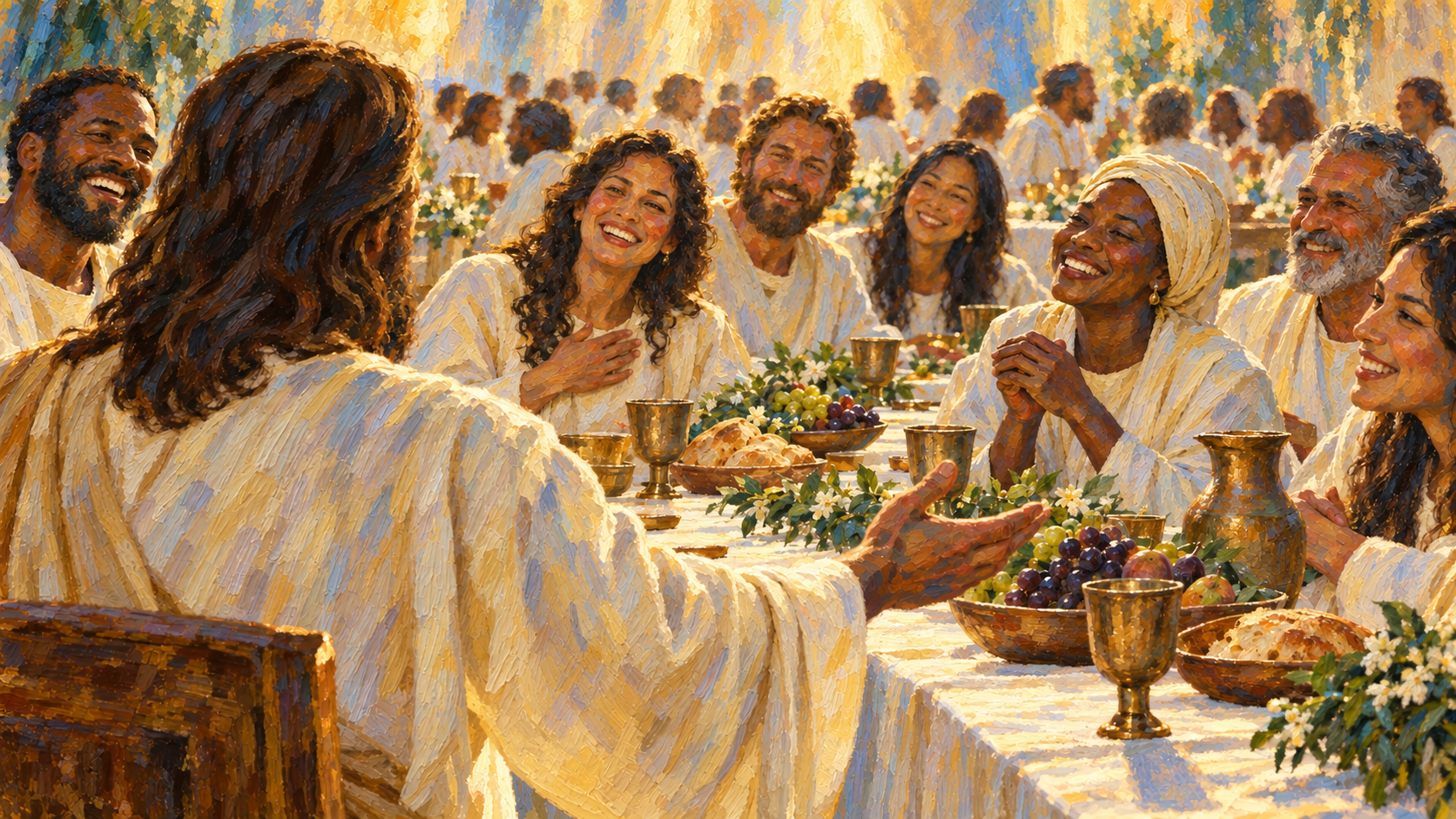
What is the Marriage Supper of the Lamb, and where does it fit in the events still ahead? Revelation announces a wedding and blesses those invited to the feast. It gives us good reason to look forward to being with Christ, while leaving some of the arrangements unexplained. I want to follow what Scripture tells us without making those unanswered questions carry more weight than the promise itself.
The Lamb’s Marriage Is Announced Before His Return
After these things I heard a loud voice of a great multitude in heaven, saying, “Alleluia! Salvation and glory and honor and power belong to the Lord our God! For true and righteous are His judgments, because He has judged the great harlot who corrupted the earth with her fornication; and He has avenged on her the blood of His servants shed by her.” Again they said, “Alleluia! Her smoke rises up forever and ever!” And the twenty-four elders and the four living creatures fell down and worshiped God who sat on the throne, saying, “Amen! Alleluia!” Then a voice came from the throne, saying, “Praise our God, all you His servants and those who fear Him, both small and great!” And I heard, as it were, the voice of a great multitude, as the sound of many waters and as the sound of mighty thunderings, saying, “Alleluia! For the Lord God Omnipotent reigns! Let us be glad and rejoice and give Him glory, for the marriage of the Lamb has come, and His wife has made herself ready.” And to her it was granted to be arrayed in fine linen, clean and bright, for the fine linen is the righteous acts of the saints. Then he said to me, “Write: ‘Blessed are those who are called to the marriage supper of the Lamb!'” And he said to me, “These are the true sayings of God.” And I fell at his feet to worship him. But he said to me, “See that you do not do that! I am your fellow servant, and of your brethren who have the testimony of Jesus. Worship God! For the testimony of Jesus is the spirit of prophecy.”
Revelation 19 follows the fall of Babylon, the corrupt world system that seduced the nations and shed the blood of God’s servants. Heaven praises God because His judgments are true and righteous. The repeated “Alleluia” celebrates the overthrow of the power that persecuted His people. God has not forgotten His murdered servants or allowed their oppressor to continue forever. As heaven celebrates His reign, the Lamb’s marriage is announced.
His wife has made herself ready, and she receives clean, bright linen, which Revelation identifies as the righteous acts of the saints. The angel declares those invited to the marriage supper blessed, then assures John, “These are the true sayings of God.” We look forward to this wedding because God has promised it. The passage does not identify every guest or tell us where the supper will be held, what will be served, or how long it will last.
The Bridegroom is called the Lamb because He was slain and redeemed people to God by His blood, as Revelation has already shown. He gave Himself to save the people who will share His joy. Their place with Him rests on that redemption; no beauty, status, or religious achievement of theirs could have secured it.
That name also keeps His coming victory connected to His saving work. The Rider who will judge the nations is the same Jesus who gave His life for us, and His victory will fulfill His purpose to deliver His people.
When John falls before the angel, the angel refuses his worship and tells him, “Worship God!” The messenger who announces this joy must not become the object of devotion. Prophecy testifies to Jesus, and our attention belongs on Him. Paul’s comparison of Christ and the church with a husband and wife helps us understand the relationship the wedding celebrates.
Wives, submit to your own husbands, as to the Lord. For the husband is head of the wife, as also Christ is head of the church; and He is the Savior of the body. Therefore, just as the church is subject to Christ, so let the wives be to their own husbands in everything. Husbands, love your wives, just as Christ also loved the church and gave Himself for her, that He might sanctify and cleanse her with the washing of water by the word, that He might present her to Himself a glorious church, not having spot or wrinkle or any such thing, but that she should be holy and without blemish. So husbands ought to love their own wives as their own bodies; he who loves his wife loves himself. For no one ever hated his own flesh, but nourishes and cherishes it, just as the Lord does the church. For we are members of His body, of His flesh and of His bones. “For this reason a man shall leave his father and mother and be joined to his wife, and the two shall become one flesh.” This is a great mystery, but I speak concerning Christ and the church. Nevertheless let each one of you in particular so love his own wife as himself, and let the wife see that she respects her husband.
Paul explains earthly marriage by pointing to Christ and the church. Christ loved the church and gave Himself for her, and His care continues as He sanctifies His people. To sanctify is to set apart as holy; He cleanses the church through His Word and will present her to Himself in glory, holy and without blemish.
Paul speaks of believers together as one body, rather than millions of separate brides. Christ nourishes and cherishes the church as His own, and a husband is called to imitate that care. His headship requires him to seek his wife’s good with love and responsibility. It gives him no permission to bully or neglect her.
The church already belongs to Jesus; believers do not have to wait until the wedding announced in Revelation 19 to become His people. The future marriage brings their existing covenant relationship into its completed, public celebration.
The bride’s readiness needs to be understood within that relationship. Ephesians emphasizes Christ’s work in presenting the church, while Revelation says the wife made herself ready and that her linen was granted to her. God saves and cleanses His people, and they respond to His grace with obedience. When they sin, they are to repent and return to faithful living rather than settle into conduct that dishonors Him.
I cannot turn that readiness into a standard of performance we must reach to earn a place with Christ. A true believer is eternally secure in Him. At the same time, His promised return gives us a reason to pursue purity now. We are preparing to meet the Lord who loves holiness and who has already claimed us as His own.
Revelation identifies the linen as righteous acts, so faithful service has a place in the wedding picture. Yet the linen is granted to the bride. Our works cannot pay for sin, earn salvation, or keep us saved. God justifies us by faith apart from works, and service grows out of the new life Christ gives. Even when He recognizes faithfulness, we have no grounds for boasting, because both our salvation and the opportunity to serve come through His grace.
The invitation to the supper raises another question: if the church is the bride, who are the guests? Many dispensational interpreters, who distinguish the church from Israel in God’s prophetic purposes, understand these guests to include Old Testament saints and people saved during the Tribulation. That is a plausible way to understand other redeemed people joining the bride’s celebration. Revelation 19:9, however, does not name those groups, so I would not present the identification as an explicit statement of the verse.
I would not force every use of the wedding image into a separate class of redeemed people. The church is described together as the bride, while an individual believer can also rejoice in the promise of sharing the feast. Those images express related aspects of the joy God gives His people; using one does not cancel the other.
Verse 7 announces the marriage, and verse 9 blesses those called to the supper. The marriage and its feast belong together, though the announcement does not require every part of the celebration to occur at the same instant. The marriage celebrates the relationship between Christ and His people, while the supper emphasizes their fellowship and joy. To understand how that celebration relates to His return, I read Revelation alongside the other prophetic passages.
Christ Gathers the Church and Evaluates Her Service
No single passage lays out every future event. As I read the relevant passages together, I believe Christ will gather His church before the seven-year Tribulation. During that coming period, the man of sin will be revealed, Israel will face a severe crisis, and God’s judgments will fall on a rebellious world. Meanwhile, Christ will evaluate His people’s service in heaven and prepare the church for presentation. Revelation 19 places the marriage announcement before His visible descent to earth.
But I do not want you to be ignorant, brethren, concerning those who have fallen asleep, lest you sorrow as others who have no hope. For if we believe that Jesus died and rose again, even so God will bring with Him those who sleep in Jesus. For this we say to you by the word of the Lord, that we who are alive and remain until the coming of the Lord will by no means precede those who are asleep. For the Lord Himself will descend from heaven with a shout, with the voice of an archangel, and with the trumpet of God. And the dead in Christ will rise first. Then we who are alive and remain shall be caught up together with them in the clouds to meet the Lord in the air. And thus we shall always be with the Lord. Therefore comfort one another with these words.
Paul is writing to Christians who have lost fellow believers to death. He tells them that the Lord Himself will descend, the dead in Christ will rise, and believers still living will be caught up with them to meet Him in the air. Those who died will not miss the gathering, and those still living will not go ahead of them. They will meet the Lord together and remain with Him forever.
This catching away is commonly called the Rapture. The passage establishes the gathering itself; I understand its place before the Tribulation in light of the wider prophetic teaching, including the promise that believers are not appointed to wrath in 1 Thessalonians 5:9. That does not promise an easy life before then. Christians already suffer persecution, and some are killed for their faith. I distinguish that suffering from the coming period of judgment upon the rebellious world.
This reunion includes bodily resurrection. Believers who have died are already consciously with Christ, but He will raise their bodies and transform those still living, as Paul explains further in 1 Corinthians 15:51-53. Our future with Him is not an eternity without bodies. Paul gives this promise to comfort grieving Christians, so I want to teach it in a way that helps people face death with confidence in Christ. Attempts to calculate a date distract from the comfort he gives.
Those gathered to Christ will also answer to Him for their service. Paul uses the picture of a building to explain how the Lord will examine the work done in His name.
For we are God’s fellow workers; you are God’s field, you are God’s building. According to the grace of God which was given to me, as a wise master builder I have laid the foundation, and another builds on it. But let each one take heed how he builds on it. For no other foundation can anyone lay than that which is laid, which is Jesus Christ. Now if anyone builds on this foundation with gold, silver, precious stones, wood, hay, straw, each one’s work will become clear; for the Day will declare it, because it will be revealed by fire; and the fire will test each one’s work, of what sort it is. If anyone’s work which he has built on it endures, he will receive a reward. If anyone’s work is burned, he will suffer loss; but he himself will be saved, yet so as through fire.
In the immediate context, Paul is discussing his own work and that of others who build up the church. He laid the foundation by preaching Jesus Christ, and those who build on it must take care how they build. The coming Day will expose the quality of their work. A worker whose labor endures will receive a reward; one whose work is burned will suffer a real loss.
Paul’s warning has a wider application to Christian service. The Lord sees whether our teaching and labor actually build His people on the truth of Christ. An impressive reputation cannot make careless or self-serving work endure His examination. He knows what we did and why we did it.
Paul also says that the person whose work burns will himself be saved, though as through fire. His loss does not undo his salvation. At the judgment seat of Christ, sometimes called the Bema, believers answer to the Lord for their service. He examines what they have done as people who already belong to Him; He is not deciding whether to accept them all over again.
I understand this examination to be part of the church’s preparation for presentation to Christ. Revelation 19 does not describe the judgment seat itself, so I am drawing that connection from the passages read together. Christ’s recognition of faithful service helps me understand the linen that is both granted to the bride and identified with righteous acts. He knows the truth about His servants’ work, and His judgment leaves no room for pride. I can be secure in Him while taking His examination of my service seriously.
The Bridegroom Returns and Establishes His Kingdom
Now I saw heaven opened, and behold, a white horse. And He who sat on him was called Faithful and True, and in righteousness He judges and makes war. His eyes were like a flame of fire, and on His head were many crowns. He had a name written that no one knew except Himself. He was clothed with a robe dipped in blood, and His name is called The Word of God. And the armies in heaven, clothed in fine linen, white and clean, followed Him on white horses. Now out of His mouth goes a sharp sword, that with it He should strike the nations. And He Himself will rule them with a rod of iron. He Himself treads the winepress of the fierceness and wrath of Almighty God. And He has on His robe and on His thigh a name written: KING OF KINGS AND LORD OF LORDS. Then I saw an angel standing in the sun; and he cried with a loud voice, saying to all the birds that fly in the midst of heaven, “Come and gather together for the supper of the great God, that you may eat the flesh of kings, the flesh of captains, the flesh of mighty men, the flesh of horses and of those who sit on them, and the flesh of all people, free and slave, both small and great.” And I saw the beast, the kings of the earth, and their armies, gathered together to make war against Him who sat on the horse and against His army. Then the beast was captured, and with him the false prophet who worked signs in his presence, by which he deceived those who received the mark of the beast and those who worshiped his image. These two were cast alive into the lake of fire burning with brimstone. And the rest were killed with the sword which proceeded from the mouth of Him who sat on the horse. And all the birds were filled with their flesh.
After the wedding blessing, heaven opens and Jesus appears on a white horse. He is called Faithful and True and identified as the Word of God, with King of kings and Lord of lords written on His robe. The beast and false prophet are seized and cast into the Lake of Fire, and the armies gathered against Him are destroyed. Their rebellion cannot prevent Him from ruling the nations.
The birds are summoned to a separate supper, where they eat the flesh of the defeated armies. This is a grim scene of judgment, distinct from the marriage supper promised to the redeemed. Christ’s coming brings deliverance for His people and destroys the power of those who have opposed Him.
This visible intervention follows the Tribulation. I distinguish it from the church’s earlier meeting with Him in the air, when He gathers believers to Himself. Here He comes with heavenly armies to confront His enemies on earth. Redeemed saints accompany Him, although I would not identify every rider from the linen alone; Revelation 15:6 also describes angels wearing clean, bright linen.
The church’s future includes more than being received into heaven. The Bridegroom returns to establish His literal thousand-year kingdom, described in Revelation 20. His people will share the joy of His reign as the Lord they trusted through suffering openly rules the nations.
Although the supper is announced in heaven, Revelation does not expressly say the meal takes place there. A heavenly celebration before Christ returns is possible. Other banquet promises also direct our attention toward His kingdom on earth. In Matthew 8:11, Jesus speaks of people coming from east and west to sit with Abraham, Isaac, and Jacob in the kingdom, and Isaiah describes the LORD preparing a feast on Mount Zion.
And in this mountain The LORD of hosts will make for all people A feast of choice pieces, A feast of wines on the lees, Of fat things full of marrow, Of well-refined wines on the lees. And He will destroy on this mountain The surface of the covering cast over all people, And the veil that is spread over all nations. He will swallow up death forever, And the Lord GOD will wipe away tears from all faces; The rebuke of His people He will take away from all the earth; For the LORD has spoken. And it will be said in that day: “Behold, this is our God; We have waited for Him, and He will save us. This is the LORD; We have waited for Him; We will be glad and rejoice in His salvation.”
Isaiah describes a generous feast for all peoples and the removal of the covering spread over the nations. God will swallow up death and wipe away His people’s tears. Those who waited for Him will rejoice because He has brought the salvation they trusted Him to provide.
This promise reaches beyond the opening of the kingdom to God’s complete victory over death. Paul applies Isaiah’s words to the resurrection in 1 Corinthians 15:54, and Revelation 21:4 echoes the removal of tears and death in the new creation. Reading those passages together keeps me from squeezing everything Isaiah describes into the moment the thousand years begin.
These banquet promises help us understand the fellowship and abundance associated with the Lamb’s supper, but they do not specify all its arrangements. The celebration may include both heaven and earth, or the wedding image may embrace the joy of the kingdom more broadly than one scheduled meal. I regard those as possibilities. Scripture does not say the supper lasts throughout the entire seven-year Tribulation. We can trust Christ to gather His people and share His joy with them while leaving the feast’s exact location and duration open.
Jesus’ Wedding Parables Call Us to Be Ready
Scripture uses wedding language in several settings, and ancient customs can help explain the imagery. Betrothal was a binding pledge of marriage, followed by a period of waiting; processions and feasting help us picture the celebration. But those customs cannot supply a prophetic timetable that Scripture itself leaves unstated.
Some popular explanations present a fixed sequence in which the groom builds a room at his father’s house, comes at night with a shofar, and hides his bride for seven days. A shofar is a trumpet made from an animal’s horn. The seven days are then equated with the seven-year Tribulation. Wedding practices varied, and the New Testament does not establish that equation. I would not make a reconstructed ceremony the basis of doctrine.
Jesus’ promise about His Father’s house in John 14 rests on His own words. Likewise, the trumpet in 1 Thessalonians 4 belongs to what Paul reveals about Christ’s coming, whether or not a reconstructed wedding ceremony includes a similar signal. Jesus’ wedding parables deserve the same care: we should follow the point He makes in each one.
“Then the kingdom of heaven shall be likened to ten virgins who took their lamps and went out to meet the bridegroom. Now five of them were wise, and five were foolish. Those who were foolish took their lamps and took no oil with them, but the wise took oil in their vessels with their lamps. But while the bridegroom was delayed, they all slumbered and slept. “And at midnight a cry was heard: ‘Behold, the bridegroom is coming; go out to meet him!’ Then all those virgins arose and trimmed their lamps. And the foolish said to the wise, ‘Give us some of your oil, for our lamps are going out.’ But the wise answered, saying, ‘No, lest there should not be enough for us and you; but go rather to those who sell, and buy for yourselves.’ And while they went to buy, the bridegroom came, and those who were ready went in with him to the wedding; and the door was shut. “Afterward the other virgins came also, saying, ‘Lord, Lord, open to us!’ But he answered and said, ‘Assuredly, I say to you, I do not know you.’ “Watch therefore, for you know neither the day nor the hour in which the Son of Man is coming.
All ten virgins go out to meet the bridegroom, and all ten fall asleep during the delay. Sleep itself does not distinguish the wise from the foolish. The difference becomes clear when the cry announces his arrival: only five have brought the oil they need. They enter the wedding, and the others arrive after the door has been shut.
The virgins are attendants awaiting the bridegroom, rather than the bride herself. I would therefore be careful about treating every detail as a direct description of the church’s gathering before the Tribulation. Jesus tells His hearers to watch because the day and hour are unknown. His warning gives us no reason to assume we can wait until His arrival to become ready.
Nor can readiness be borrowed from another person when Christ arrives. A family’s faith or membership in a congregation cannot substitute for personally receiving Him. I take the closed door and the bridegroom’s refusal seriously: the opportunity to respond will not remain open forever. We do not need to turn the oil into a detailed prophetic code to understand that warning.
Another wedding parable addresses people who disregard the king’s invitation and presume they can approach him on their own terms.
And Jesus answered and spoke to them again by parables and said: “The kingdom of heaven is like a certain king who arranged a marriage for his son, and sent out his servants to call those who were invited to the wedding; and they were not willing to come. Again, he sent out other servants, saying, ‘Tell those who are invited, “See, I have prepared my dinner; my oxen and fatted cattle are killed, and all things are ready. Come to the wedding.”‘ But they made light of it and went their ways, one to his own farm, another to his business. And the rest seized his servants, treated them spitefully, and killed them. But when the king heard about it, he was furious. And he sent out his armies, destroyed those murderers, and burned up their city. Then he said to his servants, ‘The wedding is ready, but those who were invited were not worthy. Therefore go into the highways, and as many as you find, invite to the wedding.’ So those servants went out into the highways and gathered together all whom they found, both bad and good. And the wedding hall was filled with guests. “But when the king came in to see the guests, he saw a man there who did not have on a wedding garment. So he said to him, ‘Friend, how did you come in here without a wedding garment?’ And he was speechless. Then the king said to the servants, ‘Bind him hand and foot, take him away, and cast him into outer darkness; there will be weeping and gnashing of teeth.’ “For many are called, but few are chosen.”
Jesus gives this parable while confronting religious leaders who reject God’s authority and His messengers. Some invited guests dismiss the invitation and return to ordinary business; others abuse and kill the king’s servants. The king judges the murderers, then sends his servants into the roads to invite the people they find. The hall fills with guests who could claim no privileged standing.
When the king confronts the man without a wedding garment, the man has no answer and is cast out. Some explanations say the king had provided the garments, but Jesus does not tell us where they came from. Being present among the guests has not made this man acceptable to the king.
I understand the garment to picture the acceptance God gives through Christ and the changed life that follows a genuine response to Him. Jesus does not spell out that interpretation of the garment, but the warning is clear: we must receive God’s invitation on His terms. A place among religious people cannot make up for refusing to repent and believe.
These parables call for a genuine response to the Lord while there is opportunity; neither needs to mark every stage of the Rapture, Tribulation, and Millennium. Luke records another wedding illustration in which Jesus describes the readiness of people already serving their master.
“Let your waist be girded and your lamps burning; and you yourselves be like men who wait for their master, when he will return from the wedding, that when he comes and knocks they may open to him immediately. Blessed are those servants whom the master, when he comes, will find watching. Assuredly, I say to you that he will gird himself and have them sit down to eat, and will come and serve them. And if he should come in the second watch, or come in the third watch, and find them so, blessed are those servants. But know this, that if the master of the house had known what hour the thief would come, he would have watched and not allowed his house to be broken into. Therefore you also be ready, for the Son of Man is coming at an hour you do not expect.”
These servants keep their clothing gathered up for work and their lamps burning so they can open the door as soon as their master returns from the wedding. They are ready to act, even if he comes late. Then Jesus describes the master doing something remarkable: he seats the watchful servants at the table and serves them. Their readiness is met with his generous welcome.
Waiting for Christ should shape how I carry out the responsibilities He has given me. I can serve Him by doing honest work, caring for His people, using His gifts, and speaking the Gospel clearly. When I sin, I need to confess it; when temptation comes, I need to resist rather than arrange my life around it. Faithful waiting continues through ordinary duties because the Lord who is coming is the One I serve in them now.
Bridal Joy Reaches Into the New Creation
The welcome Jesus describes is part of the lasting future He promises His people. Revelation carries that future beyond the thousand-year kingdom and final judgment into the new creation.
Now I saw a new heaven and a new earth, for the first heaven and the first earth had passed away. Also there was no more sea. Then I, John, saw the holy city, New Jerusalem, coming down out of heaven from God, prepared as a bride adorned for her husband. And I heard a loud voice from heaven saying, “Behold, the tabernacle of God is with men, and He will dwell with them, and they shall be His people. God Himself will be with them and be their God. And God will wipe away every tear from their eyes; there shall be no more death, nor sorrow, nor crying. There shall be no more pain, for the former things have passed away.” Then He who sat on the throne said, “Behold, I make all things new.” And He said to me, “Write, for these words are true and faithful.” And He said to me, “It is done! I am the Alpha and the Omega, the Beginning and the End. I will give of the fountain of the water of life freely to him who thirsts. He who overcomes shall inherit all things, and I will be his God and he shall be My son. But the cowardly, unbelieving, abominable, murderers, sexually immoral, sorcerers, idolaters, and all liars shall have their part in the lake which burns with fire and brimstone, which is the second death.” Then one of the seven angels who had the seven bowls filled with the seven last plagues came to me and talked with me, saying, “Come, I will show you the bride, the Lamb’s wife.” And he carried me away in the Spirit to a great and high mountain, and showed me the great city, the holy Jerusalem, descending out of heaven from God, having the glory of God. Her light was like a most precious stone, like a jasper stone, clear as crystal. Also she had a great and high wall with twelve gates, and twelve angels at the gates, and names written on them, which are the names of the twelve tribes of the children of Israel: three gates on the east, three gates on the north, three gates on the south, and three gates on the west. Now the wall of the city had twelve foundations, and on them were the names of the twelve apostles of the Lamb.
John sees the holy city coming down from God, prepared as a bride, and the angel calls New Jerusalem “the bride, the Lamb’s wife.” Its gates bear the names of Israel’s tribes, and its foundations carry the names of the Lamb’s apostles. The city is a real dwelling place, and its bridal description also directs us to the redeemed people who will live there with God.
Paul’s teaching about Christ and the church in Ephesians does not conflict with this vision. John shows us the home of God’s people, using the bridal image to express the relationship God brings to completion. The gates and foundations honor His dealings with Israel and the apostles, while the city’s glory displays His purpose to dwell among the redeemed. Israel’s place in His promises has not been erased.
The joy associated with the wedding therefore reaches far beyond a single feast. God will dwell with His people in a creation where death, sorrow, and pain have passed away. The Lamb’s glory will fill the city, and nothing will interrupt their life with Him.
The passage also warns that unbelieving people face the Lake of Fire, “the second death.” I understand this as the final, irreversible destruction of body and soul after resurrection and judgment. The unbelieving dead remain conscious while awaiting judgment, but that does not mean they will live endlessly in torment afterward. Nor does the second death offer a later opportunity to be restored. Revelation 20:10 specifically assigns endless torment to the devil, the beast, and the false prophet. I distinguish those named subjects from Scripture’s teaching about the final destruction of unbelieving human beings.
The Invitation Rests on the Blood of the Lamb
The difference between sharing Christ’s joy and facing judgment brings us back to the Lamb Himself. Jesus is the eternal Son who became fully man without ceasing to be God. Born of a virgin, He lived without sin and willingly gave Himself to save us.
The Lamb was the perfect sacrifice because He had no sin of His own. He voluntarily gave Himself to be slain, and wicked men inflicted the torture and death He endured. He shed His blood and died, completing His saving sacrifice before His burial. He then rose bodily from the grave. The Father did not punish, curse, abandon, strike, bruise, or pour wrath upon His Son. Father and Son acted in unity to redeem us.
Christ died for the sins of the whole world, so His invitation is genuine for every person, though people can resist His grace and refuse Him. Each person must repent and believe. God forgives the one who truly believes and declares him righteous; that declaration is what justification means. He also gives the believer new birth, and the Holy Spirit indwells and seals him. The life Christ gives is eternally secure. We must not use that assurance to excuse lawlessness or treat a shallow profession as proof that someone has been born again.
Whatever I know about prophecy, I must personally trust the Savior it reveals. His invitation remains open, and whoever desires may take the water of life freely.
My Final Thoughts
I look forward to the Marriage Supper of the Lamb because it celebrates the relationship Jesus purchased with His blood. I believe He will gather the church before the Tribulation and present her ready for His visible return. The wider banquet promises also give us reason to expect abundant fellowship in His kingdom, though Scripture leaves the supper’s exact location and duration open. We can leave those arrangements with Him while responding to what He has made clear: receive His free salvation, serve Him faithfully, and be ready to welcome the Bridegroom.