
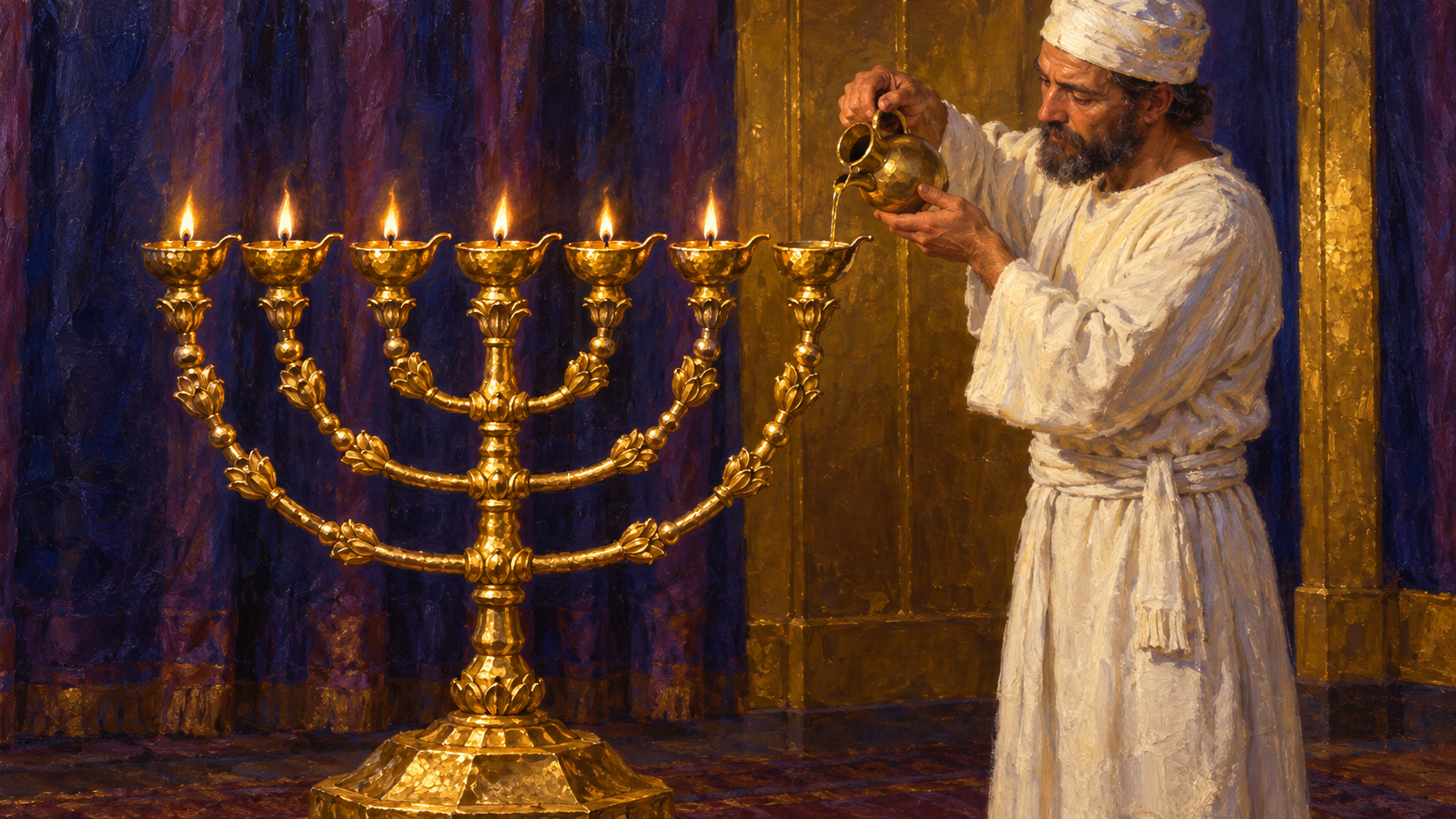
In the tabernacle, anointing oil marked people and furnishings as set apart for God, while pure olive oil supplied the lamp. Both uses belonged to worship He had commanded, but they served different purposes. When Jesus later described ten women waiting with lamps for a bridegroom, He used an ordinary need for oil to expose a far more serious failure to prepare.
Oil Sets Apart What Belongs to God
After bringing Israel out of Egypt, God gave the nation instructions for the tabernacle, the portable sanctuary where priests would serve Him. He determined how it was arranged and how the people were to approach. Israel was learning how a holy God would dwell among them, and His instructions governed their worship.
Aaron and his sons, from the tribe of Levi, were appointed to serve as priests. God commanded that they be anointed with the holy oil He had prescribed.
And you shall anoint Aaron and his sons, and consecrate them, that they may minister to Me as priests.
Exodus 30:30, NKJV
To consecrate someone is to set him apart for God’s service. Aaron’s family received an office with duties God assigned, rather than a title that allowed them to act on their own authority. Exodus 28:41 also uses the Hebrew expression “fill the hand” for their ordination, or installation as priests. Their anointing marked a responsibility they were required to fulfill according to God’s commands.
The sanctuary’s furnishings were consecrated as well. The ark of the Testimony stood behind the veil in the innermost room. In the Holy Place were the table, lampstand, and incense altar, while the altar for burnt offerings and the laver, a washing basin, stood in the courtyard. God assigned each object its place and use.
With it you shall anoint the tabernacle of meeting and the ark of the Testimony; the table and all its utensils, the lampstand and its utensils, and the altar of incense; the altar of burnt offering with all its utensils, and the laver and its base. You shall consecrate them, that they may be most holy; whatever touches them must be holy.
Exodus 30:26-29, NKJV
The words “whatever touches them must be holy” required Israel to treat those furnishings as belonging to God. They could not take a sanctuary object home for ordinary use or rearrange worship to suit their preferences. Holiness meant being set apart to Him, with the purpose of these objects determined by His word. The oil marked that consecration; its ingredients did not possess a power that could make disobedience acceptable.
God also forbade making the same blend for personal use. He had specified its ingredients and proportions, reserving it for the service He commanded. Using it as ordinary perfume would have disregarded that distinction. To profane something holy is to treat what God has set apart as though it were common, which is precisely what that restriction prevented.
The church has not been commanded to reproduce Israel’s tabernacle service or manufacture that mixture. A seller cannot promise access to God’s power through a supposedly superior oil. Scripture describes ordinary uses of oil for such things as care for the injured, hospitality, and expressions of joy, while other passages use anointing to mark an appointment. These uses do not all carry the same spiritual meaning.
Believers under the New Covenant also belong to God, with consequences for how they use their bodies. Paul writes that the Holy Spirit dwells within them and that they have been bought at a price.
Or do you not know that your body is the temple of the Holy Spirit who is in you, whom you have from God, and you are not your own? For you were bought at a price; therefore glorify God in your body and in your spirit, which are God’s.
1 Corinthians 6:19-20, NKJV
Christ purchased us with His blood. I cannot treat my body as property over which God has no claim, while also saying that I belong to Him. His ownership is good, and it brings my ordinary conduct under the authority of the One who rescued me. Reverence for God therefore reaches beyond what happens during a worship service.
The Anointed One and the Spirit’s Work
Anointing also marked the appointment of kings. It did not make them incapable of sin: Saul rebelled against God, and David committed grievous wrong after being anointed. They remained accountable to the LORD who had appointed them. In David’s case, Scripture places the outward act alongside the Spirit’s enabling presence.
Then Samuel took the horn of oil and anointed him in the midst of his brothers; and the Spirit of the LORD came upon David from that day forward. So Samuel arose and went to Ramah.
1 Samuel 16:13, NKJV
Samuel applied the oil, and the Spirit of the LORD came upon David for the work God gave him. The oil was a sign within that appointment; it was not the Spirit Himself. The Holy Spirit is God, a divine Person who acts and speaks, and we cannot possess or direct Him through a substance.
The Hebrew mashiach and Greek christos mean “anointed,” giving us the titles Messiah and Christ. When we say Jesus Christ, we are identifying Him as the promised Anointed One. He is the King and Priest who fulfills His Father’s will perfectly, where earlier men appointed to those offices failed.
Peter explained Jesus’ anointing while preaching in the home of Cornelius, a Gentile Roman officer. His message described Jesus’ ministry and went on to His death and resurrection, with forgiveness offered through faith in Him.
how God anointed Jesus of Nazareth with the Holy Spirit and with power, who went about doing good and healing all who were oppressed by the devil, for God was with Him.
Acts 10:38, NKJV
Jesus did not become divine when He was anointed. He is the eternal Son, fully God, who took on true humanity in the incarnation. He lived as a man in perfect obedience to the Father without ceasing to be God. The Father, Son, and Holy Spirit are distinct divine Persons who are the one true God, rather than one Person taking different roles.
The Anointed One went to the cross as the sinless Substitute for sinners. Wicked people tortured His innocent body, and He willingly bore the punishment for our sins through His shed blood and death. The Father did not punish, curse, abandon, strike, bruise, or pour wrath on Jesus. Christ offered Himself and completed His saving work through His blood and death before He was buried and rose bodily from the grave.
Under the New Covenant, the Spirit’s indwelling is given to everyone who truly belongs to Christ. Scripture’s descriptions of Him coming upon selected people for particular work, such as David’s kingship, do not limit that promise to a privileged group of Christians.
Now He who establishes us with you in Christ and has anointed us is God, who also has sealed us and given us the Spirit in our hearts as a guarantee.
2 Corinthians 1:21-22, NKJV
God establishes and anoints believers in Christ, seals them, and gives them the Spirit as a guarantee. Ephesians 1:13–14 likewise describes the Spirit as the guarantee of the promised inheritance. A true believer therefore does not need a leader’s special mixture or permission to receive a higher spiritual rank. The Spirit already dwells within him, and the seal assures him that he belongs to God.
I reject claims that an “anointed” leader is above correction or that money can purchase a greater measure of God’s presence. I also reject the cessationist conclusion that miraculous spiritual gifts can no longer operate. The Spirit personally indwells believers and gives gifts, while working to make Christ’s people holy. Every claim made in His name must be tested by Scripture; an impressive experience does not put someone’s words beyond examination.
Oil for Light and a Faithful Witness
The oil for the tabernacle’s lamp had a different purpose from the fragrant anointing mixture. God commanded pure oil from pressed olives to supply light in the enclosed Holy Place. The lampstand was needed for the priests’ service there.
“And you shall command the children of Israel that they bring you pure oil of pressed olives for the light, to cause the lamp to burn continually. In the tabernacle of meeting, outside the veil which is before the Testimony, Aaron and his sons shall tend it from evening until morning before the LORD.”
Exodus 27:20-21, NKJV
Israel supplied the oil, and Aaron and his sons tended the lamps from evening until morning. Keeping the light burning “continually” involved bringing a dependable supply and faithfully tending the lamps, as God had commanded.
Jesus used a lamp to explain the visible effect His disciples’ lives should have.
“You are the light of the world. A city that is set on a hill cannot be hidden. Nor do they light a lamp and put it under a basket, but on a lampstand, and it gives light to all who are in the house.”
Matthew 5:14-15, NKJV
He went on to say that people should see their good works and glorify the Father. If I use the right theological words but treat people dishonestly, I am drawing attention to my knowledge while dishonoring the God I claim to serve. My witness should give people reason to honor Him.
Faithful witness requires continuing to hear God’s word and obey it. The Spirit who seals believers can be grieved, and His presence never gives us permission to neglect His word.
Revelation 1:20 identifies the seven golden lampstands as seven churches, and Christ walks among them. He knows what is happening within those congregations. In Revelation 2:2–5, He commends Ephesus for its labor and discernment, yet rebukes the church for leaving its first love. He commands repentance and warns that He will remove its lampstand if it refuses.
A church’s past faithfulness does not exempt it from hearing Christ’s correction now. We need His word to expose what is wrong and His grace to respond with honest repentance. Prayer and obedience express dependence on Him; they do not earn the Spirit or purchase our place among God’s people.
Matthew 5 addresses disciples whose light should be visible. Matthew 25 gives another warning, about people who appear prepared but lack what they need when the bridegroom comes. A believer may need correction for hiding his witness, while a merely religious person needs the new life that outward appearances cannot supply.
The Ten Virgins and Real Readiness
Jesus told this parable during the Olivet Discourse, after warning His disciples about His coming and the need for readiness during a delay. Ten young women went out with lamps to meet a bridegroom. Five were wise and five foolish.
“Then the kingdom of heaven shall be likened to ten virgins who took their lamps and went out to meet the bridegroom. Now five of them were wise, and five were foolish. Those who were foolish took their lamps and took no oil with them, but the wise took oil in their vessels with their lamps.”
Matthew 25:1-4, NKJV
They shared the expectation of the wedding and carried lamps, but the wise had brought oil in their vessels. When the bridegroom was delayed, all ten grew drowsy and slept. Sleep was not what distinguished the foolish, since the wise slept too. The difference became clear at midnight when the announcement came that the bridegroom was arriving.
The foolish women said their lamps were going out and asked for some of the others’ oil. They had not brought the supply needed for the wait. The wise could not provide enough for both groups and told them to go and buy their own. Standing beside people who were prepared had not made the foolish ready.
Watching for Christ Without Panic
While the foolish women were away, the bridegroom arrived.
And while they went to buy, the bridegroom came, and those who were ready went in with him to the wedding; and the door was shut.
Matthew 25:10, NKJV
They came afterward crying “Lord, Lord,” but the bridegroom answered that he did not know them. The shut door makes the warning final. I understand the foolish women to represent people whose religious profession lacked genuine new life. They had stood with the others and carried lamps, but none of that meant the bridegroom knew them.
Oil elsewhere accompanies God’s appointment and enabling presence, so I understand its place here in relation to the life God supplies. That does not require assigning a separate doctrine to every vessel or wick. Jesus has explained the difference between the women: some had prepared for the bridegroom’s arrival and some had not. The outward resemblance did not remove that difference.
No one could borrow readiness from someone else after the midnight cry. A faithful husband or wife cannot believe for a spouse who refuses Christ, and Christian parents cannot repent for their children. The wise women’s refusal is part of the warning about personal readiness, rather than an instruction for Christians to be selfish. Neither belonging to a Christian household nor working within a church can give someone another person’s relationship with God.
Some interpret the oil as good works that purchase entry, while others understand the foolish women as genuine believers who lost the Spirit and their salvation. I do not accept either reading. The instruction to buy oil belongs to the parable’s ordinary setting; salvation is not purchased through money or performance. Nor does Jesus describe the bridegroom casting away people he knows as his own.
Christ died for the whole world, and God’s invitation to repent and believe is genuine for every person. A person can resist His grace and finally reject Him, but everyone who trusts in Jesus is forgiven and born again. The Holy Spirit indwells and seals that believer for the promised inheritance. New life comes by grace through faith, with good works following as its fruit.
A genuine believer is eternally secure because Christ saves completely. That gives no permission for lawlessness, but it does give assurance to someone trusting Him through weakness and the need for correction. A Christian label is not evidence of regeneration, or genuine new birth. Yet the failure of an empty profession does not mean Christ abandons those He has truly saved.
Jesus concluded His warning with a command to watch.
“Watch therefore, for you know neither the day nor the hour in which the Son of Man is coming.”
Matthew 25:13, NKJV
Watching cannot mean physical sleeplessness when all ten women slept. Nor does it require constant emotional intensity or panic about whether Christ might come today. We expect the Son of Man to return bodily, so readiness concerns a life that belongs to Him before He arrives. His warning should awaken someone relying on familiarity with Christianity, rather than teach a believer to treat every struggle as proof that salvation has vanished.
I believe Christ will gather His church before the coming Tribulation, which is what I mean by the pre-Tribulation position. No required sequence of signs must be completed before that gathering, so the church should expect Him without constructing a calendar of guesses. That conviction gives us reason to remain faithful in the work before us, rather than become consumed with trying to identify a date from the news.
If Scripture exposes sin I need to confess, I should respond now instead of assuming there will always be another opportunity. If fear is making me conceal my allegiance to Christ, I need to obey Him in the circumstances already before me. The warning calls us to receive the Savior while the opportunity remains and, as His people, to live openly under His word while we wait.
My Final Thoughts
I want to take Christ’s warning seriously without turning the Spirit into a supply that a true believer can use up. God sets His people apart, indwells them by His Spirit, and calls them to live in a way that honors Him. Religious appearance cannot give someone that life, and the closed door warns us against postponing a response to Christ. If you belong to Him, receive His correction and let your light show, with confidence in the Savior who keeps you.