
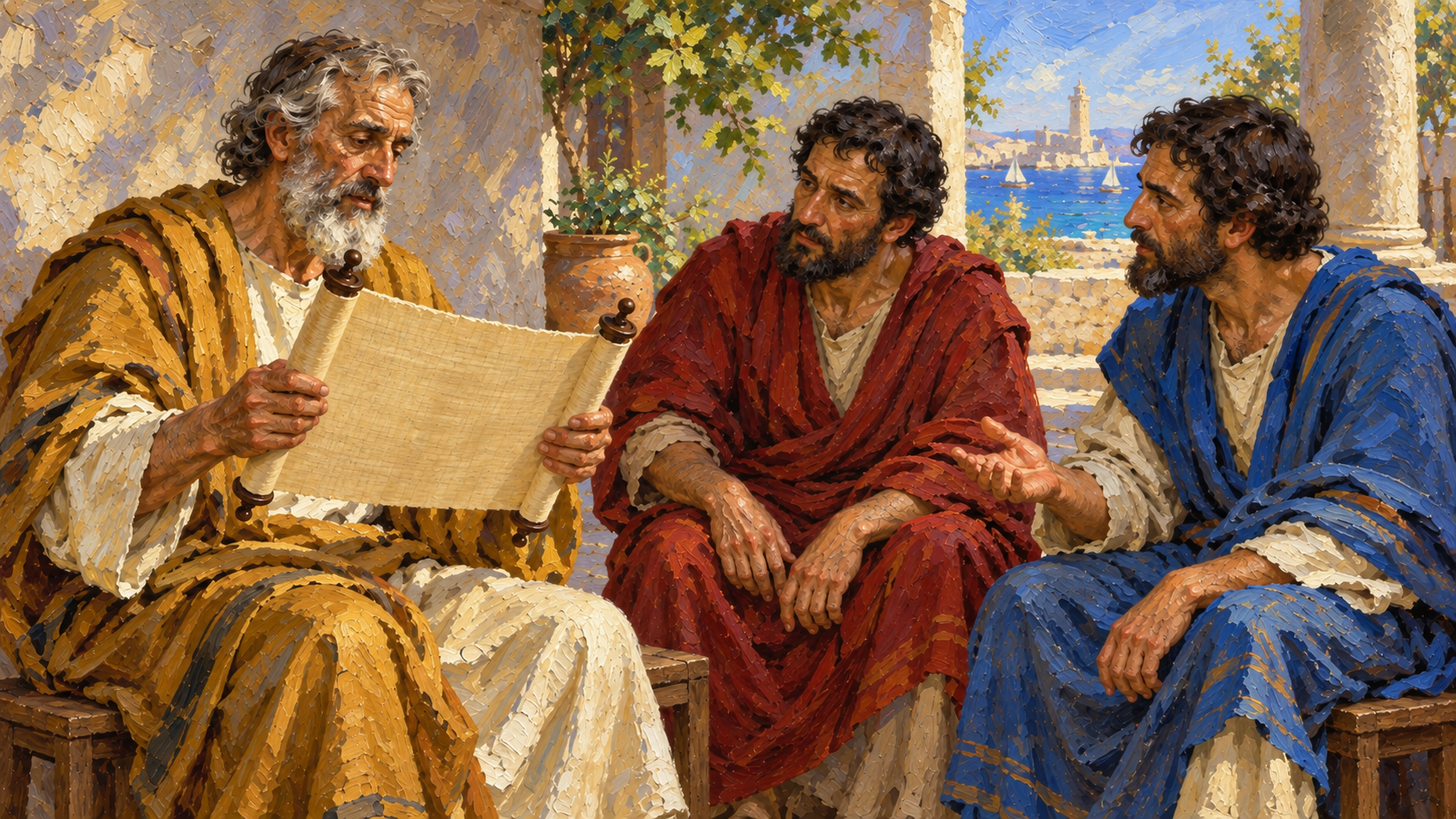
I have heard people call the Septuagint the Bible of the apostles. I have also heard it dismissed as a corrupt rival to the Hebrew Scriptures, but those claims make the question sound simpler than it is. So what is this ancient Greek translation tradition, and how much authority should a Christian give it?
What the Septuagint Actually Is
The ancient Greek Old Testament brings together books that were translated and copied in different ways. Each book therefore has its own relationship to the Hebrew text. Before I draw a conclusion about a Greek reading, I need to understand that relationship. Treating the whole collection as one uniform work will not tell us what a particular reading shows.
I use the Masoretic Text as the controlling Old Testament base, but that does not make every Greek difference worthless. A translation can preserve useful evidence about language while remaining secondary to its Hebrew source. I can examine that evidence without hiding it or accusing ancient translators of conspiracy.
When a Greek passage differs from the Masoretic Text, we need to ask how that difference may have arisen. It could reflect the translator’s method or a different Hebrew parent text. By parent text, I mean the Hebrew copy from which he translated, whose wording may have differed from the form later preserved in the Masoretic tradition. Later copying or revision of the Greek could also account for the wording. Examining those historical possibilities does not unsettle Scripture’s authority.
LXX is the Roman numeral for seventy. The name comes from an ancient account in which seventy-two Jewish elders translated the Law of Moses into Greek for an Egyptian ruler. In its earliest form, that account concerns the Torah, or Pentateuch, the first five books of the Old Testament. Later retellings extended it to the rest of the Greek Old Testament and sometimes added miraculous details about the translators. We should not receive those later additions as inspired history.
Greek-speaking Jews needed to read Scripture in the language they used. The Pentateuch’s translation is commonly placed in Alexandria, a major Greek-speaking city in Egypt, during the third century BC. Other books followed later. As those translations circulated, their Greek wording and vocabulary became familiar to many Jewish readers and, afterward, to Greek-speaking Christians.
When I say “the Septuagint,” I am using a convenient name for a collection that grew over a long period. I do not mean that one committee translated the whole Bible in a single sitting. The books differ in literary style and in how literally they follow their Hebrew sources. They did not all come from the same translator or date, much less from one manuscript.
Translation requires more than replacing Hebrew words with Greek ones. The languages differ in word order and idioms, as well as in their sound patterns. A Hebrew word rarely has exactly the same range of meaning as its Greek counterpart. Some Septuagint books stay close to the Hebrew wording, while others translate more freely. They may explain an expression or smooth a difficulty, or choose Greek phrasing that sounds natural to their first readers.
Those differences in method affect what I can learn from a translation. A close rendering may help scholars work back toward the Hebrew wording the translator had before him. A freer rendering may instead show how an ancient Jewish reader understood the passage, without preserving every feature of its wording. Both can be useful, but evidence about the text and evidence about its interpretation are different things.
I do not want to decide in advance that every difference is an error or that every difference preserves an older Hebrew reading. We first need to describe what differs, then consider the translator’s method alongside the surviving manuscripts. That comparison must respect the passage’s context and the received Masoretic base.
The earliest complete Greek Christian codices date from centuries after the first translation of the Torah. A codex is an ancient bound book rather than a scroll. In the intervening centuries, scribes copied and corrected these Greek books. Some forms were revised toward Hebrew texts, while others developed through different lines of transmission. Modern printed Septuagints reflect editors’ judgments as they compare those manuscripts. We are not looking at a photograph of one first-century apostolic Bible.
That history explains why editions differ and why “the Septuagint reading” may be found in some Greek witnesses but not others. It also makes me cautious about judging a reading simply by the age of its surviving copy. A medieval Hebrew codex may preserve consonantal wording much older than its parchment. An earlier Greek manuscript may contain a later revision or a translator’s interpretation. The age of the physical copy does not, by itself, tell us the age of its wording.
So I need to ask what wording a copy preserves and how that wording reached it, rather than choosing whichever copy is older. A difference may go back to the Hebrew source, or it may have arisen in translation. Later copying and revision are also possibilities. We have to consider those separately to understand what the comparison shows.
Why the Hebrew Text Remains the Base
What advantage then has the Jew, or what is the profit of circumcision? Much in every way! Chiefly because to them were committed the oracles of God.
Paul says the Jewish people had a real advantage in being entrusted with God’s oracles. The Old Testament came to Israel through Hebrew prophets and was guarded in the nation’s worship and the work of its scribes. Israel also received those writings in a Hebrew canonical structure, the arrangement of the books recognized as Scripture.
The Masoretes were Jewish scribes and scholars who carefully transmitted the Hebrew text in the early medieval period. Although they lived many centuries after Christ, they did not invent its consonantal wording. Hebrew had originally been copied mainly with consonants. The Masoretes recorded traditional vowel points and accents around them and supplied marginal notes and detailed checks to guide accurate copying. Earlier Hebrew manuscripts show substantial continuity with that older consonantal tradition, along with visible variants.
The Masoretic Text controls Old Testament quotation and explanation in this study, as well as its language work and chronology. I consult Greek evidence when it clarifies an ancient interpretation or brings a genuine textual question to my attention. Greek evidence remains secondary and cannot silently take the place of the controlling Hebrew reading.
Then He said to them, “These are the words which I spoke to you while I was still with you, that all things must be fulfilled which were written in the Law of Moses and the Prophets and the Psalms concerning Me.” And He opened their understanding, that they might comprehend the Scriptures.
Jesus named the Law of Moses, then the Prophets and the Psalms. Those names fit the received Hebrew divisions of Scripture, and He said that all these writings point to Him. I do not read His words as identifying a later Greek codex or endorsing every translation choice it contains.
Since the New Testament was written in Greek, its writers could quote wording their Greek readers already knew. They could also translate the Hebrew themselves or adapt a quotation to the sentence in which they used it. At times they might combine passages or give the Holy Spirit’s inspired interpretation. We therefore find citations that closely match surviving Greek forms, others closer to the Hebrew, and some that differ from both.
The authority belongs to the inspired New Testament sentence as it stands. Paul’s Greek wording in Hebrews is authoritative because the Holy Spirit inspired Hebrews. I receive it on that basis without treating a citation as a declaration that every line of every Greek Old Testament manuscript is inspired.
What the Major Passages Show
Therefore the Lord Himself will give you a sign: Behold, the virgin shall conceive and bear a Son, and shall call His name Immanuel.
In Hebrew, almah describes a young woman of marriageable age. Its biblical uses, including Isaiah’s sign, are entirely suited to a virgin. Here the promised conception is extraordinary, and the Son is to be called Immanuel.
So all this was done that it might be fulfilled which was spoken by the Lord through the prophet, saying: “Behold, the virgin shall be with child, and bear a Son, and they shall call His name Immanuel,” which is translated, “God with us.”
Matthew applies Isaiah directly to Mary’s virginal conception, using the Greek word parthenos. His inspired interpretation is decisive for us as Christians. Greek Isaiah uses the same term, so I can see that Jewish translators before Christ had already understood the prophecy in this direction.
I can recognize that agreement without claiming that parthenos never had a broader historical use. Context still determines what a word means in a passage. Our doctrine rests on what inspired Isaiah and Matthew teach, so it does not need an exaggerated dictionary definition to hold it up.
For dogs have surrounded Me; The congregation of the wicked has enclosed Me. They pierced My hands and My feet; I can count all My bones. They look and stare at Me. They divide My garments among them, And for My clothing they cast lots.
The traditional English Christian reading describes pierced hands and feet. The difficulty is that the Masoretic consonants and pointing are ordinarily read “like a lion,” an abrupt expression before “My hands and My feet.” The ancient Greek has a verb meaning “they dug,” later rendered “pierced.” There is also a Hebrew witness from Nahal Hever in which the disputed word appears to end with waw instead of the Masoretic yod. Its spelling and grammar remain debated.
That evidence gives us reason to consider a verbal reading seriously. It does not establish that medieval Jewish scribes deliberately erased a prophecy about Jesus. If I admit that accusation cannot be proved and then repeat it anyway, I am not faithfully defending Scripture.
Now Thomas, called the Twin, one of the twelve, was not with them when Jesus came. The other disciples therefore said to him, “We have seen the Lord.” So he said to them, “Unless I see in His hands the print of the nails, and put my finger into the print of the nails, and put my hand into His side, I will not believe.” And after eight days His disciples were again inside, and Thomas with them. Jesus came, the doors being shut, and stood in the midst, and said, “Peace to you!” Then He said to Thomas, “Reach your finger here, and look at My hands; and reach your hand here, and put it into My side. Do not be unbelieving, but believing.” And Thomas answered and said to Him, “My Lord and my God!” Jesus said to him, “Thomas, because you have seen Me, you have believed. Blessed are those who have not seen and yet have believed.”
The crucifixion and bodily resurrection are certain: Jesus showed His disciples the nail marks and His wounded side. Psalm 22 also depicts the Messiah’s suffering and the mockery directed at Him. It describes His garments being divided before moving toward His vindication and worldwide worship. We can rely on that Messianic witness without inventing an account of textual sabotage.
For thus says the LORD: After seventy years are completed at Babylon, I will visit you and perform My good word toward you, and cause you to return to this place. For I know the thoughts that I think toward you, says the LORD, thoughts of peace and not of evil, to give you a future and a hope. Then you will call upon Me and go and pray to Me, and I will listen to you. And you will seek Me and find Me, when you search for Me with all your heart. I will be found by you, says the LORD, and I will bring you back from your captivity; I will gather you from all the nations and from all the places where I have driven you, says the LORD, and I will bring you to the place from which I cause you to be carried away captive.
Greek Jeremiah is roughly one-eighth shorter than the Masoretic book and puts the oracles against the nations in a different location. Some discussions call that shorter form a distortion and even claim Jeremiah 29:10 is missing. That claim is false: the seventy-year promise is present in the Greek tradition, although its wording differs.
Hebrew fragments from Qumran agree at important points with the shorter form behind Greek Jeremiah. They show that a shorter Hebrew parent text circulated in antiquity. That evidence indicates that the translator did not simply cut thousands of words from the Masoretic book.
‘Behold, the days are coming,’ says the LORD, ‘that I will perform that good thing which I have promised to the house of Israel and to the house of Judah: ‘In those days and at that time I will cause to grow up to David A Branch of righteousness; He shall execute judgment and righteousness in the earth. In those days Judah will be saved, And Jerusalem will dwell safely. And this is the name by which she will be called: THE LORD OUR RIGHTEOUSNESS.’ “For thus says the LORD: ‘David shall never lack a man to sit on the throne of the house of Israel; nor shall the priests, the Levites, lack a man to offer burnt offerings before Me, to kindle grain offerings, and to sacrifice continually.'”
Jeremiah 33:14-26 is absent from the shorter Greek form. I acknowledge that omission and receive the Masoretic passage as inspired Scripture. Its promise concerning David agrees with many other passages and reaches fulfillment in Jesus. A missing passage in this Greek form cannot erase teaching found across the canon, nor does it justify attributing anti-Messianic motives to the translators.
This is the book of the genealogy of Adam. In the day that God created man, He made him in the likeness of God. He created them male and female, and blessed them and called them Mankind in the day they were created. And Adam lived one hundred and thirty years, and begot a son in his own likeness, after his image, and named him Seth. After he begot Seth, the days of Adam were eight hundred years; and he had sons and daughters. So all the days that Adam lived were nine hundred and thirty years; and he died.
Genesis gives Adam’s age at Seth’s birth separately from the years he lived afterward, then adds his total lifespan. Standard Greek witnesses put Seth’s birth when Adam was 230 instead of 130. They also give him 700 years afterward instead of 800. The two changes leave his total at 930.
Adam does not live longer in that Greek reading, so it is false to describe his lifespan as inflated. What grows longer is the chronology before Seth’s birth. We should not apply the same adjustment to every generation or manuscript, however. The figures in Genesis 5 and 11 have recognizable patterns alongside exceptions and later textual variation.
The Septuagint chronology is longer than the Masoretic chronology, but both measure the earth’s age in thousands of years. My reason for retaining the Masoretic numbers is that they belong to the settled Hebrew base used here. Adding a century would not suddenly give us the vast ages required by evolution.
the son of Jacob, the son of Isaac, the son of Abraham, the son of Terah, the son of Nahor, the son of Serug, the son of Reu, the son of Peleg, the son of Eber, the son of Shelah, the son of Cainan, the son of Arphaxad, the son of Shem, the son of Noah, the son of Lamech, the son of Methuselah, the son of Enoch, the son of Jared, the son of Mahalalel, the son of Cainan, the son of Enosh, the son of Seth, the son of Adam, the son of God.
The Textus Receptus is the received printed Greek text underlying the NKJV New Testament. It names Cainan between Shelah and Arphaxad, as does the received Byzantine manuscript tradition, so the NKJV includes him. Some readers suggest that the name entered Luke through corruption because they want to protect Masoretic Genesis 11. I do not believe that move is necessary, and it contradicts the received New Testament evidence.
The Masoretic Genesis line goes directly from Arphaxad to Shelah, whereas many Greek Genesis witnesses include Cainan. I keep the wording of both Luke and Genesis. Making a chart easier to draw would not justify deleting either reading.
Genealogies can be selective in the ancestry they record, and ancient textual history can leave questions we cannot fully reconstruct. Those questions do not obscure who Christ is. Luke follows the virgin-born Son’s actual human ancestry through Abraham and Noah, then through Adam to God.
Then Joseph sent and called his father Jacob and all his relatives to him, seventy-five people.
Stephen gives seventy-five as the number of people Joseph called to Egypt, including Jacob and all his relatives. The Masoretic count in Genesis 46 is seventy. Greek forms of Genesis and Exodus reach seventy-five by including additional descendants in their reckoning.
I receive seventy-five in Acts as the inspired New Testament reading, while also receiving Genesis as inspired and asking whom its Hebrew list includes. Family totals may differ because one writer includes people already in Egypt. Another may count later descendants but leave out wives or the named head of a family. We need to understand each list’s membership before comparing its total with another.
The comparison does not allow me to dismiss a Greek witness simply because it differs from the MT. Neither does the New Testament’s use of seventy-five require me to replace every related Hebrew number. Each inspired passage gives its count for its own purpose.
Therefore, when He came into the world, He said: “Sacrifice and offering You did not desire, But a body You have prepared for Me. In burnt offerings and sacrifices for sin You had no pleasure. Then I said, ‘Behold, I have come– In the volume of the book it is written of Me– To do Your will, O God.'” Previously saying, “Sacrifice and offering, burnt offerings, and offerings for sin You did not desire, nor had pleasure in them” (which are offered according to the law), then He said, “Behold, I have come to do Your will, O God.” He takes away the first that He may establish the second. By that will we have been sanctified through the offering of the body of Jesus Christ once for all.
Paul writes, “a body You have prepared for Me,” using wording close to the Greek Psalter. The Masoretic Psalm 40 speaks instead of ears God has opened or dug. Though the expressions differ, both concern an obedient servant whose submission involves his body and surpasses ritual offerings.
Hebrews explains that the eternal Son took a real human body and came to do God’s will, offering that body once for all. I receive Paul’s explanation as inspired and authoritative. Its authority does not depend on my being able to trace every step by comparing one modern Hebrew edition with one modern Greek edition.
We cannot use this passage to declare every Septuagint rendering inspired, but neither can we ignore its Greek wording. An apostolic writer may use a known translation while giving the Holy Spirit’s own explanation of Christ.
What the Manuscripts and Canon Show
Here, Apocrypha commonly refers to Jewish religious books included in some ancient Greek Christian codices but absent from the received Hebrew Old Testament canon. Those large Greek manuscripts do not all contain the same books or put them in the same order. I would not describe them as though there had been one fixed pre-Christian Septuagint volume with an agreed table of contents, later accepted or rejected as a whole.
Tobit and Wisdom preserve historical and religious information, as do Sirach and Maccabees. Their usefulness does not make them inspired, and being bound beside biblical books in later codices cannot settle that question. We understand this distinction when we see maps and study notes in a modern Bible. Sharing its covers does not give those materials the inspiration of Scripture.
No clear New Testament quotation formula identifies one of these books as Scripture. We should acknowledge possible echoes and shared expressions without treating resemblance as proof of canonicity. I receive the Hebrew Old Testament canon affirmed through the Law and the Prophets, with the Writings completing its structure. Those inspired books are the standard by which every later work must be tested.
The Dead Sea Scrolls include biblical manuscripts discovered near Qumran, northwest of the Dead Sea, beginning in 1947. They brought to light surviving Hebrew evidence many centuries older than the great medieval codices. Numerous readings closely resemble the proto-Masoretic tradition, the older Hebrew textual form that developed into the Masoretic Text. The Great Isaiah Scroll is recognizably the same book and carries the same prophetic message, including the Servant passages. Yet it also has many spelling and grammatical differences, along with genuine textual variants.
Other scrolls sometimes agree with readings associated with the Samaritan Pentateuch or with a Hebrew form behind the Greek. Jeremiah is a prominent example of a Hebrew form behind the Greek. Scholars call this textual plurality: more than one recognizable form of a biblical book circulated during the period represented by the scrolls. That evidence does not fit either slogan, “the scrolls prove the MT” or “the scrolls disprove the MT.”
I see evidence of careful transmission here, together with real variants that need to be examined. The manuscripts do not justify inventing a 95-to-99-percent figure and applying it to every word or biblical book. Confidence in God’s faithful preservation through this tradition should let us examine what the manuscripts contain without denying any of it.
God inspired the Scriptures and has preserved His Word. Copyists had the responsibility of passing on actual words, and the abundance of surviving witnesses lets us identify differences instead of hiding them. Finding a variant gives us evidence to evaluate. It does not prove that Scripture disappeared.
The Masoretic base gives us a stable received Old Testament text. Ancient versions can help explain how a difficult Hebrew expression was understood or draw attention to a different reading. I accept their value as evidence while maintaining that they may not overrule the Masoretic Text.
I do not see that position as a choice between blind traditionalism and endlessly reconstructing the text. An educated guess does not automatically improve Scripture, and a damaged fragment does not supply certainty about what is missing. When a translation can be explained in several ways, I need to acknowledge that limit. Trusting God’s preservation belongs with honest examination of the evidence.
Psalm 12 sets flattering lips and proud boasts against the Lord’s pure words. God promises to arise for the oppressed and keep His people in a corrupt generation. That gives me deep confidence in His truthfulness and protection.
Some readers take the psalm as a direct prediction of a manuscript edition free from visible copying differences. I cannot find that claim in its context. It names neither the Masoretes nor Greek translators. Vowel points and codices are not its subject, and it does not predict a future printing.
We can affirm what the psalm does say without making it answer a technical question it never addresses. God’s words are pure because He never lies. His Word retains its authority, and He will not fail His people. Claims about particular manuscripts still need to be established from manuscript evidence and careful comparison.
The examples leave me unwilling to judge every Greek reading older or better simply because its manuscript is older. Nor can I turn translation differences or alternate Hebrew sources into proof of a conspiracy against Christ. An inspired apostolic citation does not make an entire collection of translations inspired either. Holding a clear textual position should go along with identifying the actual evidence in each passage, not caricaturing it.
How Christians Should Use the Septuagint
The Greek Old Testament helps us understand vocabulary the New Testament writers used and how ancient Jewish translators understood Hebrew expressions. Where a book follows its source closely, it may preserve evidence of the Hebrew parent text. Freer translations can teach us about interpretation and the religious language used in the centuries before Christ.
Before drawing a conclusion from a Greek reading, we should identify the edition being cited and the manuscripts that support it. We also need to know how literally that book was translated. A difference could come from the translator’s Hebrew source or his interpretation, or it could belong to a later revision. The Masoretic context remains part of that evaluation.
When teaching, I should not say “the Septuagint says” as though naming it settles the question. I should also explain a close connection between its Greek and a New Testament citation rather than hide it. Readers need to see both the connection and what it does or does not establish.
No essential Christian doctrine depends on choosing an uncertain Septuagint variant over the Masoretic Text. Clear passages teach the Trinity and show that Christ is fully God and fully man. Direct inspired testimony establishes His virgin birth and bodily resurrection. Scripture teaches salvation through His blood by grace through faith, and it establishes His future bodily return across the canon.
A textual difference may sharpen our question about a passage, but we still need to understand it alongside the whole counsel of God. Jeremiah’s shorter Greek form cannot cancel the Davidic covenant. The Masoretic wording of Psalm 22 cannot cancel the nail wounds recorded in the Gospels, and a Greek genealogy number cannot turn Genesis into deep time.
As Scripture interprets Scripture, secondary witnesses must keep their secondary place. I would rather state an uncertainty about one line plainly than conceal it with forceful language. Sound doctrine does not need a claim the evidence cannot sustain.
Jesus is the eternal Son, fully God and fully man. He was born of a virgin and lived completely without sin. The Law anticipated His coming, while the Prophets spoke of His suffering and saving work. The Psalms also looked toward His resurrection and reign. Greek translation helped carry that witness through the ancient world. The glory belongs to the Christ those Scriptures reveal, not to the name of a translation.
Wicked men physically tortured and punished Jesus before killing Him. He willingly bore that real punishment for our sins in His innocent body. His blood was shed, and He died and was buried before rising bodily. The Father did not punish Jesus or pour wrath on Him. He did not curse or abandon His Son, nor did He strike or bruise Him.
Christ died for the whole world, although people may resist or reject God’s genuine offer. Whoever repents and believes is forgiven and justified before God, born again and made new. The Holy Spirit comes to dwell within and seal that believer, whose salvation is eternally secure. Security does not permit lawlessness, and a superficial profession does not prove that someone has been born again. Our textual study should lead us to trust the Savior Scripture proclaims.
We can confidently use the Masoretic Text as our Old Testament base and preserve the received New Testament, even when Cainan’s name complicates a chart. Seventy-five in Acts calls for the same care. We should consult the Greek for its help with ancient translation and apostolic vocabulary, as well as for the actual textual evidence it supplies.
Accuracy belongs to our Christian witness, so I do not want to repeat an allegation that outruns the proof. Jewish scribes should not be accused of erasing Jesus from Psalm 22. Neither should Greek translators be accused of deleting Jeremiah’s promises when an alternate Hebrew form accounts for the evidence.
These textual questions must not become an excuse for postponing obedience. As I read a passage in context, I also need to receive its correction. We should proclaim Christ clearly and submit every translation and textual theory to God’s inspired Word.
For closer study of the connected questions, see Lifespans in the MT and LXX, The Dead Sea Scrolls, and The Textus Receptus.
My Final Thoughts
I do not believe the Septuagint is one uniform apostolic Bible or the controlling Old Testament text. I keep the Masoretic Text as the Hebrew base and receive the New Testament citations as inspired where they stand. Greek readings remain valuable secondary evidence, which we can examine without inventing conspiracies or building doctrine on an uncertain line. A difficult reading need not make us hide the evidence or panic over it. I want an honest comparison to bring us back to Jesus, whom all Scripture proclaims.