
How much can ancient manuscripts tell us about the Bible we read today? Some people speak as though the Dead Sea Scrolls prove that every copy was identical. Others point to the differences as though the Old Testament must have been rewritten. I want to examine both the agreement and the differences honestly, with our confidence resting in the God who inspired His Word.
What the Dead Sea Scrolls Are
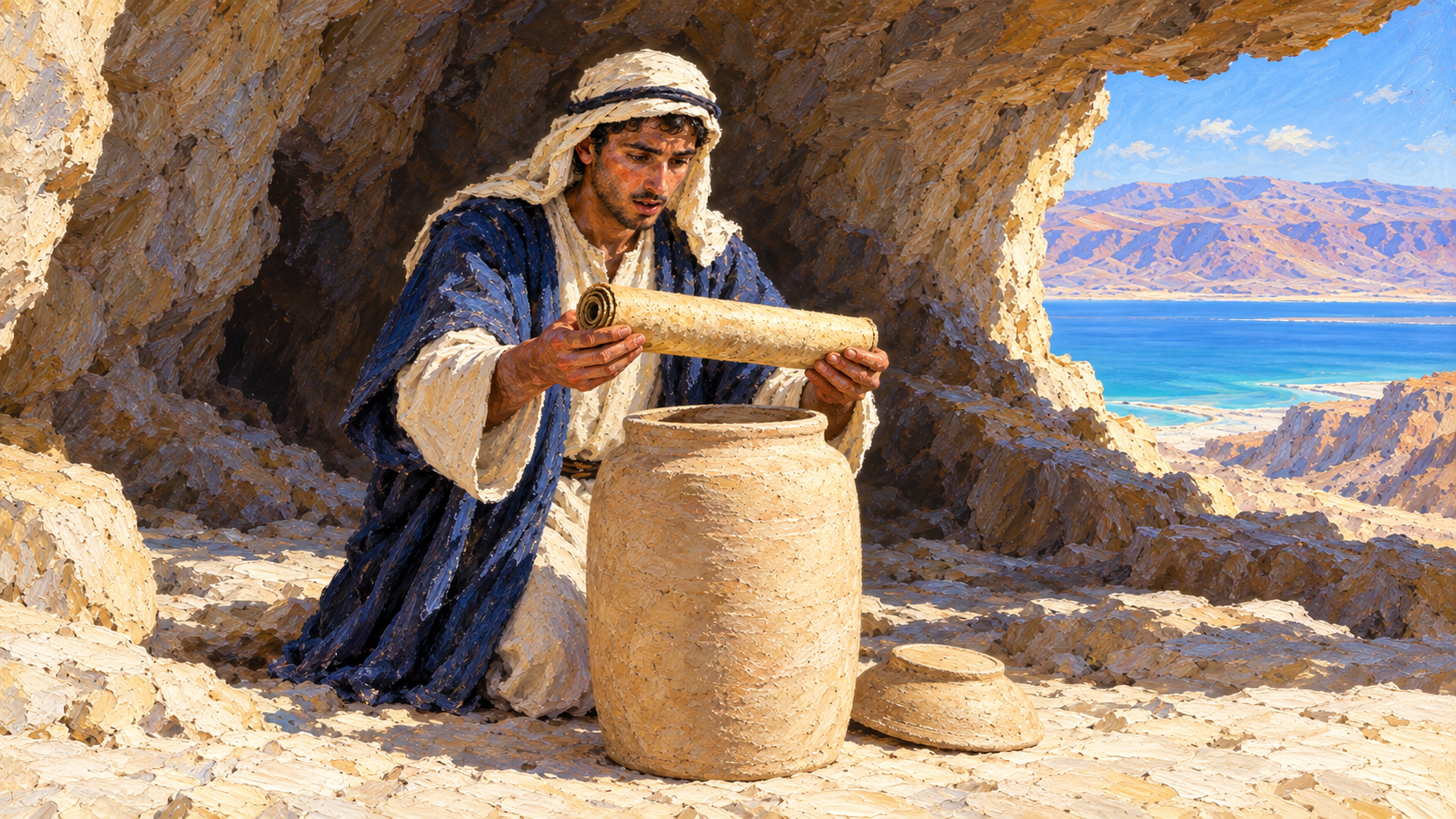
In 1947, Bedouin shepherds found scrolls in a cave near Khirbet Qumran on the northwestern shore of the Dead Sea. The first cave yielded seven major scrolls, including the Great Isaiah Scroll. Searches by Bedouin finders and archaeologists continued, and manuscript material was eventually recovered from eleven caves near Qumran. The Israel Antiquities Authority’s discovery-site record traces the finds cave by cave.
Dead Sea Scrolls can refer to discoveries from several sites in the Judean Desert. Qumran is where the famous religious library was found, but biblical manuscripts and other documents also survived at Wadi Murabba’at, Nahal Hever, and Masada. We need to know whether a claim concerns the Qumran caves or those wider regional discoveries.
The dry desert climate and the darkness of the caves helped parchment and papyrus survive when they would ordinarily have decayed. Their survival is extraordinary, though recovering them was complicated. Scattered pieces passed through the hands of dealers and scholars over decades. Governments and museums became involved too, alongside archaeological teams, and publication was slow. Modern imaging allows researchers to read damaged writing more clearly.
When a summary speaks of nearly one thousand complete scrolls, it gives us the wrong picture. The Qumran finds represent more than nine hundred distinct texts, most of them surviving only in fragments. Tens of thousands of parchment and papyrus pieces make up the archive. The official publication history describes the work of reconstructing and publishing them. One manuscript may survive as a large scroll, another as several joined fragments, and another as a scrap with only a few words.
Biblical manuscripts are only part of the collection. Alongside them are commentaries and prayers, hymns and legal writings. The finds also include community rules and calendars, with apocalyptic works and other Jewish literature from the Second Temple period. That period began with the rebuilding of Jerusalem’s temple after the Babylonian exile and ended with its destruction by Rome in AD 70. During those centuries, the land came under Persian, Greek, and Roman rule. It is the period that brings us to the opening of the New Testament.
Most of the Qumran texts are in Hebrew. Aramaic, a closely related Semitic language widely used in the region, is also common, and a smaller number are in Greek. Finding a religious work beside Scripture does not give it the same authority. The contents of a cave tell us what was deposited there, not which books God inspired.
We also need to distinguish a composition from a physical manuscript. Several copies of one biblical book are several manuscripts of the same composition. Thousands of fragments may belong to only hundreds of manuscripts. I would rather use a well-supported approximate total than offer an exact figure the evidence cannot sustain, especially when joining or reclassifying pieces can change the count.
The Qumran cave scrolls date from roughly the third century BC through the first century AD, before the temple’s destruction in AD 70. Paleography helps scholars date a manuscript by comparing the shapes and development of its handwriting. The archaeological setting where it was found provides further evidence. Radiocarbon testing measures carbon remaining in organic material such as parchment or papyrus and can supply a scientific date range. These methods do not normally tell us the exact year a scribe made a copy, which is why responsible dates are given as ranges.
The scrolls took the physical evidence for many biblical books back roughly a thousand years before the great medieval Masoretic codices known when the discovery was made. That gives us older copies to examine, so we do not have to guess what the Hebrew text looked like in the centuries before Christ.
An older manuscript deserves attention, but its age cannot settle every reading. An early scribe could make a mistake that a later copy avoided by faithfully preserving an older reading. I need to examine the manuscript’s character and context, then weigh its particular readings alongside the other witnesses.
So Moses wrote this law and delivered it to the priests, the sons of Levi, who bore the ark of the covenant of the LORD, and to all the elders of Israel. And Moses commanded them, saying: “At the end of every seven years, at the appointed time in the year of release, at the Feast of Tabernacles, when all Israel comes to appear before the LORD your God in the place which He chooses, you shall read this law before all Israel in their hearing. Gather the people together, men and women and little ones, and the stranger who is within your gates, that they may hear and that they may learn to fear the LORD your God and carefully observe all the words of this law, and that their children, who have not known it, may hear and learn to fear the LORD your God as long as you live in the land which you cross the Jordan to possess.”
Moses wrote the law and entrusted it to recognized custodians, with instructions to read it publicly. The people were to hear and learn what God had said so they could obey and teach the next generation. Preservation belonged within that covenant responsibility. It was not a matter of hiding a text where no one could hear it.
Many scholars connect the Qumran collection with the Essenes because of the nearby settlement and several sectarian writings. Ancient Jewish and Roman writers described the Essenes as a disciplined Jewish movement with distinctive practices of communal life and purity. That remains a significant view, though the precise connection between those reports, the settlement, and the caves is debated. We also cannot identify with certainty everyone who produced or owned the texts, or who gathered and deposited them.
I want to keep what we know separate from how we reconstruct what happened. Manuscripts were deposited in caves, some of which also contain jars and other remains. Political danger during the Jewish revolt may explain part of that deposit. But we did not see the owners place each scroll there, and we cannot assign the entire collection to one group with absolute certainty.
Admitting those limits does not weaken the discovery. It keeps us from defending the Bible with details the evidence cannot establish. The manuscripts still tell us about the copying and circulation of biblical texts, even when we do not know every owner’s identity or motive.
The Hebrew Bible in the Qumran Caves
About 230 Qumran manuscripts are commonly classified as biblical. In that catalog, “biblical” identifies copies of works now in the Hebrew Bible. It does not give the cataloging institution authority to decide what God inspired. Portions of the Law and the Prophets survive, along with the Writings. These are the three broad divisions of the Hebrew Scriptures. Some books have numerous surviving copies; others are represented by one small fragment. The nearly complete Great Isaiah Scroll stands at one end of that range, with scraps containing parts of verses at the other.
The uneven survival makes me cautious about judging how much a community valued a book. Many copies may indicate frequent use, but a single surviving copy may simply mean more were lost. What archaeologists recover is only part of what once existed.
These writings clearly held a special place among the people who read and interpreted them. They kept making copies across generations. I see a connection here with Moses’ command: later Israelites continued their responsibility for the written oracles entrusted to them.
What advantage then has the Jew, or what is the profit of circumcision? Much in every way! Chiefly because to them were committed the oracles of God. For what if some did not believe? Will their unbelief make the faithfulness of God without effect? Certainly not! Indeed, let God be true but every man a liar. As it is written: “That You may be justified in Your words, And may overcome when You are judged.”
Paul says Israel was entrusted with the oracles of God, and human unbelief did not cancel God’s faithfulness. People handled actual manuscripts and bore a serious responsibility for them. Yet it was God’s faithfulness, not theirs, that stood behind His gift.
Every book of the Hebrew Bible except Esther is represented among the identified biblical manuscripts from the Qumran caves. I cannot turn that absence into proof that Esther was written late or rejected by all Jews. Nor does it establish that Esther was absent from the Hebrew Scriptures. It tells us what has been identified in a damaged, incomplete collection from particular caves.
Esther might never have been in those caves, or a copy might have decayed. Other fragments could remain undiscovered, and some surviving pieces may be too small to identify. Those possibilities keep us from making the absence say more than the evidence allows.
Finding Tobit or Enoch in the caves does not make either book inspired. The same applies to community rules and other religious writings. We keep commentaries and devotional books beside Bibles today without granting them equal authority. God gave Scripture, and His people recognized it. The contents of one ancient library do not determine the canon.
Many biblical manuscripts from Qumran closely resemble the consonantal tradition later preserved in the Masoretic Text. What interests me is how much we can still recognize after that long interval. Whole passages and sequences of events remain plainly recognizable. The laws and prophecies are recognizable too, along with their theological claims.
Other manuscripts have readings similar to those in the Hebrew source behind the Greek Septuagint or to those in the Samaritan Pentateuch. Some contain distinctive spellings or expansions, and a few seem to have been copied more freely. So the evidence shows a dominant pattern of continuity while also preserving genuine differences.
We can acknowledge those differences openly. Copyists were not separately inspired each time they made a manuscript. A misspelling or skipped phrase in one manuscript does not alter all the others. Neither does a correction in the margin or an alternate reading. Because copies overlap, we can identify and examine differences that might otherwise go unnoticed.
I use the received Hebrew Masoretic Text as the base for Old Testament study, as the NKJV does for its Old Testament. Ancient Hebrew writing mainly recorded consonants, with readers supplying familiar vowel sounds. The Jewish scribes known as the Masoretes carefully preserved that consonantal text. In the medieval period, they added small vowel signs and reading accents. They also used marginal notes and counting systems to protect accurate reading and copying.
It is inaccurate to say the Masoretes created or finalized the Old Testament around AD 900. Medieval codices such as Aleppo and Leningrad preserve the fully developed Masoretic system, but the consonantal tradition is much older. Qumran manuscripts that closely resemble it show that an early, proto-Masoretic form was already circulating centuries before those codices were produced.
The scrolls give us evidence from part of that long gap. Not every Qumran reading is Masoretic, and no medieval codex is the original page a biblical author wrote. Even with those limits, we can see the traditional Hebrew text’s ancient roots and the impressive continuity of its transmission.
Then Hilkiah the high priest said to Shaphan the scribe, “I have found the Book of the Law in the house of the LORD.” And Hilkiah gave the book to Shaphan, and he read it. So Shaphan the scribe went to the king, bringing the king word, saying, “Your servants have gathered the money that was found in the house, and have delivered it into the hand of those who do the work, who oversee the house of the LORD.” Then Shaphan the scribe showed the king, saying, “Hilkiah the priest has given me a book.” And Shaphan read it before the king. Now it happened, when the king heard the words of the Book of the Law, that he tore his clothes. Then the king commanded Hilkiah the priest, Ahikam the son of Shaphan, Achbor the son of Michaiah, Shaphan the scribe, and Asaiah a servant of the king, saying, “Go, inquire of the LORD for me, for the people and for all Judah, concerning the words of this book that has been found; for great is the wrath of the LORD that is aroused against us, because our fathers have not obeyed the words of this book, to do according to all that is written concerning us.”
The Book of the Law found in Josiah’s day had been neglected. When its words were read, they confronted him with covenant truth and led him to repent. Finding the book did not give it authority. It was authoritative because it communicated what God had already commanded.
The Great Isaiah Scroll and Its Variants
Scholars designate the Great Isaiah Scroll as 1QIsaa, a label that identifies it as an Isaiah manuscript from Qumran Cave 1. It dates to about 125 BC. The scroll measures more than seven meters and contains all sixty-six chapters in their conventional order. This makes it a striking pre-Christian witness to the unity and content of Isaiah.
The Israel Museum’s manuscript record describes the text as generally agreeing with the Masoretic or traditional version. We can read through the same prophetic book in the same order and recognize its message. That continuity is what draws my attention, but it does not require me to overlook alternate spellings or scribal errors. The scroll also has corrections and changed words, with some differences extending to whole verses.
Saying the scroll is simply 95 percent identical leaves out how the comparison was made. The percentage changes with the counting method. The museum records more than 2,600 variants when differences are counted broadly. Many are orthographic, meaning differences in spelling or written form rather than a change of subject or event. Others involve words or larger units of text. A manuscript can agree generally with another and still have numerous variants. We need to explain the kind and extent of those differences for the comparison to mean anything.
Isaiah 53 appears in the Great Isaiah Scroll, a manuscript copied more than a century before Jesus was born. That rules out the claim that Christians invented the suffering-servant prophecy after the crucifixion. The ancient Hebrew text already described an innocent Servant who would be rejected and bear sins. He would be cut off from the living and associated with both the wicked and the rich in death. Afterward, He would see the fruit of His work.
I would not describe the chapter as letter-for-letter identical in the Great Isaiah Scroll and the Masoretic Text, because variants are present. But they do not erase the Servant’s identity or suffering, and His innocence remains clear through His death and burial. The text also presents His vindication. The substance of that message is unmistakably ancient.
Who has believed our report? And to whom has the arm of the LORD been revealed? For He shall grow up before Him as a tender plant, And as a root out of dry ground. He has no form or comeliness; And when we see Him, There is no beauty that we should desire Him. He is despised and rejected by men, A Man of sorrows and acquainted with grief. And we hid, as it were, our faces from Him; He was despised, and we did not esteem Him. Surely He has borne our griefs And carried our sorrows; Yet we esteemed Him stricken, Smitten by God, and afflicted. But He was wounded for our transgressions, He was bruised for our iniquities; The chastisement for our peace was upon Him, And by His stripes we are healed. All we like sheep have gone astray; We have turned, every one, to his own way; And the LORD has laid on Him the iniquity of us all. He was oppressed and He was afflicted, Yet He opened not His mouth; He was led as a lamb to the slaughter, And as a sheep before its shearers is silent, So He opened not His mouth. He was taken from prison and from judgment, And who will declare His generation? For He was cut off from the land of the living; For the transgressions of My people He was stricken. And they made His grave with the wicked– But with the rich at His death, Because He had done no violence, Nor was any deceit in His mouth. Yet it pleased the LORD to bruise Him; He has put Him to grief. When You make His soul an offering for sin, He shall see His seed, He shall prolong His days, And the pleasure of the LORD shall prosper in His hand. He shall see the labor of His soul, and be satisfied. By His knowledge My righteous Servant shall justify many, For He shall bear their iniquities. Therefore I will divide Him a portion with the great, And He shall divide the spoil with the strong, Because He poured out His soul unto death, And He was numbered with the transgressors, And He bore the sin of many, And made intercession for the transgressors.
We must understand the prophecy through Christ and the apostolic witness. When it says people esteemed Him smitten by God, it reports their mistaken judgment. It does not say the Father personally beat or abandoned His Son. The LORD laid our iniquity on the willing Servant, who gave His innocent life for sinners and afterward lives to see the result.
A textual variant is simply a place where manuscripts differ. The term does not tell us whether the difference is large or important. One spelling may use an extra letter, or a scribe may reverse two words. He might accidentally skip a line because it ends like the line before it. Elsewhere, a phrase may be brought into agreement with a parallel passage or given a short clarification. Some forms of the text also preserve longer or shorter readings.
Most variants in the biblical scrolls do not change a passage’s teaching. That does not make the words disposable, and I still want each reading examined. Larger differences should be described plainly. Dismissing every variation looks evasive, but treating every spelling difference as a theological crisis misrepresents the evidence too.
We can see variants because more than one witness survives. A phrase skipped in one copy may remain in another, allowing us to identify the difference by comparing them. That abundance of manuscripts is a strength, even though weighing their evidence takes careful judgment.
The scrolls show that books known from the Masoretic tradition were circulating long before the medieval codices. Isaiah’s sixty-six chapters were already in their conventional sequence before Christ. Many ancient Hebrew readings also closely match the traditional text despite the centuries of transmission between them.
Second Temple Jewish readers copied these writings and studied them with reverence. They interpreted the Law and Prophets, as well as the Writings, long before the medieval period. None of those books was invented by medieval writers or English translators. The surviving physical evidence takes us closer to the biblical events and to the world of Jesus and the apostles.
That evidence answers the casual claim that unknown medieval editors freely rewrote the entire Old Testament. Such a claim cannot account for the broad agreement between Qumran manuscripts and the later Masoretic tradition. The early copies contain the same books and historical persons. Their events and covenant claims remain, as do the messianic promises. A critic has to account for that continuity.
The evidence has limits as well. It does not show that every ancient copy was identical or allow us to identify every original reading by age alone. It cannot establish that the people associated with Qumran had correct doctrine. Nor does the collection prove that everyone agreed on every detail of the canon or copied without error.
Archaeology does not make the Bible God’s Word. Inspiration is God’s act, and Scripture makes that claim about itself. Historical evidence can answer careless accusations and help us understand how the text reached us. It can show remarkable stability, but no discovery gives human beings authority over the God who speaks.
I do not take the scrolls as permission to replace the Masoretic Text whenever a fragment or ancient translation differs. Each manuscript provides evidence to evaluate; it does not automatically settle the question. The Hebrew Masoretic Text remains my Old Testament base for language work. Other witnesses help me understand transmission and examine difficult readings.
Inspiration and Preservation Through Human Hands
In 2 Timothy, Scripture is God-breathed and useful for doctrine. It reproves and corrects us, training us in righteousness so that God’s servant is complete and equipped for every good work. That makes inspiration a practical concern for me. I cannot defend the book as inspired and then act as though I need not obey what it says.
But you have carefully followed my doctrine, manner of life, purpose, faith, longsuffering, love, perseverance, persecutions, afflictions, which happened to me at Antioch, at Iconium, at Lystra–what persecutions I endured. And out of them all the Lord delivered me. Yes, and all who desire to live godly in Christ Jesus will suffer persecution. But evil men and impostors will grow worse and worse, deceiving and being deceived. But you must continue in the things which you have learned and been assured of, knowing from whom you have learned them, and that from childhood you have known the Holy Scriptures, which are able to make you wise for salvation through faith which is in Christ Jesus. All Scripture is given by inspiration of God, and is profitable for doctrine, for reproof, for correction, for instruction in righteousness, that the man of God may be complete, thoroughly equipped for every good work.
Paul reminded Timothy that he had known the Holy Scriptures since childhood and that they could make him wise for salvation through faith in Christ. He possessed and learned from copies passed down to him, rather than the original pages Moses, David, or Isaiah had written.
The law of the LORD is perfect, converting the soul; The testimony of the LORD is sure, making wise the simple; The statutes of the LORD are right, rejoicing the heart; The commandment of the LORD is pure, enlightening the eyes; The fear of the LORD is clean, enduring forever; The judgments of the LORD are true and righteous altogether. More to be desired are they than gold, Yea, than much fine gold; Sweeter also than honey and the honeycomb. Moreover by them Your servant is warned, And in keeping them there is great reward. Who can understand his errors? Cleanse me from secret faults. Keep back Your servant also from presumptuous sins; Let them not have dominion over me. Then I shall be blameless, And I shall be innocent of great transgression. Let the words of my mouth and the meditation of my heart Be acceptable in Your sight, O LORD, my strength and my Redeemer.
Psalm 19 calls the LORD’s law perfect and His testimony sure. His statutes are right, His commandment is pure, and His judgments are true. The psalmist expresses his desire for His Word and his willingness to receive its warnings. It leads us toward obedience and prayerful confession. If my belief in preservation never brings me under the Word’s authority, I have missed where this psalm is leading me.
Preservation does not mean parchment cannot burn or a scribe cannot make a mistake. Jeremiah dictated a scroll to Baruch, and King Jehoiakim cut and burned it piece by piece. God then told Jeremiah to take another scroll and repeat the former words. He also gave further words of judgment.
Now after the king had burned the scroll with the words which Baruch had written at the instruction of Jeremiah, the word of the LORD came to Jeremiah, saying: “Take yet another scroll, and write on it all the former words that were in the first scroll which Jehoiakim the king of Judah has burned. And you shall say to Jehoiakim king of Judah, ‘Thus says the LORD: “You have burned this scroll, saying, ‘Why have you written in it that the king of Babylon will certainly come and destroy this land, and cause man and beast to cease from here?'” Therefore thus says the LORD concerning Jehoiakim king of Judah: “He shall have no one to sit on the throne of David, and his dead body shall be cast out to the heat of the day and the frost of the night. I will punish him, his family, and his servants for their iniquity; and I will bring on them, on the inhabitants of Jerusalem, and on the men of Judah all the doom that I have pronounced against them; but they did not heed.”‘” Then Jeremiah took another scroll and gave it to Baruch the scribe, the son of Neriah, who wrote on it at the instruction of Jeremiah all the words of the book which Jehoiakim king of Judah had burned in the fire. And besides, there were added to them many similar words.
Burning that copy did not defeat God’s revelation. He preserved His message through servants who wrote it again. That account lets me distinguish God’s Word from a particular physical copy without separating it from written language.
God’s providence worked through people who copied and read manuscripts. They stored and taught the writings, correcting mistakes they found. The Dead Sea Scrolls allow us to examine some of that work. We do not find chaos, but neither do we find mechanical perfection in every copy. A recognizable, stable scriptural tradition came through fallible human hands under God’s rule.
Forever, O LORD, Your word is settled in heaven. Your faithfulness endures to all generations; You established the earth, and it abides. They continue this day according to Your ordinances, For all are Your servants. Unless Your law had been my delight, I would then have perished in my affliction. I will never forget Your precepts, For by them You have given me life. I am Yours, save me; For I have sought Your precepts. The wicked wait for me to destroy me, But I will consider Your testimonies. I have seen the consummation of all perfection, But Your commandment is exceedingly broad. Oh, how I love Your law! It is my meditation all the day. You, through Your commandments, make me wiser than my enemies; For they are ever with me. I have more understanding than all my teachers, For Your testimonies are my meditation. I understand more than the ancients, Because I keep Your precepts. I have restrained my feet from every evil way, That I may keep Your word. I have not departed from Your judgments, For You Yourself have taught me. How sweet are Your words to my taste, Sweeter than honey to my mouth! Through Your precepts I get understanding; Therefore I hate every false way.
Jesus, Modern Translations, and the Hebrew Text
Jesus affirmed the authority and fulfillment of the Law and Prophets. He did not treat them as a corrupted religious memory that needed modern scholarship to rescue it. His reference to the smallest Hebrew letter and stroke shows how seriously He regarded the written text. His warning also directs our attention to obeying and teaching it.
“Do not think that I came to destroy the Law or the Prophets. I did not come to destroy but to fulfill. For assuredly, I say to you, till heaven and earth pass away, one jot or one tittle will by no means pass from the law till all is fulfilled. Whoever therefore breaks one of the least of these commandments, and teaches men so, shall be called least in the kingdom of heaven; but whoever does and teaches them, he shall be called great in the kingdom of heaven. For I say to you, that unless your righteousness exceeds the righteousness of the scribes and Pharisees, you will by no means enter the kingdom of heaven.
At Nazareth, Jesus stood in the synagogue and read Isaiah publicly to people accustomed to hearing Scripture. He then declared that the passage had been fulfilled in their hearing.
So He came to Nazareth, where He had been brought up. And as His custom was, He went into the synagogue on the Sabbath day, and stood up to read. And He was handed the book of the prophet Isaiah. And when He had opened the book, He found the place where it was written: “The Spirit of the LORD is upon Me, Because He has anointed Me To preach the gospel to the poor; He has sent Me to heal the brokenhearted, To proclaim liberty to the captives And recovery of sight to the blind, To set at liberty those who are oppressed; To proclaim the acceptable year of the LORD.” Then He closed the book, and gave it back to the attendant and sat down. And the eyes of all who were in the synagogue were fixed on Him. And He began to say to them, “Today this Scripture is fulfilled in your hearing.”
After His resurrection, Jesus rebuked disciples for failing to believe all that the prophets had spoken. He explained how Moses and the Prophets bore witness to His suffering and glory. His confidence in Scripture must govern mine too.
Then He said to them, “O foolish ones, and slow of heart to believe in all that the prophets have spoken! Ought not the Christ to have suffered these things and to enter into His glory?” And beginning at Moses and all the Prophets, He expounded to them in all the Scriptures the things concerning Himself.
Sometimes people say the NIV and ESV rely more on the Septuagint than on the Masoretic Text. That does not accurately describe their Old Testaments, which are translated primarily from scholarly editions of the Masoretic Hebrew. Translators may consult other witnesses when the Hebrew is difficult or manuscripts differ. These include the Dead Sea Scrolls and the Septuagint, the ancient Greek translation tradition of the Old Testament. They may also consider the Samaritan Pentateuch, a distinct form of the five books of Moses, along with ancient translations such as the Syriac and Latin Vulgate.
I can reject a translation choice or a method that allows critical reconstructions to overrule the received Hebrew base without misrepresenting the translators’ work. A footnote citing the Septuagint does not mean the entire Old Testament was translated from Greek. We need to examine the stated base text and the note itself. Then we can compare the Hebrew reading and consider why that decision was made.
The NKJV translates its Old Testament from the Masoretic Text and notes selected differences. I see that as a consistent way to retain the Masoretic base while acknowledging other witnesses honestly. Confidence in Scripture does not require hiding evidence from the reader.
The Septuagint is the name commonly given to ancient Greek translations of the Hebrew Scriptures. It is historically valuable and sometimes witnesses to a Hebrew reading different from the medieval Masoretic codices. The Qumran finds confirm that some alternate Hebrew forms existed before and around the time of Christ.
I believe that evidence deserves study, but neither the Septuagint nor the assumptions of Alexandrian textual criticism should overrule the Hebrew Masoretic Text as our Old Testament base. Those methods often prefer a reading reconstructed from older witnesses. A Greek translation is still a translation, and its own manuscripts differ. Sometimes its wording reflects interpretation or a different Hebrew source. It may also expand or compress that source.
We should examine ancient witnesses carefully rather than dismiss them. They may clarify a passage’s history or help with a difficult reading, and significant evidence deserves an honest explanation. The received Hebrew tradition still governs as the base. Being older does not automatically make a manuscript better.
Someone may say, “The Bible was copied for centuries, so it must have become a different book.” The Dead Sea Scrolls let us test that claim against something concrete. An ancient Isaiah manuscript has the same prophetic structure and historical setting as the Masoretic tradition. The divine names remain, with the judgments and promises. We still encounter the Servant and the book’s future hope.
That answer must acknowledge the differences too. If I promise complete identity when a reader can see variants, my exaggeration may be mistaken for the Christian case itself. A stronger explanation shows the significance of stable agreement across so much text, then explains how we can evaluate the variants by comparing witnesses.
A critic may move from claiming the whole book was rewritten to questioning a particular reading. Now we have a specific issue to examine. We can read the passage in context and compare manuscripts, paying attention to its grammar and theology. One difficult reading does not justify a vague accusation against the entire Old Testament.
“Comfort, yes, comfort My people!” Says your God. “Speak comfort to Jerusalem, and cry out to her, That her warfare is ended, That her iniquity is pardoned; For she has received from the LORD’s hand Double for all her sins.” The voice of one crying in the wilderness: “Prepare the way of the LORD; Make straight in the desert A highway for our God. Every valley shall be exalted And every mountain and hill brought low; The crooked places shall be made straight And the rough places smooth; The glory of the LORD shall be revealed, And all flesh shall see it together; For the mouth of the LORD has spoken.” The voice said, “Cry out!” And he said, “What shall I cry?” “All flesh is grass, And all its loveliness is like the flower of the field. The grass withers, the flower fades, Because the breath of the LORD blows upon it; Surely the people are grass. The grass withers, the flower fades, But the word of our God stands forever.”
God’s Word stands even as human life fades. That promise does not remove the need to copy it or resolve every variant for us. Its endurance rests in the faithfulness of the God who speaks.
How the Scrolls Should Shape Our Faith
The scrolls should encourage us to return to the Old Testament with confidence. They do not uncover a lost religion beneath the Bible. They witness to the same scriptural world of creation and covenant, with its law and sacrificial system. We meet Israel’s kings and prophets, and Scripture continues through judgment and mercy toward the Messiah and His kingdom.
That confidence needs to be honest. Before repeating a viral statistic, we should ask where it came from. Fragments must not be presented as complete scrolls, and we cannot claim with certainty that every Qumran resident was an Essene. The variants deserve acknowledgment too. Speaking precisely honors the God of truth and gives our neighbors reason to trust our testimony.
Preservation should bring us to submission. Israel gathered to hear the law, and Josiah tore his clothes when he heard it read. Timothy learned Scripture because it makes a person wise for salvation and trains believers in godliness. I need to ask whether my defense of the manuscripts is accompanied by obedience to their commands. Otherwise, I am using that defense to avoid repentance.
Museums and archaeological institutions provide useful descriptions of artifacts and their dates, along with manuscript readings. We can use that work without making those institutions our final authority. Their conclusions about canon or inspiration, and their theological judgments, still have to answer to Scripture.
A manuscript photograph cannot save anyone, however clear or detailed it may be. Scripture makes us wise for salvation through faith in Christ Jesus. Isaiah’s ancient witness points us to the Servant, and the New Testament identifies Him as Jesus. He suffered and died, then rose in fulfillment of the prophets.
Jesus is the eternal Son who is fully God and fully man. He was born of a virgin and remained completely sinless. Wicked men physically tortured and punished Him before killing Him. Jesus willingly bore that real punishment for our sins in His innocent body. He shed His blood and died before being buried, and then He rose bodily from the grave. The Father did not punish or curse His Son. He did not abandon Jesus or strike and bruise Him, nor did He pour wrath upon Him.
Christ died for the whole world, and His offer is genuine even though people can resist it. Everyone who repents and believes is forgiven and justified. That person is born again and made a new creation, with the Holy Spirit living in him and sealing him. He is eternally secure, but that security gives no permission for lawlessness. A superficial profession does not prove that new birth has occurred. Salvation brings the believer under Christ’s gracious rule.
Readers who want to inspect the physical and historical evidence can begin with the Israel Antiquities Authority Dead Sea Scrolls introduction and the Israel Museum Great Isaiah Scroll. For the biblical setting, see A Complete Bible Study on Isaiah. The study A Complete Bible Study on the Majority Text and Textus Receptus explains the related New Testament textual position.
My Final Thoughts
I see the Dead Sea Scrolls as powerful ancient witnesses to Scripture, while its authority comes from the God who inspired it. They show that the Hebrew Scriptures were being copied and read long before the medieval codices. Their broad agreement with the Masoretic tradition strongly answers claims that the Old Testament was freely rewritten. We should be honest about the variants and examine them carefully, without promising an identity the manuscripts do not show. I continue to use the Masoretic Text as the Hebrew base and consult other witnesses without allowing them to replace it. Beyond the manuscripts themselves, I want us to recognize God’s faithfulness in preserving His Word’s witness through history and fulfilling the Law and the Prophets in Jesus Christ.