
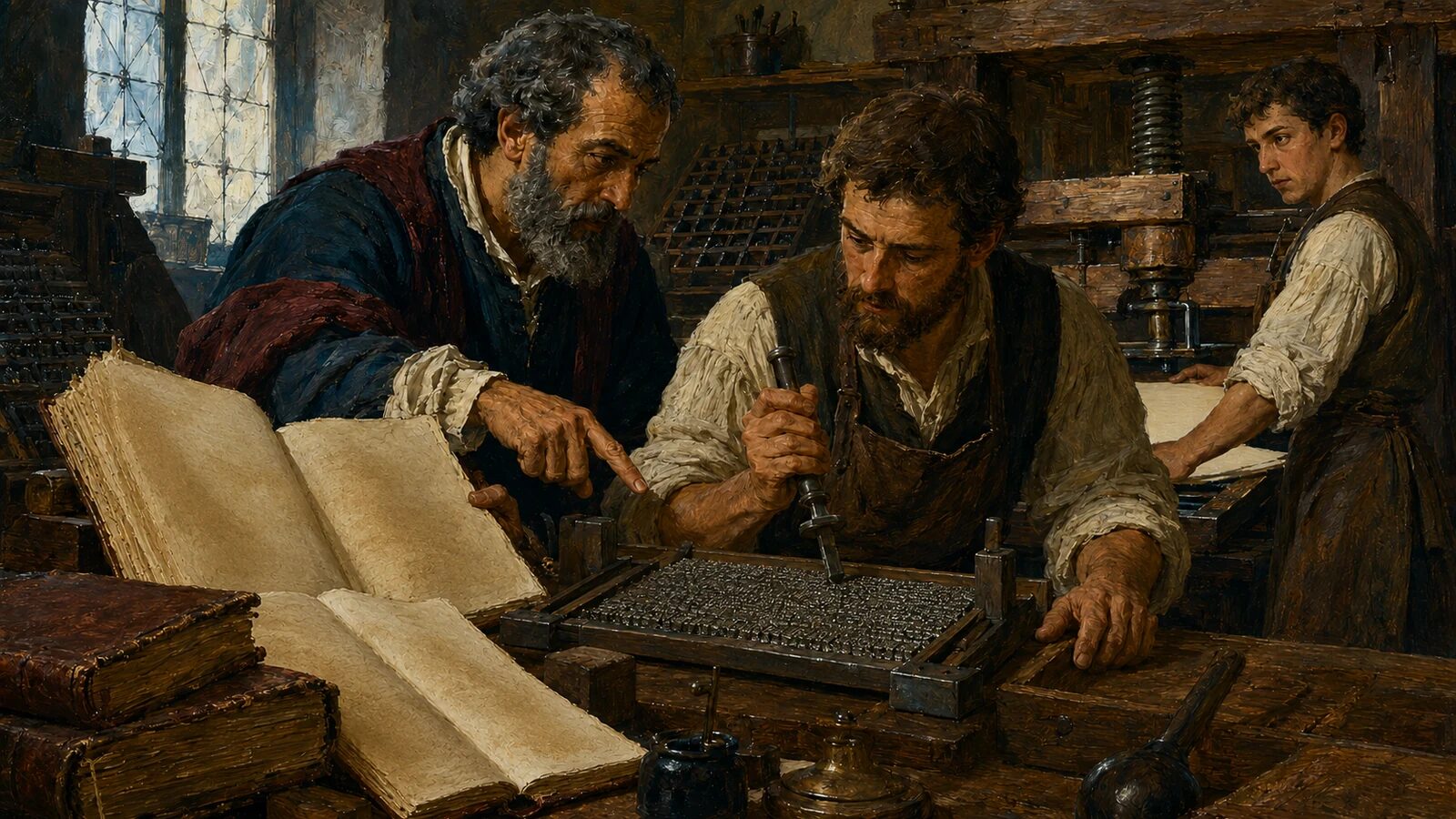
Why do I use the Textus Receptus and the received Byzantine tradition as the New Testament base text for Unforsaken? This affects the words we read and memorize, the passages we teach our children, and what we expect to hear preached. Before looking at the surviving manuscripts, I want to begin with what Scripture says about God preserving His words.
God Preserves His Words
A manuscript is a handwritten copy, the kind people made before printed books became common. We no longer have the original documents the apostles wrote, so scholars compare the surviving Greek copies with ancient translations and books used for church readings. Quotations in early Christian writings provide further evidence. When those witnesses differ, the difference is called a textual variant. Many involve spelling or word order, though some affect a word, a whole verse, or a longer passage.
Acknowledging that copyists made mistakes does not require us to give up our confidence in Scripture. The question is how we recognize its preserved wording among the witnesses we have. I use the Hebrew Masoretic Text for the Old Testament and the Textus Receptus with the received Byzantine tradition for the New Testament. My understanding is that God kept His words available to His people so they could read and preach them. They could translate those words into other languages and live by what He had said.
That does not make every copyist, printer, or translator inspired. Inspiration belongs to the God-breathed Scriptures themselves. It also gives me no reason to be proud of holding the right position while refusing correction from the Bible I defend. We need to examine the history honestly and trust God’s preservation with reverence, rather than speak as though Christ left His church without His words until modern editors reconstructed them.
Some dismiss the Received Text as late or merely traditional, as though it cannot deserve serious consideration. Its printed history is more complicated than a single perfect edition, but that doesn’t make it unreliable. I don’t think a slogan from either side can settle the question. We need to consider which tradition of copying best accounts for the surviving evidence and agrees with Scripture’s promise that God’s words would remain available to His people.
I begin with the Bible’s teaching on preservation because our starting point affects how we interpret manuscript history. If Scripture is treated as just another ancient book, its survival can seem to depend on chance, a favorable climate, or the power of an institution. From there, it is easy to picture a text lost by the church and recovered by scholars. My confidence begins with the God who inspired His Word and is able to keep it.
The words of the LORD are pure words, Like silver tried in a furnace of earth, Purified seven times. You shall keep them, O LORD, You shall preserve them from this generation forever.
Psalm 12:6-7, NKJV
Psalm 12 speaks of the LORD’s pure words and His promise to keep them. It does not describe the preservation of a vague religious impression. Although it doesn’t explain every step in copying Scripture, it gives us a reason to trust God through that history. His people have not been left with a Bible that disappeared and had to be rebuilt from uncertain fragments.
Jesus spoke confidently about the written Law, down to its smallest marks. He did not treat those details as temporary or expendable. He also said that His own words would remain even after heaven and earth passed away.
For assuredly, I say to you, till heaven and earth pass away, one jot or one tittle will by no means pass from the law till all is fulfilled.
Matthew 5:18, NKJV
Heaven and earth will pass away, but My words will by no means pass away.
Matthew 24:35, NKJV
These promises should shape what we expect to find in history. Matthew 4:4 says that man lives by every word that proceeds from the mouth of God. Proverbs 30:5 calls every word of God pure, and the next verse warns against adding to His words. Revelation 22 gives a serious warning against adding to or taking away from the words of that book. Scripture repeatedly draws our attention to words, not merely to a theme that can survive while the wording remains unknown.
Those passages do not settle every disputed reading or give us a chart identifying each manuscript. I still need to examine the evidence. But they tell me that God intended His people to have words they could actually live by. Our understanding of the copying history should allow for that usable preservation, rather than assume that lasting uncertainty is the most responsible position.
What the Received Text Is
Textus Receptus is Latin for “Received Text.” The name is associated with printed Greek New Testaments from the Reformation era. Erasmus published his first edition in 1516, followed by Robert Stephanus’s important edition in 1550 and several editions from Theodore Beza. The Elzevirs followed in the seventeenth century, and their 1633 edition described the text as received by all. That description helped establish the name by which these editions are now known.
The editions differ in some accents, spellings, and minor readings. We don’t need to pretend otherwise to defend the Textus Receptus, nor do we need to claim that a printer was inspired. These printed editions represent a received form of the Greek New Testament within the broader Byzantine tradition, which had long been copied and used in Greek-speaking churches.
I am not grounding the preserved text in the personal perfection of Erasmus, Stephanus, Beza, or the Elzevir printers. My confidence rests in God’s providential care for the received stream through ordinary human work. Copyists could make errors, and printers could differ in small details, while the public text remained recognizable and available to the churches.
Using the Received Text does not mean choosing English over Greek. The King James Version was translated from that Greek tradition, and the New King James Version retains the same New Testament foundation in clearer modern English. I honor the KJV without believing that an English translation was newly inspired or replaced the Hebrew and Greek. Its authority comes from faithfully conveying the words God gave and preserved.
By “received text” I mean more than a Bible edition that happens to be familiar. I am referring to the printed Greek New Testaments associated with Erasmus, Stephanus, Beza, and the Elzevirs, and their close relationship to the Byzantine tradition. This is the textual foundation of the KJV and NKJV. We need to consider whether it or the modern critical text best represents the New Testament God preserved for His people.
The Manuscript Streams and Their Major Witnesses
The evidence includes thousands of surviving Greek New Testament manuscripts, but we should also consider how Scripture was used in other languages. Ancient translations show how Christians understood the text before many of our surviving Greek copies were made. Lectionaries preserve passages arranged for church readings rather than in the usual order of New Testament books. Early Christian writers also quoted Scripture frequently, giving us another way to examine the wording they knew.
Not every manuscript fits neatly into a single family. Even so, we can recognize broad differences between the Byzantine and Alexandrian texts. The Byzantine text was widely copied and used in the Greek-speaking churches of the Byzantine world. The Alexandrian text is represented by a smaller group of early surviving witnesses associated especially with Egypt. These names describe patterns in the manuscripts and their settings, not identical copies from each region.
Modern critical editions are called eclectic because their editors choose readings from different witnesses. They do not simply reproduce Codex Sinaiticus or Codex Vaticanus from beginning to end. Instead, they judge each reading according to what they believe is earliest. I want to describe that method fairly while also recognizing how influential Alexandrian witnesses have been, particularly when they shorten or omit readings found in the Received Text.
A manuscript’s age deserves careful consideration, but age by itself does not prove faithfulness. A manuscript might survive because it was protected and treasured. It might also survive because it was set aside and rarely used. Climate affects what lasts, while copies read continually in churches wear out and must be replaced. The absence of a very early surviving manuscript from a well-used tradition does not prove the wording represented by that tradition began late.
Many surviving Byzantine copies are later, which explains why this tradition is often described as late. But if they preserve a stable text that was widely received, we need to weigh their agreement across that widespread use. These were words believers heard in worship and committed to memory. Churches replaced worn copies and carried the text into other languages. I don’t want to overlook that ordinary use, because it also provided opportunities for errors to be noticed and corrected.
Codex Sinaiticus and Codex Vaticanus are fourth-century Greek manuscripts, so both deserve attention. A codex is a book with pages rather than a scroll. The term majuscules describes their writing, which consists mainly of large capital-style Greek letters. Their age makes them valuable historical witnesses, but it does not by itself give them final authority over the text received in the churches.
Sinaiticus is associated with Saint Catherine’s Monastery at Mount Sinai. The events surrounding its nineteenth-century history have been interpreted in different ways, and I would be careful about claiming more than the evidence proves. We do not need to call the manuscript a fraud in order to question the weight placed upon it. The more direct concern is its text and condition.
The Codex Sinaiticus Project describes the manuscript as heavily corrected. That does not make it useless for historical study, but I want to weigh those corrections when considering how clearly it represents the earliest New Testament. Its condition gives me reason to question whether it should overrule wording that was read broadly in the churches.
Vaticanus is another fourth-century majuscule. The surviving ancient portion lacks the Pastoral Epistles, Philemon, and Revelation. Partway through Hebrews 9:14, the surviving ancient text ends; the following material comes from a much later hand. Vaticanus is valuable evidence, but it is not a complete New Testament. Its age should be weighed with its gaps rather than used as though it settled every reading.
I value early manuscripts and the careful comparison of their readings. My concern is with letting age outweigh everything else. A manuscript’s completeness and correction history also need to be considered, alongside agreement among copies and the way the text was received and used publicly. If a theory repeatedly leads believers to doubt verses the churches have long read and preached, we should test it against that wider evidence and God’s providential care for His Word.
Readings That Ordinary Bible Readers Notice
A difference in spelling is not the same as the absence of a whole verse. We should remember that when discussing textual variants, since not every difference threatens a doctrine. At the same time, I understand why someone wants an explanation when a familiar passage appears in brackets or is moved to a footnote. The reader needs to know whether those words belong in Scripture.
Brackets generally indicate that a translation committee doubts whether the enclosed words are original, even if it leaves them in the text. A note such as “some manuscripts omit” gives only a brief account of the issue. Behind it are judgments about which witnesses deserve the most weight and how their differences should be evaluated.
In 1 John 5:7-8, the passage often called the Johannine Comma, the Received Text names the heavenly witnesses as the Father, the Word, and the Holy Spirit. Our belief in the Trinity does not rest on this verse alone. Scripture teaches elsewhere that the three co-equal and co-eternal Persons are one God. But I don’t believe a passage becomes disposable because its doctrine can be established somewhere else. If these words belong in the received text, we have no right to discard them.
For there are three that bear witness in heaven: the Father, the Word, and the Holy Spirit; and these three are one. And there are three that bear witness on earth: the Spirit, the water, and the blood; and these three agree as one.
1 John 5:7-8, NKJV
The wording of 1 Timothy 3:16 makes the confession explicit: “God was manifested in the flesh.” This agrees with the New Testament’s teaching that Christ is fully God and fully man. Other readings may express the sentence less directly. We can still establish Christ’s deity from other passages, but that does not give us a reason to give up this clear received reading.
And without controversy great is the mystery of godliness: God was manifested in the flesh, Justified in the Spirit, Seen by angels, Preached among the Gentiles, Believed on in the world, Received up in glory.
1 Timothy 3:16, NKJV
Colossians 1:14 explicitly connects redemption with Christ’s blood. I don’t regard that as a decorative phrase, because our salvation involved His actual suffering and death. The eternal Son became fully man without ceasing to be God. He suffered in His innocent body and shed His physical blood on the cross. He died for our sins and rose bodily from the grave, and we receive salvation by grace through faith in Him.
in whom we have redemption through His blood, the forgiveness of sins.
Colossians 1:14, NKJV
Acts 8:37 records the Ethiopian eunuch confessing his faith before being baptized. That order helps us explain what baptism means: it follows faith and publicly identifies the believer with Christ, rather than producing salvation. I want people learning about baptism to be able to read that clear account of personal faith in Jesus, which is why the verse’s absence from many modern versions concerns me.
Then Philip said, “If you believe with all your heart, you may.” And he answered and said, “I believe that Jesus Christ is the Son of God.”
Acts 8:37, NKJV
Mark 16:9-20, commonly called the longer ending of Mark, also carries warnings in many Bibles. Christ’s bodily resurrection is taught in every Gospel and in the apostles’ preaching, so it does not depend on this passage alone. Still, the received ending brings Mark’s account to a coherent conclusion. It records resurrection appearances and the commission before describing Christ’s ascension and His work through those who preached.
So then, after the Lord had spoken to them, He was received up into heaven, and sat down at the right hand of God. And they went out and preached everywhere, the Lord working with them and confirming the word through the accompanying signs. Amen.
Mark 16:19-20, NKJV
Many translations also bracket or footnote John 7:53-8:11, the account of the woman taken in adultery. Jesus answered the trap with perfect wisdom and showed her mercy, but He did not excuse her sin. He told her to “go and sin no more” in John 8:11. We see both His authority to judge and His refusal to join in hypocritical condemnation.
Other examples are shorter but still noticeable. Matthew 18:11 says, “For the Son of Man has come to save that which was lost.” Romans 16:24 preserves the closing blessing, “The grace of our Lord Jesus Christ be with you all. Amen.” John 6:47 keeps the object of faith explicit: “he who believes in Me has everlasting life.” In Mark 1:2, the Received Text says “in the Prophets,” which fits a combined quotation drawn from Malachi and Isaiah.
I am not saying that every doctrine disappears from translations based on the modern critical text. The gospel is still present in many passages, and people can be saved while reading those translations. My concern is the cumulative effect of removing or questioning received readings, or expressing them less clearly. This reaches statements about Christ and His blood, as well as passages concerning confession and repentance. It also affects what readers see about baptism, resurrection, and the unity of Scripture.
Translation, Confidence, and Careful Guardrails
Once we have chosen a base text, we still need a faithful translation. Inspiration belongs to the original God-breathed Scriptures, while the translator’s task is to carry those words accurately into another language. Because God gave words, I want a translation to preserve their wording and structure as closely as good English permits.
Formal equivalence, often called word-for-word translation, aims to remain close to the source’s wording and structure. It does not assign one English word mechanically to each Greek word, since languages do not correspond that neatly. The purpose is to help readers see more of what the biblical writers actually said. Both the KJV and NKJV follow this approach.
I use the NKJV for public teaching at Unforsaken because it keeps the Received Text foundation for the New Testament and the Masoretic Text for the Old Testament while using current English. Its notes also identify major textual differences. Readers can see where the critical text differs and consider the question rather than have it hidden from them.
Dynamic equivalence gives translators more freedom to express what they understand a sentence to mean. A paraphrase restates the thought even more freely. This can make a passage feel easier to read, but it also brings more of the translator’s interpretation into the wording. I would consult a paraphrase as I might a devotional aid or short commentary. I would not use it as the foundation for doctrine, because we need to distinguish Scripture from someone’s explanation of it.
Recommending the NKJV does not require me to condemn Christians who own other translations. Someone beginning to read an NIV or ESV needs patient instruction and a clear standard, not shame. Nor does a family with several translations need to panic. The gospel remains present in many passages in critical-text versions. For public ministry, however, I need to choose a text that agrees with my conviction that God preserved His words.
The same care should govern how we discuss Sinaiticus and Vaticanus. Their histories, corrections, and gaps give us reasons to examine the authority granted to them. Unsupported accusations of fraud do not strengthen that examination. If I say more than the evidence supports, I weaken the case I am trying to make.
Erasmus and the other editors were ordinary people, not prophets. The minor differences among their editions should keep us from treating the Textus Receptus as one flawless printed artifact. I understand preservation in terms of the received textual tradition, without pretending that every person or stage in its history was free from human limitations.
Respect for the KJV should not become a belief that only English carries God’s Word. He gave Scripture in Hebrew and Greek, and an English translation has authority as it faithfully conveys that preserved text. I honor the KJV’s place in the church while appreciating the NKJV’s ability to present the same textual foundation in language many readers understand more readily.
I am not opposed to careful scholarship. Manuscript comparison, historical study, and language work can serve believers when they remain under Scripture’s authority. The problem comes when Scripture is treated like any other ancient book and a reconstructed scholarly text receives practical authority over the text publicly received among God’s people.
As we discuss this, I want us to care for the people reading these Bibles. We should help them read with settled trust in the God who speaks, without humiliating them for the Bible on their shelf or trying to win an argument by frightening them. The right view of preservation should make us teachable before Scripture, not smug toward other Christians.
Receiving and Obeying the Preserved Word
When you encounter brackets, a textual footnote, or a missing verse, take time to compare the readings. The note reflects a method of evaluating manuscripts and assumptions about their relative importance. Those assumptions also deserve examination in light of Scripture’s testimony about God’s words. We can consider the evidence without concluding that the Lord failed to preserve what He gave.
For public teaching at Unforsaken, the NKJV is the English Bible I recommend reading with confidence. Regular reading gives its words room to shape our thinking, and memorizing passages helps us carry them into daily life. We can teach those words to our children and bring our Bibles to church to examine the sermons we hear. I don’t want to defend a preserved Bible and then leave it closed. Its purpose is to bring us to faith and obedience as we hear God speak.
The center of that Word is Jesus Christ. The Bible was not preserved so we could defend it while our hearts grow cold. It reveals the Son of God and exposes our sin. Jesus lived without sin and willingly gave Himself for the whole world. The Father and Son remained united in that work. The Father did not hate or curse Jesus, and He never abandoned Him. Nor did the Father strike or bruise the Son or pour His wrath on Him. Christ physically bore the punishment for our sins in His innocent body. He endured real torture and shed His blood before dying and rising bodily from the dead.
God genuinely offers salvation to every person, though that offer can be resisted. Everyone who repents and believes in Christ receives forgiveness and everlasting life. God makes the believer a new creation, and the Holy Spirit comes to live within him and seals him for the day of redemption. Genuine salvation is eternally secure, yet that security never gives permission for lawlessness. A superficial profession cannot prove that someone has been born again.
If questions about manuscripts have unsettled your confidence, don’t leave them unaddressed until you begin to withdraw from the Bible. You don’t have to master every manuscript before you can trust God and His preserved Word. Bring your questions honestly, receive Scripture with reverence, and allow it to correct your sin and strengthen your faith.
For more detailed study, see A Bible Study on Which Bible Translation I Can Trust, A Bible Study on the Johannine Comma, and A Biblical Examination on How to Study the Bible Properly.
My Final Thoughts
I believe the Textus Receptus and received Byzantine tradition remain the proper New Testament base for Unforsaken. My confidence is in God preserving His words through the copies His people received and used, not in an inspired printer or a history without human mistakes. Through that tradition, the New Testament continued to be preached and became the foundation of the Reformation Bibles. The NKJV gives us that text in clear English. But defending it is only part of our responsibility. I want to open it humbly and listen, because through His preserved Word God teaches us the gospel of Christ and how He calls us to live.