
How should Christians speak about America’s Christian heritage without turning patriotism into worship? I believe we can tell the truth about the nation’s biblical influence while also telling the truth about its sins. To do this honestly, we have to keep America separate from Israel and remember that our hope rests in Christ, not in a founding document.
“And He has made from one blood every nation of men to dwell on all the face of the earth, and has determined their preappointed times and the boundaries of their dwellings.”
God made the nations and rules over their times and boundaries, so civil governments are not morally independent of Him. Popular will cannot turn evil into righteousness. I also need to keep historical evidence in its proper place. Public records help us understand what earlier Americans believed and how those beliefs shaped their words and institutions, but those documents do not create Christian doctrine. Scripture remains our final authority.
Why should Christians care about getting this history right? God is the God of truth, so we should not erase evidence merely because a secular age finds it uncomfortable. We also should not stretch the record because patriotic feeling wants a stronger claim than the documents support. Beyond the history itself, every nation remains accountable to its Maker. The Lord appoints its place in history and commands people everywhere to repent, so no nation has the right to invent its own moral law.
Reading the Founding Without Confusing America With Israel
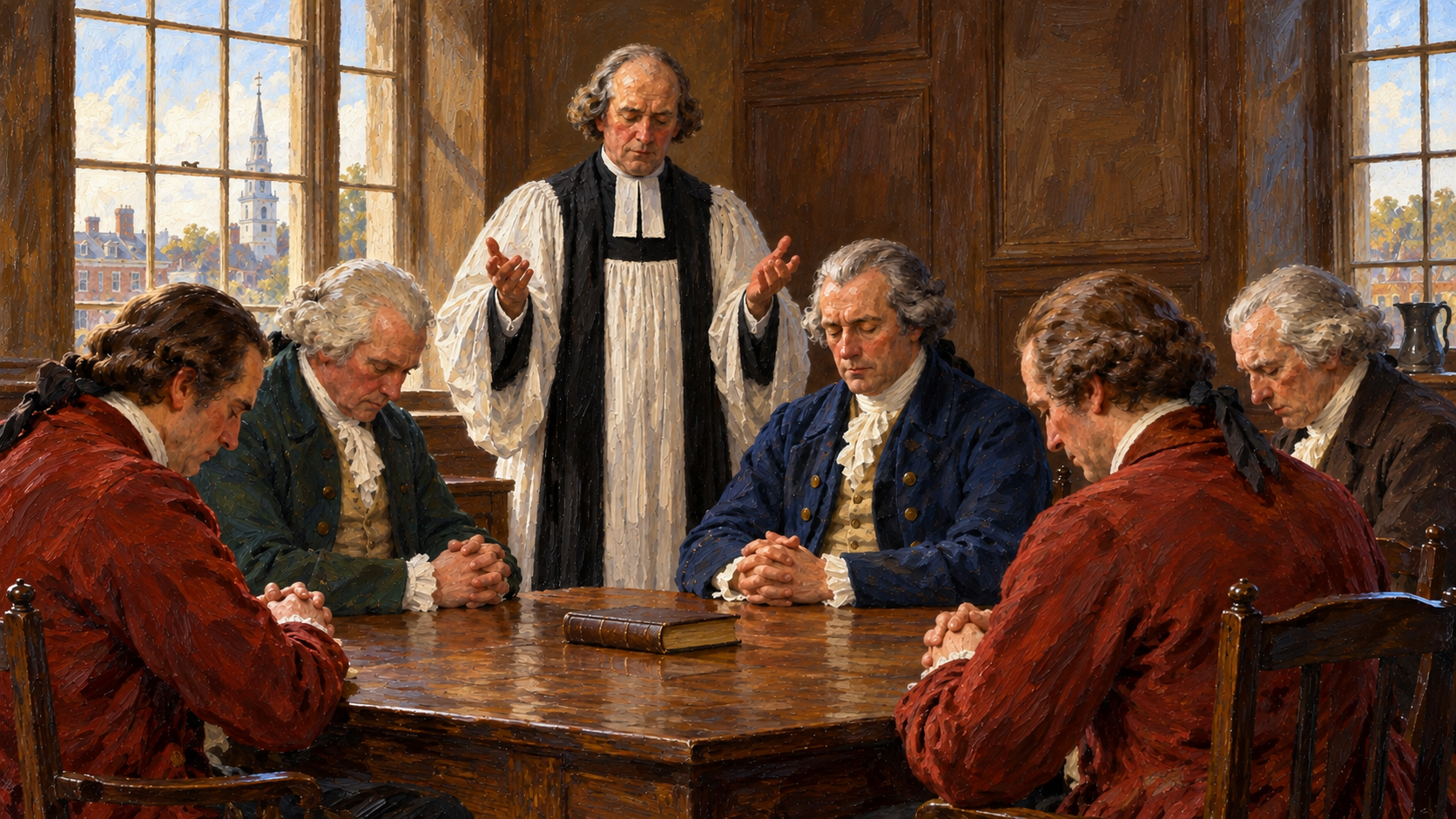
We cannot understand America’s founding honestly while leaving God and Scripture out of the account. Protestant Christianity shaped much of the culture, where public prayer and moral accountability were common parts of civic life. Christian language appears in colonial compacts and state constitutions, as well as in public sermons and political pamphlets. Early colleges also stated Christian purposes. I cannot take that evidence as proof that every founder was born again or every law was righteous, but neither can I accept a purely secular account of the founding when so much of the record points elsewhere.
Each document needs to be read in its own setting and allowed to say what it actually says. The Mayflower Compact shows that the Plymouth settlers connected their civil order with God’s glory and the advancement of Christianity. It cannot establish that every later American institution was equally biblical. The Declaration of Independence appeals to a Creator and the Supreme Judge of the world, then expresses reliance on divine Providence. That language is plainly not atheistic, though the document is not a church confession. The Constitution had a different purpose. Its protection of free exercise and rejection of a federal religious test restrained federal power without erasing the Christian assumptions found among the states and the people.
We need the same care when applying Deuteronomy to America, because God gave that book to Israel under the Mosaic covenant. Its land promises and national penalties were not transferred wholesale to the United States. Neither were its priestly order, civil laws, or covenant ceremonies. America did not stand at Sinai or receive Canaan, and it did not become the people God chose through Abraham, Isaac, and Jacob.
Deuteronomy still teaches the truth about God’s holiness and the danger of idolatry. It shows us why public justice deserves serious attention and why prosperity can tempt a people to forget the Lord. We may receive those lessons without claiming Israel’s covenant identity for another nation.
“Righteousness exalts a nation, But sin is a reproach to any people.”
That principle applies to any people. America is not Israel, but America remains accountable to Israel’s God. A constitution cannot save a nation from moral ruin when its people celebrate evil and despise the Lord.
The colonies were taking shape long before 1776. In 1620, the Pilgrims aboard the Mayflower entered a compact before going ashore. Although their original handwritten document has not survived, early accounts preserved its wording, including its unmistakably Christian opening and purpose.
“Having undertaken, for the Glory of God, and Advancement of the Christian Faith.”
Mayflower Compact, 1620
The settlers said they would “Covenant and Combine” themselves into a civil body politic. They were agreeing to live together under lawful authority, and they understood that agreement as a solemn promise made in God’s presence. It was more than a temporary travel arrangement. Their words came from a world shaped by Scripture, where people expected to answer to God for the promises they made.
The compact joined authority to the common good. Civil freedom meant an ordered life with responsibilities toward God and one another, rather than freedom from all obligation. The settlers bound themselves to that common life through a civil covenant, which must still be distinguished from the Mosaic covenant.
I can recognize the settlers’ Christianity and the seriousness of their agreement without treating their colony as a new Sinai. The Fundamental Orders of Connecticut likewise acknowledged Almighty God’s providence in their settlement and association as a commonwealth. Those words show that many early communities believed their public life stood before God. Recognizing that conviction does not require us to defend every colonial policy.
“You shall love the LORD your God with all your heart, with all your soul, and with all your strength.”
For Israel, love for God stood at the center of covenant life. Early Christian settlers did not obey that command perfectly, but their vocabulary shows that they did not confine worship to private thought. They believed homes and churches belonged under the Lord, and that schools and civil communities also answered to Him.
The Creator, Human Equality, and Liberty
When the Continental Congress approved the Declaration of Independence on July 4, 1776, it grounded human rights in creation rather than secular moral relativism. According to the Declaration, those rights came from God. They did not originate with a king or parliament, and neither a court nor a voting majority could be their source.
“We hold these truths to be self-evident, that all men are created equal, that they are endowed by their Creator with certain unalienable Rights.”
Declaration of Independence, 1776
The Declaration later appeals to “the Supreme Judge of the world” and closes with reliance on divine Providence. These expressions do not present the whole gospel, but they place civil government beneath a higher moral authority. I notice how much depends on where rights come from. If government creates them, it may redefine or remove them. If the Creator gives them, rulers are responsible to protect those rights, not treat them as their own possessions.
Scripture explains more about human equality than the Declaration does. Every person descends from Adam and bears God’s image, and each of us will answer to Him. The early nation often denied the force of that truth, most grievously by tolerating and protecting slavery. Yet its own phrase “created equal” gave later generations a public standard by which to expose the nation’s injustice.
Christian teaching about human worth helps us understand why political liberty should extend to everyone. Wealth and ancestry do not make one person worth more than another, nor does social rank or usefulness to the state. America failed badly when it refused to apply that truth to all people. Its failure did not make the truth false, however, and reformers could point to the contradiction when calling the nation back to its own stated standard.
“So God created man in His own image; in the image of God He created him; male and female He created them.”
I can be grateful that the Declaration appeals to the Creator and Judge without confusing those true words with national obedience to Christ. The document rejects the idea that civil power is ultimate, yet a nation can profess a moral principle while practicing terrible evil. We should neither erase the principle nor excuse the evil. Both the nation’s words and its conduct must answer to God’s truth.
A Limited Government Among a Christian-Shaped People
The Constitution differs from the Declaration because it provides a frame of government rather than a theological proclamation. It does not repeat the Declaration’s explicit references to the Creator, Judge, and Providence. Article VI rejects a religious test for federal office, while the First Amendment forbids Congress from establishing religion or prohibiting its free exercise.
The federal Constitution created no national church and required no Trinitarian confession from federal officers. Instead, it limited federal power among states whose church establishments and religious tests differed, as did their Protestant traditions. Those limits provided real protection for conscience, which we should not overlook.
I don’t read the Constitution as a detailed statement of Christian doctrine, but its limited federal language does not persuade me that religion was meant to become invisible. It was written to organize federal authority among states with different religious arrangements. That purpose helps explain why it leaves many theological questions unanswered.
Still, federal restraint is not evidence that the Founders intended a morally secular republic. John Adams wrote in 1798 that the Constitution was made for a moral and religious people and was inadequate for any other. George Washington described religion and morality as indispensable supports of political prosperity in his Farewell Address. These statements came from central figures in the founding generation and reveal the assumptions they brought to self-government.
“When the righteous are in authority, the people rejoice; But when a wicked man rules, the people groan.”
Dividing governmental power also fits what Scripture teaches about fallen humanity. People need government because they sin, but the people who govern are sinners too and must have limits on their power. James Madison addressed this in Federalist No. 51 when he observed that government would be unnecessary if men were angels. I would not give his words the authority of Scripture, but his observation agrees with what Scripture says about the human heart.
“The heart is deceitful above all things, And desperately wicked; Who can know it?”
Some Christians connect America’s three branches of government directly with Isaiah 33:22, where the Lord is Judge, Lawgiver, and King. I would be careful about saying that the Constitution was simply copied from Isaiah. The verse does teach that every kind of civil authority remains under God. Whether a person judges cases, makes laws, or holds executive power, he still answers to the Lord whose authority is final.
“For the LORD is our Judge, The LORD is our Lawgiver, The LORD is our King; He will save us.”
State constitutions make the Christian character of the era even more visible. Delaware’s 1776 constitution required officials to profess faith in God the Father, Jesus Christ His only Son, and the Holy Ghost. They also had to acknowledge the divine inspiration of the Old and New Testaments. Pennsylvania required legislators to affirm one God and the inspiration of both Testaments, along with future rewards and punishments. New Jersey limited certain offices to Protestants. Other states had their own provisions concerning Protestant Christianity or public religious support.
We do not have to approve every feature of those arrangements to recognize that the early republic was not culturally secular in the modern sense. Religious liberty developed among people whose Protestant assumptions and biblical vocabulary shaped their moral reasoning. The First Amendment did not require Christianity to disappear from public life. The same generation could protect religious exercise while supporting chaplains and calling for prayer and thanksgiving.
These state provisions also remind us that religious liberty developed over time and was not practiced perfectly from the beginning. Some arrangements protected one group more fully than another. Recognizing those limits does not require us to deny the public Christianity of the period. It helps us describe the record honestly instead of forcing it into either a secular myth or an idealized Christian past.
“Therefore submit yourselves to every ordinance of man for the Lord’s sake, whether to the king as supreme, or to governors.”
Submission does not make government divine. Lawful authority is delegated by God and should serve justice. When rulers command what God forbids or forbid what He commands, believers must obey God rather than men. In ordinary life, however, Christians should be good citizens whose conduct and public witness are truthful.
Scripture, Education, and Public Practice
The Bible influenced public life in colonial and founding-era America. People drew on it in sermons and pamphlets, and it shaped how they reasoned about law and civic duty. Its influence also extended to education and politics. Research into late eighteenth-century political writing has found Scripture among the dominant sources cited in that period, with Deuteronomy especially prominent.
I can see why readers thinking about public life turned to Deuteronomy. It calls a people to remember its past and gives direction about leadership and justice. It also warns against idolatry and against forgetting God when life becomes prosperous. Those words were addressed to Israel within its covenant, but Protestant readers drew moral lessons from them for public life.
“Beware that you do not forget the LORD your God by not keeping His commandments, His judgments, and His statutes which I command you today.”
America was not promised Canaan or commanded to gather on Mount Ebal and Mount Gerizim, and its history is not a second book of Joshua. Yet the moral lessons still confront us. Forgetting God destroys wisdom, and idolatry corrupts public life. Leaders still answer to God, while parents remain responsible to teach their children. We also need to recognize the temptation toward pride that comes with prosperity.
“You shall appoint judges and officers in all your gates, which the LORD your God gives you, according to your tribes, and they shall judge the people with just judgment. You shall not pervert justice; you shall not show partiality, nor take a bribe.”
Founding-era preachers used biblical language to urge repentance and resistance to tyranny, while also calling people to gratitude and public virtue. Their applications deserve careful examination because preachers can overreach. Even with that qualification, the sermons show how deeply the Bible influenced the way Americans thought about moral and political questions.
Deuteronomy was especially useful to readers who were thinking about ordered liberty because it never separates worship from public conduct. It demands honest judgment and warns leaders against partiality. It also places responsibility on homes to teach the next generation. Those themes helped shape how many Protestants spoke about law and national character, even when their direct application of Israel’s covenant required more caution than they sometimes showed.
That history should humble me. Having access to God’s truth makes us more accountable for how we respond to it. Generations had Bibles and churches where they could hear preaching, along with Christian schools and public prayer. Those opportunities to know God make later rebellion more serious, not less.
Early education supplies further evidence. Harvard was founded in 1636 in a Puritan setting and soon became connected with training ministers. Its early rules pressed students to know God and Jesus Christ, citing John 17:3. Yale was established by ministers concerned with faithful learning and ministry. Princeton, originally the College of New Jersey, had Presbyterian roots and later counted the minister and Declaration signer John Witherspoon among its presidents.
Dartmouth began through Eleazar Wheelock’s missionary aims toward Native Americans. Brown grew from Baptist roots while defending broad liberty of conscience, and Rutgers began as Queen’s College under the Dutch Reformed Church. These institutions were not founded merely as secular paths toward a career. They joined learning and moral formation to the knowledge of God.
“The fear of the LORD is the beginning of wisdom, And the knowledge of the Holy One is understanding.”
Those beginnings do not prove that every college stayed faithful or every student was godly. Many institutions did drift, but that does not erase what their beginnings reveal. Students encountered Hebrew and Greek alongside theology and moral philosophy. Chapel and catechism were also part of that educational world. It prepared ministers while shaping the lawyers and judges, teachers and statesmen who passed through it.
Education was meant to do more than prepare students to earn a living. They were also being taught to recognize truth and exercise moral responsibility. That purpose could be applied inconsistently, and learning never guaranteed faith, but the mind was understood to belong under God. Modern institutions may have moved far from those convictions. Their later direction cannot change the purposes stated at their founding.
God made the world and speaks truthfully, so I have good reason to love learning. Seeking knowledge belongs with reverence for Him. Separated from the fear of the Lord, skill can become dangerous and liberty can decay into license. Learning serves us best when it remains subject to Him.
Public life also included shared prayer and formal acknowledgment of Providence. The Continental Congress opened with prayer and appointed chaplains. During the Revolution, public days of humiliation, fasting, and prayer were recommended, and thanksgiving also had a public place. George Washington’s 1789 Thanksgiving Proclamation said that nations had a duty to acknowledge Almighty God’s providence and obey His will. They were to thank Him for His benefits and humbly seek His favor.
The leaders who spoke this way did not all share the same theological precision. Still, many publicly acknowledged God’s providence and spoke of human duty and judgment. They called for gratitude and repentance as part of public life. I cannot reconcile that record with the claim that American public life was designed to be emptied of God.
“I exhort first of all that supplications, prayers, intercessions, and giving of thanks be made for all men, for kings and all who are in authority.”
The Northwest Ordinance of 1787 declared religion, morality, and knowledge necessary to good government and human happiness, then encouraged schools. Although the ordinance was not a sermon, that connection reveals a belief that a healthy civil society depended on moral and religious formation.
Washington’s proclamation directed thanksgiving toward God and joined it to humble prayer. The nation was being called to more than congratulating itself. Public fasting likewise allowed a people to confess need and seek mercy instead of presenting itself as self-sufficient. These practices did not convert every participant, but they expressed dependence on God’s providence and accountability to Him.
I should pray for rulers and thank God for lawful order and constitutional protection without treating any leader as a messiah. Confessing national sins belongs alongside that gratitude. Patriotism is rightly ordered when it gives thanks for God’s providence and moves us to love our neighbors. When love of country becomes flattery that excuses evil and looks to political power for salvation, it has become idolatry.
Telling the Truth Without National Idolatry
The evidence for America’s Christian-shaped heritage is strong enough that it needs no exaggeration. Doubtful quotations weaken the case we are trying to defend, as does turning complicated people into simple heroes. Claiming Israel’s covenant status for America also misrepresents the truth. I want our account of the past to be governed by what is true, even when patriotic nostalgia would make a different account more appealing.
We should not claim that every founder was a faithful Christian. Some held orthodox Christian beliefs, while others were theologically mixed. Church attendance and biblical vocabulary carry real historical meaning, but they do not prove the new birth. The Lord alone knows the heart.
America is not a new Israel. God made covenant promises to Abraham, Isaac, Jacob, and their descendants. Through Moses, He gave Israel its land order and civil laws, along with its priesthood and sacrifices. Covenant blessings and curses belonged to that national life. The church is Christ’s body, formed from Jews and Gentiles who believe the gospel. America remains a nation under providence, not the covenant people of God.
Christian language in founding documents cannot erase America’s sins. Slavery and injustice toward Native Americans remain evil, as does racial partiality. Greed and sexual sin cannot be excused either. Abortion, lawlessness, and pride are no more righteous because we remember the nation patriotically.
Hypocrisy reveals the need for repentance, but it does not prove that Christian influence was absent. We can bring the whole record under Scripture without whitewashing it or turning to hatred of the nation.
If I defend a claim the evidence cannot support, I make it easier for critics to dismiss the stronger record along with a weak quotation. But pointing to real hypocrisy and then denying every Christian influence distorts the record too. Secular criticism and patriotic exaggeration can feed each other in that way. We can admit the nation’s sin while preserving valid evidence and refusing conclusions that the evidence does not support.
“For there is no partiality with God.”
We should begin with gratitude for mercies no nation is owed. God has allowed churches and Bibles to be present among us, along with public acknowledgment of Him. Ordered liberty and protection for conscience are also gifts we should receive humbly. Remembering His providence gives us reason to thank Him.
Repentance must follow gratitude because greater light brings greater responsibility. When public leaders and institutions cast off God’s Word, nostalgia will not repair the loss. Christians must confess sin and return to obedience. Political success can never substitute for holiness.
We also need courage to use the freedom we have. Religious liberty rests on God being Lord of conscience, rather than the state. Civil government has real authority only as He delegates it. Where believers remain free to preach Christ, we should use that liberty faithfully. We can strengthen our homes and churches and take responsibility for teaching children. We can also defend vulnerable neighbors and do good in our communities. Government cannot accomplish the church’s calling for us.
Using liberty faithfully also means accepting the duties of ordinary citizenship. Christians may vote and speak about public questions, but we must still honor lawful authority and pay what we owe. Loyalty to a party or leader never gives me permission to call evil good. Our public conduct should show that obedience to Christ governs our politics, not the other way around.
“Render therefore to all their due: taxes to whom taxes are due, customs to whom customs, fear to whom fear, honor to whom honor.”
America may repent or harden, and its laws and institutions may become better or worse. My hope cannot depend on which direction the nation takes. Christ remains Lord, and God’s kingdom does not rise or fall with an earthly republic. That assurance gives us reason to serve without panic rather than become passive, because our Savior reigns.
The Gospel Above the Nation
America needs the gospel of Jesus Christ, not just a better memory of its founding. A person may admire the Declaration and defend the Constitution while still standing guilty before God. Warm words about Providence do not reconcile a sinner to Him. Neither citizenship nor national heritage offers salvation, and a political party cannot give the new birth any more than moral reform can.
Jesus is the eternal Son of God, fully God and fully man. He was born of a virgin and lived without sin. Wicked men physically tortured and killed Him, yet He willingly bore real punishment for our sins in His innocent body. He suffered, shed His blood, and died before being buried and rising bodily from the dead. The Father did not hate, abandon, or personally abuse the Son. Jesus offered Himself willingly, and through His blood sinners may be forgiven. Those who receive Him by faith are made new, sealed by the Holy Spirit, and given eternal life.
“In Him we have redemption through His blood, the forgiveness of sins, according to the riches of His grace.”
Just laws and religious liberty are good, and so is Christian influence in education and public life. Yet none of those things can raise a spiritually dead heart. Only Christ saves, so the church’s first calling cannot be to make America impressive. We are to preach Him and teach what He commanded. Wherever He has placed us, we are to worship God in spirit and truth and live faithfully before Him.
These related studies can help carry the subject further: The Book of Deuteronomy, Blessings and Curses, The Mosaic Covenant, and The Law. The studies on Providence and Provision and The Gospel also develop the truths that should govern Christian gratitude and hope.
“Blessed is the nation whose God is the LORD, The people He has chosen as His own inheritance.”
My Final Thoughts
America’s heritage bears clear marks of Christian influence, and I do not believe honesty permits us to erase them. That same honesty keeps us from calling the nation sinless or treating it as another Israel. Psalm 33:12 first speaks of the people God chose as His inheritance, so religious language does not give another nation Israel’s covenant identity. America has received much light and mercy, which makes repentance more urgent. Better politics cannot save the nation. I want to thank God for what He has provided and serve my neighbors faithfully, while keeping my hope in the risen Lord Jesus Christ.