
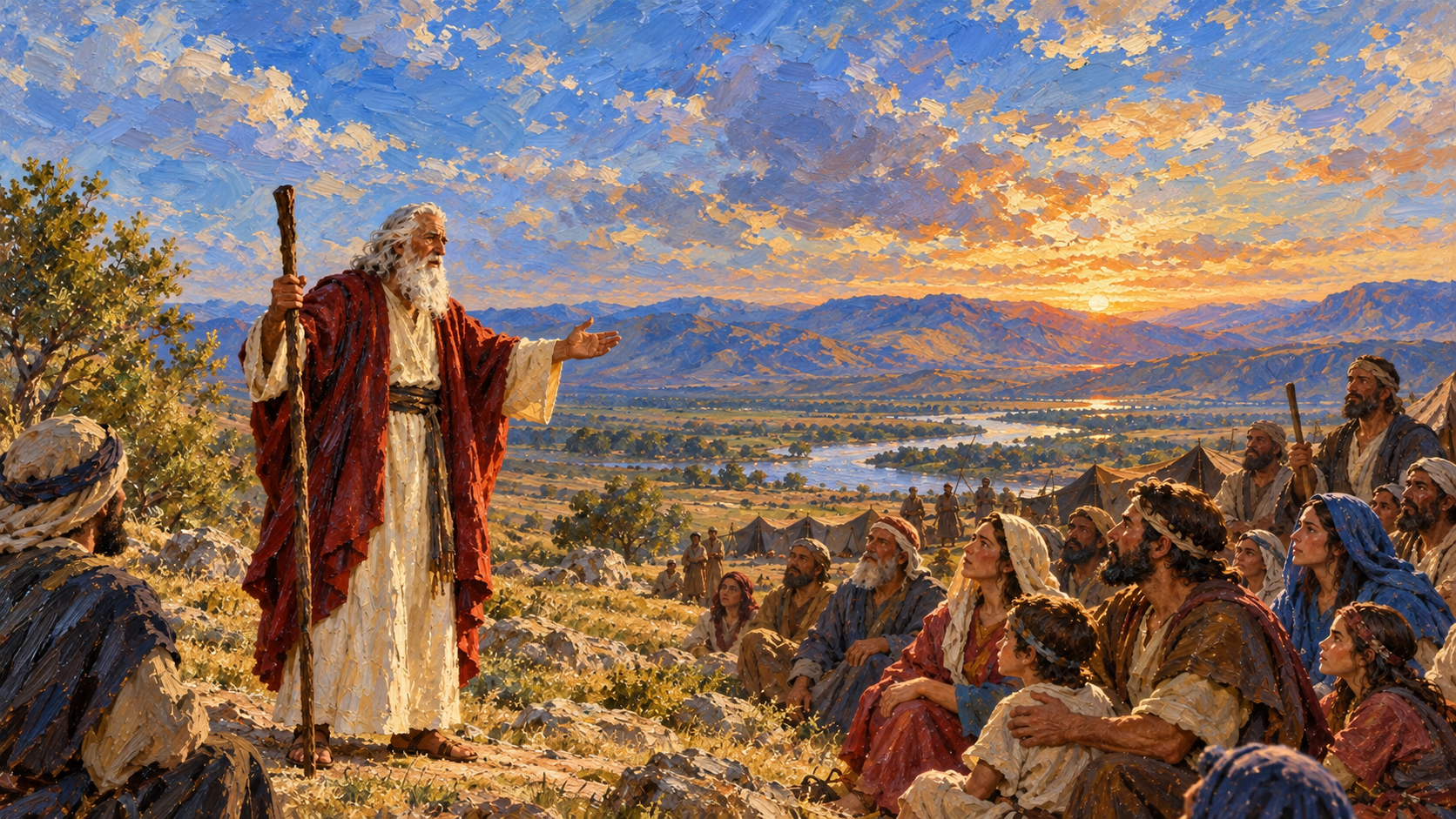
Deuteronomy brings us to the plains of Moab, where Moses speaks to Israel one last time before the nation crosses the Jordan. I hear both urgency and tenderness in these chapters. Moses knows how easily Israel forgot the Lord, so his final appeal keeps returning to one question: will this generation love Him and believe His Word?
“These are the words which Moses spoke to all Israel on this side of the Jordan in the wilderness.”Deuteronomy 1:1
Moses Speaks on the Edge of the Promised Land
A new generation stood within sight of the land God had promised to Abraham, Isaac, and Jacob. Their parents had reached the edge of Canaan and turned back in unbelief. Now Moses spoke to their children with warnings and hope. He wanted them to enter the land with the Lord’s Word in their ears and His works fixed in their memory.
The English title Deuteronomy comes from the idea of a “second law,” but Moses was not giving Israel a different law to replace what God gave at Sinai. He restated the Mosaic covenant and explained how it applied to the generation about to inherit Canaan. The Hebrew opening means “These are the words.” Although Moses spoke these words to Israel, they are also the inspired Word of God. They bound His covenant people to the Lord who had redeemed them from Egypt.
Deuteronomy contains history and law, but it sounds to me like a pastor’s final sermon. Moses began by looking back over Israel’s journey so the people would understand what unbelief had cost them. He then explained how the covenant should shape their hearts and their life in Canaan. After reviewing their history in chapters 1-4, he turned to the heart of their covenant relationship in chapters 5-11. Chapters 12-26 explain how they were to live in the land, and chapters 27-30 set blessing and curse before them. In chapters 31-34, Moses gave his final witness and transferred leadership to Joshua.
Deuteronomy speaks directly to Israel under the Mosaic covenant, and I need to remember that when I read it as a Christian. The church is not national Israel. Believers are not placed under Israel’s civil covenant, with its land promises and penalties or its national government transferred to us unchanged. Yet this book is still Scripture for us. We learn about God’s holiness and faithfulness through what He said and did for Israel. His hatred of idolatry appears alongside His mercy toward the repentant and His concern for justice. Above all, Deuteronomy shows why we need hearts that truly love Him.
“For whatever things were written before were written for our learning, that we through the patience and comfort of the Scriptures might have hope.”Romans 15:4
Remembering the Wilderness: Deuteronomy 1-4
Moses begins by locating Israel east of the Jordan. The journey from Horeb to Kadesh Barnea was only eleven days. Yet Israel’s refusal to enter the land brought the judgment of forty years in the wilderness. God had not been weak, and His promise had not become uncertain. Israel heard the promise and saw the land, but the people feared its inhabitants and refused to trust the Lord.
“See, I have set the land before you; go in and possess the land which the LORD swore to your fathers, to Abraham, Isaac, and Jacob, to give to them and their descendants after them.”Deuteronomy 1:8
The report of the spies remained central to Moses’ warning. The people accused God in their hearts and claimed He had brought them out to be destroyed. I find that accusation sobering because they were treating His mercy as a danger to them. Instead of trusting His promise, they measured it against the obstacles they could see. Moses wanted the new generation to remember why their parents had refused to go up: they had rebelled against the Lord’s command.
“Nevertheless you would not go up, but rebelled against the command of the LORD your God.”Deuteronomy 1:26
Even Moses would not enter the land because of his own disobedience at Meribah. His position as the Lord’s servant did not put him above the Lord’s Word. His exclusion from the land makes me take the responsibility of leadership seriously. No position exempts us from accountability to God. Joshua would take the people across the Jordan, and Moses was told to encourage and strengthen the man who would lead them.
“But command Joshua, and encourage him and strengthen him; for he shall go over before this people, and he shall cause them to inherit the land which you will see.”Deuteronomy 3:28
Chapters 2-3 also recall Israel’s victories over Sihon and Og. Although the wilderness years brought judgment, God continued to guide and provide for His people. His covenant purpose had not ended, and when the time came He gave them victory according to His promise.
In chapter 4, Moses used that history to urge Israel to hear the Lord and obey Him. At Horeb, the people had heard God’s voice but had seen no form. They had no right to turn that encounter into a carved image or pretend that an object could represent the living God.
“Take careful heed to yourselves, for you saw no form when the LORD spoke to you at Horeb out of the midst of the fire, lest you act corruptly and make for yourselves a carved image.”Deuteronomy 4:15-16
Moses warned that Israel would be scattered if the nation turned from the covenant. Yet even in that place of judgment, the Lord held out mercy: if the people sought Him with all their heart and soul, they would find Him. The warning was severe without closing the way back to God.
“But from there you will seek the LORD your God, and you will find Him if you seek Him with all your heart and with all your soul.”Deuteronomy 4:29
Moses was teaching Israel how to remember its past. They needed to face their rebellion and the discipline it brought, while also remembering how God had provided for them and given them victory. He had revealed Himself to them and shown them mercy. Holding those things together should have made them humble and obedient, rather than proud or nostalgic.
Hear, Love, and Teach: Deuteronomy 5-11
When Moses restated the covenant made at Horeb, he presented the Ten Commandments as part of Israel’s relationship with the Lord who had brought them out of Egypt. They were not abstract moral sayings. The command to worship Him alone came first because He alone is God.
“The LORD our God made a covenant with us in Horeb.”Deuteronomy 5:2
“You shall have no other gods before Me.”Deuteronomy 5:7
Israel trembled when the people heard God’s voice from the fire. They asked Moses to hear Him and bring His words to them as their mediator. The Lord approved their fear and expressed His desire that they would always have hearts that feared Him and obeyed. I notice that He wanted more than written commandments standing before the nation. He wanted truth and love within them, a concern that keeps returning throughout Deuteronomy.
“Oh, that they had such a heart in them that they would fear Me and always keep all My commandments, that it might be well with them and with their children forever!”Deuteronomy 5:29
Chapter 6 contains the Shema, one of Scripture’s great confessions. “Hear, O Israel” calls the whole nation to listen to the Lord’s covenant words. The Lord is one, and Israel must love Him with the whole person. Jesus later identifies this as the first and great commandment.
“Hear, O Israel: The LORD our God, the LORD is one! You shall love the LORD your God with all your heart, with all your soul, and with all your strength.”Deuteronomy 6:4-5
Love for the Lord had to fill ordinary life. Parents were to teach God’s words diligently at home and while traveling, keeping them before the family at bedtime and in the morning. I don’t see how we can reduce that kind of teaching to an occasional formal lesson. God’s Word belongs in the daily life and conversation of a home, where one generation teaches the next.
Moses also warned Israel not to forget the Lord when prosperity came. Hunger had tested them in the wilderness, and abundance would test them in the land. They would have houses and vineyards, with wells and herds to provide for them. Even their silver could feed pride if they forgot that every good thing came from the Lord.
“Beware, lest you forget the LORD who brought you out of the land of Egypt, from the house of bondage.”Deuteronomy 6:12
Chapter 8 recalls how God allowed Israel to hunger and then fed them with manna. He was teaching them that life depends on every word from His mouth. When Satan tempted Jesus in the wilderness, the faithful Son answered with this passage from Deuteronomy. His use of it shows us that the book remains living Scripture, not a relic of Israel’s past.
“So He humbled you, allowed you to hunger, and fed you with manna which you did not know nor did your fathers know, that He might make you know that man shall not live by bread alone; but man lives by every word that proceeds from the mouth of the LORD.”Deuteronomy 8:3
In chapters 9-10, Moses recounted the golden calf and Israel’s stubbornness to make clear that their own righteousness had not earned them the land. The renewed tablets showed God’s mercy, not something Israel could congratulate itself for deserving. Having external signs of the covenant could never take the place of surrendering to the Lord inwardly.
“Therefore circumcise the foreskin of your heart, and be stiff-necked no longer.”Deuteronomy 10:16
Chapter 11 closes this movement by placing blessing and curse before the people. Love for the Lord must become obedience. Faithfulness would bring covenant blessing in the land, while rebellion would bring the curse. Moses will make this choice public again when he commands the ceremony at Mount Gerizim and Mount Ebal.
Ordering Life in the Land: Deuteronomy 12-26
The long central section explains how loyalty to the covenant should govern Israel’s national life. They were not free to build their society around the customs of their neighbors. God’s Word directed their worship and leadership, and it governed what happened in their courts and families. It also governed their economic life and warfare. Care for vulnerable people belonged within that same obedience to His Word.
Chapter 12 begins with instructions to destroy pagan places of worship and seek the place where the Lord chose to put His name. Worship was to remain pure and united around His direction. Israel could not borrow the methods of idolaters and simply attach the Lord’s name to them.
“You shall not worship the LORD your God in that way.”Deuteronomy 12:4
Chapter 13 addresses false prophets and even close family members who tried to pull Israel toward other gods. The penalties were severe because idolatry was covenant treason. Chapter 14 distinguishes clean from unclean animals and commands tithes. Those gifts supported worship and provided for Levites, strangers, fatherless children, and widows. Holiness reached into the household and into the nation’s generosity.
Chapter 15 requires the release of debts and openhanded care for the poor. Israel’s economy was to reflect the mercy of the God who had redeemed them from slavery.
“For the poor will never cease from the land; therefore I command you, saying, ‘You shall open your hand wide to your brother, to your poor and your needy, in your land.’”Deuteronomy 15:11
Chapter 16 reviews Passover, the Feast of Weeks, and the Feast of Tabernacles, which kept redemption and God’s provision before the nation. It then turns to the judges, who were forbidden to pervert judgment or accept bribes. Justice under God was part of the life Israel was called to live in the land.
“You shall follow what is altogether just, that you may live and inherit the land which the LORD your God is giving you.”Deuteronomy 16:20
Deuteronomy 17 required Israel’s future king to write his own copy of the Law and read it throughout his life. He was forbidden to multiply horses or wives, and he could not keep multiplying silver and gold for himself. I can see why the king needed that continuing instruction. Even he stood under Scripture, and his authority was never meant to become proud independence from God’s Word.
“And it shall be, when he sits on the throne of his kingdom, that he shall write for himself a copy of this law in a book.”Deuteronomy 17:18
Chapter 18 reaffirms the Levites’ portion and warns Israel against learning the occult practices and abominations of the nations. Instead, the Lord promised a Prophet like Moses who would speak His words. Peter applies that messianic promise to Jesus in Acts 3, and the Gospels show Christ as the greater Prophet who perfectly speaks God’s words.
“I will raise up for them a Prophet like you from among their brethren, and will put My words in His mouth, and He shall speak to them all that I command Him.”Deuteronomy 18:18
Chapter 20 gives directions for warfare. When the Lord sent Israel into battle, the people were not to fear, but they still had to obey His commands in the way they fought. Even during a siege they were forbidden to destroy fruit trees. Going to war did not place the nation beyond God’s restraint.
“For the LORD your God is He who goes with you, to fight for you against your enemies, to save you.”Deuteronomy 20:4
Chapters 21-25 take covenant holiness into the details of community life. Laws about unsolved murder and inheritance stood alongside commands protecting marriage and family responsibilities. Honesty in trade mattered, as did care for animals and justice for strangers, fatherless children, and widows. Holiness could not be confined to the sanctuary when God was also directing life in the courtroom and household, out in the field and in the marketplace.
“You shall not pervert justice due the stranger or the fatherless, nor take a widow’s garment as a pledge.”Deuteronomy 24:17
Chapter 26 closes the legal section with firstfruits and confession. As the worshiper brought the first produce, he recalled how God had been faithful. He began with a wandering ancestor and remembered the affliction in Egypt, then God’s deliverance by His mighty hand and His bringing the people into the land. Remembering those acts was part of worship. Gratitude moved Israel toward obedience because every blessing had come from the Lord.
“And now, behold, I have brought the firstfruits of the land which you, O LORD, have given me.”Deuteronomy 26:10
The Covenant Choice and Moses’ Final Witness
Before Israel enters the land, Moses commands a public covenant ceremony. The Law is to be written on large stones, and an altar is to be built on Mount Ebal. Half the tribes will stand toward Mount Gerizim for blessing, while the others stand toward Ebal for the curse. All the people must answer “Amen” as the covenant words are proclaimed.
“And it shall be, on the day when you cross over the Jordan to the land which the LORD your God is giving you, that you shall set up for yourselves large stones, and whitewash them with lime.”Deuteronomy 27:2
The whole nation had to hear God’s Word and answer to it in that public ceremony. I also notice that God placed the altar for sacrifice on Ebal, the very mountain where the curse would be announced. Israel could not treat sin lightly, yet the Lord provided an altar there. Chapter 28 goes on to spell out the covenant consequences in sobering detail.
The blessings promised in chapter 28 reached ordinary life in both the city and the field. God promised fruitfulness and needed rain, with full storehouses and victory over Israel’s enemies. The curses reversed that picture. A nation that abandoned the covenant would face defeat and drought, along with disease and famine. Oppression, exile, and fear were also among the consequences. Israel’s later history shows that these were not empty threats.
“But it shall come to pass, if you do not obey the voice of the LORD your God… that all these curses will come upon you and overtake you.”Deuteronomy 28:15
Chapters 29-30 renew the covenant with the new generation and those not yet born. Moses warned that future generations would see a devastated land and ask what had happened. The answer would be Israel’s treachery against the covenant. But restoration was still promised: if Israel returned to the Lord, He would gather the people and do the inward work they needed.
“And the LORD your God will circumcise your heart and the heart of your descendants, to love the LORD your God with all your heart and with all your soul, that you may live.”Deuteronomy 30:6
Moses set life and good before Israel, in contrast to death and evil. His call to “Choose life” meant loving the Lord and obeying His voice while clinging to Him. We need to hear those words within the covenant, rather than treating them as a vague saying meant to motivate us.
“I call heaven and earth as witnesses today against you, that I have set before you life and death, blessing and cursing; therefore choose life.”Deuteronomy 30:19
In the final chapters, Moses prepared Israel for new leadership and left a witness to guide the nation. He was 120 years old and would not cross the Jordan, but God Himself would go before the people. The Lord’s purpose would continue as Joshua was publicly commissioned to lead. Israel was commanded to be courageous.
“Be strong and of good courage, do not fear nor be afraid of them; for the LORD your God, He is the One who goes with you.”Deuteronomy 31:6
Moses gives the written Law to the priests and elders. Every seventh year, during the Feast of Tabernacles, it must be read before the entire nation. Men and women will hear it, along with children and strangers. The Word must remain public so that the coming generation learns to fear the Lord.
“Gather the people together, men and women and little ones, and the stranger who is within your gates, that they may hear and that they may learn to fear the LORD your God.”Deuteronomy 31:12
Chapter 32 records the Song of Moses, which calls heaven and earth as witnesses to what it declares. The song proclaims God’s greatness and recalls His care for Israel before exposing the nation’s future rebellion. It announces righteous judgment, yet ends with compassion on the Lord’s servants.
“For I proclaim the name of the LORD: Ascribe greatness to our God.”Deuteronomy 32:3
Moses blessed the tribes in chapter 33. In chapter 34, God showed him the land from Mount Nebo, though he would not enter it. Moses then died and the Lord buried him. Joshua, filled with the spirit of wisdom, led Israel forward.
“But since then there has not arisen in Israel a prophet like Moses, whom the LORD knew face to face.”Deuteronomy 34:10
Moses had been unique in Israel’s history, and that final statement makes me think again about the promise in chapter 18. Where was the other Prophet like him? Moses had died and Joshua was leading the people, but the promised Prophet had not yet come. The book closes with that loss and expectation, leaving the promise open until Christ.
The Greater Prophet and How Christians Should Read
The book’s main themes lead us to Jesus in the New Testament. Every recorded answer Jesus gave when Satan tempted Him in Matthew 4 came from Deuteronomy. That helps me see how directly this book teaches us to depend on God’s Word. He trusted the Father in the wilderness and lived by every word from God. Where Israel had failed, the faithful Son stood firm.
Jesus also named Deuteronomy 6:4-5 as the first and great commandment. He did not discard the call to love the Lord with heart, soul, and strength. He fulfilled it perfectly and taught His people what true love for God requires.
The promise of a Prophet like Moses points most directly to Christ. Moses spoke God’s words and mediated the covenant as he led and shepherded Israel. He also interceded for the people. Jesus is greater than Moses because He is the eternal Son made flesh. As the perfect Mediator and Lord, He speaks with divine authority.
“The LORD your God will raise up for you a Prophet like me from your midst, from your brethren. Him you shall hear.”Deuteronomy 18:15
Deuteronomy also shows why we need a change of heart that only God can bring about. Israel was commanded to circumcise the heart, and later the Lord promised to do that inward work. I need to keep both passages in view: His command does not remove our need for His help. The New Covenant does not make sin less serious, but reveals how deeply we need God’s transforming grace through the Spirit.
The law prepares us to understand the gospel by revealing God’s holiness and exposing our sin. It establishes accountability before God and sets out blessing and curse, but sinners cannot save themselves by keeping it. That is why we need the true Mediator.
Jesus Christ is the sinless Son of God. Wicked men physically tortured, punished, and killed Him. He willingly bore that real punishment for our sins in His innocent body through suffering, the shedding of His blood, and death. He was buried and rose bodily. The Father did not hate, abandon, or personally abuse the Son. Through Christ’s blood and resurrection, forgiveness and eternal life are offered to everyone who repents and believes.
“For Christ is the end of the law for righteousness to everyone who believes.”Romans 10:4
Christians should therefore read Deuteronomy first as the covenant book God gave to Israel. The land blessings and national curses belong to that setting, as do the civil penalties and conquest commands. We should not flatten the covenants or transfer every command directly to the church in the same form.
We should also read Deuteronomy as inspired Scripture that reveals the Lord’s ways. Its call to remember His works and love Him from the heart still speaks to us. Parents learn from its instruction to teach the Word diligently, while every believer needs to heed its warnings about idols. Its laws show the need for justice and God’s care for vulnerable people. Even the instructions for Israel’s king remind us that leadership must remain under Scripture.
Israel’s failure gives Gentiles no reason for pride. When I read the warnings about forgetting God in comfortable circumstances, I need to consider my own heart. We can still forget Him when life becomes easy. Jesus’ use of Deuteronomy shows that Scripture is sufficient for temptation and worship, and we should receive God’s warnings with reverent faith.
These related studies develop the book’s major themes: The Mosaic Covenant, The Law, and Blessings and Curses. You can also continue with Mount Ebal and Mount Gerizim, Israel’s Kings Keeping the Word, and The Messiah in the Bible.
My Final Thoughts
Deuteronomy lets us hear Moses plead with a new generation to remember the Lord and choose life under His covenant. I understand why he kept returning to the heart when neither the land nor written commandments could cure Israel’s unbelief. The book leaves us waiting for the greater Prophet, and Jesus is the answer. As we hear Him and trust the salvation He gives, His Word should shape the ordinary life of our homes and churches.