
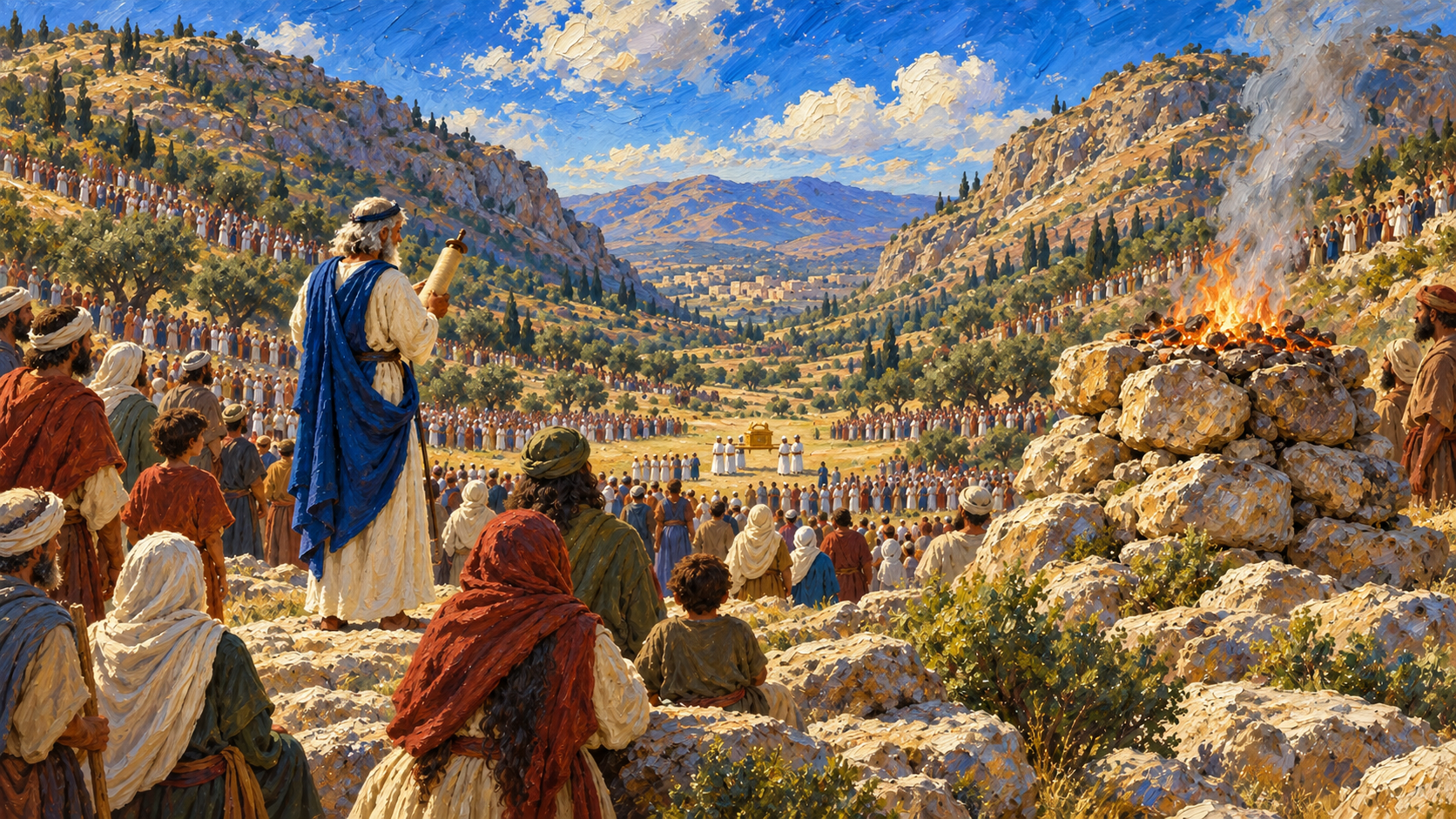
Two mountains rise over the valley of Shechem in central Israel. Mount Gerizim stands to the south, and Mount Ebal stands to the north. When I picture Israel gathered between them, I cannot help asking why God put the altar on the mountain of the curse.
“Now it shall be, when the LORD your God has brought you into the land which you go to possess, that you shall put the blessing on Mount Gerizim and the curse on Mount Ebal.”Deuteronomy 11:29
The Mountains and the Covenant
Gerizim and Ebal form a natural amphitheater near Shechem, a place where Israel could remember God’s promises and the choices made in response to them. Abraham had built his first altar in Canaan there, and Jacob later renounced his household’s idols there. Now the Lord commanded Israel to rehearse His covenant in that setting. His law was to be engraved on stones, and sacrifice was to be offered. The people would hear the blessing and curse for themselves while seeing God’s written Word before them.
“See, I have set before you today life and good, death and evil… I call heaven and earth as witnesses today against you, that I have set before you life and death, blessing and cursing; therefore choose life.”Deuteronomy 30:15, 19
Before Israel crossed the Jordan, God gave Moses detailed instructions for the ceremony. Large stones were to be covered with plaster so that the words of the law could be written clearly upon them. An altar of uncut stones was to be built on Mount Ebal, and Israel was to present offerings there.
“And it shall be, on the day when you cross over the Jordan to the land which the LORD your God is giving you, that you shall set up for yourselves large stones, and whitewash them with lime. You shall write on them all the words of this law… Therefore it shall be, when you have crossed over the Jordan, that on Mount Ebal you shall set up these stones… And there you shall build an altar to the LORD your God, an altar of stones; you shall not use an iron tool on them. You shall build with whole stones the altar of the LORD your God.”Deuteronomy 27:2-3, 4-6
I notice that God specified how both the written law and the altar were to be prepared. Plaster on the stones made His words public and lasting, while uncut rock that had not been worked with iron kept the altar from becoming a monument to human skill. Even those materials taught Israel to receive righteousness and atonement as God’s provision rather than something people could invent for themselves.
The tribes divided, with half standing before Mount Gerizim for the blessing and half before Mount Ebal for the curse. As the Levites proclaimed the covenant conditions, all the people answered, “Amen.” They were agreeing that the Lord’s judgment was true, rather than merely listening to private advice.
“These shall stand on Mount Gerizim to bless the people… and these shall stand on Mount Ebal to curse… And the Levites shall speak with a loud voice… ‘Cursed is the one who makes a carved or molded image…’ And all the people shall answer and say, ‘Amen!’”Deuteronomy 27:12-15
I want us to notice how much of the law this final curse requires Israel to obey:
“Cursed is the one who does not confirm all the words of this law by observing them.”Deuteronomy 27:26
Deuteronomy 28 unfolds what obedience and disobedience would mean for Israel under the covenant. God promised His presence and favor, but He also warned of judgment when the people turned their hearts away from Him. Their conduct and their response to Him both mattered, because this covenant was moral and personal.
“The LORD will command the blessing on you in your storehouses and in all to which you set your hand.”Deuteronomy 28:8
“But it shall come to pass, if you do not obey the voice of the LORD your God… all these curses will come upon you and overtake you.”Deuteronomy 28:15
After the victories at Jericho and Ai, Joshua carried out everything Moses had commanded for this gathering. He built the altar on Mount Ebal and presented burnt offerings and peace offerings there. He also wrote the law on the stones and read it before the whole assembly.
“Now Joshua built an altar to the LORD God of Israel in Mount Ebal, as Moses the servant of the LORD had commanded… an altar of whole stones over which no man has wielded an iron tool… And there, in the presence of the children of Israel, he wrote on the stones a copy of the law of Moses… Then he read all the words of the law, the blessings and the cursings… There was not a word of all that Moses had commanded which Joshua did not read before all the assembly.”Joshua 8:30-35
“All Israel, with their elders and officers and judges, stood on either side of the ark… half of them were in front of Mount Gerizim and half of them in front of Mount Ebal.”Joshua 8:33
The Ark and the priests stood at the center while the people filled the valley. The same Word was heard by women and children as well as strangers among them. Israel was beginning life in the land with the law before their eyes and sacrifice offered on their behalf. God had plainly set before them the choice between life and death.
Why the Altar Stood on Mount Ebal
Why did God place the altar on the mountain where the curse was announced? The law exposed sin and pronounced a curse upon every transgressor, but the altar offered the answer through sacrifice. God placed the sign of atonement at the place of judgment to show that the way from curse to blessing required shed blood. To me, this is the deepest lesson of the gathering: the God whose law condemns the sinner also provides the sacrifice.
“For as many as are of the works of the law are under the curse; for it is written, ‘Cursed is everyone who does not continue in all things which are written in the book of the law, to do them.’… Christ has redeemed us from the curse of the law, having become a curse for us.”Galatians 3:10, 13
Deuteronomy had already connected the curse with a body hung on a tree:
“He who is hanged is accursed of God.”Deuteronomy 21:23
Paul applies the curse connected with hanging on a tree directly to Christ. I understand the altar on Ebal as pointing ahead to Calvary, where the sinless Christ hung for us. Judgment fell there, and redemption was accomplished through the cross. The blessing promised to Abraham could then come to Jew and Gentile alike.
The blessing promised to Abraham is not a matter of national pride or generic happiness. Nor is it a reward we earn. Paul says Scripture preached the gospel beforehand to Abraham when God promised to bless all nations in him. Christ is the promised Seed in whom that promise is fulfilled. While the mountains taught Israel to hear blessing and curse under the law, the gospel announces that sinners from every nation may receive Abraham’s blessing through faith in Christ.
“That the blessing of Abraham might come upon the Gentiles in Christ Jesus, that we might receive the promise of the Spirit through faith.”Galatians 3:14
Shechem, the City of Choices
God’s promise to Abraham helps us understand what Shechem already meant before Israel gathered there. When Abraham entered the land, the Lord appeared to him at Shechem and promised the land to his descendants. Abraham responded by building an altar.
“Abram passed through the land to the place of Shechem… Then the LORD appeared to Abram and said, ‘To your descendants I will give this land.’ And there he built an altar to the LORD.”Genesis 12:6-7
Jacob had built an altar to the God of Israel near Shechem. Later he called his household to put away their foreign gods and buried those idols under the terebinth near Shechem.
“So they gave Jacob all the foreign gods… and Jacob hid them under the terebinth tree which was by Shechem.”Genesis 35:4
“Then he erected an altar there and called it El Elohe Israel.”Genesis 33:20
At the end of Joshua’s life, Shechem hosted another covenant gathering. Joshua recounted the Lord’s mercies and placed a clear decision before the people.
“Choose for yourselves this day whom you will serve… But as for me and my house, we will serve the LORD.”Joshua 24:15
He wrote the words in the Book of the Law and set up a great stone as a witness.
“Then Joshua wrote these words in the Book of the Law of God. And he took a large stone, and set it up there under the oak that was by the sanctuary of the LORD.”Joshua 24:26
At Shechem, people had built altars in response to God’s promises and buried idols they were called to put away. The later covenant gatherings brought the need to choose before the people again. I see why blessing and curse must not remain vague ideas to us. With the mountains on either side, Israel faced the choice between life and death that still confronts every soul.
The book of Judges shows how quickly Israel forgot. Abimelech seized power at Shechem and brought treachery into the region. Jotham climbed Mount Gerizim and cried out a parable of trees to warn the city.
“Now when they told Jotham, he went and stood on top of Mount Gerizim, and lifted his voice and cried out… ‘Listen to me, you men of Shechem, that God may listen to you!’”Judges 9:7
Gerizim had been appointed for blessing, yet Jotham stood there to expose Israel’s failure. The mountains were still in place and the choice was still before the people, but neither could change the human heart apart from God’s grace. That failure helps me understand our need for a better Mediator and a better covenant.
From the Curse to the Cross
The New Testament helps us understand the relationship between the law’s curse and the blessing pictured by these mountains. The law reveals sin and pronounces condemnation, while the gospel reveals Christ and announces justification by faith. That means being declared righteous through faith rather than remaining condemned under the law. Every hearer still faces the choice between blessing and curse, but the way of blessing has now been fully revealed in Christ. He redeemed us from the curse of the law, and His blessing comes to those who believe.
When Paul says in Galatians that Christ became a curse for us, I do not understand him to mean that the Father hated or abandoned the Son, or personally abused Him. Jesus offered Himself willingly, and wicked men physically tortured and punished Him before killing Him. In His innocent body He willingly bore that real punishment for our sins, suffering and shedding His blood as He died. He was buried and rose bodily. The Father was pleased with the obedient Son, through whom Abraham’s promised blessing comes to everyone who believes.
“For He made Him who knew no sin to be sin for us, that we might become the righteousness of God in Him.”2 Corinthians 5:21
“For the wages of sin is death, but the gift of God is eternal life in Christ Jesus our Lord.”Romans 6:23
John’s Gospel describes the same decision as a verdict:
“He who believes in Him is not condemned; but he who does not believe is condemned already.”John 3:18
The choice these mountains portray helps me understand why every person needs Christ. We cannot provide our own salvation, because the law that instructs us also exposes our guilt. In Christ we receive blessing as a gift through the salvation provided at the cross. Apart from Him, the curse remains.
The pattern of two ways appears throughout Scripture, from Genesis to Revelation. Psalm 1 describes the blessed man delighting in the law of the LORD in contrast to the wicked, who are like chaff. The wisdom books use paths and doors to describe these choices, while the prophets call God’s people to return to Him. Jesus likewise speaks of two gates and two roads.
“Enter by the narrow gate… Because narrow is the gate and difficult is the way which leads to life, and there are few who find it.”Matthew 7:13-14
The Gospels call us to believe in Christ, and the epistles contrast life in the flesh with life in the Spirit. They also distinguish condemnation from justification. Through these different pictures, Scripture keeps bringing us to the same response: blessing belongs to those who hear and believe, while the curse remains upon those who refuse the Son.
At Shechem, Israel began to taste in the land the blessing promised to Abraham. In Christ, that same blessing extends through the gospel to the nations.
“And the Scripture, foreseeing that God would justify the Gentiles by faith, preached the gospel to Abraham beforehand, saying, ‘In you all the nations shall be blessed.’”Galatians 3:8
Ebal exposes our need under the curse, and Gerizim announces God’s good will in blessing. But it is at Calvary that we see where that blessing was secured. God gives the promised Spirit, and Abraham’s family grows to include people from every tribe and tongue who rest in the grace of Christ’s finished salvation.
“For Christ is the end of the law for righteousness to everyone who believes.”Romans 10:4
True Worship and the Better Mountain
By the time Jesus met the Samaritan woman at Jacob’s well near Shechem, the Samaritans had made Mount Gerizim their place of worship. She brought up the old dispute about whether Gerizim or Jerusalem was the right place. Jesus directed her attention beyond the location to the Father and the truth revealed in the Son.
“Our fathers worshiped on this mountain, and you Jews say that in Jerusalem is the place where one ought to worship.” Jesus said to her, “Woman, believe Me, the hour is coming when you will neither on this mountain, nor in Jerusalem, worship the Father… the true worshipers will worship the Father in spirit and truth; for the Father is seeking such to worship Him.”John 4:20-23
Jesus’ answer leads me to look beyond the dispute between Gerizim and Jerusalem to Christ Himself. He is the true Temple and Priest, and in Him we have the true Altar.
“We have an altar from which those who serve the tabernacle have no right to eat.”Hebrews 13:10
The altar of uncut stones on Ebal pointed ahead to the cross, where Christ accomplished redemption through His blood and death. Worship no longer depends on standing at Ebal or Gerizim, or even in Jerusalem. We worship through faith in the Son of God and according to the truth of His finished work.
Hebrews uses Sinai and Zion to explain the new covenant. At Sinai we see the fear and distance associated with the condemning law. Zion gives us a picture of joyful access to God through the Mediator whose sprinkled blood speaks better things.
“For you have not come to the mountain that may be touched and that burned with fire… But you have come to Mount Zion and to the city of the living God… to Jesus the Mediator of the new covenant, and to the blood of sprinkling that speaks better things than that of Abel.”Hebrews 12:18, 22, 24
Access to God through Christ does not erase the fear of God. Hebrews neither weakens the law’s holy demand nor treats its curse as imaginary. It shows us that we come through Jesus, the Mediator of the new covenant, and through His blood. Abel’s blood cried from the ground after his murder, but Christ’s blood declares completed redemption for everyone who belongs to Him.
The command to answer Amen makes this personal for me. If I take God’s Word seriously, I need to agree when it exposes my sin and turn to the sacrifice He has provided. I cannot claim the blessing pictured by Gerizim as something my obedience earned. We receive it through faith in Christ, and our obedience follows because grace has made us alive.
Hebrews does not name Ebal and Gerizim, so I am connecting the message of those mountains with its contrast between Sinai and Zion. The law confronts us with a curse and demands we could not meet, while the gospel brings us to the Savior who met those demands for us and through whom we receive blessing. Israel once stood between the mountains facing blessing and curse. Every soul still faces the choice between condemnation and justification, and we must choose life by trusting the Son.
These passages help me follow how the command at the mountains leads us toward Christ. Deuteronomy 11 appoints the two mountains, and Deuteronomy 27-28 sets out the written law and its public reading, with the altar on Ebal. Joshua 8 records Israel’s obedience, while Judges 9 exposes the covenant failure that followed. In John 4, Jesus takes the question beyond sacred places to worship in spirit and truth. Galatians 3 explains our redemption from the curse through Christ, and Hebrews 12 describes believers’ movement from Sinai’s fear to the joy of access at Zion.
Israel’s public reading of the Word gives us a reason to read it aloud in our own homes. Adults heard it alongside children and strangers. Families today should likewise read Scripture aloud and explain what it means. As we read its words and speak them aloud, we can ask the Lord to write them on our hearts.
Jacob’s burial of the idols also asks something of me. Repentance means putting away loyalties and false sources of security that compete with Christ, rather than simply agreeing that they are wrong. I should not quietly retain those rivals, as though an idol kept hidden in the tent were no longer a problem. Whatever promises security apart from Jesus needs to be brought into the light and laid down.
Blessing comes through the sacrifice Christ willingly offered, and we must not treat it as the result of our performance. His grace strengthens us to obey without removing the need to choose whom we will serve. Worship in spirit and truth ties our devotion to Christ Himself. Neither a sacred location nor a tradition or feeling can substitute for Him.
“Blessed is the man who walks not in the counsel of the ungodly… His delight is in the law of the LORD.”Psalm 1:1-2
“He who believes in the Son has everlasting life; and he who does not believe the Son shall not see life, but the wrath of God abides on him.”John 3:36
“I have set watchmen on your walls, O Jerusalem; they shall never hold their peace day or night… do not keep silent.”Isaiah 62:6
“Choose for yourselves this day whom you will serve… But as for me and my house, we will serve the LORD.”Joshua 24:15
If you want to follow these themes further, read Blessings and Curses, The Mosaic Covenant, and The Abrahamic Covenant. The studies on the Book of Galatians, the Woman at the Well, and the Gospel develop the New Testament fulfillment in greater detail.
My Final Thoughts
The altar on Ebal helps me hold together what God taught through these mountains. His law tells the truth about our sin, and the sacrifice on the mountain of the curse shows His provision for blessing. It points us to Christ, who willingly shed His blood and died for us, then rose bodily. As we listen to God’s Word and put away our idols, we need to trust the Son rather than our own performance. His grace produces the obedience He calls us to live out.