
What did God promise when He called Abraham? He spoke about the land of Canaan and the nation of Israel, but His promise also leads us to the gospel of Jesus Christ and righteousness received by faith. I want to understand how those promises belong together. The New Testament brings blessing to the nations without canceling what God promised Abraham’s physical descendants.
God Called Abram and Gave Him a Promise
God’s call to Abraham came after creation and the fall, and after the flood and the scattering at Babel. He called one man with a promise that would shape the rest of Scripture. God promised him land and descendants who would become a great nation. God would also give him a great name and protect him, while bringing blessing to every family of the earth through his line.
The nations had been scattered at Babel and had turned to idolatry, yet God did not abandon them. By choosing Abram, He was also promising that blessing would one day reach those nations through him. His promise reached far beyond making one man’s life easier.
Abram himself did not come from a family untouched by the idolatry around him. Joshua later reminded Israel where their fathers had come from.
And Joshua said to all the people, “Thus says the LORD God of Israel: ‘Your fathers, including Terah, the father of Abraham and the father of Nahor, dwelt on the other side of the River in old times; and they served other gods.'”
Abram’s family background helps me see the grace in God’s call. Abram had not built a perfect religious life that put God in his debt. God called him and gave him a promise, and Abram responded by trusting Him. Hebrews 11:8 says he obeyed by faith and left without knowing exactly where he was going.
Genesis calls him Abram until his name becomes Abraham in Genesis 17. When the LORD first called him, He told him to leave his country and family, including his father’s house, for a land He would show him. Abram had to trust the God who spoke without having every detail settled in advance.
Genesis 12 Sets Out the Covenant Promises
Genesis 12 brings together promises about Abram himself and the people who would come from him. God would bless him with a great name and protection, and give him land and a great nation. Through him, blessing would reach all the families of the earth. Later passages explain these promises more fully without separating them from one another.
Now the LORD had said to Abram:
“Get out of your country, From your family And from your father’s house, To a land that I will show you.
I will make you a great nation; I will bless you And make your name great; And you shall be a blessing.
I will bless those who bless you, And I will curse him who curses you; And in you all the families of the earth shall be blessed.”
God’s words “to a land that I will show you” begin the land promise. His promise of a great nation also means Abram will have descendants. Protection concerns how others treat Abram and the line God has chosen, while the blessing for every family extends beyond Israel to the whole earth.
We can follow these promises through the rest of Scripture. Genesis continues with Abraham’s family, and Exodus opens with his descendants multiplying in Egypt. Joshua then records Israel entering the land. The prophets speak in light of God’s covenant purposes, and the New Testament opens by identifying Jesus Christ as the Son of David and the Son of Abraham. The covenant helps us understand how these parts of the Bible belong together.
I cannot read the covenant as only a promise of personal salvation when Genesis plainly includes a land and a nation. But if I limit it to Abraham’s physical family, I leave out the blessing promised to every family of the earth. Scripture follows both promises until the Messiah comes from Abraham’s descendants and carries salvation to the nations.
The land promise and the nation that comes from Abraham are real. Blessing Gentiles through Christ does not erase Israel or turn those earthly promises into figures with no future meaning. We can recognize the blessing given to the nations and still expect God to remain faithful to Abraham’s physical descendants.
Genesis 15 Shows Righteousness by Faith
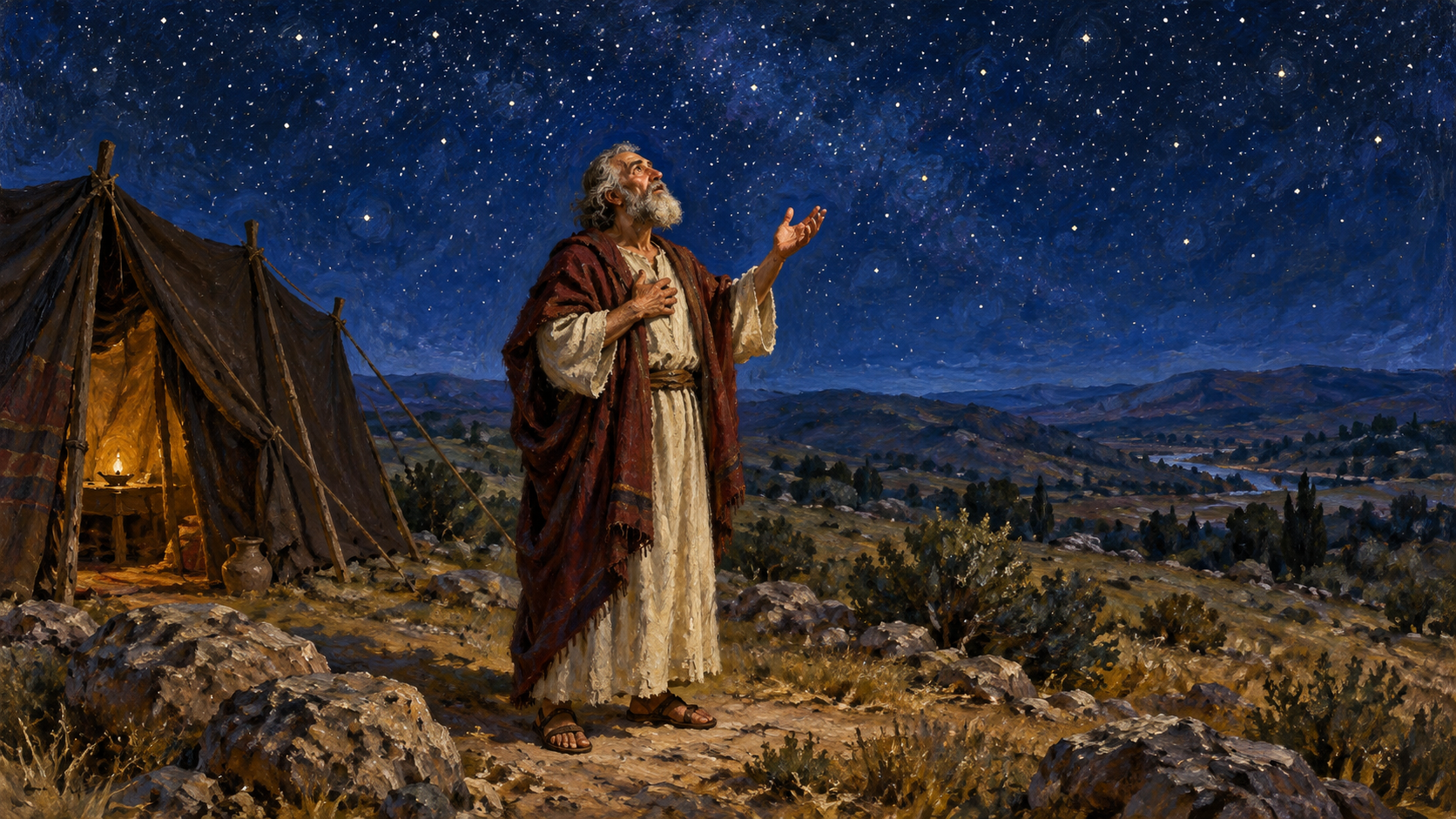
Years passed with no child of promise, and Genesis 15 records Abram bringing his concern to God. What would God give him while he remained childless? The LORD answered by taking him outside to look at the stars.
Then He brought him outside and said, “Look now toward heaven, and count the stars if you are able to number them.” And He said to him, “So shall your descendants be.”
And he believed in the LORD, and He accounted it to him for righteousness.
Genesis 15:6 gives us one of the clearest Old Testament explanations of salvation: Abram believed the LORD, and God counted his faith to him for righteousness. The timing helps me understand what God was doing. Circumcision would not be given until Genesis 17, and the Law through Moses was still centuries away. Paul uses that sequence in Romans 4 and Galatians 3 to explain how a person is counted righteous.
For what does the Scripture say? “Abraham believed God, and it was accounted to him for righteousness.”
Abraham received God’s promise by faith without doing anything to make God owe him righteousness. God counted him righteous when he believed. That helps me understand why faith is not another work by which we earn salvation. The gospel calls us to trust the God who saves through Christ. Neither ceremonies nor obedience to the Law can cause a sinner to be declared righteous before Him, and religious effort or family heritage cannot do it either.
Abraham trusted the LORD who had spoken about the promised descendant, rather than vaguely hoping that life would improve. Our faith in the gospel also rests in someone: the God who raised Jesus from the dead. I am trusting Him to give the salvation Christ accomplished, not treating the strength of my own belief as what saves me.
Genesis 15 then confirms the land promise. Abram asked how he would know he would inherit it, and God told him to bring animals and divide them. In that ancient setting, passing between divided pieces could picture the deadly seriousness of a covenant commitment. Abram fell into a deep sleep, however, and the decisive action belonged to God.
And it came to pass, when the sun went down and it was dark, that behold, there appeared a smoking oven and a burning torch that passed between those pieces.
On the same day the LORD made a covenant with Abram, saying:
“To your descendants I have given this land, from the river of Egypt to the great river, the River Euphrates.”
Abram did not walk between the pieces as an equal partner promising to uphold half the covenant. God bound Himself to His word. That gives me confidence in His promise. Abraham’s obedience still mattered, and not every physical descendant believed. The covenant’s final fulfillment depends on God’s faithfulness, not on our ability to make His promise succeed.
God also told Abram that his descendants would live as strangers and suffer affliction for four hundred years before leaving with great possessions. The iniquity of the Amorites was not yet complete, so Israel would receive the land at God’s appointed time. I see patience as well as justice in that delay. God would give generations of mercy to the people He would later judge; His gift of the land was not random favoritism.
Circumcision Was a Sign, Not the Source of Righteousness
Abram was ninety-nine when God appeared as Almighty God in Genesis 17 and commanded him to walk before Him. God changed his name to Abraham because he would become the father of many nations. Sarai also received a new name, Sarah.
“As for Me, behold, My covenant is with you, and you shall be a father of many nations.
No longer shall your name be called Abram, but your name shall be Abraham; for I have made you a father of many nations.
I will make you exceedingly fruitful; and I will make nations of you, and kings shall come from you.
And I will establish My covenant between Me and you and your descendants after you in their generations, for an everlasting covenant, to be God to you and your descendants after you.”
Genesis 17 calls Canaan an everlasting possession for Abraham’s descendants, repeating the land promise. I do not see a reason to set those words aside when reading about Gentile believers in the New Testament. God can bring salvation to every nation through the Messiah while keeping His promises to Abraham’s physical line.
God also gave Abraham’s household a covenant responsibility. Every male was to receive circumcision as the visible sign in the flesh, and refusal brought exclusion from the covenant people.
This is My covenant which you shall keep, between Me and you and your descendants after you: Every male child among you shall be circumcised;
and you shall be circumcised in the flesh of your foreskins, and it shall be a sign of the covenant between Me and you.
Genesis 15:6 places Abraham’s justification before his circumcision. Romans 4 therefore calls circumcision a sign and seal of the righteousness he already possessed by faith while uncircumcised. The sign testified to his covenant identity; it did not make him righteous. I need to keep that order clear when explaining the gospel, because God counted righteousness through faith before the outward sign was given.
A descendant could bear the covenant sign and still refuse to believe God. Circumcision identified him with the covenant people and brought a real responsibility to obey, but it could not create faith in his heart. That also gives me reason to examine what I expect from a Christian ceremony. The ceremony itself cannot give new life.
Moses called Israel to circumcise their hearts and stop being stiff-necked, and Jeremiah later gave Judah the same call. Outward obedience could not be separated from the heart. Paul explains that true circumcision is inward and of the Spirit, while Colossians 2 connects believers with a circumcision made without hands through union with Christ. Salvation requires the Savior to whom the promises point, not physical circumcision.
The Hebrew word for “Covenant” is בְּרִית (berith), meaning a binding pledge or covenant arrangement. The word translated “sign” is אוֹת (oth), which can refer to a sign or mark, a token or visible pledge. Understanding these words helps us distinguish the covenant from its sign. The same term for sign describes the Noahic rainbow and Cain’s mark, so the passage must tell us what each sign means. Here circumcision is the Abrahamic sign in the flesh, while the rainbow is the Noahic sign in the cloud.
Christ Is the Promised Seed of Worldwide Blessing
The Hebrew word translated “seed” is זֶרַע (zera), and it can refer to offspring as a group or to a representative descendant. That range helps us understand why Genesis often uses it for Abraham’s many descendants, while Paul brings the promise to its final saving focus in one descendant, Christ.
Now to Abraham and his Seed were the promises made. He does not say, “And to seeds,” as of many, but as of one, “And to your Seed,” who is Christ.
Paul is not denying Abraham’s many physical descendants in Galatians 3. Genesis repeats that promise plainly. He is explaining that blessing reaches the nations through the Messiah. Galatians 3:8 says Scripture preached the gospel to Abraham beforehand in the promise, “In you all the nations shall be blessed.”
Through faith in Christ, believers become sons of Abraham and share the blessing of justification and life in Him. I do not need to erase Scripture’s other distinctions to appreciate that inclusion. Gentiles receive Abraham’s blessing because God kept His promise, not because His other promises lost their meaning.
Genesis 22 reaffirms the covenant after Abraham’s faith is tested. God commanded him to offer Isaac, the son of promise, and Abraham obeyed until the Angel of the LORD stopped him. God provided a ram in Isaac’s place. The test did not make Isaac expendable or show that God delights in human sacrifice. It revealed Abraham’s faith while God’s intervention preserved the promised line.
Isaac was the son through whom God had said the promise would continue. That makes Abraham’s test difficult to read: he had to trust that obeying God’s command could not make God’s earlier word fail. The LORD stopped the knife and supplied the sacrifice Himself. His provision preserved Isaac and the covenant line that would continue through him.
By Myself I have sworn, says the LORD, because you have done this thing, and have not withheld your son, your only son,
blessing I will bless you, and multiplying I will multiply your descendants as the stars of the heaven and as the sand which is on the seashore; and your descendants shall possess the gate of their enemies.
In your seed all the nations of the earth shall be blessed, because you have obeyed My voice.
God’s oath confirms what He promised in Genesis 12, 15, and 17, without replacing those promises. Hebrews later points to the oath as assurance that His promise cannot fail: He swore by His own name because there is no one greater. Genesis 22 also helps us understand the coming sacrifice of Christ. God spared Isaac, the beloved son of promise, by supplying a substitute. Jesus, the beloved Son, was not spared at the cross. He willingly gave Himself as the true sacrifice for sin.
I do not need to find a hidden meaning in every detail of Genesis 22 to see its connection to Christ. Abraham obeyed in faith, and God preserved the promised son by supplying a substitute. Those events already help us understand how God’s purpose would be fulfilled in Christ.
The Nations Are Blessed Without Israel Being Erased
Some conclude that Gentile salvation means the church replaces Israel and takes over every Abrahamic promise. I cannot reconcile that reading with everything Genesis says. God promised Abraham physical descendants and a particular land, with kings and nations coming from him. He also promised worldwide blessing through the Seed. Both belong in our understanding of the covenant.
Romans 11 warns Gentile believers not to boast against the natural branches. Paul describes a partial hardening of Israel until the fullness of the Gentiles comes in, then looks forward to God’s mercy toward Israel. He does not speak as though God discarded the nation.
Concerning the gospel they are enemies for your sake, but concerning the election they are beloved for the sake of the fathers.
For the gifts and the calling of God are irrevocable.
Paul’s reference to the fathers includes Abraham, Isaac, and Jacob. His argument depends on God’s continuing faithfulness to them. I want to rejoice that grace includes Gentiles without treating that inclusion as a reason for arrogance. The God who justifies Gentiles through faith will also keep His promises to Israel.
Present unbelief in much of Israel does not mean God has finished with the nation. Romans 11 describes a partial hardening with a limit within His purpose. His faithfulness to Israel should strengthen our confidence in His word and make Gentile believers grateful. It gives us no reason to despise the people connected to the fathers.
Jesus Christ is the Son of Abraham through whom the promised blessing reaches the nations. As the promised Seed, He lived without sin and fulfilled God’s will perfectly, something neither Abraham nor Israel nor the nations could do.
Jesus physically bore the punishment for our sins in His innocent body. His enemies betrayed and mocked Him, then beat and scourged Him before crucifying Him. He shed His blood and died for sinners. After He was buried, He rose bodily from the dead on the third day. The promise to bless every nation is fulfilled through this crucified and risen Messiah.
That if you confess with your mouth the Lord Jesus and believe in your heart that God has raised Him from the dead, you will be saved.
For with the heart one believes unto righteousness, and with the mouth confession is made unto salvation.
For “whoever calls on the name of the LORD shall be saved.”
God counted Abraham righteous when he believed, and sinners today must believe the gospel of Jesus Christ. We receive salvation by grace through faith, without earning it through works or religious effort. Circumcision and law-keeping cannot take the Savior’s place. Neither can national heritage or baptism. The God who made the promise has provided the Savior we need.
Abraham’s long wait for Isaac makes me consider whether I trust God’s word apart from my own timetable. His faith rested on the unchanging character of the One who promised, without forcing Him to work on Abraham’s schedule. Genesis also shows that righteousness was counted before circumcision and before the Law. I cannot turn either into a way of earning what God gave through faith.
Gentile believers have reason for humility, not for boasting over Israel. From the beginning, God promised blessing for all families, so our attention should turn toward those who still need to hear about Christ. The gospel belongs to no single tribe. Christ is to be preached to every nation, and whoever calls on the name of the LORD shall be saved.
For related studies, see A Bible Study on God Keeping His Promise to Abraham, A Complete Bible Study on Faith, A Complete Bible Study on The New Covenant, and A Complete Bible Study on The Gospel.
My Final Thoughts
The Abrahamic Covenant shows us a God who calls by grace and counts righteousness through faith. He keeps His word across generations. We should not shrink His promise until the land and Israel disappear, nor should we miss its saving center in Jesus Christ. The promised Seed has come, and His blood, death, burial, and bodily resurrection bring the blessing of salvation to every nation. I want to trust the God Abraham believed instead of trying to earn what only grace can give. His faithfulness to old promises gives us every reason to rest our hope in the Savior He provided.