
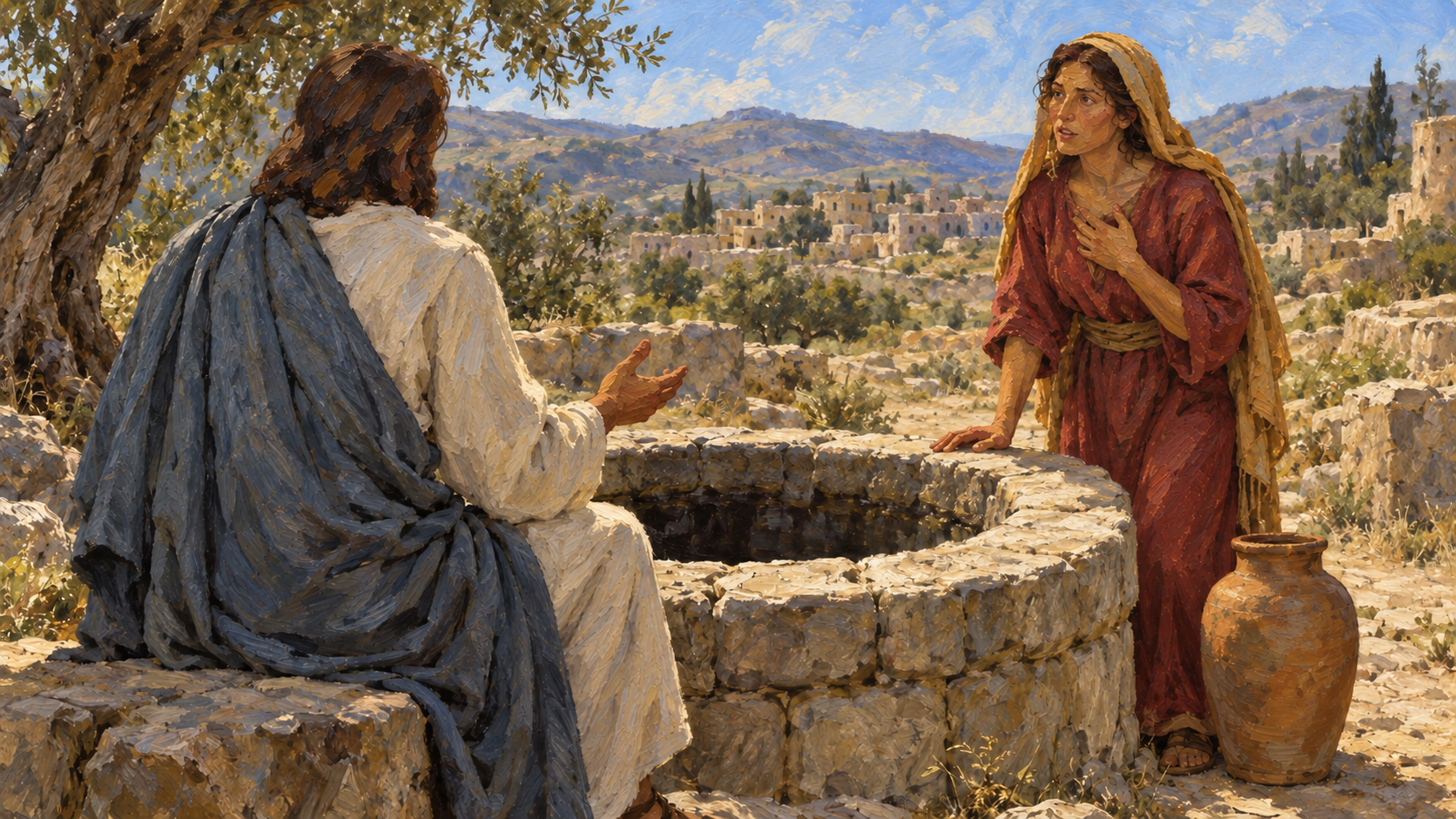
In John 4, Jesus asked a Samaritan woman for a drink, and their conversation soon turned to her life, true worship, and the Messiah. What draws my attention is how He spoke to her. I want to follow that conversation and understand how His kindness and His truth belonged together.
Jesus Meets the Woman at Jacob’s Well
The conversation in John 4 began with physical thirst, but Jesus offered the woman eternal life. He brought her sin into the light before explaining true worship and identifying Himself as the Messiah. He also taught His disciples to recognize a harvest ready before them. By the end of the encounter, Samaritans were confessing Him as the Savior of the world. He had crossed a boundary His contemporaries felt deeply without setting truth aside to show kindness.
We need to pay attention to the woman herself as we read. She was a real Samaritan who asked intelligent questions and found that Christ knew her life completely. She is neither a prop for moral condemnation nor a modern symbol we can detach from the passage. Jesus revealed Himself to her, and she called the people of her city to come and investigate Him for themselves.
Jesus directed each stage of the encounter. He traveled through Samaria and rested at the well, where He asked the woman for water. From there He offered God’s gift and revealed things about her life that a stranger could not have known. He corrected her understanding of worship and told her plainly who He was. After teaching His disciples, He stayed with the Samaritans who asked Him to remain.
I cannot understand this conversation without keeping Jesus’ identity in view. The weary Jewish traveler at the well was also the divine giver of living water. His knowledge of the woman’s history showed prophetic authority, yet He was much more than a prophet. He was the promised Messiah, Israel’s Christ, whom the Samaritans would come to confess as the Savior of the world.
John 3 introduces Nicodemus, a Jewish Pharisee who was a ruler and a recognized teacher of Israel. He came to Jesus at night and learned that his religious standing could not take the place of the new birth. In John 4, a Samaritan woman met Jesus during the day. She learned that neither her inherited worship nor her personal history could supply the living water she needed.
John deliberately places these very different people before us, but I do not want to draw the wrong conclusion from the contrast. Nicodemus’ respected position did not put him beyond grace. Neither did the woman’s life or her community, though they stood outside Jewish respectability. Both needed the Son of God to reveal the truth to them.
Jesus speaks differently to each while giving the same kind of life. He tells Nicodemus about birth from above and tells the woman about living water. Eternal life is God’s gift received through faith in Christ.
The hostility between Jews and Samaritans had developed over centuries. After Solomon’s reign, the kingdom divided and Samaria became the capital of the northern kingdom of Israel. Assyria later conquered that kingdom and deported many of its inhabitants, while people from other lands were settled there. In 2 Kings 17, we read about the mixed worship that followed: people feared the LORD while continuing to serve other gods. In later centuries, Samaritans claimed descent from Israel and received the Pentateuch in their own textual tradition. Their worship centered on Mount Gerizim.
The Jews worshiped in Jerusalem and rejected both the Samaritan sanctuary and the community’s competing claims to Israelite identity. Political conflict and the destruction of sacred places deepened the division. Concerns about purity made the hostility worse, as did each community’s contempt for the other.
John tells us that Jews had no dealings with Samaritans. That helps me understand why the woman was surprised by a request for a drink from her vessel. Religion and ancestry divided the two communities, but the division also affected ordinary contact between people. Even asking for water crossed that boundary.
Samaria lay between Judea and Galilee, so the route was geographically natural even though some travelers took alternatives. John’s wording also fits the Gospel’s repeated emphasis on Jesus carrying out the Father’s appointed work.
I see no need to choose between geography and God’s purpose here. Jesus took a reasonable road through Samaria, and the meeting at the well belonged to His mission. God’s purpose often unfolds in real places through ordinary needs. Fatigue and the need for a meal can be part of it, as can a conversation that seems routine at first. Jesus did not arrive in Samaria by accident, and the Samaritans’ hostility did not put them outside God’s saving concern.
Jesus sat beside the well because the journey had wearied Him. He was truly tired and thirsty. The eternal Word had become flesh and was living a real human life without ceasing to be God.
His request for water was not a pretense. The One through whom all things were made had accepted the ordinary needs of human life, including thirst.
That real humanity also helps us understand His saving death. Wicked men later physically tortured and punished Jesus before killing Him, and He willingly bore that punishment in His innocent body for our sins. He shed His blood and died, then rose bodily from the grave. The Father did not punish or curse Him. Nor did He abandon Jesus, strike or bruise Him, or pour wrath on Him.
Under ordinary Jewish reckoning, the sixth hour was about noon. Jesus was tired in the heat of the day when the woman came to draw water.
Many sermons explain her arrival by saying that respectable women always drew water together in the cooler hours. From that, they conclude that she came alone to avoid public shame. It is a possible explanation, but John does not tell us her motive or say that the community excluded her. He does not describe the usual water-drawing schedule of Sychar’s women either.
The inspired detail tells us when the scene took place. It does not tell us why she came alone. I do not think we should turn a possible explanation into her biography, especially when Jesus will soon reveal the part of her history that John wants us to know.
Jesus Offers Living Water
A woman of Samaria came to draw water. Jesus said to her, "Give Me a drink." For His disciples had gone away into the city to buy food. Then the woman of Samaria said to Him, "How is it that You, being a Jew, ask a drink from me, a Samaritan woman?" For Jews have no dealings with Samaritans. Jesus answered and said to her, "If you knew the gift of God, and who it is who says to you, ‘Give Me a drink,’ you would have asked Him, and He would have given you living water."
Jesus began with a straightforward request for water, and the woman immediately noticed how unusual it was. He was Jewish and she was Samaritan, as her question pointed out. He had crossed an established boundary without beginning with a speech about Samaria.
He did not insult her people or pretend their religious disagreement did not exist. Instead, He turned her attention to what she lacked and the gift God offered. Most of all, she needed to understand who was speaking to her.
Jesus said she would ask Him for living water if she knew God’s gift and recognized who He was. That connection helps me understand the offer: God’s grace comes to us in the person of Christ. Ancestry and a place of worship cannot give eternal life. We cannot obtain it through moral achievement or secret knowledge either.
He was already speaking to someone who could not repay Him. Christ offered grace before she fully understood Him, then patiently led her toward understanding. Faith would require her to face the truth about her condition, but confession could not buy the water. What He offered remained God’s gift from beginning to end.
In ordinary speech, living water meant fresh flowing water from a source such as a spring rather than water stored in a cistern. So the woman’s question about how Jesus could reach it without a vessel was natural. She also wondered whether He was claiming to be greater than Jacob.
Jesus answered and said to her, "Whoever drinks of this water will thirst again, but whoever drinks of the water that I shall give him will never thirst. But the water that I shall give him will become in him a fountain of water springing up into everlasting life."
Water from Jacob’s well could sustain her body for a while, but she would have to come back and drink again. Jesus offered an enduring life that physical water could not give. He was not promising an easier way to do her daily chore, but spiritual life from Him that would never run dry. I also would not read His promise as freedom from bodily need or sorrow. Believers still face temptation and hardship. The promise is an inward fountain springing toward everlasting life.
Jeremiah rebuked Judah for forsaking the LORD, whom he called the fountain of living waters. The people had made broken cisterns that could not hold water. Later, Zechariah looked ahead to living waters flowing from Jerusalem, while Ezekiel saw life spreading wherever the river from the temple went.
Those passages help me hear what Jesus was offering. He was not pointing the woman toward a better religious cistern. He was giving the life associated with God Himself, so His offer carried divine authority.
Later in John’s Gospel, Jesus called the thirsty to come to Him and drink through faith. John explained that He was speaking about the Holy Spirit whom believers would receive. That explanation makes the image’s fulfillment under the new covenant clear.
The verb translated “springing up” can describe leaping or welling upward. It helps us understand that Christ gives active divine life. He is not simply offering a temporary emotional experience or an outward improvement in religion.
Everlasting life begins when a person believes in the Son and reaches its fullness in resurrection life with Him. We do not have immortality by nature; life is God’s gift through Christ. John 7 explains that the living-water promise points to the Holy Spirit, whom believers would receive after Jesus was glorified. The image connects eternal life with the Spirit’s personal presence and work, rather than with a feeling that comes and goes.
Everyone who is truly born again becomes a new creation. The Holy Spirit indwells and seals each believer, making that believer eternally secure. That security never excuses sin, because the same Christ who gives life also brings truth into the open.
Jesus Brings the Woman Into Truth
When the woman asked for the water, Jesus told her to call her husband. He deliberately turned the conversation from the gift she wanted to the truth about her life that she needed to face.
Jesus said to her, "Go, call your husband, and come here." The woman answered and said, "I have no husband." Jesus said to her, "You have well said, ‘I have no husband,’ for you have had five husbands, and the one whom you now have is not your husband; in that you spoke truly."
Her short answer was technically true, and Jesus acknowledged that truth before showing how much more He knew. He knew her past as well as her present condition, though a stranger could not have known those things.
Notice the setting in which He told her this. The disciples were away, and there were no public accusers around her. Jesus was not entertaining a crowd or showing His superiority. He revealed what He knew so that she could recognize Him and turn from sin.
Grace does not require pretending that sin and disorder are harmless, and truth never gives anyone permission to be cruel. Jesus named the issue precisely and acknowledged the truthful part of her answer. Then He continued speaking with her about worship and the Messiah.
People often fear that being fully known would make God turn away. Yet Jesus knew this woman fully and still offered her life. That encourages me because nothing in her life was hidden from Him. His knowledge left no room for hypocrisy, while His grace gave her every reason to come into the light.
John tells us she had five husbands, but he does not explain how those marriages ended. Some may have ended in death and others in divorce. She may have been abandoned, and sin may have been hers or someone else’s. I do not want to assign her a whole moral history when the passage has not given us those details.
Jesus did identify her current relationship as one outside marriage: the man she now had was not her husband. John does not say explicitly that they shared a home, nor does he tell us the man’s marital status or other details of the relationship.
We can recognize a complicated history and a present relationship that was not marriage without filling in what John leaves unsaid. The passage does not assign her all the blame for the five ended marriages or identify the present man’s conduct. I want to keep my teaching within those limits, rather than add speculation that increases her shame.
True Worship in Spirit and Truth
She recognized Jesus as a prophet and asked about the competing places of worship. Some readers see this only as an attempt to avoid conviction. She may have been deflecting, but John does not tell us that was her motive.
A Samaritan who meets a prophet could naturally raise the central dispute between her people and the Jews. She may also be asking sincerely, and more than one motive could be present. I would not dismiss the question when Jesus Himself takes it seriously and gives her a real answer.
Jesus did not let the religious controversy conceal her personal need, but He did not dismiss her theological question either. She needed to know who God is and how He had revealed Himself in history. She also needed an answer about where worship belonged and how the coming hour would change that.
The Samaritans regarded Mount Gerizim as the chosen sanctuary and shaped their tradition of the Pentateuch around that claim. The Jews worshiped at Jerusalem’s temple according to the Davidic covenant and the history recorded in the Prophets.
Jesus did not tell her that sincerity made both places equally valid. He said Samaritan worship lacked full knowledge, while Jewish worship stood within God’s revealed work of salvation in history.
Then He announced a change that neither side could control. Worship would no longer belong exclusively to Gerizim or Jerusalem, because the Messiah was bringing the promised fulfillment.
God had entrusted His covenants and law to Israel. The prophetic promises and the history of the temple also belonged to that nation. Jesus was born from Israel according to the flesh as David’s promised Son, and His apostles and the first witnesses of His resurrection were Jewish.
The words “Salvation is of the Jews” identify the people through whom God had given revelation and brought the Messiah. Jesus was not boasting about ethnicity or giving permission for hatred. The Jewish Messiah was offering life to a Samaritan, and soon the Samaritans would confess Him as Savior of the world.
Christian faith cannot detach Jesus from Israel’s Scriptures and promises. It also cannot limit His genuine saving offer to one people.
Jesus said to her, "Woman, believe Me, the hour is coming when you will neither on this mountain, nor in Jerusalem, worship the Father. You worship what you do not know; we know what we worship, for salvation is of the Jews. But the hour is coming, and now is, when the true worshipers will worship the Father in spirit and truth; for the Father is seeking such to worship Him. God is Spirit, and those who worship Him must worship in spirit and truth."
The word “coming” looks ahead to the change Christ would establish through His death and bodily resurrection. After ascending to the Father, He would give the Holy Spirit to believers. But He also said “now is” because the promised reality had already begun to appear. The Messiah was there, speaking to her at the well.
The temple in Jerusalem was still standing, but the One greater than the temple had arrived. Access to the Father would center on Christ rather than depend on a pilgrimage to a mountain.
Jesus was explaining God’s nature. A material sanctuary cannot contain God, and access to a particular place cannot give us control over Him. No physical image can adequately represent Him. He is the living, personal God whose nature is Spirit, and He remains invisible to human sight.
Being Spirit does not make God an impersonal force. The Father seeks worshipers and speaks to His people, whom He knows and loves. He acts according to His will and sends the Son. The Holy Spirit is also personal and fully divine. God eternally exists as three coequal Persons.
The eternal Son truly took flesh without ceasing to share the divine nature. His incarnation allows people to see the Father’s glory revealed personally while God remains Spirit.
Worship in spirit is inwardly real and enabled by God’s Spirit, so it cannot be reduced to a performance of outward rituals. Worship in truth agrees with what God has revealed and centers on Christ, who is the truth.
I can be sincere and still be wrong about worship, just as I can say the right words without turning my heart toward God. The Father seeks worshipers whose inward response agrees with the truth they confess.
The Greek verb translated worship is proskyneo, which often describes bowing in reverence. Here it helps us see that worship honors the Father according to His nature and what He has revealed. The emphasis is not on a preferred emotional style.
Jesus Reveals Himself as Messiah
The woman said to Him, "I know that Messiah is coming" (who is called Christ). "When He comes, He will tell us all things." Jesus said to her, "I who speak to you am He."
The Samaritans’ expectation drew especially on Moses and their hope for a coming prophet. Jesus brought the conversation to His own identity rather than leaving her with a vague spiritual experience.
The One offering her living water was the same One who knew her history. He taught her about true worship and then revealed that He was the promised Messiah. That helps me keep the offer of life personal: Christianity is faith in Him, not a method for satisfying spiritual thirst apart from Him.
The Woman’s Testimony and the Samaritan Harvest
The woman then left her waterpot, went her way into the city, and said to the men, "Come, see a Man who told me all things that I ever did. Could this be the Christ?" Then they went out of the city and came to Him.
Leaving the jar explains her immediate movement and may show urgency. John never says that it symbolizes abandoning her old life. I would not turn a vivid detail into a required allegory when the passage does not interpret it that way.
Her invitation is simple and appropriately modest. She reports Christ’s supernatural knowledge and asks the city to consider whether He is the Messiah. She does not pretend to possess mature understanding.
The people left the city and came toward Jesus. Her understanding was still new, but she had pointed them to the One they would need to hear for themselves.
After the disciples returned and the woman left, they were still thinking about food while she was bringing people from the city. Jesus used the contrast to explain what satisfied Him more deeply: doing the Father’s will and completing His work.
Jesus said to them, "My food is to do the will of Him who sent Me, and to finish His work. Do you not say, ‘There are still four months and then comes the harvest’? Behold, I say to you, lift up your eyes and look at the fields, for they are already white for harvest! And he who reaps receives wages, and gathers fruit for eternal life, that both he who sows and he who reaps may rejoice together. For in this the saying is true: ‘One sows and another reaps.’ I sent you to reap that for which you have not labored; others have labored, and you have entered into their labors."
The disciples had been amazed that Jesus was speaking with a woman, though none of them openly challenged Him. Their surprise helps me understand why they needed the lesson about the harvest. The approaching Samaritans likely supplied the visible setting for His command to lift their eyes. People they might have overlooked were ready to hear.
God lets His servants share the work of sowing and reaping. Someone may prepare the ground before another person gathers the harvest, but both can rejoice in what God has done. That gives me no reason to compete for recognition or use evangelism to build a personal empire.
And many of the Samaritans of that city believed in Him because of the word of the woman who testified, "He told me all that I ever did." So when the Samaritans had come to Him, they urged Him to stay with them; and He stayed there two days. And many more believed because of His own word. Then they said to the woman, "Now we believe, not because of what you said, for we ourselves have heard Him and we know that this is indeed the Christ, the Savior of the world."
John honors both stages of their response. Many believed because of the woman’s testimony, and more believed because they heard Jesus during the two days He stayed. Her witness had genuine value, and it led people to Christ’s own word. They did more than share her excitement. They listened to Jesus and considered His words, reaching a conviction about Him for themselves.
Our testimony should tell the truth about what Jesus has done and keep the attention on Him. This woman did not dramatize the details or present herself as perfect. She invited people to come and investigate Christ for themselves, which is what I want my own witness to do.
When the Samaritans called Jesus the Savior of the world, they were saying more than that He had come for Sychar or even all Samaria. Their confession looked beyond Israel to the nations. He is the promised Jewish Messiah whose saving mission extends to the whole world. This encounter anticipates what happened later in Acts 8, when the Samaritans received the message about Christ and the apostles witnessed the Holy Spirit’s work among them.
Christ died for every person, and God’s offer of salvation is genuine, though people can resist and reject it. Everyone who repents and believes in the Son receives everlasting life by grace, apart from works. That person is truly born again, and the Holy Spirit comes to indwell and seal the believer. The new life is eternally secure because of His work. This security never gives permission for lawlessness. The life Christ gives begins to change how the believer walks.
The Samaritans confessed the Christ after He corrected their worship and revealed Himself. They were not accepting a generic teacher who approved every tradition. His mission to the whole world does not weaken exclusive truth. It brings the one Savior to every people.
Jesus began with a real person and an ordinary need. He listened to her questions and answered them, patiently leading her toward the truth when she misunderstood. He addressed her sin before explaining true worship and revealing Himself as the Messiah. The conversation has a clear purpose, but it never sounds mechanical.
The way Jesus spoke with her should make me examine any prejudice that decides beforehand who might respond to the gospel. A person’s ancestry or reputation does not put that sinner beyond His offer. Nor does being a man or a woman change the invitation. Broken relationships and religious confusion cannot place someone beyond its reach either.
His kindness also challenges me to speak truthfully. Jesus corrected the errors in Samaritan worship and explained that salvation came through the Jewish people. He brought the woman’s present condition into the open instead of leaving it concealed. If kindness hides that truth, it fails to reflect the grace that calls people out of darkness and into life.
We want people to hear Christ and believe in Him. Winning a cultural argument or collecting a dramatic testimony is not the purpose. Those who receive His life can worship the Father in spirit and truth, then share in His harvest with the humility of servants who know that God gives the increase.
My Final Thoughts
John 4 leaves me encouraged by the way Jesus speaks to this woman. He knows her life fully and tells her the truth, yet He is the One who offers her living water and plainly reveals Himself as Messiah. Her neighbors then hear Him for themselves and confess that He is the Savior of the world. A painful history or a cultural boundary cannot place someone beyond His invitation to come and believe. We should bring people to the same Christ and let them hear His word.