
Who are the 144,000 in Revelation, and what does the book say they do? They appear in two main scenes, both of which give us details about them. I want to understand those details without filling the gaps with familiar claims that go beyond what John wrote.
A Literal Sealed Remnant From Israel
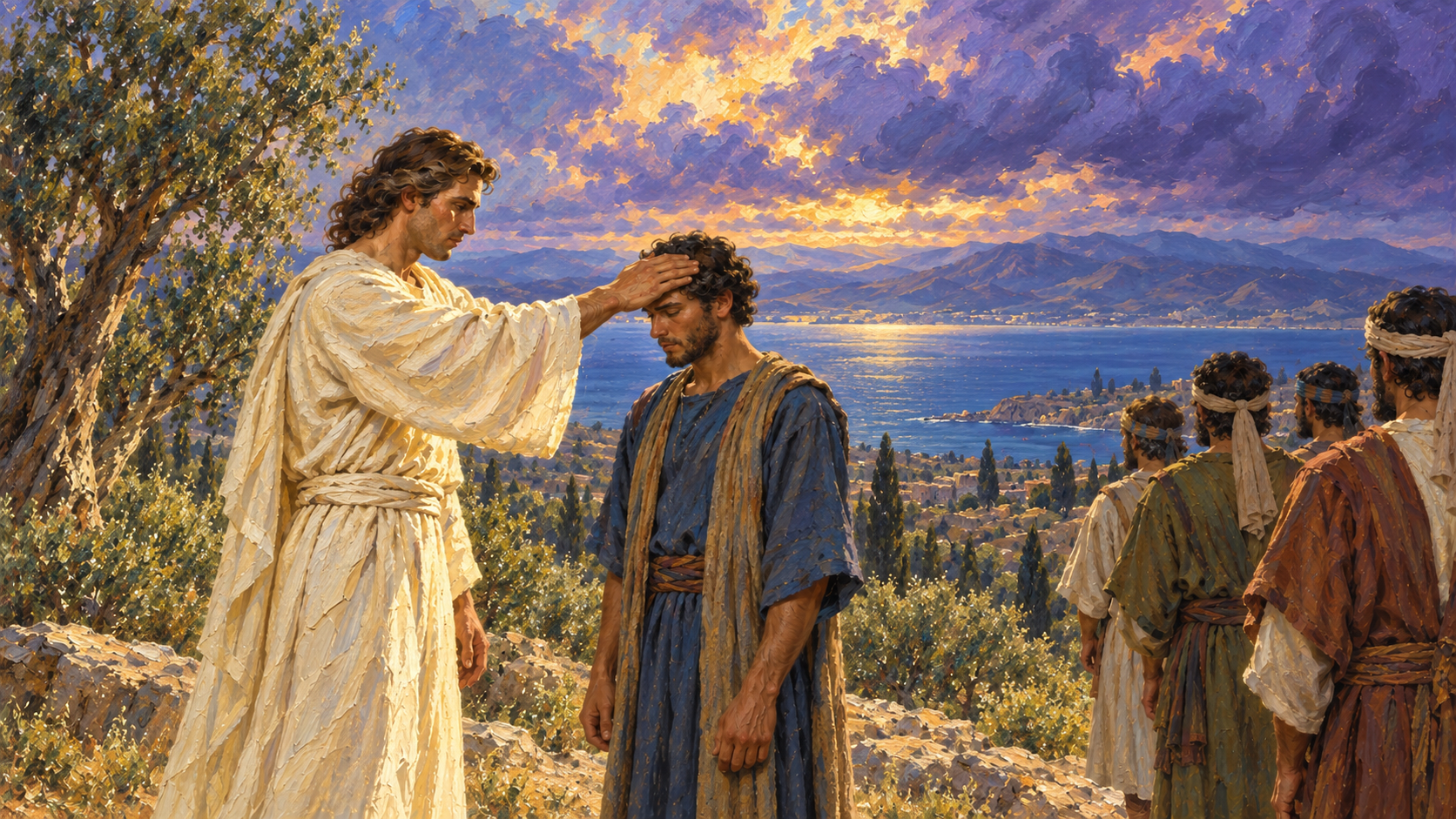
Revelation 7 introduces the 144,000 as God’s servants from the tribes of the children of Israel. Revelation 14 shows that same number standing with the Lamb, with the Father’s name on their foreheads. They sing a song no one else can learn and are called firstfruits to God and to the Lamb.
Some readers understand this group symbolically because Revelation uses vivid prophetic language. Others describe an elaborate system of Tribulation evangelism built around them. Before accepting either claim, I need to account for the details John gives. He hears a precise number and is told these servants come from Israel, with a count for each tribe. Revelation tells us much about who they are and how they are set apart for God, but it never explicitly calls them the chief evangelists of the Tribulation.
I understand Revelation as future prophecy, with the church gathered before a literal seven-year Tribulation. National Israel still has a future in God’s plan, and Christ will return bodily to reign for a literal thousand years. That is how I approach Revelation 7. God is preserving and using a numbered remnant from Israel during the final period of judgment before the kingdom. The chapter does not replace Israel with the church.
After these things I saw four angels standing at the four corners of the earth, holding the four winds of the earth, that the wind should not blow on the earth, on the sea, or on any tree.
saying, “Do not harm the earth, the sea, or the trees till we have sealed the servants of our God on their foreheads.” And I heard the number of those who were sealed. One hundred and forty-four thousand of all the tribes of the children of Israel were sealed.
Notice when the sealing happens: judgment is restrained until God’s servants have been marked. The command names the earth and sea along with the trees, and the first trumpet later brings harm to the earth and trees. God seals these servants before that wave of judgment moves forward.
John identifies the servants as “of all the tribes of the children of Israel.” He does not call them “spiritual Israel” or “the church.” He gives a precise total and then says that twelve thousand come from each named tribe. I find that detailed accounting difficult to explain if no actual counted group is intended. A symbolic reading has to account for both the total and the tribal numbers. The most natural reading is that these are a literal numbered remnant from Israel.
Recognizing Israel here does not diminish Gentile believers. In the same chapter, a great multitude from every nation stands before the throne and the Lamb. God keeps His promises to Israel while saving that multitude through the Lamb’s blood. Recognizing either truth does not require us to set aside the other.
The Tribal List and the Protective Seal
The tribal list differs from some other lists in Scripture, but that alone does not make it symbolic. Biblical lists arrange the tribes differently according to their purpose. Here we need to consider the list God gives for this particular scene, where each named tribe contributes twelve thousand servants.
Judah comes first, fitting the prominence of the Messiah’s tribe. Revelation has already called Jesus the Lion of the tribe of Judah. Levi is included here even though land-inheritance lists treat that tribe differently. Joseph and Manasseh appear as separate entries, while Ephraim does not appear under his own name.
Dan’s absence from Revelation 7 does not mean God has permanently erased the tribe. Ezekiel 48 includes Dan in Israel’s future land allotment. Some suggest that the omission in Revelation relates to Dan’s idolatry in Judges 18 and 1 Kings 12. That may be relevant, but John does not give us a reason. I can acknowledge the possible connection without presenting it as something Revelation explains.
Ezekiel 48:1-2 places Dan in the restored land arrangement, and verse 32 even names a gate for the tribe. I cannot turn the omission in Revelation into permanent rejection when Ezekiel is so specific about Dan’s future.
The names in this list also give me reason to reject replacement theology. A detailed count of Israel’s tribes would be a strange way to describe an unnamed, spiritualized church. God is showing that Israel remains part of His prophetic purposes.
The seal is more than a label. Revelation 9 shows that it sets a boundary during judgment.
They were commanded not to harm the grass of the earth, or any green thing, or any tree, but only those men who do not have the seal of God on their foreheads.
The demonic locusts of the fifth trumpet may harm only people who lack God’s seal. God marks these servants as His own and protects them for His appointed purpose. We see a similar pattern in Ezekiel 9, where people who sigh and cry over Jerusalem’s abominations receive a mark on their foreheads and are spared in judgment. Revelation does not repeat every part of that scene, but both passages show God distinguishing His own while judgment takes place.
I also need to distinguish this mark from the church’s sealing with the Holy Spirit in Ephesians 1:13 and Ephesians 4:30. Both express God’s ownership and security, but they occur in different settings. Revelation 7 describes an end-time mark on His servants’ foreheads during judgment. That setting tells us how this seal functions, so a shared word does not make the two passages describe the same thing.
Revelation shows harm being held back while God’s servants are sealed on earth. Later, during the fifth trumpet, that seal protects them from the locusts’ torment. We then see the 144,000 with the Lamb in another vision, bearing the Father’s name and singing before the throne. I can follow that sequence without claiming to know every transition between the scenes, because John does not describe them all.
The Great Multitude Is a Different Group
After John hears the numbered servants from Israel, he sees a second scene.
After these things I looked, and behold, a great multitude which no one could number, of all nations, tribes, peoples, and tongues, standing before the throne and before the Lamb.
These are the ones who come out of the great tribulation, and washed their robes and made them white in the blood of the Lamb.
The differences between the two scenes help me see why Revelation does not merge these groups. Israel’s servants are counted by tribe and sealed on earth. The other multitude is beyond counting and includes every nation, tribe, people, and tongue. That second scene shows them worshiping before the throne.
Some teachers say the great multitude is the result of the 144,000 evangelizing. I would have to label that an inference, because Revelation does not say it. We are shown God sealing the 144,000 and saving a vast multitude out of the great Tribulation, but the multitude’s salvation is explicitly connected to the blood of the Lamb. The passage does not attribute it to a particular group of human evangelists.
John sometimes hears something and then sees it described in another way elsewhere in Revelation. Even so, I cannot set aside the identifiers given here. Israel is counted by tribe, while the international multitude is beyond counting. I believe the natural conclusion is that this chapter shows God remaining faithful to Israel and extending mercy to the nations.
These two groups also show why the 144,000 cannot represent every saved person. Revelation describes far more redeemed people than that numbered company. Nor can the Jehovah’s Witness teaching that only 144,000 form a special heavenly class account for what John sees. He distinguishes the numbered Israelites from the innumerable redeemed multitude worshiping before the throne.
With the Lamb, Redeemed and Consecrated
Revelation 14 gives another view of the same numbered group.
Then I looked, and behold, a Lamb standing on Mount Zion, and with Him one hundred and forty-four thousand, having His Father’s name written on their foreheads.
They sang as it were a new song before the throne, before the four living creatures, and the elders; and no one could learn that song except the hundred and forty-four thousand who were redeemed from the earth.
The 144,000 now stand with the Lamb, and the Father’s name on their foreheads recalls their earlier sealing. They sing their unique song before the throne in the presence of the four living creatures and the elders. Having shown their protection during earthly judgment, Revelation now lets us see them worshiping with the Lamb.
There are different understandings of Mount Zion in this vision. Hebrews 12:22 speaks of heavenly Mount Zion, and I think the throne language in Revelation 14 points strongly to a heavenly scene. Others read it as a prophetic preview of the Lamb’s earthly kingdom from Zion. What the text certainly gives us is worship before the throne. It shows these servants sealed on earth in chapter 7 and later with the Lamb in chapter 14, without explaining every movement between those scenes.
These are the ones who were not defiled with women, for they are virgins. These are the ones who follow the Lamb wherever He goes. These were redeemed from among men, being firstfruits to God and to the Lamb. And in their mouth was found no deceit, for they are without fault before the throne of God.
Revelation describes these people by their devotion to the Lamb. They are virgins who have not been defiled with women, and they follow Him wherever He goes. They have been redeemed from among men and stand without fault before God’s throne, with no deceit in their mouths. What draws my attention is how completely they belong to the One they follow.
Some understand the virgin language literally, as male celibacy during a unique end-time calling. Others read it as prophetic language for purity in contrast with spiritual harlotry and compromise. The words “not defiled with women” give me strong reason to take the literal reading unless the context requires symbolism. Either way, they plainly belong wholly to the Lamb in a defiled world.
Calling them firstfruits to God and to the Lamb identifies them as a dedicated first portion that belongs to Him and points toward more to come. It tells us that they are set apart for God and have a place of priority within His covenant faithfulness. But Revelation does not explain every detail of the harvest. I would go beyond the text if I built a complete system from those unstated details.
What Revelation Actually Says They Do
The claim that the 144,000 are the chief evangelists of the Tribulation needs more support than Revelation gives it. God seals and protects them, and later we see these redeemed servants with the Lamb. The book calls them firstfruits and describes their purity and truthfulness. Yet it does not say that they preach.
And I will give power to my two witnesses, and they will prophesy one thousand two hundred and sixty days, clothed in sackcloth.
Then I saw another angel flying in the midst of heaven, having the everlasting gospel to preach to those who dwell on the earth–to every nation, tribe, tongue, and people.
Revelation explicitly describes the two witnesses prophesying and an angel bringing the everlasting gospel to the earth during this period. So gospel witness is clearly present in the Tribulation. The book simply does not assign that preaching role to the 144,000. They may participate in witness, but a possibility is different from a statement that they are the primary evangelists. I cannot teach that as Revelation’s explicit claim.
That is the kind of restraint I need when studying prophecy. I want to receive every detail God gives, while making sure my conclusions are no stronger than Scripture’s evidence. A reasonable possibility still should not be presented as revealed certainty.
I also do not want questions about the 144,000 to draw our attention away from the gospel. Revelation 7 says the multitude made their robes white in the Lamb’s blood. Revelation 14 calls the 144,000 redeemed and places them with the Lamb. Both scenes direct us to Jesus Christ, because every person saved in Revelation is saved through Him.
Jesus is the eternal Son, fully God and fully man. He was born of a virgin and remained completely sinless, yet wicked men physically tortured and punished Him before killing Him. He willingly bore that real punishment for our sins in His innocent body and shed His blood when He died. After His burial, He rose bodily. The Father did not abandon or curse the Son. He did not punish, strike, or bruise Him, nor did He pour wrath on Him. The triune God remained united in the saving purpose.
Christ died for the whole world, so the gospel is genuinely offered to all. Those who repent and believe receive forgiveness and are born again. The Holy Spirit indwells and seals them, and they are eternally secure in Christ. I do not want the terrible judgments in Revelation to obscure the Lamb’s victory. Even during the final conflict, God marks these servants as His own and receives their holy worship, while preserving the future He has promised Israel.
For further study, see The Twelve Tribes of Israel, The End Times Timeline, and The Seven Trumpets of Revelation. The studies on The Ten Horns in Daniel and Revelation, The Pre-Tribulation Rapture, and Wormwood in Revelation develop the larger prophetic setting.
My Final Thoughts
After following both scenes, I believe the simplest reading is also the strongest: the 144,000 are literal servants from Israel whom God seals during the Tribulation and later shows with the Lamb. Revelation gives us good reasons to reject replacement theology and the idea that this number includes every saved person. It also teaches us to be humble about what they do, because the book never explicitly calls them the chief evangelists. The Lamb remains the main figure in both chapters. They are redeemed by His blood and find their hope in His presence. His victory assures us that God will remain faithful to Israel and to every promise He has made.