
Wormwood appears in Revelation as the name of a star whose fall turns water bitter and brings death. The severity of the image has produced many guesses, but I think we should let Revelation 8 speak before attaching it to a modern theory. The Old Testament background then helps us understand the warning without making the prophecy less literal.
Wormwood in the Trumpet Sequence
The seven trumpets in Revelation 8 sound like solemn alarms over the earth. Each announces a judgment under God’s authority, so I don’t read these events as a series of random disasters. The Lamb who opens the seals is never surprised by what happens, and the angels sound their trumpets at God’s direction.
To place Wormwood in that sequence, we need to begin with the scroll in Revelation 5. Jesus Christ, the Lamb, is the only One worthy to open it. Judgments unfold as He opens its seven seals in chapters 6 through 8. The seventh seal leads into the seven trumpets, with Wormwood appearing at the third trumpet and more severe judgments still to come. This places it within the future seven-year Tribulation. We cannot detach it from that order and match it to any bitter event in history.
The first four trumpets affect the major realms of created life, beginning with the land and its vegetation. Judgment then reaches the sea, followed by rivers and springs, before the fourth trumpet affects the heavenly lights. The repeated limit of one third shows that these devastating judgments do not yet bring creation to its complete end.
I would not take that limit to mean the judgments are small. The first trumpet burns a third of the trees and all the green grass. At the second, a third of the sea becomes blood, killing a third of its creatures and destroying a third of its ships. A third of the freshwater becomes bitter at the third trumpet, and a third of the heavenly lights are darkened at the fourth. None of this offers comfort to rebellion, but the restraint leaves survivors who can recognize God’s warning and repent.
God can judge decisively while still warning people before the final reckoning. He can strike without exhausting His patience, and people’s response exposes what is in their hearts. The trumpets follow that pattern: the holy God who rules the earth gives ordered warnings rather than leaving the world in meaningless chaos.
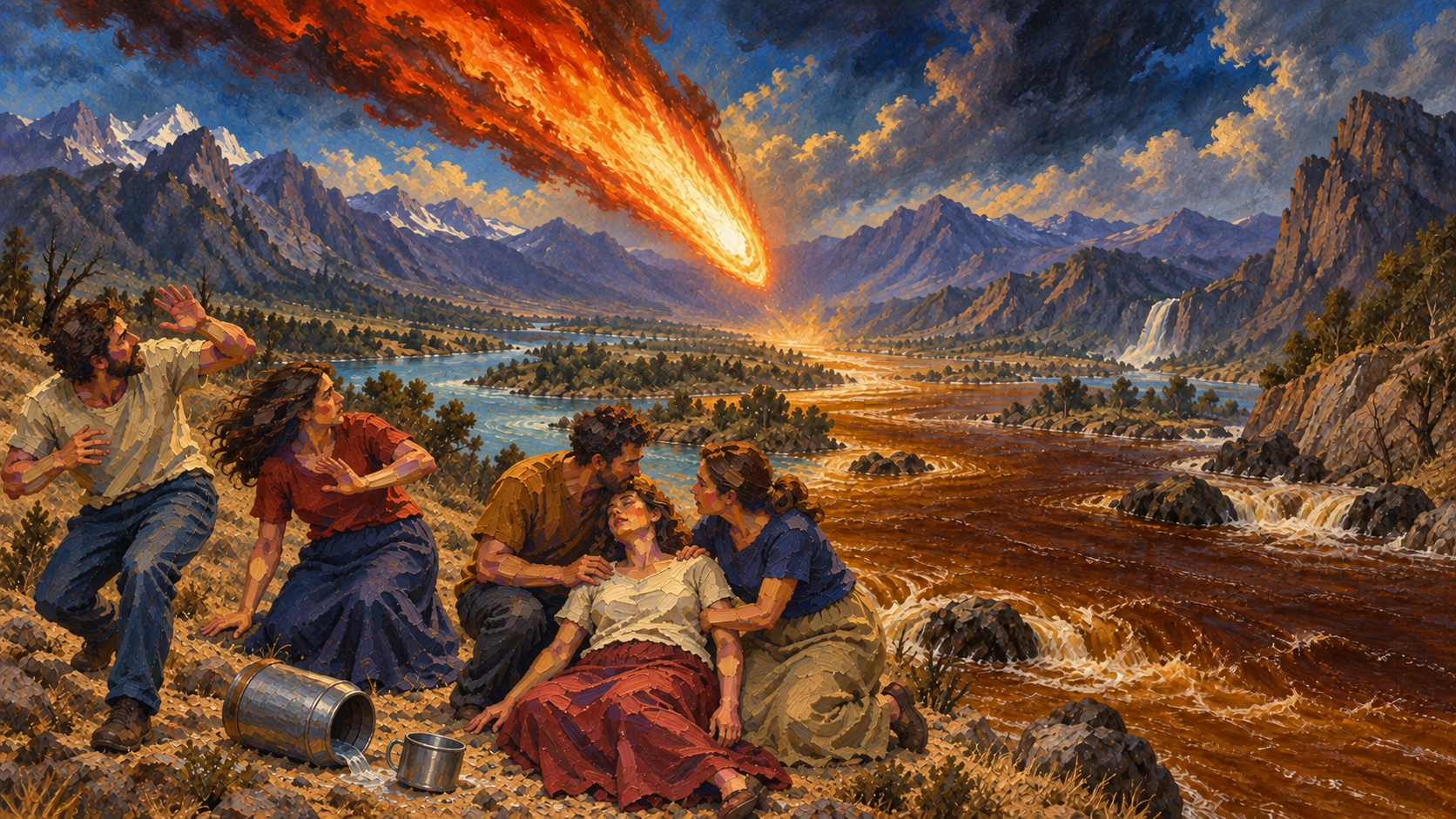
When the third angel sounds, John sees a great star fall from heaven, burning like a torch. It strikes a third of the rivers and springs, making the water so bitter that many people die from it. John names the star Wormwood, a name that describes what happens to those waters.
Then the third angel sounded: And a great star fell from heaven, burning like a torch, and it fell on a third of the rivers and on the springs of water. The name of the star is Wormwood. A third of the waters became wormwood, and many men died from the water, because it was made bitter.
What keeps me from reading this as only an image of spiritual trouble is the effect on the water. The blazing star strikes rivers and springs that people need for life, and drinking the changed water kills them. Revelation’s signs point to actual realities, and this judgment reaches into the physical world.
When the NKJV says that “many men died,” it uses men to mean human beings, not only adult males. Likewise, bitter describes more than an unpleasant taste. John says the changed water causes death, so whatever physical process God uses, the result is lethal.
John describes the star as burning like a torch to help us understand its appearance and effect. That comparison does not give me enough to classify it as an asteroid or a comet. A meteor or another physical mechanism could be involved, but I would be going beyond the text to give it a confident scientific label. What John does tell us is that God uses this blazing heavenly judgment to strike freshwater.
John describes rivers and springs being struck, rather than damage to a single lake, but he does not name the affected rivers or connect them to a modern nation. We are told that one third of these freshwater sources are affected. That is a vast crisis for ordinary life without our supplying a map Scripture never gives us.
Since Revelation uses stars to represent angels elsewhere, I understand why some readers ask whether this star could be an angelic being. But in Revelation 8:10-11, John does not describe someone speaking or leading an army. The star receives no key and opens no pit. I need to let the details here guide my reading: its impact on the waters and the deaths of people who drink them.
John also gives the star a name. Names often carry meaning in Scripture, and Revelation uses them along with its images to help us understand what John sees. Calling this star Wormwood tells us something about the bitterness of the judgment.
The Greek apsinthos in Revelation 8 is the ordinary word for the bitter plant called wormwood, while the Old Testament Hebrew word often translated wormwood is la’anah. Knowing those words helps us recognize the plant’s bitterness behind the passages. But to understand the warning, we need to see how Scripture uses that bitterness to describe the poisoned consequences of turning from the Lord and the sorrow of judgment.
God could have shown John bitter waters without naming the star, or given it another name. Instead, Wormwood directs us back to language already used in Scripture. I don’t need to treat it as a mysterious word with no explanation when the Bible connects its bitterness with the bitter fruit of rebellion.
I would not use that connection to call every hard season in someone’s life wormwood or pronounce it a direct judgment. Scripture does not let us draw careless conclusions about everyone who suffers. Revelation 8 concerns a particular future trumpet judgment, and its name connects that event with the Bible’s teaching about rebellion. The God who gives living water also has authority to turn water bitter when the world persists in rejecting Him.
Wormwood’s Old Testament Background
In Deuteronomy, Moses warned Israel against turning from the Lord to serve the gods of the nations. He described that rebellion as a root bearing bitterness or wormwood, giving us one of the clearest backgrounds for the name.
so that there may not be among you man or woman or family or tribe, whose heart turns away today from the LORD our God, to go and serve the gods of these nations, and that there may not be among you a root bearing bitterness or wormwood;
The root helps me understand why Moses’ warning reaches beyond an outward act. Roots can grow underground long before fruit appears, and idolatry often develops in much the same way. A heart turns from God, then a person’s life begins to adjust around that choice. Excuses accumulate until the poisonous effects become visible. What may be hidden is not merely a private preference: rebellion against the Lord eventually harms the whole community.
Jeremiah described people who had forsaken God’s law and refused to obey His voice. Following their own desires had led them to serve the Baals. In answer to that rebellion, the Lord said He would give them bitter food and water.
And the LORD said, “Because they have forsaken My law which I set before them, and have not obeyed My voice, nor walked according to it, but they have walked according to the dictates of their own hearts and after the Baals, which their fathers taught them,” therefore thus says the LORD of hosts, the God of Israel: “Behold, I will feed them, this people, with wormwood, and give them water of gall to drink.”
Here I can see that wormwood is not describing random pain. These people had rejected God’s Word and broken covenant with Him by choosing idolatry. The bitter water would reverse a blessing they had despised, making those who refused His instruction taste the consequences of their rebellion.
Lamentations speaks from within the grief of Jerusalem’s devastation after the city has fallen under judgment. Its language gives voice to deep sorrow and affliction through the image of bitterness.
He has filled me with bitterness, He has made me drink wormwood.
With those passages in mind, Wormwood in Revelation 8 no longer seems like an isolated image. Scripture has already used it for the bitter consequences of judgment and the sorrow of finding that rebellion cannot deliver what it promises. Sin may offer freedom and satisfaction, but the pain that follows exposes what those promises hid.
That background also helps me understand the severity of judgment reaching the water itself. The previous trumpet has affected the sea; now the third reaches the rivers and springs people draw from every day. Freshwater sustains ordinary life, so losing its use is far more than losing a luxury.
Scripture often presents water as God’s merciful provision. He opened Hagar’s eyes to a well in the wilderness and gave Israel water from the rock. Later, the prophets described restoration through images of flowing water. Jesus offers living water, and Revelation ends beside the river of the water of life. Against that background, I see how severe the third trumpet is: what is associated with cleansing and life becomes a means of death.
In Revelation 8:11, people die because the water is bitter, not because it has disappeared. They can see it before them but cannot safely drink it. God has struck an ordinary gift they depend on to live.
The name Wormwood also fits the world’s rejection of the Lord as the true source of life. People who turn from Him encounter bitterness in the very waters where they expected to find survival. That moral connection does not make the event any less physical. The judgment on the water reveals the world’s spiritual condition.
The plague on Egypt’s waters gives us an earlier example of God judging in this way. Pharaoh hardened himself against the Lord and refused His command, so God struck the Nile. The river that sustained Egypt became blood, its fish died, and the water stank until the Egyptians could no longer drink it. Revelation’s judgments often echo such earlier acts recorded in Scripture.
And Moses and Aaron did so, just as the LORD commanded. So he lifted up the rod and struck the waters that were in the river, in the sight of Pharaoh and in the sight of his servants. And all the waters that were in the river were turned to blood. The fish that were in the river died, the river stank, and the Egyptians could not drink the water of the river. So there was blood throughout all the land of Egypt.
I see a common pattern here without making Revelation 8 a repeat of the Nile plague in the same setting. In Exodus, God judged Egypt while delivering Israel from slavery; Revelation describes future judgments during the Tribulation. In both, God confronts defiance by striking the water people depend on. False gods cannot help them, and creation remains subject to its Maker.
Egypt’s water did not change by accident and acquire a religious explanation afterward. The Lord commanded that judgment. He also directs the trumpet judgments, with angels sounding them as the sequence unfolds under heaven’s authority. The God who judged Egypt still judges the world.
That makes me think about how easily technological confidence can hide our dependence on God. We can study rivers and test water, as well as build complex systems and describe physical processes. Yet a wealthy nation still needs water, and a scientific culture still depends on its Creator’s mercy. Understanding creation does not make us its owners or prevent the Lord from touching what we assume is stable.
Warning, Repentance, and Careful Interpretation
I might expect undeniable judgment to make repentance seem the obvious response. Revelation gives me reason to question that confidence in the human heart. After further trumpet plagues, many survivors still refuse to repent.
But the rest of mankind, who were not killed by these plagues, did not repent of the works of their hands, that they should not worship demons, and idols of gold, silver, brass, stone, and wood, which can neither see nor hear nor walk. And they did not repent of their murders or their sorceries or their sexual immorality or their thefts.
These people survive the plagues without giving up their idols. Even as the world around them loses its stability, they keep defending sin. More information alone will not solve that problem, and suffering does not compel them to receive the Lord. Revelation exposes rebellion that can persist even through judgment.
Yet the survivors in Revelation 9 also show us mercy within the warning. They are still alive and accountable for how they respond to God. His warnings call them to leave their idols and turn from violence, not simply study the plagues out of curiosity. The demand to repent includes sorcery, sexual immorality, and theft, and extends to every form of rebellion against Him.
That leaves no basis for assuming, “I will repent when the end-time alarms become undeniable.” Refusing Christ today does not prepare a heart to receive Him more readily tomorrow. Delay gives sin time to train the conscience and harden the heart, so the response we need now is to come to Christ while He offers mercy.
The gospel stands at the center of that response. Jesus Christ is the eternal Son of God who became fully man without ceasing to be fully God. He lived without sin. Wicked men tortured and crucified Him, but He willingly bore the punishment for our sins in His innocent body. He shed His blood and died before rising bodily from the dead. The Father and Son remained united in this saving work. God’s offer of salvation is genuine, but a person may resist and reject it. Everyone who repents and believes in Christ is forgiven and receives everlasting life. Revelation’s warnings should drive sinners to the Savior rather than to speculation.
Wormwood’s vivid image can draw me into speculation unless I keep both of the passage’s limits in view. I cannot remove its physical reality, and I cannot fill in details God has not revealed. Following the text means accepting what it says and stopping where it stops.
So when I read Revelation 8:10-11, I take seriously the affected water sources and the deaths of those who drink from them. Those effects prevent me from making Wormwood only a spiritual metaphor. They do not, however, identify a known asteroid or give the falling star a modern scientific classification.
The use of stars for angels elsewhere does not change John’s emphasis here on rivers and springs rather than a being who acts or speaks. I understand this event within the future Tribulation sequence. Earlier judgments help us recognize biblical patterns, but they do not fulfill everything Revelation describes.
That future expectation gives me no authority to set dates. Jesus warned His disciples about deception and taught them to watch faithfully without announcing what the Father had not given them to know. A pre-Tribulation and premillennial reading should encourage sober watchfulness and eagerness to share the gospel, not reckless predictions.
The church is not appointed to wrath, and the Lord will gather her before the coming hour of trial that tests the whole world. We are not waiting to pass through the trumpet judgments before He gathers us. This does not rule out people turning to Christ during the Tribulation, since Revelation describes saints in that period. For me, that hope should encourage holiness and concern for people who still need the gospel. The future belongs to Jesus, and every warning in Revelation remains under His lordship.
From Bitter Water to Living Water
Alongside the deadly water in Revelation 8, I want us to keep Christ’s offer of living water in view. In John 4, He offers water that becomes a fountain springing up into everlasting life.
Jesus answered and said to her, “Whoever drinks of this water will thirst again, but whoever drinks of the water that I shall give him will never thirst. But the water that I shall give him will become in him a fountain of water springing up into everlasting life.”
Jesus used the woman’s ordinary thirst to show her a deeper spiritual need without suggesting that physical water had no value. A better bucket could not give her that life, nor could a cleaner reputation or less complicated circumstances satisfy her soul. She needed life from God, and Jesus offered it as a gift.
In John 7, Jesus again called thirsty people to come to Him and drink. John explains that He meant the Holy Spirit, whom those who believed in Him would receive. The living water comes from Christ and is received through faith. It speaks of the Spirit’s presence and the life God gives.
On the last day, that great day of the feast, Jesus stood and cried out, saying, “If anyone thirsts, let him come to Me and drink. He who believes in Me, as the Scripture has said, out of his heart will flow rivers of living water.” But this He spoke concerning the Spirit, whom those believing in Him would receive; for the Holy Spirit was not yet given, because Jesus was not yet glorified.
I don’t want to become so absorbed in the disaster that I miss how clearly this warning brings Christ’s invitation before us. The world defends its idols and drinks from broken sources, treating God’s patience as weakness. Yet Christ calls thirsty sinners to Himself now. He gives eternal life by grace, not as an earned reward, because He paid for sin through His shed blood and death before rising bodily from the dead.
The believer who comes to Christ is born again and made a new creation. The Holy Spirit indwells and seals that person for the day of redemption. Genuine salvation is eternally secure, but security is never permission for lawlessness. The Spirit produces a changed direction in the believer’s life. A shallow claim to believe with no evidence of new birth should not be confused with the living water Jesus gives.
By the closing invitation in Revelation, John has seen God’s judgments completed, evil finally defeated, and the holy city revealed. After all those visions, the book still calls thirsty people to come.
And the Spirit and the bride say, “Come!” And let him who hears say, “Come!” And let him who thirsts come. Whoever desires, let him take the water of life freely.
When I read freely, I need to remember who bore the cost. The water of life costs the thirsty nothing because Christ shed His blood for sinners and died, then rose bodily from the dead. He is the living Savior to whom Wormwood’s warning should lead us in repentance and faith, beyond fearful curiosity.
My Final Thoughts
After working through these passages, I believe Wormwood is a real future judgment within the trumpet sequence and a fitting name for its bitter result. Revelation does not invite us to turn every headline into a fulfilled prophecy. It calls us to take God’s warnings seriously. The only lasting refuge from judgment is found in Jesus Christ, the One who gives living water freely.