
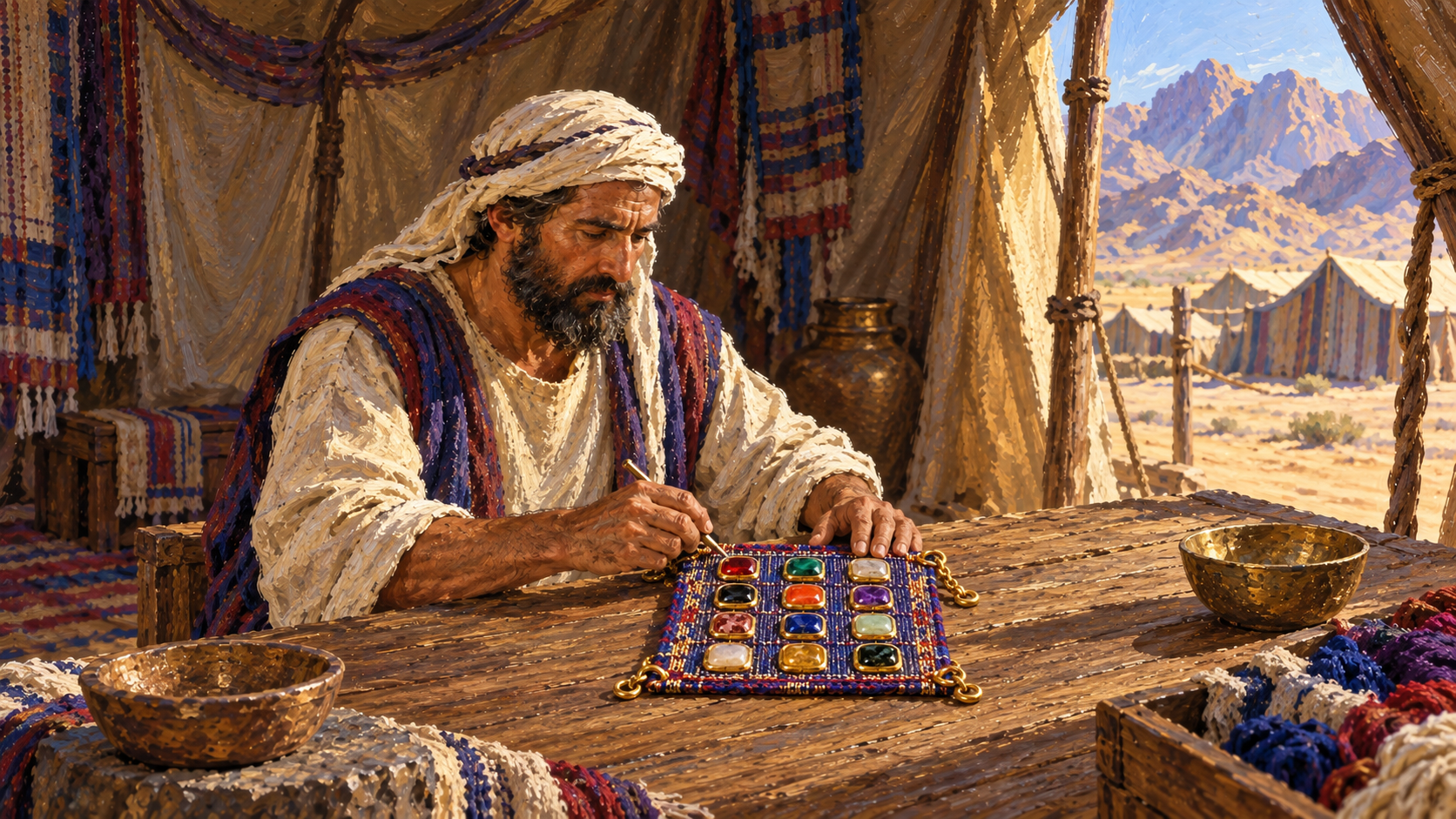
Israel’s high priest carried the names of the tribes over his heart when he served before the Lord. God commanded him to bear those names on the breastplate of judgment, a carefully made part of his holy garments. I want to begin with what Exodus says about its construction and purpose, then follow the Bible’s explanation of the greater High Priest who brings His people to God.
The Breastplate Belonged to Aaron’s Holy Garments
The instructions in Exodus 28 belong to the tabernacle pattern God began giving Moses in Exodus 25. He had redeemed Israel from Egypt and brought the people to Sinai, where He entered into covenant with them. The sanctuary would be the place of His dwelling among them. Its furniture, sacrifices, and priesthood were to follow His instructions, because a holy God must be approached on His terms.
Aaron’s garments belonged to that service. They included the robe, tunic, turban, and ephod, the priestly garment to which the breastplate was fastened. These were holy garments, set apart for the work God appointed. God specified how the breastplate was to be made:
You shall make the breastplate of judgment. Artistically woven according to the workmanship of the ephod you shall make it: of gold, blue, purple, and scarlet thread, and fine woven linen, you shall make it.
God called this woven piece “the breastplate of judgment.” Judgment here includes a righteous decision or determination, rather than referring only to condemnation. Aaron would bear Israel’s names and judgment before the Lord, and the breastplate would hold the Urim and Thummim used in seeking His direction.
Aaron’s office gave him no authority to invent truth or turn his preferences into God’s commands. He represented the people before the Lord and was himself subject to the Lord’s judgment. That was a serious responsibility in a nation whose worship and decisions were to be governed by its covenant with God. The study on the role of the high priest considers the wider duties of his office.
Its Construction Served Its Holy Purpose
The breastplate matched the ephod in workmanship and materials: gold, blue, purple, and scarlet thread, with fine woven linen. Gold and those colored threads also appeared in the tabernacle’s furnishings and curtains. Fine linen belonged to priestly service and its concern for purity. The materials visibly connected Aaron’s garment with the sanctuary in which he served.
It shall be doubled into a square: a span shall be its length, and a span shall be its width.
A span was the distance between the tips of the thumb and little finger of an outstretched hand, commonly estimated at about nine inches. The breastplate was therefore a relatively small square, doubled over, with the stones set in it and the Urim and Thummim placed within it. We do not need an exact modern conversion to understand how it was worn.
Exodus 28:22–28 describes the gold chains, rings, and blue cord that secured it to the ephod. Chains attached it to the shoulder settings, while the lower rings and cord held it above the ephod’s woven band. The stated purpose of the fastening was to keep the breastplate from coming loose during Aaron’s service.
God also specified the arrangement of twelve stones in gold settings:
And you shall put settings of stones in it, four rows of stones: The first row shall be a sardius, a topaz, and an emerald; this shall be the first row; the second row shall be a turquoise, a sapphire, and a diamond; the third row, a jacinth, an agate, and an amethyst; and the fourth row, a beryl, an onyx, and a jasper. They shall be set in gold settings.
Some ancient gemstone names cannot be matched with certainty to modern mineral classifications. Even with that uncertainty, Exodus gives a clear explanation of their number: they represented the twelve tribes. Verse 21 says each stone bore a name engraved like a signet, a seal used to identify its owner and confirm his authority. The names were cut into the stones as lasting inscriptions.
These were the names of a real covenant people. God had called Abraham, Isaac, and Jacob, brought Jacob’s descendants out of Egypt, and organized them by tribes. The breastplate brought those tribes together in one priestly memorial without erasing their distinct identities. The related study on the tribe of Levi examines the tribe from which Aaron’s priestly family came.
I can appreciate the stones’ beauty without assigning a personality, hidden power, or private spiritual message to each gem. Exodus does not give us a system of modern birthstones or sacred color charts. God explained what the stones carried and whom they represented. That explanation gives us enough to understand their place in worship without making guesses into doctrine.
The detailed instructions were also a mercy to Israel. The people were not left to construct a religious object and hope God would accept it. He told them how their priest was to serve. Yet neither the garment’s beauty nor the engraved names removed Israel’s sin. The nation still needed sacrifice and cleansing, and its people remained responsible to obey Him.
Aaron Carried Israel’s Names Over His Heart
God specified both the place where Aaron carried the names and the purpose of bearing them there:
So Aaron shall bear the names of the sons of Israel on the breastplate of judgment over his heart, when he goes into the holy place, as a memorial before the LORD continually.
The memorial was appointed by God; it was not needed because He might otherwise forget His people. Aaron entered holy service carrying Israel’s names as their representative. He did not come as an isolated worshiper concerned only with himself.
The position over his heart also suits the personal concern that such service required. In Scripture, the heart includes our thoughts, desires, loyalty, and moral direction. I see a fitting picture here of a priest responsible for the people he brought before God. Their needs were not an interruption to his service; representing them belonged to his work.
That work included intercession, bringing the people before God on their behalf. Aaron’s own heart, however, was not pure enough to save them. He was a sinner who needed sacrifice and cleansing himself, and his ministry could not continue forever. The memorial represented Israel before the Lord while also showing the need for someone greater than its mortal priest.
The Urim and Thummim Sought God’s Judgment
The Urim and Thummim joined that representation with seeking God’s judgment. Their names are commonly understood as lights and perfections. Scripture does not describe their exact shape, material, or the full procedure for receiving an answer. It does tell us where God commanded them to be placed:
And you shall put in the breastplate of judgment the Urim and the Thummim, and they shall be over Aaron’s heart when he goes in before the LORD. So Aaron shall bear the judgment of the children of Israel over his heart before the LORD continually.
Numbers 27:21 shows the arrangement in Israel’s leadership. As Moses prepared for his death, Joshua was appointed to lead the people. He was to stand before Eleazar the priest, who would inquire before the Lord by the judgment of the Urim. Joshua’s commission did not make his own instinct sufficient for every decision. Israel was to go out and come in according to the direction received from the Lord.
In 1 Samuel 28:6, Saul inquired of the Lord but received no answer through dreams, Urim, or prophets. In Saul’s case, that silence belonged to the judgment upon his persistent disobedience. His desire for an answer did not force God to supply one. The Urim were not magical objects by which a ruler or priest could control Him.
We must distinguish seeking God’s judgment from substituting our own. Aaron had no right to present intuition, political calculation, or religious theatrics as revelation. The Lord’s appointed means of inquiry did not give His servants permission to speak for Him whenever they thought an answer useful.
Nor does this arrangement authorize modern divination, random signs, or attempts to reproduce Gideon’s fleece as a method of guidance. The Urim and Thummim belonged to Israel’s priestly service under the old covenant. We cannot transfer that command into a promise that a religious object will tell us what God wants us to do.
God has given us His written Word, and His Spirit dwells in believers. We should pray for wisdom, seek godly counsel, and let Scripture govern our decisions. A counselor’s advice or my strong impression has no authority to overturn what God has already said. If I am looking for a sign to justify disobedience, my need is to submit to His command.
Christ Is the Greater High Priest
The breastplate helps us understand priestly representation, but the Bible’s larger teaching on priesthood leads us to Christ. Aaron served in an earthly sanctuary with appointed garments and sacrifices. His ministry maintained the worship God commanded and showed the people’s need for atonement, the provision for sin by which people can be reconciled to God. The repeated sacrifices could not cleanse the worshiper from sin forever.
In Hebrews, Paul directs our confidence to the sinless Son who has passed through the heavens:
Seeing then that we have a great High Priest who has passed through the heavens, Jesus the Son of God, let us hold fast our confession.
Jesus is fully God and fully man, understanding our weakness while remaining completely without sin. He is exalted in heaven, and Hebrews 4 calls believers to come boldly to the throne of grace through Him. I can approach God with that confidence because of who Jesus is and what He has done. It gives me no reason to be arrogant or to imagine that I have made myself worthy.
Aaron died and had to be succeeded by another priest. Jesus continues forever, so His priesthood does not pass to someone else. Paul explains what that means for those who come to God through Him:
Therefore He is also able to save to the uttermost those who come to God through Him, since He always lives to make intercession for them.
Christ’s intercession is His continuing work on behalf of His people before God. He knows those who belong to Him and saves them completely. Aaron bore names on stones as a memorial; Jesus does not need a jeweled garment to know His own or secure their salvation.
That salvation rests on a sacrifice Aaron could never provide. Hebrews contrasts the earthly sanctuary and animal blood with Christ’s entrance once for all:
But Christ came as High Priest of the good things to come, with the greater and more perfect tabernacle not made with hands, that is, not of this creation. Not with the blood of goats and calves, but with His own blood He entered the Most Holy Place once for all, having obtained eternal redemption.
Jesus is the eternal Son, born of a virgin and completely sinless. He physically bore the punishment for our sins in His innocent body on the cross. Wicked men inflicted the real torture and crucifixion He willingly endured. He shed His blood and completed His saving work through His death, was buried, and rose bodily from the dead. His continuing intercession does not mean that His sacrifice must be repeated or that His death left redemption unfinished.
The Father did not punish, curse, abandon, strike, bruise, or pour wrath on Jesus. Christ died for the sins of the whole world, and God’s offer of salvation is genuine for every person, though people may resist His grace and reject Him. Everyone who repents and believes is forgiven and born again, indwelt and sealed by the Holy Spirit, and eternally secure. The studies on the blood of Christ for salvation and the gospel explain that provision more fully.
Admiring priestly garments, remembering a religious heritage, or claiming a family identity cannot cleanse anyone’s sin. We need Christ Himself. Those who belong to Him can draw near honestly and rest in His faithful intercession. Being known by Him gives us reason to obey; it never excuses sin or spiritual laziness.
His care for us should also shape our prayers for other people. We do not take Aaron’s office or wear his garments, but we can learn from the concern his service pictured. When I bring someone before God, I am praying for a person with actual burdens and needs. I should ask for mercy and healing where there is suffering, take sin and repentance seriously, and seek reconciliation rather than overlook what is wrong. Reciting names without love falls short of that responsibility.
My Final Thoughts
Aaron carried Israel’s engraved names over his heart in service God had commanded. The breastplate joined representation with judgment, bringing the people before the Lord on His terms. Its beauty could not remove sin, and its priest could not live forever. I find its deepest comfort in the greater High Priest to whom that ministry pointed. Jesus obtained eternal redemption through His own blood and always lives to intercede. We can draw near through Him, trusting the One who knows His people and saves them completely.