
What turned Levi from a tribe marked by fierce violence into the tribe appointed to serve around God’s sanctuary? I want to understand how God gave these descendants a place in His service without excusing what Levi had done at Shechem. Following that change also helps us understand the limits of their calling: not every Levite was a priest, and even the Levitical priesthood could never finish redemption. That brings us to the better priesthood of Jesus.
From Fierce Anger to Service Scattered Through Israel
Leah bore Levi after Reuben and Simeon and named him in hope that Jacob would now become attached to her. She had borne him three sons, and the name’s connection with joining or attachment expressed her longing within that family.
I wouldn’t read his descendants’ later priestly calling back into Levi’s name. Scripture first introduces him as a son in a troubled covenant family, where rivalry and Jacob’s favoritism deepened Leah’s grief and shaped the children’s lives. God would eventually give Levi’s descendants their distinct assignment, but Genesis does not say Leah’s choice of name predicted it.
Levi went into Egypt with the rest of Jacob’s household, and his descendants multiplied there. His sons Gershon, Kohath, and Merari became the heads of the three family divisions that later determined how Levitical service was organized in the wilderness.
After Shechem violated Dinah, Simeon and Levi deceived the men of the city through a false covenant of circumcision. They waited until the men were in pain and then killed every male. The brothers removed Dinah from Shechem’s house before joining the rest of Jacob’s sons in plundering the city.
Dinah’s rape was evil, and Jacob’s household had reason to seek justice. But defending their sister did not make Simeon and Levi’s rage righteous. They answered her violation with deception and slaughtered an entire male population before taking property that did not belong to them. I cannot call that holy zeal simply because their anger began with a real wrong.
Jacob first rebuked the danger they had brought upon the family in Genesis 34. Near death he went further by pronouncing judgment on their fierce anger. We need to keep that judgment in view when we reach Levi’s sacred assignment, because the later calling never made the earlier cruelty holy.
“Simeon and Levi are brothers; Instruments of cruelty are in their dwelling place. Let not my soul enter their council; Let not my honor be united to their assembly; For in their anger they slew a man, And in their self-will they hamstrung an ox. Cursed be their anger, for it is fierce; And their wrath, for it is cruel! I will divide them in Jacob And scatter them in Israel.
Notice what Jacob curses: their anger and wrath. He refuses to join their council and declares that they will be divided and scattered, but he does not pronounce the two men themselves beyond mercy.
Simeon later received towns within Judah’s territory and diminished as a distinct territorial presence. Levi received no ordinary tribal allotment and lived in cities spread through Israel. When God took Levi for Himself, that scattering gave the tribe places to serve throughout the nation.
God’s grace did not cancel Jacob’s word about scattering. He fulfilled it by placing Levitical cities among the other tribes, so that sanctuary servants and teachers of the law lived throughout Israel. Scripture does not say every Levite continuously taught every surrounding town. Still, I can see how God used the settlement that followed ancestral violence to support the work He now assigned these descendants.
Now when Moses saw that the people were unrestrained (for Aaron had not restrained them, to their shame among their enemies), then Moses stood in the entrance of the camp, and said, “Whoever is on the LORD’s side–come to me!” And all the sons of Levi gathered themselves together to him. And he said to them, “Thus says the LORD God of Israel: ‘Let every man put his sword on his side, and go in and out from entrance to entrance throughout the camp, and let every man kill his brother, every man his companion, and every man his neighbor.'” So the sons of Levi did according to the word of Moses. And about three thousand men of the people fell that day. Then Moses said, “Consecrate yourselves today to the LORD, that He may bestow on you a blessing this day, for every man has opposed his son and his brother.”
Aaron had enabled the golden calf and failed to restrain the people. When Moses called for those on the LORD’s side, the sons of Levi gathered to him and carried out God’s severe judgment. They did not spare people because of close family ties or friendship.
The difference from Shechem is God’s direct command through Moses. These Levites were carrying out a judicial sentence, and I would not turn that particular command into permission for religious violence today. The church has no authority to reproduce Israel’s covenant judgment through the sword.
Moses called the Levites to consecrate themselves and spoke of a blessing. Deuteronomy 33 later remembers their loyalty to God’s covenant above family partiality. That helps us understand their faithfulness, but Numbers gives the direct explanation of their formal selection: God took them in place of the firstborn.
And the LORD spoke to Moses, saying: “Bring the tribe of Levi near, and present them before Aaron the priest, that they may serve him. And they shall attend to his needs and the needs of the whole congregation before the tabernacle of meeting, to do the work of the tabernacle. Also they shall attend to all the furnishings of the tabernacle of meeting, and to the needs of the children of Israel, to do the work of the tabernacle. And you shall give the Levites to Aaron and his sons; they are given entirely to him from among the children of Israel. So you shall appoint Aaron and his sons, and they shall attend to their priesthood; but the outsider who comes near shall be put to death.” Then the LORD spoke to Moses, saying: “Now behold, I Myself have taken the Levites from among the children of Israel instead of every firstborn who opens the womb among the children of Israel. Therefore the Levites shall be Mine, because all the firstborn are Mine. On the day that I struck all the firstborn in the land of Egypt, I sanctified to Myself all the firstborn in Israel, both man and beast. They shall be Mine: I am the LORD.”
God had spared Israel’s firstborn at Passover while judging Egypt, and those firstborn belonged specially to Him. In the wilderness He took the Levites as their representative substitute.
The tenth plague explains why this substitution mattered. Every Egyptian firstborn died, while Israelite households sheltered under the Passover lamb’s blood were spared according to God’s command. Consecrating Israel’s firstborn kept that deliverance before the nation. Numbers 3 even records a census of both groups and redemption money for the 273 firstborn beyond the Levitical total. God required an actual accounting of the substitution rather than leaving it as a vague symbol.
The Levites were brought near and given to Aaron and his sons to assist the tabernacle ministry. They served the needs of the congregation by guarding boundaries and performing assigned work, yet the priesthood remained Aaron’s responsibility.
The Levites did not create an office for themselves through tribal ambition; God chose them and assigned their work. That makes the later rebellion especially serious. Some Levites treated the service He had given them as permission to seize priestly duties He had not given them.
Three Clans Served Within Carefully Drawn Boundaries
These were the sons of Levi by their names: Gershon, Kohath, and Merari. And these are the names of the sons of Gershon by their families: Libni and Shimei. And the sons of Kohath by their families: Amram, Izehar, Hebron, and Uzziel. And the sons of Merari by their families: Mahli and Mushi. These are the families of the Levites by their fathers’ houses.
Each of the three clans camped on a designated side of the tabernacle and carried a different part of it. The assigned duties made each family’s responsibility clear and protected the holy things entrusted to their care.
Within the clan of Kohath, Amram’s family produced Moses and Aaron. Their sister Miriam also held a prominent place in Israel’s history. Aaron’s sons became priests, while Moses remained the covenant mediator and prophet. His unique office did not create another priestly house.
This family boundary helps me understand why belonging to Levi did not automatically authorize a man to offer incense or sacrifice. Every Aaronic priest was a Levite, but not every Levite was an Aaronic priest. Gershonites and Merarites could not claim that office, and neither could a Kohathite outside Aaron’s line.
Aaron and his sons were appointed to the priesthood, where they offered sacrifices and handled blood at the altar according to God’s commands. They also burned incense and pronounced the LORD’s blessing over the people. When questions of ritual condition arose, the priests carried out the required examinations, and their office permitted them to enter sanctuary spaces that remained closed to other Levites.
Other Levites helped the priests by transporting the tabernacle and guarding its boundaries. They carried out the practical work required for worship, with singing and teaching also becoming part of their service in later periods. Those responsibilities were valuable in their own right. Sharing Aaron’s tribe did not authorize them to cross into the priestly duties.
The Hebrew word for priest is kohen, with kohanim as its plural. Understanding that term helps us read these passages accurately, because it does not describe every Levite. Korah’s demand for priesthood was therefore rebellion, not a request to exercise a duty he already possessed.
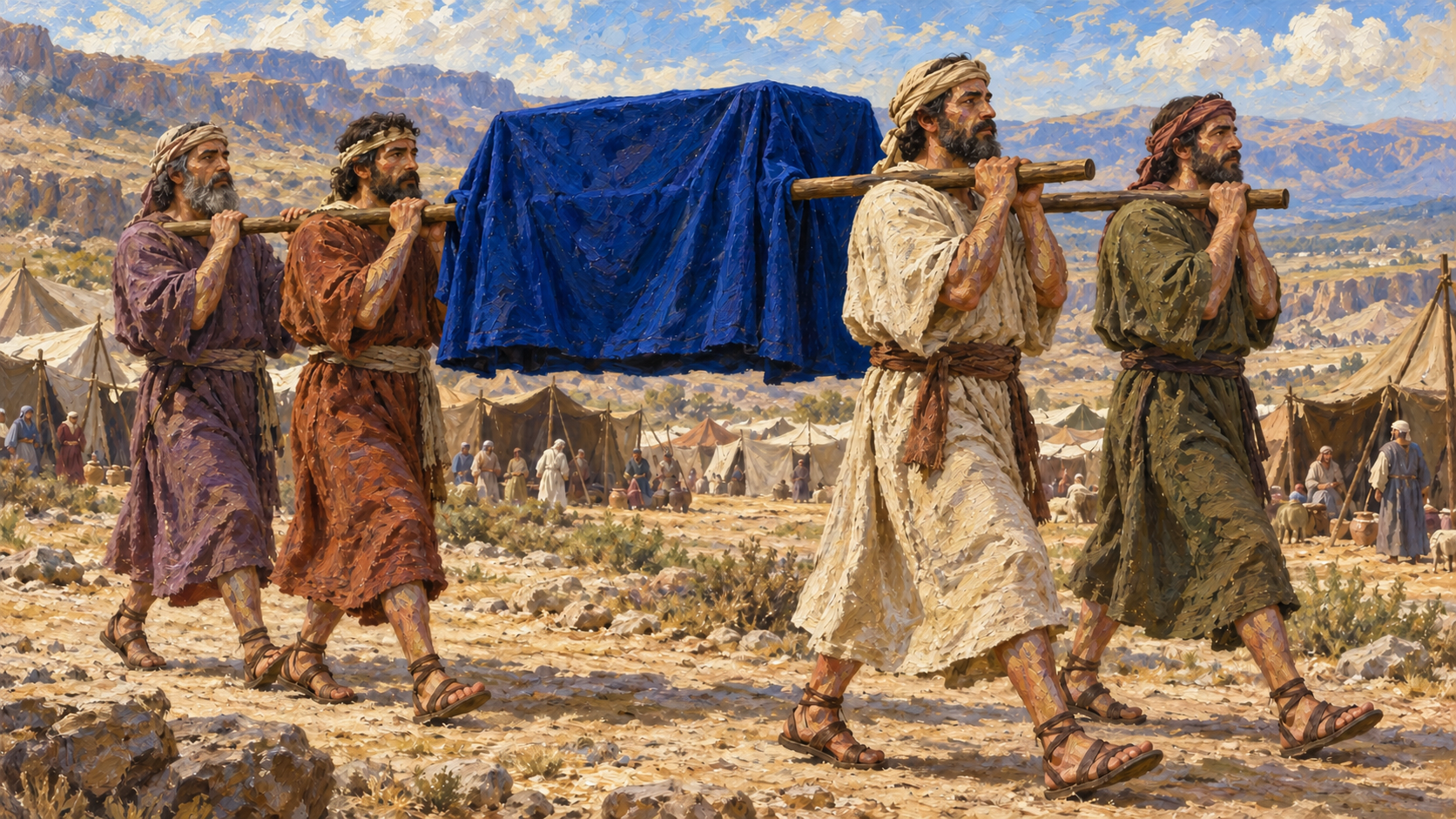
“This is the service of the sons of Kohath in the tabernacle of meeting, relating to the most holy things: When the camp prepares to journey, Aaron and his sons shall come, and they shall take down the covering veil and cover the ark of the Testimony with it. Then they shall put on it a covering of badger skins, and spread over that a cloth entirely of blue; and they shall insert its poles. “On the table of showbread they shall spread a blue cloth, and put on it the dishes, the pans, the bowls, and the pitchers for pouring; and the showbread shall be on it. They shall spread over them a scarlet cloth, and cover the same with a covering of badger skins; and they shall insert its poles. And they shall take a blue cloth and cover the lampstand of the light, with its lamps, its wick-trimmers, its trays, and all its oil vessels, with which they service it. Then they shall put it with all its utensils in a covering of badger skins, and put it on a carrying beam. “Over the golden altar they shall spread a blue cloth, and cover it with a covering of badger skins; and they shall insert its poles. Then they shall take all the utensils of service with which they minister in the sanctuary, put them in a blue cloth, cover them with a covering of badger skins, and put them on a carrying beam. Also they shall take away the ashes from the altar, and spread a purple cloth over it. They shall put on it all its implements with which they minister there–the firepans, the forks, the shovels, the basins, and all the utensils of the altar–and they shall spread on it a covering of badger skins, and insert its poles. And when Aaron and his sons have finished covering the sanctuary and all the furnishings of the sanctuary, when the camp is set to go, then the sons of Kohath shall come to carry them; but they shall not touch any holy thing, lest they die. “These are the things in the tabernacle of meeting which the sons of Kohath are to carry.
Before the camp moved, Aaron’s priests covered the ark and prepared the table and lampstand, along with the altars and sacred utensils. The Kohathites could approach to carry them only after every holy object had been covered. They were forbidden both to touch those objects and to watch while the priests covered them.
So when I describe the Kohathites as caring for the Ark, I need to explain the limits of that care. Their work began after the priests had prepared the objects, and they carried them by their poles with the holy things hidden beneath protective coverings. Crossing that boundary could bring death. Moses gave them no carts for the task because they had to carry the sacred burden on their shoulders.
These sacred objects taught Israel about God’s holiness and the need for atonement. The lampstand spoke of light, and the table displayed His provision. Prayer belonged with the altar of incense, while the Ark testified to His covenant presence. I want to understand that symbolism from Scripture itself rather than invent a hidden meaning for every fabric color or tool.
The families of Gershon handled the tabernacle curtains and their coverings, including the entrance screen, the court hangings, and the cords that held this part of the structure in place. Merari’s families carried its heavier framework. Their responsibility covered the boards and bars as well as the pillars, sockets, pegs, and other structural equipment.
Caring for the coverings and framework was less visually central than carrying the Ark, but the sanctuary could not function without that work. Its supports had to be assembled carefully for the structure to stand, and it needed clear boundaries and protective coverings. God named each clan’s items and appointed supervisors over their work. Those practical details help me appreciate how necessary the less visible duties were.
The Merarites received four carts with eight oxen for their heavy burdens, while the Gershonites received two carts with four oxen. God provided according to the work each family had to do. The number of carts did not measure their spiritual value.
Numbers 4 counts men from thirty through fifty for the labor of tabernacle transport. Numbers 8 says a Levite began entering service at twenty-five and withdrew from the heavy work at fifty while still assisting his brethren.
I understand these ages as a distinction between beginning to participate or assist at twenty-five and entering the full count for burden-bearing at thirty. That would give younger men five years to learn the detailed duties before taking responsibility for dangerous, heavy work. It is a reasonable way to reconcile the two passages, but Numbers does not actually call those years an apprenticeship.
David later counted Levites from age twenty for temple service, when they no longer needed to transport the tabernacle through the wilderness. Their setting and the royal organization of their work had changed. We can account for that later age without treating God’s earlier instructions as mistaken.
The LORD Provided Levi’s Portion and Place in Israel
Then the LORD said to Aaron: “You shall have no inheritance in their land, nor shall you have any portion among them; I am your portion and your inheritance among the children of Israel. “Behold, I have given the children of Levi all the tithes in Israel as an inheritance in return for the work which they perform, the work of the tabernacle of meeting. Hereafter the children of Israel shall not come near the tabernacle of meeting, lest they bear sin and die. But the Levites shall perform the work of the tabernacle of meeting, and they shall bear their iniquity; it shall be a statute forever, throughout your generations, that among the children of Israel they shall have no inheritance. For the tithes of the children of Israel, which they offer up as a heave offering to the LORD, I have given to the Levites as an inheritance; therefore I have said to them, ‘Among the children of Israel they shall have no inheritance.'”
Unlike Judah, Ephraim, or Naphtali, Levi received no single connected tribal territory. God described Himself as Aaron’s portion and supported the tribe through the sanctuary system in place of the agricultural inheritance given to the others.
That does not mean every Levite was poor or forbidden to own property. Families could possess houses in their Levitical cities and use the surrounding common land for ordinary needs. Jeremiah, though from a priestly family, could lawfully purchase a field. I need to distinguish the absence of a normal tribal allotment from a ban on personal ownership.
Supporting the Levites through this arrangement made them dependent on Israel’s obedience. Nehemiah later found that neglected support had forced them to leave their service and work their fields. Calling their work spiritual did not feed or house their families. Israel remained responsible for providing the material support that enabled them to serve.
God gave Israel’s tithes to the Levites in return for their tabernacle service, and they in turn presented a tenth to Aaron’s priestly house. Receiving support did not release them from the responsibility to give the best portion themselves.
This system belonged to Israel’s life in the promised land. Its commands addressed the produce of the fields and the increase of the herds. The tithes supported the sanctuary and its priesthood while also fitting into Israel’s festival life and care for the poor. Because the whole structure belonged to the Mosaic covenant, it cannot be transferred unchanged into a demand that churches maintain a Levitical tax.
For the church, I would begin with the apostolic instructions about willing, purposeful giving according to our ability and from a generous heart. Churches are responsible for supporting faithful workers and caring for people in need. We should teach that obligation from the instructions given to believers rather than import Israel’s tithe unchanged.
All the cities of the Levites within the possession of the children of Israel were forty-eight cities with their common-lands. Every one of these cities had its common-land surrounding it; thus were all these cities.
The forty-eight cities were drawn from the territories of the other tribes in proportion to their inheritance. Six were cities of refuge where a person accused of manslaughter could flee pending judgment.
These cities gave someone who killed without premeditation protection from immediate blood vengeance while the congregation heard the case. They did not grant a murderer permanent immunity, and deliberate murder still required judgment. I see mercy here that allowed a fair hearing without treating accidental killing and intentional violence as the same thing.
Jacob’s word was fulfilled in Levi’s scattering, yet the tribe was not left homeless. Each city included land for livestock and ordinary life, giving families a place to live among the people while they served the sanctuary.
We should not turn that distribution into a claim that every Levite constantly taught every neighboring tribe. It does show that sanctuary ministers and teachers of the law lived throughout the covenant nation instead of being confined to one isolated province.
And of Levi he said: “Let Your Thummim and Your Urim be with Your holy one, Whom You tested at Massah, And with whom You contended at the waters of Meribah, Who says of his father and mother, ‘I have not seen them’; Nor did he acknowledge his brothers, Or know his own children; For they have observed Your word And kept Your covenant. They shall teach Jacob Your judgments, And Israel Your law. They shall put incense before You, And a whole burnt sacrifice on Your altar. Bless his substance, LORD, And accept the work of his hands; Strike the loins of those who rise against him, And of those who hate him, that they rise not again.”
Moses’ blessing remembers Levi’s covenant loyalty and connects the tribe with the Urim and Thummim. It also assigns Levi the work of teaching God’s law. It also names incense and sacrifice before asking the LORD to accept Levi’s work. Here again, I need to distinguish the priests’ particular duties within the tribe from teaching and other service that belonged to Levi’s broader ministry.
The Urim and Thummim belonged to the high priest’s breastplate and were used to seek decisions from the LORD in Israel’s covenant administration. Scripture gives too little detail for us to reconstruct their appearance or how they were used. This was no occult technique, nor are modern believers instructed to reproduce it for private guidance.
Priests were commanded to preserve knowledge, and people should seek the law from their mouths. Levites taught during reforms under Jehoshaphat and helped people understand Scripture after the exile.
Music became prominent in Levitical service during the temple era, when David organized singers and instrumentalists from the tribe. The families of Asaph, Heman, and Jeduthun received places in that work. Their music served worship under God’s appointed order, so I would not separate their performance from the truth they were serving.
An Aaronic priest had to establish his descent from the appointed family, receive consecration, and maintain the ceremonial cleanness required for his office. He remained subject to all the priestly commands. Certain physical blemishes prevented a priest from approaching the veil or altar, although he could still eat his family’s holy food. That restriction taught ceremonial wholeness; it did not declare someone with a disability spiritually inferior.
The law prohibited an ordinary priest from marrying a prostitute, a defiled woman, or a divorced woman. The high priest faced a stricter requirement: he had to marry a virgin from his own people and could not marry a widow. Reading those instructions together helps me avoid imposing the high priest’s rule on every priest.
On the Day of Atonement, the high priest entered the Most Holy Place with blood for his own sin before addressing the people’s sin. Other priests served under him, and the broader body of Levites could not assume his access.
We also need to keep those qualifications within the Aaronic order to which God gave them. A church elder does not hold the same office, so we should read pastoral qualifications from the apostolic instructions. Those instructions assign authoritative church leadership to qualified men.
Holy Service Could Still Be Corrupted
Korah was a Kohathite Levite who joined Dathan and Abiram in rebellion. He claimed that the whole congregation’s holiness erased the appointed distinctions between Moses and Aaron and the people they served. Moses answered by exposing what Korah wanted: priesthood beyond the Levitical nearness God had already given him.
Korah gathered 250 recognized leaders to bring censers and incense for a public test of his claim. His appeal to the congregation’s holiness sounded like a demand for equality, but he used that true statement to deny offices God Himself had assigned. Moses asked whether being separated for tabernacle service seemed a small thing to them. That question makes me consider Korah’s discontent: coveting Aaron’s priesthood showed contempt for the privilege he already had.
The earth swallowed the chief rebels, and fire consumed the men who offered unauthorized incense. Their censers were hammered into a covering for the altar as a lasting warning that no outsider should approach as an Aaronic priest.
Hophni and Phinehas held the Aaronic priesthood, so their conduct was not an example of ordinary Levitical service. They stole from sacrifices and treated the LORD’s offering with contempt, adding sexual sin to the corruption of their ministry. Repeated warnings did not turn them from that course. They hardened themselves against correction, and judgment fell on Eli’s house.
Malachi later rebuked priests for offering defiled animals and showing partiality when teaching God’s law. Their careless service made worship wearisome instead of honoring the LORD, and they caused people to stumble. These failures remind me that an inherited office and the right genealogy could never guarantee a faithful heart.
Once the Ark and sanctuary had a permanent setting, David reorganized Levitical service for the coming temple. Wilderness transport was no longer necessary, but there was still work to do. Some Levites assisted the priests while others served as officers and judges. They guarded the gates and oversaw the treasuries, and organized music and praise became a prominent part of their service.
The priests continued their work at the altar and inside the sanctuary. Other Levites prepared and carried the necessary supplies. They also guarded their assigned spaces and purified the areas in their care. During some reforms they also slaughtered Passover offerings for the people. Their contribution to public worship was substantial, yet Chronicles repeatedly distinguishes them from their priestly brethren.
Ezra and Nehemiah recorded the priests and Levites who returned to Judah after the exile and helped restore public worship. They read and explained the law, with some leading thanksgiving and others guarding the gates or managing the portions for sacred service. Small numbers made that work difficult, and neglected support added to the burden. Through those difficulties, the distinction between priests and other Levites remained in place.
“And the Levites who went far from Me, when Israel went astray, who strayed away from Me after their idols, they shall bear their iniquity. Yet they shall be ministers in My sanctuary, as gatekeepers of the house and ministers of the house; they shall slay the burnt offering and the sacrifice for the people, and they shall stand before them to minister to them. Because they ministered to them before their idols and caused the house of Israel to fall into iniquity, therefore I have raised My hand in an oath against them,” says the Lord GOD, “that they shall bear their iniquity. And they shall not come near Me to minister to Me as priest, nor come near any of My holy things, nor into the Most Holy Place; but they shall bear their shame and their abominations which they have committed. Nevertheless I will make them keep charge of the temple, for all its work, and for all that has to be done in it. “But the priests, the Levites, the sons of Zadok, who kept charge of My sanctuary when the children of Israel went astray from Me, they shall come near Me to minister to Me; and they shall stand before Me to offer to Me the fat and the blood,” says the Lord GOD. “They shall enter My sanctuary, and they shall come near My table to minister to Me, and they shall keep My charge.
I read Ezekiel 40-48 as describing a literal future temple during Christ’s thousand-year reign. Within that vision, God distinguishes Levites disciplined for past idolatry from Zadokite priests who had faithfully kept charge of His sanctuary.
In Ezekiel’s vision, the Levites still serve as gatekeepers and perform the general work of the temple. The sons of Zadok alone approach for the priestly ministry described there. Future sacrifice does not compete with the finished atonement of Christ. It functions within the promised order of His kingdom and possesses no power to remove sin.
Revelation 11 also mentions a measured temple, this time during the Tribulation, but it neither names Levites nor explains their duties. I would therefore base an account of future Levitical service on Ezekiel’s explicit description instead of filling in what Revelation leaves unsaid.
Jesus Holds a Better and Eternal Priesthood
Therefore, if perfection were through the Levitical priesthood (for under it the people received the law), what further need was there that another priest should rise according to the order of Melchizedek, and not be called according to the order of Aaron? For the priesthood being changed, of necessity there is also a change of the law. For He of whom these things are spoken belongs to another tribe, from which no man has officiated at the altar. For it is evident that our Lord arose from Judah, of which tribe Moses spoke nothing concerning priesthood. And it is yet far more evident if, in the likeness of Melchizedek, there arises another priest who has come, not according to the law of a fleshly commandment, but according to the power of an endless life. For He testifies: “You are a priest forever According to the order of Melchizedek.”
Levi’s priests were sinners who eventually died, and their sacrifices had to be repeated because those offerings could never finish redemption. That is why the Levitical priesthood could not bring perfection. The law governing this temporary order anticipated the greater Priest announced in Psalm 110.
Paul is not arguing in Hebrews that the Levitical ministry was evil or that God made a mistake by appointing it. It served His covenant purpose, but the repeated sacrifices and restricted access showed that redemption remained unfinished. The priests themselves could not continue beyond death. When Psalm 110 announced another Priest centuries after Aaron, Scripture was promising an enduring order beyond the one Israel already knew.
Jesus descended from Judah, which would disqualify Him from serving at Aaron’s altar. That might seem like a problem until we follow Paul’s argument: Jesus belongs to a different priestly order. His priesthood therefore brings the necessary change in the law tied to Levi.
I understand Melchizedek to be a Christophany, a pre-incarnate appearance of Christ. His titles identify Him as the king of righteousness and the king of peace, and he appears as the priest of God Most High. After the incarnation, Christ exercises His priesthood in the power of an endless life.
Also there were many priests, because they were prevented by death from continuing. But He, because He continues forever, has an unchangeable priesthood. Therefore He is also able to save to the uttermost those who come to God through Him, since He always lives to make intercession for them. For such a High Priest was fitting for us, who is holy, harmless, undefiled, separate from sinners, and has become higher than the heavens; who does not need daily, as those high priests, to offer up sacrifices, first for His own sins and then for the people’s, for this He did once for all when He offered up Himself. For the law appoints as high priests men who have weakness, but the word of the oath, which came after the law, appoints the Son who has been perfected forever.
Death ended each Aaronic priest’s service, so the office had to pass to another descendant. Jesus continues forever with an unchangeable priesthood. I can come to Him knowing that His intercession rests on a completed offering, not on another sacrifice still needing to be made.
Jesus needed no offering for His own sin because He had none. He offered Himself once for all and completely saves everyone who comes to God through Him. Nothing remains for a human priest or pastor to complete. Neither a church’s sacraments nor future animal offerings can supplement His finished sacrifice.
Through their appointed ministry and its boundaries, the Levites taught Israel both God’s holiness and the need for mediation on His terms. Jesus supplies what that ministry could not finally accomplish. He is the sinless Son who rose bodily from the grave and now holds the eternal office of High Priest, the only Mediator between God and man.
Coming to Him as to a living stone, rejected indeed by men, but chosen by God and precious, you also, as living stones, are being built up a spiritual house, a holy priesthood, to offer up spiritual sacrifices acceptable to God through Jesus Christ.
The church’s holy priesthood consists of believers joined together as living stones. We have not inherited Aaron’s genealogy, and we do not offer sacrifices for sin. Instead, Jesus makes our praise and prayer acceptable to the Father. Our generosity and obedience are received through Him too, along with every faithful act of service.
Every born-again believer shares that access to the Father through the one Mediator. I can affirm our common priestly identity while respecting the different gifts God gives His people and the order He establishes in the local church. Qualified male eldership and its authority remain part of that order.
For that reason, I would be careful about calling Christians spiritual Levites. Peter describes us as a spiritual house and holy priesthood through Christ. Treating the church as a new branch of Aaron’s order would obscure the access we actually share in Jesus.
The Limits of Levi’s Ministry Lead Us to the Gospel
Before leaving Levi’s ministry, I want to keep its boundaries clear. Aaron’s male descendants alone held the priesthood, while the other Levites served in the duties God assigned them. The tribe lacked an ordinary territory but still received property: families could possess houses in its forty-eight cities and use the surrounding common lands. Israel’s tithes provided covenant support for that service.
Those boundaries also governed the work itself. Kohathites carried sacred objects only after Aaron’s priests had covered them, and they could not touch the holy things. Even within the priesthood, marriage restrictions differed. Leviticus required the high priest to marry a virgin without imposing that exact rule on every ordinary priest.
The same care is needed when we speak of future service. Revelation 11 mentions a temple without identifying its ministers, whereas Ezekiel 44 distinguishes future Levites from the sons of Zadok. Meanwhile, our Christian calling is to offer spiritual sacrifices through Jesus. We do not become Aaronic priests, and He alone remains our eternal High Priest and sole Mediator.
The priests’ handling of blood taught Israel that sin brings death, while the sanctuary boundaries showed that we approach God only in the way He appoints. Yet the sacrifices kept being repeated and the ministers kept dying. Their service exposed guilt and dealt with it ceremonially without perfecting the conscience forever. I see in those limitations why we need more than the Levitical order could provide.
Jesus is the eternal Son, fully God and fully man. Born of a virgin, He remained completely sinless and willingly bore real punishment for our sins in His innocent body. Wicked men physically tortured and punished Him before killing Him. He shed His blood for the whole world and died, then rose bodily from the grave after His burial. The punishment came from those wicked men; the Father did not punish or curse His Son. Neither did He abandon Jesus or pour wrath on Him.
Because Christ died for the whole world, God’s offer of salvation is genuine even though people can resist and reject it. Everyone who repents and believes is forgiven and justified apart from works, and God gives that person new birth. Ancestry and tithes cannot give us that life, nor can animal sacrifices or a human priest’s mediation.
Everyone who is truly born again becomes a new creation. The Holy Spirit indwells and seals that believer, whose salvation is eternally secure. Eternal security never gives permission for lawlessness, and a superficial profession does not prove that someone was truly born again. God’s children draw near through the blood of Christ and serve Him with gratitude. Their obedience never adds merit to His sufficient offering.
Related studies: The Twelve Tribes of Israel, The Role of the High Priest, The Sons of Kohath.
My Final Thoughts
God turned Levi’s scattering into service without calling the tribe’s earlier sin righteous. That encourages me to appreciate His mercy while taking the boundaries of His calling seriously. Even an inherited holy office could be corrupted, and the Levitical ministry could never finish redemption despite its real covenant purpose. Jesus came from Judah as the eternal Priest they could never become, and His one offering opened the way to God that repeated sacrifices could not secure. We serve as a holy priesthood through Him alone. Our worship should therefore express gratitude for His finished work and respect for the order He gives.