
Who are the twelve tribes of Israel, and why do their names change from one Bible list to another? The answer begins with Jacob’s family, whose descendants appear throughout the rest of Scripture. When I compare the lists, I need to know what each passage is counting. A record of births and a record of land inheritance can name members of the same family differently without contradicting each other.
From Jacob to the Twelve Tribes
Knowing these tribes helps us follow much of the Bible. Genesis introduces the family, and the books of Moses show how that family became a nation. Joshua and Judges expect us to understand the tribal inheritance, while Kings and the prophets describe what happened after the kingdom divided. The Gospels still speak of Israel’s tribes, and Revelation names them in prophecy. These connections are easier to follow when we know the history behind the names.
Before Jacob had any children, God had already promised Abraham a land and descendants. He also promised that blessing would reach every family of the earth through that covenant line. The LORD confirmed the line through Isaac and then chose Jacob rather than Esau. I notice that Genesis makes no attempt to hide Jacob’s schemes or fear, or the trouble in his household. We are seeing God carry His promise forward by grace, not reward a man whose conduct was consistently admirable.
Jacob’s name is tied to the scene of his birth because he came out grasping Esau’s heel. His early life shows him grasping for blessing in much the same way, relying on his own methods until God met him beside the Jabbok at night.
And He said, “Your name shall no longer be called Jacob, but Israel; for you have struggled with God and with men, and have prevailed.”
Jacob had not overpowered God, as we can see from the way the Man disabled his hip with a single touch. God broke Jacob’s reliance on his own strength while giving him a blessing and a new name. Jacob limped away as Israel, bearing the name that would identify the people descended from him.
Genesis calls the wrestler a Man, yet Jacob said that he had seen God face to face. Hosea describes that same meeting as a struggle with the Angel and identifies Him as the LORD God of hosts. Those descriptions tell us who met Jacob: the distinctive Angel of the LORD, an appearance of Christ before He became man. This was no ordinary created angel. The eternal Son personally humbled Jacob while preserving his life.
Genesis 35 confirms the new name while connecting it directly to the growth of the nation and the promise of kings.
And God said to him, “Your name is Jacob; your name shall not be called Jacob anymore, but Israel shall be your name.” So He called his name Israel. Also God said to him: “I am God Almighty. Be fruitful and multiply; a nation and a company of nations shall proceed from you, and kings shall come from your body.”
Israel was first the name of a man and then of the people descended from him. Here God connects that name with the growth of a nation and promises kings from Jacob’s own body. So the tribes did not begin as a later political invention. They grew out of God’s covenant dealings with Jacob and his household.
The two names help me understand the change in Jacob. His old name recalls how he grasped Esau’s heel at birth, and his life had shown that same determination to gain an advantage by his own efforts. God explained the name Israel through Jacob’s struggle with God and men. Jacob’s new identity rested on God’s promise and His work in Jacob’s life, rather than on the strength Jacob could muster for himself.
Genesis 29 and 30 record the births of Jacob’s sons amid painful family conflict. Leah and Rachel suffered in their rivalry, and Bilhah and Zilpah were drawn into it as well. Favoritism and envy harmed the household, while the account takes the grief of barrenness seriously. God formed the family that would become Israel through people whose lives were troubled in these very personal ways.
Jacob’s sons were Reuben, Simeon, Levi, Judah, Dan, Naphtali, Gad, Asher, Issachar, Zebulun, Joseph, and Benjamin. Each became the head of a tribe. The Bible later speaks of “the children of Israel” and “the tribes of Israel” because a nation grew from this family.
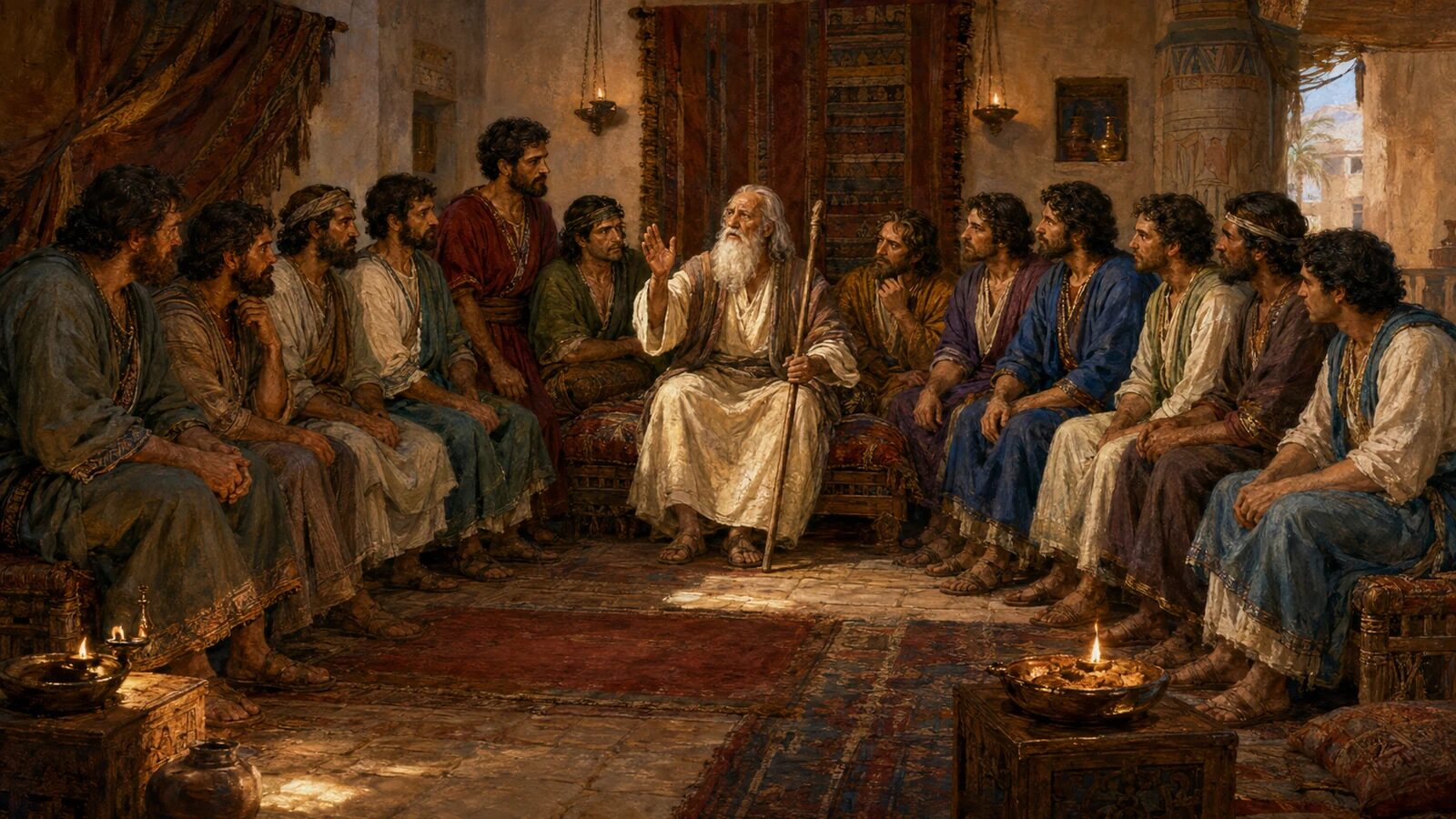
Near the end of Jacob’s life, he gathered his sons and spoke about what would happen to them in the days ahead.
And Jacob called his sons and said, “Gather together, that I may tell you what shall befall you in the last days: Gather together and hear, you sons of Jacob, And listen to Israel your father.”
In Genesis 49, Jacob’s farewell included both blessing and rebuke. He confronted Reuben’s instability and the violence of Simeon and Levi, yet spoke a royal promise over Judah and blessed Joseph with fruitfulness. He described Benjamin with fierce imagery. I don’t want to overlook the severe words simply because this was a father addressing his sons. God was working through this family, but Scripture never asks us to pretend their sins were harmless.
Jacob was also speaking about the future of their descendants, so the failures of the sons standing before him did not settle everything that would happen to their tribes. Levi would later be set apart for sacred service despite Jacob’s condemnation of his violence. Judah’s serious sins did not prevent God from placing the royal promise in his line. We should recognize God’s grace here without treating their sin lightly. Human failure could not overturn what God had determined to accomplish.
Moses later blessed the tribes in Deuteronomy 33 before Israel entered the land under Joshua. By then, Jacob’s household had become a covenant nation. The family names continued, but they now described a people preparing to receive the land God had promised.
Why the Tribal Lists Differ
The names and order differ because the lists serve different purposes. A birth record tells us who belonged to the original family, while a census counts people for a particular need. Numbers describes how Israel camped and marched through the wilderness, and Joshua records how the land was allotted. Elsewhere the tribes are named in connection with blessing or priestly service, or in passages about judgment and prophecy. The number twelve remains important, but we need to consider the purpose of a list before deciding that a difference is a mistake.
We can see this by comparing the passages. Genesis 29 and 30 record the birth family, while Genesis 49 and Deuteronomy 33 contain blessings and prophecies about the tribes. In Joshua 13–21, the subject is land inheritance, which is why Levi is treated differently and Joseph’s sons are counted. Revelation 7 gives a deliberate future list of servants sealed from Israel. Each passage counts members of the same covenant family in a way that fits what it is telling us.
The arithmetic becomes easier if we begin with Jacob’s twelve sons. Levi was set apart from ordinary territorial inheritance, leaving eleven territorial names. Joseph’s inheritance was then divided between Ephraim and Manasseh, bringing the land count back to twelve. When another passage includes Levi or uses Joseph’s own name, it may leave out or substitute another name while still presenting twelve tribal units for that particular purpose.
Tribal identity also shaped everyday life in the wilderness. Numbers describes the tribes camping around the tabernacle in groups on its four sides, led by Judah, Reuben, Ephraim, and Dan under their respective banners. Those groups determined how Israel camped and marched, with the LORD’s presence at the center. I notice that each tribe had its own identity and place, yet none was the center of Israel’s worship. God had arranged their life around His presence among them.
When Joshua records the tribes receiving land, we can see God fulfilling His promise to Abraham in an actual inheritance for his family. The tribal map records that faithfulness, but the account also reveals how the people responded. Some tribes settled east of the Jordan, and others failed to drive out their enemies fully. As we read those land records, we are also seeing whether Israel trusted and obeyed the One who gave them their inheritance.
The same distinction helps with records of Israel’s public life. A census may count men available for war, whereas a priestly record follows Levitical families. A territorial boundary tells us where a tribe’s land lay; a prophetic blessing tells us something about its future. I need to let each list answer its own question, whether it traces births, arranges the camp, assigns land, or identifies people for a future work of God.
Levi accounts for much of the difference in the land lists. As one of Jacob’s sons, he belongs in the family record, but his descendants did not receive a normal tribal territory. God set them apart to serve at the tabernacle and later at the temple. Within Levi, Aaron’s family supplied the priests, while the other Levitical families carried out the broader sacred duties.
Then the LORD said to Aaron: “You shall have no inheritance in their land, nor shall you have any portion among them; I am your portion and your inheritance among the children of Israel.”
The Levites had a different inheritance, not a forgotten place among God’s people. They lived in cities throughout Israel, some of which served as cities of refuge. This spread teaching and holy service across the land instead of confining them to one region. Their calling centered on service to the LORD rather than possession of a broad tribal territory.
Because the Levites did not receive the same land inheritance as the other tribes, the Law of Moses provided for their support through Israel’s tithes.
“Behold, I have given the children of Levi all the tithes in Israel as an inheritance in return for the work which they perform, the work of the tabernacle of meeting.”
Under the covenant given through Moses, the tithes supported Israel’s worship by providing for those who served at the sanctuary instead of receiving a normal land inheritance. That setting is why I would not impose the Levitical tithe system on the church as though the New Testament commands the same arrangement. Christians are called to give willingly and with purpose, but our giving is not governed by Israel’s land-based structure.
Joseph’s double portion explains the other major change. Although Joseph was one of Jacob’s sons, Jacob counted both of Joseph’s sons, Ephraim and Manasseh, as his own for the purpose of inheritance. Joseph therefore received two portions within the family.
“And now your two sons, Ephraim and Manasseh, who were born to you in the land of Egypt before I came to you in Egypt, are mine; as Reuben and Simeon, they shall be mine. Your offspring whom you beget after them shall be yours; they will be called by the name of their brothers in their inheritance.”
That family arrangement explains why a land list can omit Levi, who had no single tribal territory, and count Ephraim and Manasseh separately. Another passage may name Joseph himself. Once we take Jacob’s blessing into account, we can understand the different names as part of God’s providence rather than confusion in the record.
Judah and the Promised King
Judah’s tribe received the royal line through which the Messiah would come, even though Judah was not Jacob’s firstborn. Reuben held that place but forfeited his honor through sin, and Simeon and Levi came under judgment for violence. When Jacob addressed Judah in Genesis 49, he used unmistakably royal language.
“Judah is a lion’s whelp; From the prey, my son, you have gone up. He bows down, he lies down as a lion; And as a lion, who shall rouse him? The scepter shall not depart from Judah, Nor a lawgiver from between his feet, Until Shiloh comes; And to Him shall be the obedience of the people.”
The promise moves through David and reaches its fulfillment in Jesus Christ. Revelation identifies Him by the same royal tribe and also connects Him to David.
But one of the elders said to me, “Do not weep. Behold, the Lion of the tribe of Judah, the Root of David, has prevailed to open the scroll and to loose its seven seals.”
The attention given to Judah tells us where God placed Israel’s line of kingship without erasing the other tribes. Jesus came from that family line as the promised Son of David from Judah. He is the King and also the Lamb who was slain. Following these names helps me see how the promise reached Christ through history, rather than thinking of Him as a spiritual ruler with no connection to the people God had chosen.
There is good reason to give the other tribes that same attention. Levi’s service helps us understand why Israel needed priestly ministry and sacrifice, while Joseph’s suffering and later exaltation show God’s providence within the family. With Judah, we follow the promise of the King. Their histories differ, but each belongs to the covenant family through whom God brought the promised Messiah.
Scattering and the “Lost Tribes”
The phrase “lost tribes” comes from the division of the kingdom and the scattering that followed. After Solomon’s reign, the northern kingdom was commonly called Israel and was dominated by ten tribes. The southern kingdom, called Judah, centered on Judah and Benjamin. But those political borders did not completely separate the family lines, since Levites and other faithful worshipers crossed them.
Assyria conquered the northern kingdom in the eighth century BC. Many Israelites were deported, and other peoples were brought into the region. More than a century later, Babylon conquered Judah and carried many from the southern kingdom into exile. Some Judeans returned under Persian rule, but long periods of war and deportation disrupted family records. Intermarriage and migration made many lines difficult for people to trace. This history explains why people speak about ten “lost tribes.”
I would not take the word lost to mean that every northerner disappeared, because Scripture never says that. James still addresses “the twelve tribes which are scattered abroad” in James 1:1. In Matthew 19:28, Jesus says that in the regeneration the apostles will sit on twelve thrones judging the twelve tribes of Israel. Revelation also speaks of the tribes in the future. Whatever has happened to human records, God has not lost track of a single tribe.
Romans 11 warns Gentile believers against arrogance. We receive blessing through Christ, but that gives us no reason to speak as though Israel has been replaced and God’s promises to them no longer mean anything. He remains able to graft Israel in again, and His gifts and calling have not been set aside.
For I do not desire, brethren, that you should be ignorant of this mystery, lest you should be wise in your own opinion, that blindness in part has happened to Israel until the fullness of the Gentiles has come in.
Believing Jews and Gentiles belong to one body in Christ, and we can affirm that unity without erasing Israel’s future. God saves Gentiles while remaining faithful to His promises to Israel. Although He judges unbelief, He does not abandon His covenants. He will fulfill His prophetic plan without making Israel and the church the same entity.
Ancestry itself cannot save anyone. Belonging to Abraham’s physical family does not save a Jewish person, just as lacking that ancestry does not shut a Gentile out of salvation. Everyone who is saved receives grace through faith in Jesus Christ. The warning in Romans 11 leaves me no room to boast: unbelief brings judgment, and salvation comes by grace.
The Tribes in Revelation and God’s Future Plan
Revelation 7 brings the tribes into end-times prophecy. John hears the number of those sealed: 144,000 from all the tribes of the children of Israel. The passage then names twelve thousand from each tribe in its list.
And I heard the number of those who were sealed. One hundred and forty-four thousand of all the tribes of the children of Israel were sealed.
The list begins with Judah and Reuben, followed by Gad and Asher. Naphtali and Manasseh come next, then Simeon and Levi. Issachar, Zebulun, Joseph, and Benjamin complete the twelve. Dan and Ephraim are not named. Levi appears even though land lists usually treat his tribe differently, while Joseph is named alongside Manasseh. This preserves twelve named tribal units without listing Ephraim separately.
God will seal these real servants from Israel during the coming Tribulation, so their tribal identity still has meaning. Our inability to trace every family line does not limit His knowledge of whom He will seal.
I would like to know why Dan and Ephraim are absent, but Revelation does not give us a direct answer. Their connection with idolatry offers the strongest biblical explanation, though it remains an inference. Dan became closely tied to corrupt worship in Judges 18 and later in the northern kingdom, and the prophets also associated Ephraim with northern idolatry.
“Ephraim is joined to idols, Let him alone.”
We do not need certainty about the omission to heed Scripture’s warning about idolatry. Idolatry corrupts worship and can reshape an entire people before judgment comes. Still, nothing in this list suggests that God has lost track of Israel. He knows exactly whom He seals from the tribes.
The two groups described in Revelation 7 are also why I do not understand these tribes as a vague picture of the church. John first identifies a numbered group from Israel’s tribes and then sees an innumerable multitude from every nation. If we treat them as the same group, we lose the distinction the passage itself gives us.
In Revelation 21, the names of the twelve tribes of the children of Israel appear on the twelve gates of the New Jerusalem. The apostles’ names are on its foundations. I notice that both are present in the final city. God displays both in the final city, keeping these distinct witnesses together as part of His united plan for His redeemed people rather than replacing the tribes with the apostles.
These examples give us a practical way to approach a difficult tribal list. Before deciding what a missing or substituted name means, we should look at the purpose of the passage. In a land record, inheritance may explain the difference; elsewhere, service may account for it. That helps us ask why Levi appears in one place and not another, or why Joseph is named instead of Ephraim. We should give Revelation’s list the same attention.
I don’t want to force a quick answer onto these lists, either by calling every difference a contradiction or by making them all mean the same general symbol. God recorded particular names in particular settings. We need to read those settings carefully enough to understand why each list counts the tribes as it does.
Across these records, we can follow God keeping His promises through history. Jacob’s family became a people with a land and with distinct responsibilities within the nation. God judged their idolatry, yet preserved a remnant through repeated rebellion. In the fullness of time, He brought the Messiah through Judah, and He will keep the promises that still await fulfillment.
Israel’s history leads us to Christ and also shows us the sin from which every person needs to be saved. Jesus shed His physical blood and died for the sins of the whole world, then rose bodily. He willingly bore the punishment for our sins in His innocent body through real torture and death. The Father did not punish or curse Jesus, nor did He abandon Him. He did not strike or bruise His Son or pour wrath on Him. Father and Son remained united in the work of redemption.
If we belong to Christ, we should respond to Israel’s history with gratitude and trust, not arrogance or indifference. Gentile believers are not natural branches and have no grounds to boast over Israel, while Jewish ancestry cannot take the place of personal faith in the Messiah. As I follow these families, I see God’s patience toward sinful people and His determination to keep His Word. Since we stand only by grace, that faithfulness should humble us rather than feed our pride.
God genuinely offers salvation to every person, though people can resist His grace and reject the Messiah. Everyone who repents and believes in Jesus is forgiven and born again as a new creation. The Holy Spirit indwells and seals the true believer, whose eternal life is secure because salvation is God’s work. That security gives no permission for lawlessness, and a shallow profession without new life does not prove that someone has been born again.
For related studies, see A Complete Bible Study on the 144,000, A Complete Bible Study on the Tribe of Levi, A Complete Bible Study on the Tribe of Judah, and A Complete Bible Study on Tithing.
My Final Thoughts
The changing names make sense when we understand why each passage counts the tribes as it does. Levi’s service and Joseph’s double portion explain most of the variation within this one covenant family. Judah’s royal promise reaches Jesus Christ, and Revelation shows that God still knows Israel’s tribes and will fulfill His future plan for them. I want to give these names the attention they deserve, with gratitude for God’s faithfulness rather than any thought of boasting over Israel. He preserved the family line through whom the Messiah came, and that Messiah is our only hope of salvation.