
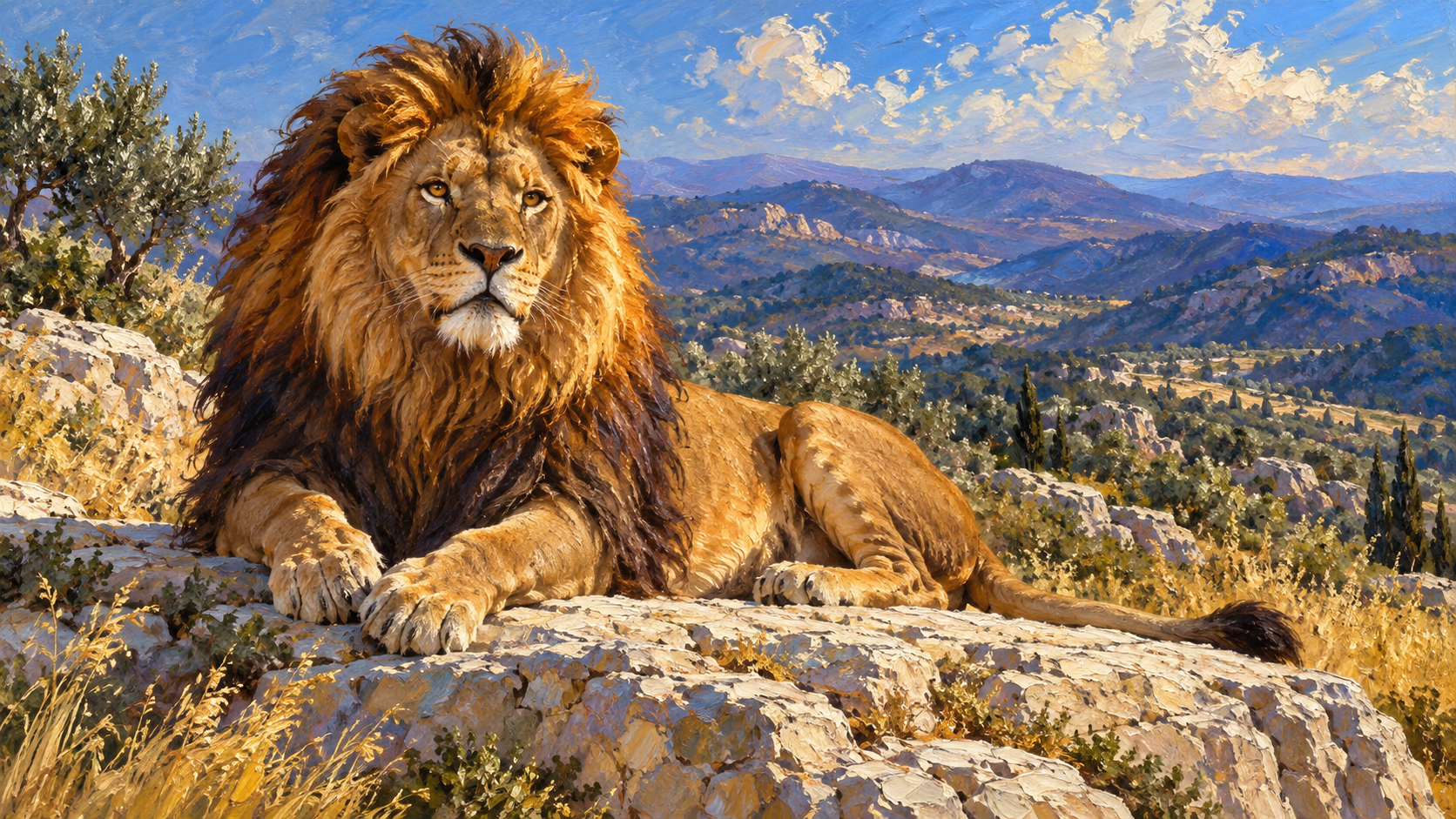
It is easy to move straight from Judah’s name to David and Jesus without spending much time with Judah himself. Yet Scripture introduces a man from a wounded family who committed serious sins of his own. I want to understand how God’s royal promise came through that man and ultimately leads us to Jesus, the Lion of the tribe of Judah. We also need to distinguish Judah’s calling from the honors God gave Joseph and Levi.
Judah’s Sin, Repentance, and Willingness to Stand in Another’s Place
When the LORD saw that Leah was unloved, He opened her womb; but Rachel was barren. So Leah conceived and bore a son, and she called his name Reuben; for she said, “The LORD has surely looked on my affliction. Now therefore, my husband will love me.” Then she conceived again and bore a son, and said, “Because the LORD has heard that I am unloved, He has therefore given me this son also.” And she called his name Simeon. She conceived again and bore a son, and said, “Now this time my husband will become attached to me, because I have borne him three sons.” Therefore his name was called Levi. And she conceived again and bore a son, and said, “Now I will praise the LORD.” Therefore she called his name Judah. Then she stopped bearing.
Judah was Jacob and Leah’s fourth son, born into a home wounded by rivalry and favoritism. With each of her first three sons, Leah spoke about Jacob’s affection and her hope that he would finally become attached to her. At Judah’s birth she turned directly toward the LORD and said, “Now I will praise the LORD.” That expression of praise introduces both Judah’s name and his place in Genesis.
The Hebrew name Yehudah is connected through inspired wordplay with yadah, the verb used here for praising or thanking. Understanding the words helps us hear the connection Genesis makes with Leah’s praise, but I wouldn’t take the name as a description of everything Judah did. His early life included grievous sin. God would show grace through him without hiding his guilt.
So Judah said to his brothers, “What profit is there if we kill our brother and conceal his blood? Come and let us sell him to the Ishmaelites, and let not our hand be upon him, for he is our brother and our flesh.” And his brothers listened. Then Midianite traders passed by; so the brothers pulled Joseph up and lifted him out of the pit, and sold him to the Ishmaelites for twenty shekels of silver. And they took Joseph to Egypt.
Judah persuaded his brothers not to murder Joseph, but selling him for profit was hardly a righteous alternative. He proposed the sale and joined in the deception that devastated their father. I find his acknowledgment of their family bond especially troubling: he knew Joseph was their own flesh and still treated him as something to sell.
The royal tribe therefore began with a man who needed repentance and mercy, not a spotless hero who already seemed suited to kingship. God’s later choice did not make Judah’s cruelty virtuous. It shows how His purposes could advance through this family while its members remained accountable for the evil they had done.
Genesis 38 exposes Judah’s hypocrisy through his dealings with Tamar. He had promised to give her his son Shelah but failed to do so. Later, when she concealed her identity and Judah slept with her, he left his signet, cord, and staff as a pledge. Hearing that she was pregnant, he demanded severe judgment. He did not yet realize that the possessions he had left with her would identify him.
When the evidence appeared, Judah confessed, “She has been more righteous than I.” I hear an admission of his broken promise and hypocrisy in that comparison, not a declaration that everything Tamar did was sinless. Scripture preserves this humiliating part of his life because Perez, the son born from their union, belongs to the Messianic genealogy. Matthew even names Tamar openly. God did not need to conceal the family’s sin for His work of redemption to proceed.
“Now therefore, when I come to your servant my father, and the lad is not with us, since his life is bound up in the lad’s life, it will happen, when he sees that the lad is not with us, that he will die. So your servants will bring down the gray hair of your servant our father with sorrow to the grave. For your servant became surety for the lad to my father, saying, ‘If I do not bring him back to you, then I shall bear the blame before my father forever.’ Now therefore, please let your servant remain instead of the lad as a slave to my lord, and let the lad go up with his brothers. For how shall I go up to my father if the lad is not with me, lest perhaps I see the evil that would come upon my father?”
Years later, Judah stood before Egypt’s ruler without realizing he was speaking to Joseph. Benjamin now faced enslavement, and Judah explained the grief his loss would bring Jacob. Since Judah had pledged himself as surety, accepting responsibility for Benjamin’s safe return, he offered to stay as a slave in his brother’s place.
Compare that offer with Genesis 37. Judah had helped sell one favored son, but now he was willing to lose his own freedom so another could go home. Joseph saw the change in his family and soon revealed himself. I see genuine growth in Judah too, without concluding that his better behavior purchased the royal promise. Grace had produced responsibility in him, but God did not owe him a kingdom as payment.
The Scepter Belonged to Judah, but Not Every Israelite Honor Did
“Judah, you are he whom your brothers shall praise; Your hand shall be on the neck of your enemies; Your father’s children shall bow down before you. Judah is a lion’s whelp; From the prey, my son, you have gone up. He bows down, he lies down as a lion; And as a lion, who shall rouse him? The scepter shall not depart from Judah, Nor a lawgiver from between his feet, Until Shiloh comes; And to Him shall be the obedience of the people. Binding his donkey to the vine, And his donkey’s colt to the choice vine, He washed his garments in wine, And his clothes in the blood of grapes. His eyes are darker than wine, And his teeth whiter than milk.
Jacob’s blessing takes up the meaning of Judah’s name as it describes the praise his brothers will give him. Judah will overcome his enemies, and his father’s children will bow before him. The lion pictures strength and safety under royal authority, while the scepter and lawgiver point to continuing rule. I also notice that the promise reaches beyond this one family, because it speaks of the obedience of peoples.
The final images describe abundance so great that a choice vine could serve as a tether and wine is pictured as wash water. We are reading poetry about royal prosperity, not instructions for laundering clothes. Through those images, the blessing looks toward a ruler whose dominion and provision exceed what Judah’s ordinary kings would ever accomplish.
The NKJV follows the Masoretic Text with the wording “Until Shiloh comes.” The exact derivation and meaning of Shiloh remain debated. Some take it as a personal title, while related explanations understand it as the one to whom rule belongs. I don’t want to claim certainty about each lexical detail when the royal setting already gives us something definite: Judah retains the scepter until the expected ruler comes, and peoples obey Him. Ezekiel 21:27 later uses similar language about rightful rule. The New Testament identifies that Davidic King from Judah as Jesus.
Two other Hebrew words help us understand that royal setting. Yehudah recalls Leah’s declaration of praise. Shevet can mean a staff or rod, but here it is translated “scepter,” expressing royal authority. Whatever questions remain about the form of Shiloh, the promise itself is unmistakably Messianic.
Now the sons of Reuben the firstborn of Israel–he was indeed the firstborn, but because he defiled his father’s bed, his birthright was given to the sons of Joseph, the son of Israel, so that the genealogy is not listed according to the birthright; yet Judah prevailed over his brothers, and from him came a ruler, although the birthright was Joseph’s–
Reuben was born first, but defiling his father’s bed cost him the birthright honor. Joseph received the double portion through Ephraim and Manasseh, while Judah prevailed among his brothers and supplied the ruler. These distinctions help me keep three things separate: being the biological firstborn, receiving the birthright portion, and carrying the royal line. Scripture does not give all three to Judah.
Levi’s tabernacle service and Aaronic priesthood were another distinct calling. Joseph received the double portion, and Judah supplied the royal line, while Levi served the sanctuary. Jesus eventually brings kingship and priesthood together through a different priestly order. He does not do so by making Judah part of Aaron’s house.
On the east side, toward the rising of the sun, those of the standard of the forces with Judah shall camp according to their armies; and Nahshon the son of Amminadab shall be the leader of the children of Judah.” And his army was numbered at seventy-four thousand six hundred. “Those who camp next to him shall be the tribe of Issachar, and Nethanel the son of Zuar shall be the leader of the children of Issachar.” And his army was numbered at fifty-four thousand four hundred. “Then comes the tribe of Zebulun, and Eliab the son of Helon shall be the leader of the children of Zebulun.” And his army was numbered at fifty-seven thousand four hundred. “All who were numbered according to their armies of the forces with Judah, one hundred and eighty-six thousand four hundred–these shall break camp first.
Judah’s standard stood on the east side of the tabernacle with Issachar and Zebulun, and that large formation broke camp first when Israel traveled. God gave Judah visible leadership generations before David became king. But leading the tribes did not make Judah a priestly tribe. The tabernacle remained at the center, with the Levites carrying out its appointed service.
Judah’s prominence continued in the land. Caleb was associated with Judah and received Hebron after showing persevering faith. After Joshua died, Israel asked who should go up first against the Canaanites. The LORD answered, “Judah shall go up. Indeed I have delivered the land into his hand” (Judges 1:2).
Judah’s victories did not make the tribe consistently obedient. Judges 1:19 tells us the LORD was with Judah, yet the inhabitants of the lowland remained because they had iron chariots. I don’t read that as a limit on God’s strength. The wider book shows Israel failing to obey completely as fear and compromise took hold, even though the LORD could fully give them victory. Their tribal privilege never replaced the need to trust and obey Him.
Joshua 15 describes Judah’s large southern allotment, from wilderness and lowland to the hill country and Negev. Bethlehem and Hebron later became central to its history. These were actual communities with responsibilities in the land, and we shouldn’t imagine that the whole region was fertile or naturally safe. Nearby Philistines and Edomites pressed against Judah, and the larger empires of Assyria and Babylon later threatened it. Geography did not automatically protect the tribe; its endurance depended on God’s covenant purpose.
Jerusalem’s location helps explain why we need care when assigning it to a tribe. Joshua 15 places Judah’s northern border near the city and records the tribe’s failure to drive out the Jebusites. Joshua 18 then lists Jebus, or Jerusalem, among Benjamin’s cities. The city lay in a boundary setting with related tribal claims. David later captured the Jebusite stronghold and made it his capital, where Solomon built the temple. Even there, Judah’s royal city and dynasty did not absorb the sanctuary duties that remained with the priests and Levites.
God Preserved David’s Throne Through a Failing Kingdom
Moreover He rejected the tent of Joseph, And did not choose the tribe of Ephraim, But chose the tribe of Judah, Mount Zion which He loved. And He built His sanctuary like the heights, Like the earth which He has established forever. He also chose David His servant, And took him from the sheepfolds; From following the ewes that had young He brought him, To shepherd Jacob His people, And Israel His inheritance. So he shepherded them according to the integrity of his heart, And guided them by the skillfulness of his hands.
David was Jesse’s youngest son and a shepherd in Bethlehem. After rejecting Saul, God sent Samuel to Jesse’s house and chose the son others had overlooked. Psalm 78 brings God’s choice of Judah and Zion together with His choice of David, whose calling was to shepherd God’s people with an upright heart and capable hands.
David served God’s purpose, yet his own life also showed why the covenant hope could not depend on a king’s personal merit. His adultery and arranged killing of Uriah brought terrible consequences. His failed family leadership and unlawful census added further grief. Israel needed more than David could give. It needed his greater Son, whose righteous reign would never fail.
“When your days are fulfilled and you rest with your fathers, I will set up your seed after you, who will come from your body, and I will establish his kingdom. He shall build a house for My name, and I will establish the throne of his kingdom forever. I will be his Father, and he shall be My son. If he commits iniquity, I will chasten him with the rod of men and with the blows of the sons of men. But My mercy shall not depart from him, as I took it from Saul, whom I removed from before you. And your house and your kingdom shall be established forever before you. Your throne shall be established forever.”
David wanted to build the LORD a house, but God promised to build David a house in the sense of a dynasty. Solomon fulfilled the near part of that promise as David’s own son who built the temple. When the passage speaks of discipline, it addresses sinful royal sons. God could correct them without withdrawing His covenant mercy.
Yet the word “forever” takes us beyond Solomon and every mortal king who followed him. The prophets continued to look for a righteous Branch from David, and Gabriel announced that Jesus would receive David’s throne and reign over Jacob’s house forever. I need to keep the promise of that throne distinct from the discipline for iniquity. The completely sinless Christ fulfills the everlasting reign without ever needing correction for sin.
The kingdom divided after Solomon’s sin and Rehoboam’s harsh answer. Jeroboam led the northern kingdom, commonly called Israel, while Rehoboam retained the southern kingdom called Judah. But that name does not tell us the ancestry of every person who lived there. 1 Kings 12:21 places both Judah and Benjamin under Rehoboam, and Levites and faithful people from other tribes moved south at different times. The kingdom took its name from its dominant tribe and Davidic throne.
The kings of Judah ranged from faithful reformers to hardened idolaters. Asa and Jehoshaphat led genuine reforms, and so did Hezekiah and Josiah. No revival permanently cured the nation’s rebellion. The royal line carried a promise that its own kings could not complete.
Babylon destroyed Jerusalem and the temple in the sixth century BC and carried many people away. Historians commonly use 586 or 587 BC for that destruction, depending on chronological conventions. I don’t think we need to force certainty between those dates to understand why the kingdom fell. God had repeatedly warned Judah about its idolatry and violence, along with its injustice and refusal to hear His Word. The fall brought that judgment upon them.
Cyrus later authorized the return and rebuilding of the temple. Groups returned under Zerubbabel and subsequent leaders such as Ezra and Nehemiah, though many Jewish people remained scattered throughout the wider world. We need to read the prophetic seventy-year passages in their own settings instead of assuming each measures exactly the same interval. Through judgment God still preserved the people and their genealogy, along with their connection to the land and their hope in David’s promised heir.
The Promised King Came From Judah and Gave Himself as the Lamb
The book of the genealogy of Jesus Christ, the Son of David, the Son of Abraham: Abraham begot Isaac, Isaac begot Jacob, and Jacob begot Judah and his brothers. Judah begot Perez and Zerah by Tamar, Perez begot Hezron, and Hezron begot Ram. Ram begot Amminadab, Amminadab begot Nahshon, and Nahshon begot Salmon. Salmon begot Boaz by Rahab, Boaz begot Obed by Ruth, Obed begot Jesse, and Jesse begot David the king. David the king begot Solomon by her who had been the wife of Uriah.
Matthew introduces Jesus Christ as the Son of David and the Son of Abraham, giving Him both royal and covenant titles. He traces the line through Judah and Perez to Jesse, then through David and Solomon. Along the way he openly names Tamar and Rahab as well as Ruth, and he refers to the woman who had been Uriah’s wife. Gentiles and widows appear beside kings and exiles in this record. Their inclusion helps me see God’s faithfulness to His promise without pretending human sin was absent from the family.
Both Matthew and Luke establish Jesus’ Davidic ancestry, although they arrange and trace their genealogies differently. Many readers understand Luke to trace Mary’s line, but Luke does not explicitly identify it that way. I would keep that explanation distinct from the conclusion the Gospels plainly announce: Jesus truly belongs to David’s house and fulfills the royal line.
“But you, Bethlehem Ephrathah, Though you are little among the thousands of Judah, Yet out of you shall come forth to Me The One to be Ruler in Israel, Whose goings forth are from of old, From everlasting.” Therefore He shall give them up, Until the time that she who is in labor has given birth; Then the remnant of His brethren Shall return to the children of Israel. And He shall stand and feed His flock In the strength of the LORD, In the majesty of the name of the LORD His God; And they shall abide, For now He shall be great To the ends of the earth; And this One shall be peace. When the Assyrian comes into our land, And when he treads in our palaces, Then we will raise against him Seven shepherds and eight princely men.
Bethlehem was David’s town, yet Micah called it little among Judah’s clans. From this modest place would come Israel’s ruler, whose goings forth are from old, from everlasting. Matthew 2 identifies Jesus’ birth there as the fulfillment of Micah’s prophecy.
Micah’s ruler will shepherd in the LORD’s strength and be great to the ends of the earth. He Himself will be peace. The One born in Bethlehem truly belongs to David’s family, yet His existence reaches beyond any ordinary human beginning. We are looking at One who is fully man from Judah and also the eternal Son who entered His creation.
Isaiah 11 portrays David’s royal house as a tree cut down to a stump, then describes a Rod from Jesse’s stem and a Branch growing from his roots. Life appears where the dynasty seemed finished. The Spirit of the LORD rests on this ruler, who judges righteously and brings the peace of Messiah’s kingdom. Revelation 22:16 calls Jesus both David’s Root and Offspring. I understand those two descriptions together: in His humanity He descends from David, yet as the divine Son through whom all things were made He existed before David.
But one of the elders said to me, “Do not weep. Behold, the Lion of the tribe of Judah, the Root of David, has prevailed to open the scroll and to loose its seven seals.” And I looked, and behold, in the midst of the throne and of the four living creatures, and in the midst of the elders, stood a Lamb as though it had been slain, having seven horns and seven eyes, which are the seven Spirits of God sent out into all the earth. Then He came and took the scroll out of the right hand of Him who sat on the throne. Now when He had taken the scroll, the four living creatures and the twenty-four elders fell down before the Lamb, each having a harp, and golden bowls full of incense, which are the prayers of the saints. And they sang a new song, saying: “You are worthy to take the scroll, And to open its seals; For You were slain, And have redeemed us to God by Your blood Out of every tribe and tongue and people and nation, And have made us kings and priests to our God; And we shall reign on the earth.”
The elder announced the Lion of Judah and Root of David, but John turned and saw a Lamb standing as though slain. The Lion and Lamb are the same Person. His royal victory came through His sacrifice, and the wounds testify to a completed death. Yet He stands alive, showing His bodily resurrection and living authority.
The new song explains His worthiness by pointing to His death and the people He redeemed to God by His blood from every tribe and nation. That was no display of theatrical weakness, nor was His victory won through brute conquest. The promised King willingly gave Himself and rose from the dead. He has the right to open the scroll and bring God’s purposes to their completion.
For He of whom these things are spoken belongs to another tribe, from which no man has officiated at the altar. For it is evident that our Lord arose from Judah, of which tribe Moses spoke nothing concerning priesthood. And it is yet far more evident if, in the likeness of Melchizedek, there arises another priest who has come, not according to the law of a fleshly commandment, but according to the power of an endless life. For He testifies: “You are a priest forever According to the order of Melchizedek.”
Moses assigned altar service to Aaron’s family within Levi, with no provision for a priest from Judah. Jesus’ ancestry would therefore exclude Him from Aaron’s office. Paul, the author of Hebrews, uses that fact to explain why Christ’s priesthood belongs to a different and greater order. Jesus did not seize an office for which He lacked the required ancestry. His authority belongs to the eternal order Scripture connects with Melchizedek.
I understand Melchizedek to be a Christophany, a real appearance of the eternal Son before His incarnation. He appeared as King of righteousness and King of peace while serving as priest of God Most High. Jesus serves in the power of an endless life. His kingship and priesthood meet without transferring Aaron’s office to Judah or to the church.
Judah’s Promise Reaches Christ’s Salvation and Future Reign
Jesus presently reigns at the Father’s right hand and will return bodily, so the Davidic promise is not exhausted by an invisible influence or by the church. Christ will gather His church before the Tribulation and judge the rebellious world. He will then save Israel’s believing remnant before establishing His literal thousand-year reign on earth.
God has not forgotten Judah or Israel. The apostles will sit on twelve thrones judging Israel’s twelve tribes, and Revelation continues to name those tribes in future prophecy. I can rejoice that Gentile believers share salvation in Christ without concluding that they become biological Judahites. God’s one work of redemption preserves the distinctions He made in His promises.
Looking back over Judah’s place among the tribes helps me avoid giving it every Israelite honor. Joseph held the birthright portion, while Levi held the Aaronic priesthood and Judah supplied the ruler. Even the southern kingdom contained Benjamin and people from other tribes. Jerusalem’s boundary setting also requires more care than a simple slogan allows. The northern tribes were scattered, but God never lost track of them.
The title Lion of Judah comes from royal prophecy, and Revelation shows us that Lion as the slain Lamb. That confidence does not require us to settle every question about the derivation of Shiloh, which belongs to the Messianic promise. Nor does Jesus’ certain Davidic ancestry depend on treating Mary’s genealogy as Luke’s explicit claim. Keeping those qualifications helps me affirm what Scripture says without adding certainty to an interpretation.
Jesus is the eternal Son, fully God and fully man. He was born of a virgin and is completely sinless, fulfilling Judah’s royal line without repeating Judah’s sin or David’s failures. Wicked men physically tortured and punished Him before killing Him, and He willingly bore that real punishment for our sins in His innocent body. Christ shed His blood and died for the whole world. He was buried and rose bodily. The Father did not punish or curse Jesus, nor did He abandon, strike, or bruise Him. He did not pour wrath on His Son.
The King’s offer of salvation is genuine and reaches beyond any one tribe or nation. People can resist and finally reject it, but everyone who repents and believes is forgiven and justified. God gives each believer new birth, making that person new, and the Holy Spirit indwells and seals them. Their salvation is eternally secure. We receive it through faith in Jesus Christ because of His blood, never through ancestry or law-keeping. Neither mediation through a human priest nor personal merit can provide it.
Eternal security does not turn rebellion into obedience or make a shallow profession saving faith. It gives no permission for lawlessness. The King who saves us commands holy lives shaped by love and truth, and we submit to Him with gratitude because we already belong to Him. Our obedience does not keep us born again.
Judah’s scepter and David’s throne point to Jesus, the only Savior and Mediator. He is also Micah’s ruler from Bethlehem and Isaiah’s Branch, with Revelation completing the witness by naming Him the Lion of Judah. I don’t want to stop at admiring a tribal emblem when these passages bring us to the living Christ. He bought sinners with His blood and will return to reign, and He calls for our trust.
For a broader view of the tribal setting, see The Twelve Tribes of Israel. The promises to David are examined more fully in The Davidic Covenant, and Isaiah’s royal image is developed in The Root of Jesse.
My Final Thoughts
Following Judah’s life leaves me with no reason to boast in human worthiness. God told the truth about his sin and produced real repentance while keeping a royal promise that no failing king could fulfill. That promise reaches Jesus, the Lion who conquered as the slain and risen Lamb. He is the King from Judah and our eternal Priest according to Melchizedek. Our confidence belongs in Him rather than in ancestry or religious merit. We should trust Him and live under His authority as we await His bodily return, encouraged by every promise God has kept.