
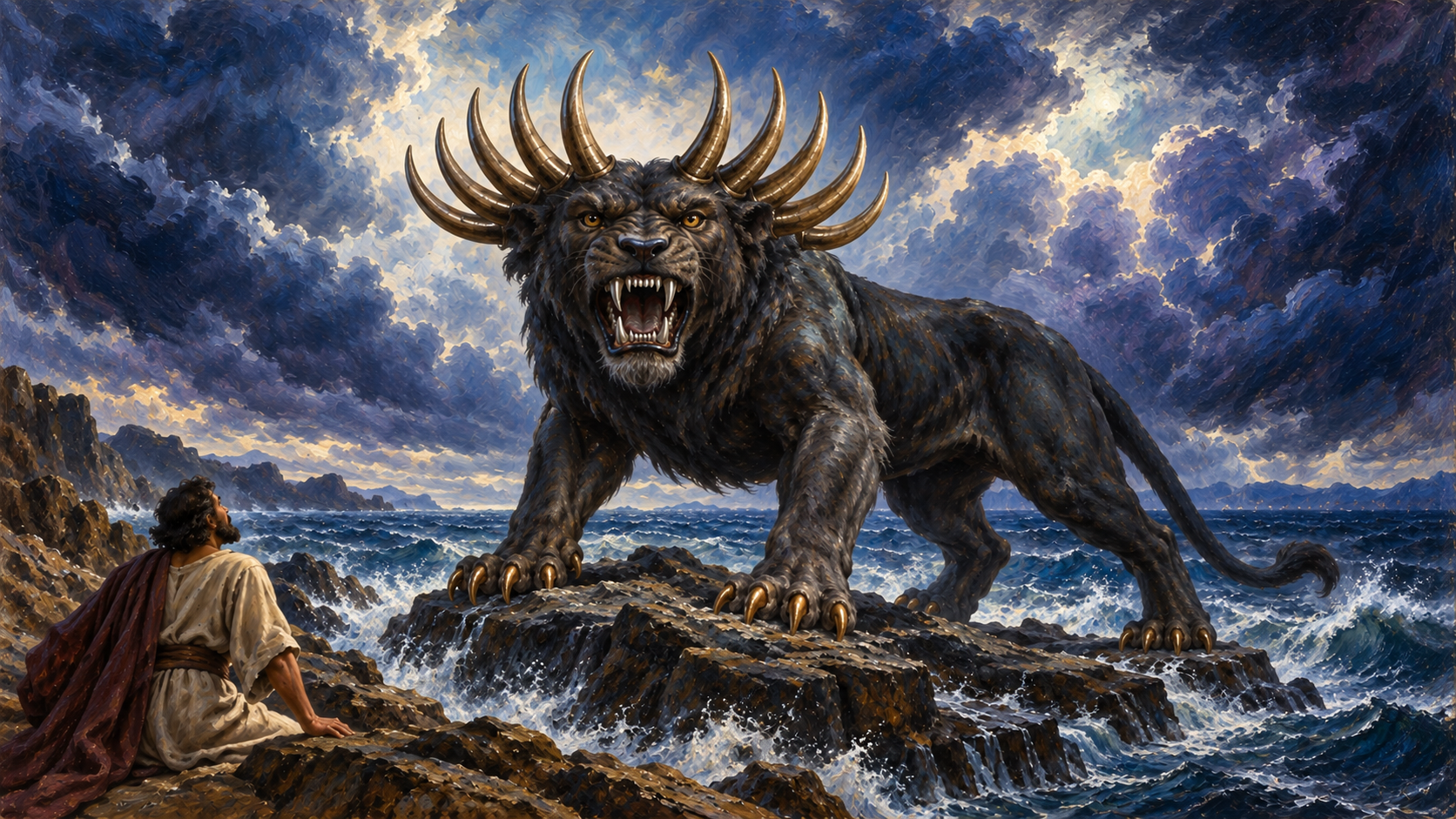
The ten horns appear again and again in Daniel and Revelation, so what are we supposed to understand when we see them? We do not need to match them with the latest headline or turn them into a vague picture of evil. Both books explain the image, and their explanations give us a firm place to begin.
What the Horns Represent
A horn often represents visible strength or royal power in Scripture. Since an animal uses its horn as a weapon, the image fits rulers who push against rivals and exalt themselves. But I don’t have to guess what these particular horns mean from the image alone. Daniel 7 and Revelation 17 identify them directly as ten kings.
The ten horns are ten kings Who shall arise from this kingdom. And another shall rise after them; He shall be different from the first ones, And shall subdue three kings.
The ten horns which you saw are ten kings who have received no kingdom as yet, but they receive authority for one hour as kings with the beast.
The explanation names ten kings connected with the final beast kingdom. That gives us something more definite than a general idea of political pride or a hidden philosophy. Scripture does not yet describe their kingdoms’ exact borders or political form, but it does tell us what the kings will do. They will receive authority for a short time and unite with the beast against the Lamb.
Those direct explanations give me a reason to be restrained about naming a modern leader as the final ruler. I need the text’s warrant for that identification, just as I do before calling a new alliance or economic system the beast system. Daniel received his visions within real history, and they also reach forward to real future events. Reading literally and in context requires attention to both. We need to understand the grammar and historical setting while following the interpretation Scripture provides.
Revelation unveils Jesus Christ, so the beast should not become the one who seems to control everything as we read. God already knows how the horns will rise and how their power will end. Alongside their power, the visions show us God’s throne and the Son of Man. The Lamb’s kingdom cannot be shaken, however threatening these rulers appear.
The Hebrew and Aramaic word commonly translated “horn” is qeren. It can name an animal’s horn, a horn on an altar, or a musical horn. It can also describe strength and exalted authority, including a prophetic image of rule. Understanding that range helps us read the passage accurately, but the context determines which meaning applies. Daniel 7 gives its own interpretation: these horns are kings.
John carries Daniel’s image forward with the Greek word keras, which means “horn.” Revelation 17 also uses exousia for the authority granted to these kings. The word describes a right or authority they receive. The passage also shows us the limits on their rule. Their power is real, but it is neither independent nor permanent. It lasts for a brief season and finally comes under Christ’s judgment.
Daniel’s Kingdom Pattern and the Fourth Beast
Reading Daniel 7 beside Daniel 2 helps us follow the succession of kingdoms. Nebuchadnezzar saw a great image whose head was gold and whose chest and arms were silver. Its belly and thighs were bronze, with legs of iron and feet of iron mixed with clay. Daniel explained that the image represented a sequence of kingdoms beginning with Babylon. The final stage would be divided and unstable, and then the God of heaven would establish a kingdom that could never be destroyed.
Daniel 7 follows the same broad movement, but Daniel saw four beasts instead of a human statue. They represented Babylon, Medo-Persia, Greece, and the fourth kingdom. The dreadful fourth beast caught his attention because it was unlike the others. It had iron teeth and bronze nails, with tremendous strength and ten horns.
I notice that iron appears in both visions. The statue’s legs in Daniel 2 are iron, and the fourth beast in Daniel 7 has iron teeth. The feet and toes in Daniel 2 combine iron with clay, so strength is present alongside instability. Daniel 7 shows the same final kingdom through its ten horns and the ruler who rises among them. Those connections help me follow both visions toward the same outcome: divided Gentile rule gives way to God’s everlasting kingdom.
The ten horns therefore belong to the fourth-beast kingdom. They are not ten random governments chosen from different parts of history. Daniel is showing a final expression of Gentile imperial power that stands against God. That power is destroyed when dominion is given to the Son of Man and to the saints of the Most High. The broader prophetic sequence is covered in more detail in The End Times Timeline, but Daniel gives us the foundation here.
While Daniel was considering the ten horns, a little horn came up among them and three of the first horns were pulled out before it. The new horn had eyes like a man and a mouth speaking proud words.
I was considering the horns, and there was another horn, a little one, coming up among them, before whom three of the first horns were plucked out by the roots. And there, in this horn, were eyes like the eyes of a man, and a mouth speaking pompous words.
The angel explained that the little horn would rise after the ten kings and subdue three of them. He would speak against the Most High and persecute the saints. He would also intend to change times and law. Daniel 7:25 limits his rule to “a time and times and half a time”, and Revelation gives matching periods of forty-two months and 1,260 days. These descriptions fit the future Tribulation, especially its intense second half following the midpoint crisis.
Daniel does not give the whole New Testament sequence in this one vision, so I would not try to force every later detail into it. But he does show that the ruler’s authority begins and ends within limits set by heaven. The saints will suffer a real attack, yet heaven never loses jurisdiction over their persecutor. Judgment is already part of the vision; God’s court is not left scrambling to respond to his rise.
The little horn matches the final Antichrist, whom Paul calls the man of sin and the lawless one in 2 Thessalonians 2. He is an individual, not merely a symbol of arrogant rulers in general. His proud speech and persecution correspond to the beast in Revelation 13, as does the limit on his authority. Paul says he will exalt himself above all that is called God or worshiped. Yet the Lord Jesus will consume him with the breath of His mouth and destroy him by the brightness of His coming.
John said that many antichrists had already come, and many rulers have shown that same spirit. Scripture still points ahead to a final individual, though. I can recognize the pattern in other rulers without claiming to know who that final man is before God makes it plain. The prophetic timing behind this period is developed further in The 70 Weeks of Daniel.
The vision in Daniel 7 does not leave us watching the little horn indefinitely. God’s court sits in judgment, the beast is slain, and the horn loses his dominion. The Son of Man receives everlasting rule, and the kingdom is given to the saints of the Most High. That is what encourages me as I read about such terrible power. If I stop before God’s judgment, I leave out the very part that shows why the horns cannot prevail.
Why Daniel 8 Belongs in the Study
Daniel 8 gives us another explanation of horn imagery, though its historical setting is different. Daniel saw a ram with two horns and a male goat with one notable horn. The angel then identified what those images represented.
The ram which you saw, having the two horns; they are the kings of Media and Persia. And the male goat is the kingdom of Greece. The large horn that is between its eyes is the first king.
The ram’s horns are the kings of Media and Persia. The goat represents Greece, and its large horn is the first king. When that horn is broken, four kingdoms arise from the Greek nation. This gives us another clear example of horns representing rulers or ruling powers.
The angel’s explanation helps me see how a vision can refer both to a ruler and to the kingdom he represents. The goat is Greece, while its large horn is the first king. The four horns that replace it stand for later kingdoms from that nation. I need to follow those distinctions rather than demand one rigid definition every time a horn appears. In one sentence the emphasis may be on the man, and in another on the power organized under him.
That connection does not make Daniel 8 another account of everything in Daniel 7. Daniel 8 looks toward the Greek era, and its fierce ruler has a historical fulfillment in Antiochus Epiphanes and his desecration of the sanctuary. Antiochus also gives us a pattern of blasphemous opposition that will reach its fullest form in the last days. His pride and persecution help us understand what that opposition looks like, but he is not the complete final Antichrist of Daniel 7 and Revelation 13.
Daniel 8 therefore helps me understand the horn imagery without taking its events out of their historical setting. A symbol may appear in several visions without every detail referring to the same person or moment. Recognizing the shared image does not settle every question about its fulfillment.
The Beast and the Ten Kings in Revelation
Revelation 13 takes up Daniel’s beast imagery as John sees a beast rise from the sea with seven heads and ten horns. The horns bore ten crowns, while a blasphemous name appeared on the heads. The dragon gave the beast his power and throne along with great authority. This is the final form of world power energized by Satan.
Then I stood on the sand of the sea. And I saw a beast rising up out of the sea, having seven heads and ten horns, and on his horns ten crowns, and on his heads a blasphemous name.
The crowns identify the horns’ royal authority, though Revelation 13 leaves their detailed explanation until Revelation 17. The beast blasphemes God and His name, as well as His tabernacle and those who dwell in heaven. He is allowed to make war against the saints for forty-two months. Both that opposition and the limit on it closely follow Daniel 7.
The dragon gave the beast a throne and great power, and the world marveled after the beast. We are seeing more than ordinary politics here: political authority has become an instrument of open worship and rebellion against God. Even so, Revelation describes the beast’s authority as “given” to him. I need to keep that limit in view while considering Satan’s part in this kingdom. Satan energizes it, but he cannot prolong its rule beyond what God permits.
I believe these saints belong in the Tribulation setting. The church will be gathered to Christ before that period, yet people will still turn to the Lord and bear witness during it. The beast’s war against those saints does not cancel Christ’s promise to gather His church before the hour of trial. It shows that God will continue to have faithful witnesses during the beast’s brief reign. The related passages are examined more fully in Matthew 24-25 and The Pre-Tribulation Rapture.
Revelation 17 explains the final coalition most clearly. These ten kings had not yet received kingdoms in John’s day, but they will receive authority with the beast for “one hour.” I understand that phrase as a very short, limited season under God’s rule. It does not give me an exact duration to calculate.
These are of one mind, and they will give their power and authority to the beast. These will make war with the Lamb, and the Lamb will overcome them, for He is Lord of lords and King of kings; and those who are with Him are called, chosen, and faithful.
The ten kings will willingly hand their authority to the beast and unite behind him. Their rebellion will finally become open war against Christ. The Lamb will overcome them because He is Lord of lords and King of kings. Their titles do not put them outside His rule. They can form a coalition for a moment, but they cannot bring an end to His dominion.
The Seven Heads, the Harlot, and the Final Rebellion
The seven heads and ten horns belong to the same beast image, but they are not the same thing. Revelation 17 says the heads are seven mountains and also seven kings. Five have fallen, one exists in John’s day, and another is still to come for a short time. The beast who was and is not is also called the eighth. He belongs to the seven and goes to destruction.
I need to distinguish that sequence of heads from the ten horns. The heads trace beastly world power through history: some kingdoms had passed before John wrote, one ruled in his day, and another stage still lay ahead. The final beast will bring that rebellious pattern to its climax. The ten horns, however, are kings who rise together in the final stage and give their power to the beast. Keeping those two descriptions distinct helps me avoid claiming more than this dense passage explains.
The heads show successive expressions of beastly rule, while the horns show the last coalition of kings. I can understand that distinction without trying to attach every new political alliance to the vision. God knows the final rebellion beforehand and keeps it within limits. The outcome is already clear: it cannot win.
The beast “was, and is not,” yet appears again before going to perdition. I cannot explain every detail of how that description will be fulfilled, but its direction is clear. The last beast belongs to the older history of rebellion and becomes its final personal expression. We can be confident about that movement while admitting that the passage has not yet made every detail plain.
Revelation 17 also shows the harlot riding the beast for a time. She represents a corrupt world system marked by idolatry and spiritual unfaithfulness. Her wealth seduces the earth, and she persecutes God’s people. The ten kings will eventually turn against her in hatred. They will make her desolate and consume her. They will also burn her with fire. The identity and character of this system receive a fuller treatment in The Harlot of Babylon.
Revelation 17:17 says that God puts it into the kings’ hearts to fulfill His purpose. I need to hold that statement together with what the vision shows about the kings themselves. Their violence is wicked and self-serving, and they act according to their own desires. God does not make their evil righteous. Yet He uses their rebellion to judge the corrupt system they once supported, so even those actions remain under His providence.
Destroying the harlot will not end the coalition’s rebellion. In Revelation 19, the beast and the kings of the earth gather to fight Christ, who defeats them. The beast and false prophet are cast into the Lake of Fire. Their kingdoms cannot determine the final outcome because that belongs to the Lamb.
How to Read This Prophecy Faithfully
Daniel 7:24 and Revelation 17:12 call the horns kings. That is where I need to begin, allowing Scripture to explain its own symbol. Reducing the horns to a private code or an invisible force would set aside that explanation, as would treating them as a general political mood.
We can follow the explanation from one passage to the next. Daniel 7 introduces the ten kings and the little horn who subdues three of them. Daniel 8 shows in its Medo-Persian and Greek setting that horns can represent rulers. In Revelation 13, the horns wear crowns on the beast empowered by the dragon. Revelation 17 then explains how the kings unite with the beast and destroy the harlot before finally fighting the Lamb. Each passage adds to our understanding without overturning the plain interpretation in the others.
Teachers in many generations have identified the ten kings with whatever international group or treaty seemed important at the time. Those guesses usually failed as history moved on. That should make me reluctant to name rulers whom Scripture has not yet identified for us. We can speak confidently about what it does say without pretending it has given us their names.
Daniel 8 must remain in its own setting, even while it helps explain the symbolism. The Greek-era ruler provides a real historical pattern of blasphemous power. Daniel 7 and Revelation carry us beyond that pattern to the final kingdom and its ruler.
We should also keep Israel and the church distinct. The church’s blessed hope is to be gathered to Christ before the Tribulation. Israel still has a future in God’s prophetic plan, and saints who believe during the Tribulation will remain faithful through terrible oppression.
Prophecy should lead us toward worship and endurance because Revelation centers on Jesus Christ. The beast never takes His place. I do not need to build my confidence on a theory about current events or live in fear of every political development. The Lord already knows the final coalition and has declared its end, so our hope rests in Him.
That confidence does not mean ignoring the character of rulers or the growth of open rebellion. We still need to watch and discern, testing what we see against Scripture. But our guesses must not acquire the authority of revelation. If a theory has to be rebuilt whenever the news changes, it cannot provide a sound foundation for Christian confidence.
The pride described in these visions is already at work in the world, so they also prepare us to face pressure now. I must not trade truth for safety or join the idolatry of the age. We are called to proclaim the gospel while trusting God’s timing, and Revelation 17 gives us reason for that trust: His providence is greater than the schemes of wicked rulers.
The rulers remain responsible for handing their power to the beast and making war against Christ. God’s providence does not excuse those choices, but it does mean their wickedness can never trap Him or redirect His plan. He can use one evil system to judge another and then judge the instrument He used. That gives me confidence when earthly powers look united and unstoppable.
The gospel is the urgent part of that witness. Jesus physically bore the punishment for our sins in His innocent body through real torture, the shedding of His blood, and death. He was buried and rose bodily. The Christ who now saves every sinner who comes to Him in faith will also return as King and Judge. Prophecy should therefore draw us to repentance, steady faith, and worship rather than speculation.
My Final Thoughts
After comparing Daniel and Revelation, I believe the ten horns are ten future kings who receive brief authority with the final beast and unite behind him. Their power will be real, and their persecution will be terrible, but neither lasts beyond the limit God has set. The same visions that show the horns also show the Son of Man receiving His kingdom and the Lamb overcoming every ruler gathered against Him. That keeps prophecy from becoming either entertainment or a source of panic. We can watch carefully without allowing our guesses to become doctrine. We can live faithfully because Jesus Christ is Lord of lords and King of kings.