
In Matthew 24 and 25, Jesus speaks about the temple’s destruction before describing the coming Tribulation and His own return. That is a lot to follow, so I want to begin with the disciples’ questions and work through His answer in the order He gives it. We need to distinguish the church’s promised gathering to Christ from the events involving Israel and the nations during the Tribulation. Through it all, His call to faithfulness concerns every reader.
Daniel and Revelation give us essential prophetic context, and other passages describe the gathering of the church. But Matthew 24 and 25 need to remain at the center of this discussion, allowing Christ’s own sequence here to guide our understanding.
The Temple and the Mountain
The disciples admired the temple buildings, and it is easy to understand why. Herod’s temple was massive and beautiful, standing at the center of Jewish life. Its stones and courts were part of the religious world of first-century Israel, along with its sacrifices and ceremonies. To many who looked at it, the whole structure must have seemed permanent.
After leaving the temple area, Jesus crossed toward the Mount of Olives. From that ridge east of Jerusalem, He and the disciples could look back across the Kidron Valley toward the temple complex. They discussed His prediction while the threatened buildings remained in view. That setting explains why one conversation moves from the temple’s fall to events in Jerusalem and Judea before reaching the end of the age and the Son of Man’s return.
And Jesus said to them, “Do you not see all these things? Assuredly, I say to you, not one stone shall be left here upon another, that shall not be thrown down.”
Jesus answered their admiration by saying that the stones would come down. He meant the actual destruction of the temple in Jerusalem, not simply spiritual decline. Roman armies devastated Jerusalem in AD 70, fulfilling that warning. I need to keep that historical event in view rather than turn the passage into a collection of symbols.
Yet AD 70 cannot account for everything Jesus described. He spoke of worldwide deception and tribulation unlike anything before or after it. Cosmic signs would precede the Son of Man’s coming on the clouds with power and great glory, followed by judgment at the end of the age. Jerusalem’s destruction was a real judgment and a preview of what was coming, but Jesus also looked ahead to the final period before His public return.
Scripture often places a near event and a future climactic event within the same prophecy. The near fulfillment confirms God’s word and helps us recognize the shape of what lies ahead. The future event then brings the prophecy to its full appointed end.
Shaken by His statement, the disciples questioned Jesus privately. They wanted to know when the temple would fall, but they also asked about the sign of His coming and the end of the age. Their questions help us follow the different parts of His answer.
Now as He sat on the Mount of Olives, the disciples came to Him privately, saying, “Tell us, when will these things be? And what will be the sign of Your coming, and of the end of the age?”
The disciples connected the temple’s destruction with the end, which helps me understand why Jesus answered as He did. He kept their questions together without treating them as one event. His answer addressed what would happen to Jerusalem and then looked ahead to His coming and the end of the age.
The Greek word parousia, translated coming in Matthew 24:3, can describe a presence or an arrival. The context tells us what sort of arrival Jesus meant: the Son of Man visibly returning in glory as King. A private rumor or local appearance would not fit that description.
Jesus began His answer with a warning: “Take heed that no one deceives you.” His warning directs my attention to deception rather than to finding a date. His first concern was not whether believers would follow the news closely enough, but whether people would be deceived about Christ.
After warning about deception, Jesus spoke of wars and the rumors surrounding them. Nations would rise against one another amid famines and pestilences, with earthquakes adding to the suffering. These terrible events are real, but none marks the end by itself. Turmoil in a fallen world does not give anyone grounds to announce the day and hour.
And you will hear of wars and rumors of wars. See that you are not troubled; for all these things must come to pass, but the end is not yet.
We should neither declare a final countdown whenever a war or disaster occurs nor dismiss Jesus’ warnings because such things have happened throughout history. He corrects both responses by calling these troubles the beginning. They reveal a world under judgment, but they do not by themselves mark the end.
For nation will rise against nation, and kingdom against kingdom. And there will be famines, pestilences, and earthquakes in various places. All these are the beginning of sorrows.
The beginning of sorrows carries the picture of birth pains, which increase and tighten as birth approaches. Jesus was describing trouble moving toward an appointed end, not history wandering aimlessly. Its intensity will grow, but the timing remains in God’s hands.
I can take the world’s suffering seriously without giving way to panic. Jesus said these things would come and wanted His people to remain steady. The world may be shaken, but God’s throne is not.
The pressure Jesus described also reaches His people through hatred and betrayal. False prophets add to the danger, while growing lawlessness causes love to grow cold. Those conditions will intensify as the end approaches, so we cannot separate this prophecy from discipleship. Those who belong to Christ must expect the world to hate what it cannot control.
“Then they will deliver you up to tribulation and kill you, and you will be hated by all nations for My name’s sake. And then many will be offended, will betray one another, and will hate one another.”
Enduring to the end does not earn eternal life. Scripture teaches salvation by grace through faith rather than works, and endurance shows that faith at work under pressure. In this passage, Jesus also connects endurance with deliverance through a specific period of trouble.
But he who endures to the end shall be saved. And this gospel of the kingdom will be preached in all the world as a witness to all the nations, and then the end will come.
I find hope in the gospel continuing to reach the nations even as judgment approaches. Deception and persecution do not stop God from bearing witness or saving people. An unstable world still needs to hear His message.
The gospel is not a vague announcement that history will improve. It is the good news that Jesus Christ, the eternal Son of God, came in the flesh and lived without sin. He physically bore the punishment for the sins of the whole world in His innocent body and shed His blood. Wicked men crucified Him within God’s foreknown saving purpose; the Father did not mistreat Him. Jesus died and was buried, then rose bodily from the dead.
God’s offer is genuine, and people may resist it. Those who repent and believe are born again. The Holy Spirit indwells and seals them, and God keeps them eternally secure. That security does not excuse lawlessness, and a shallow claim to believe is not proof that someone was genuinely born again. This is the message that must keep going out until the end comes.
The Turning Point Sign
Jesus then moved from general conditions to a specific sign, the abomination of desolation. He directed the reader to Daniel to understand it. That instruction tells me where to look for an explanation: Scripture must interpret Scripture.
“Therefore when you see the ‘abomination of desolation,’ spoken of by Daniel the prophet, standing in the holy place” (whoever reads, let him understand), “then let those who are in Judea flee to the mountains.”
An abomination is something detestable to God, often idolatry that profanes what is holy. Desolation describes the ruin that follows. Daniel connected this future defilement with sacrifice and the sanctuary during a final period of trouble. Jesus still spoke of it as future during His earthly ministry and warned that the resulting crisis would require people in Judea to flee immediately.
Daniel 9:27 places this event within the final prophetic week. In the chapter’s pattern, one week represents seven years. A coming ruler confirms a covenant for that period and then brings sacrifice and offering to an end in the middle of the week. The midpoint divides the seven years into two halves. Daniel 12 and Revelation describe that final half with equivalent periods: a time, times, and half a time; forty-two months; and 1,260 days. This is the biblical basis for calling the future Tribulation a literal seven-year period rather than an arbitrary prophetic timetable.
Paul helps us understand the same kind of blasphemy in his description of the man of sin. This man exalts himself and takes a blasphemous place connected with the temple of God.
Let no one deceive you by any means; for that Day will not come unless the falling away comes first, and the man of sin is revealed, the son of perdition, who opposes and exalts himself above all that is called God or that is worshiped, so that he sits as God in the temple of God, showing himself that he is God.
Notice how specific Jesus was about the people who must flee. He named Judea and directed them toward the mountains, warning those on housetops or in fields not to turn back even for a cloak. Pregnancy and nursing would make escape harder, as would winter. His mention of the Sabbath also places the warning in a real Jewish setting. I cannot turn those details into an abstract picture of spiritual decline. A future defilement will put people in actual danger and require them to flee.
Jerusalem’s horrific fall in AD 70 remains a historically significant preview, but it does not fulfill the whole description in Matthew 24. The abomination connected with Daniel and the unparalleled Tribulation reach beyond it. Christ’s visible coming confirms that Jesus was also describing the future end-time fulfillment.
Great Tribulation
Jesus called the period following the abomination great tribulation. The Greek phrase thlipsis megale means great distress or affliction, describing the unique severity of what He went on to explain.
For then there will be great tribulation, such as has not been since the beginning of the world until this time, no, nor ever shall be. And unless those days were shortened, no flesh would be saved; but for the elect’s sake those days will be shortened.
Jesus also said that the suffering would have a limit: the days will be shortened for the elect’s sake. However terrifying evil becomes, it does not control how long this period lasts. The Antichrist’s rage and false prophecy remain within God’s boundary, along with persecution and judgment. God knows its exact length and will not allow it to exceed His decree.
I read this passage within a pre-Tribulation and premillennial framework. By pre-Tribulation, I mean that the Lord gathers His church before the hour of trial comes upon the whole world. Premillennial means that Christ returns before establishing His kingdom reign. The church is not appointed to wrath, and Paul’s description of believers being caught up is distinct from the public return in Matthew 24. This discourse focuses on Israel and the nations during the Tribulation before Christ appears publicly after that period.
Because Christ can gather His church at any time, I should be pursuing holiness and staying busy with the gospel. That hope gives me no reason to become spiritually sleepy or make peace with sin. Understanding prophecy should purify my hope, not give me something to be proud of.
The Public Coming
Jesus warned that people during the Tribulation would claim Christ had appeared in the wilderness or in inner rooms. He told His people not to believe them. False christs and prophets will perform signs and wonders powerful enough to deceive, if possible, even the elect.
“Therefore if they say to you, ‘Look, He is in the desert!’ do not go out; or ‘Look, He is in the inner rooms!’ do not believe it. For as the lightning comes from the east and flashes to the west, so also will the coming of the Son of Man be.”
An impressive sign cannot make a false prophet trustworthy. Scripture tests spiritual claims by truth, so someone who contradicts God remains false however powerful he appears. Before accepting such a claim, I need to ask whether it agrees with Christ’s words. The strength of an experience cannot answer that for me.
Christ’s true coming will not depend on a rumor or be confined to a cave or inner room. No city or private group will have Him exclusively to themselves. Accompanied by cosmic signs, His coming will flash across the sky like lightning. The Son of Man will come on heaven’s clouds with power and great glory.
Immediately after the tribulation of those days the sun will be darkened, and the moon will not give its light; the stars will fall from heaven, and the powers of the heavens will be shaken. Then the sign of the Son of Man will appear in heaven.
This is the King’s public appearing after the Tribulation. It must be distinguished from the church being caught up to meet the Lord in 1 Thessalonians 4. Paul describes the Lord descending as the dead in Christ rise. Living believers are then caught up with them to meet Him in the air. Matthew 24 instead describes the Son of Man coming in glory after the Tribulation with the nations in view.
I look for Christ to gather His church, and I also look for Him to return publicly to judge and reign, setting the world right. Both promises belong to our hope. Letting each passage speak in its own context keeps me from forcing every prophetic event into the same moment.
Jesus used the fig tree to explain how people recognize that a season is near. Tender branches putting forth leaves announce the approach of summer. In the same way, those alive when the appointed signs unfold will recognize that the time is near, at the doors. The lesson concerns recognition, not calculating a date.
“Now learn this parable from the fig tree: When its branch has already become tender and puts forth leaves, you know that summer is near. So you also, when you see all these things, know that it is near – at the doors!”
The signs have meaning, but recognizing them does not give us control over God’s calendar. Jesus immediately went on to say that no one knows the day or hour. We need to hear that limit alongside the fig tree lesson.
Then Jesus says, “This generation will by no means pass away till all these things take place.” Because the discourse includes the near judgment on Jerusalem and the final end-time fulfillment, we need care. The generation that saw Jerusalem fall saw a real fulfillment of Jesus’ temple warning. The generation that sees the final cluster of signs will see the end-time events reach their completion. Either way, Jesus anchors interpretation in the certainty of His words.
Heaven and earth will pass away, but My words will by no means pass away.
Even the visible creation is less permanent than Christ’s word. That gives me something to rely on when events are confusing: His words cannot fail, however solid the world around us may seem.
After describing the signs, Jesus made clear what men and angels do not know: the day and hour. We are therefore called to watch. The Greek verb gregoreo, often translated watch, carries the sense of staying awake and remaining alert, which helps us understand the response He wanted.
“But of that day and hour no one knows, not even the angels of heaven, but My Father only. But as the days of Noah were, so also will the coming of the Son of Man be.”
In Noah’s day, people continued eating and drinking, marrying and forming families until judgment suddenly arrived. Those ordinary activities were not sinful in themselves. The danger was living as though God’s warning did not deserve attention. Jesus used that spiritual blindness to explain how unprepared people will be for His coming.
This context helps with the difficult saying about one person being taken while another is left. In the comparison with Noah, the flood took the unprepared away in judgment while Noah and his family remained alive. Many readers therefore understand those taken in Matthew 24 as being taken in judgment. Others connect the language with a gathering. The passage does not stop to settle every debate because its main point is direct. Judgment will divide people suddenly and personally, regardless of how close they appeared outwardly.
Working beside someone in a field or at a mill does not mean sharing that person’s readiness. Neither does sitting in the same church and hearing the same sermons. Two people who appear close may face very different ends. I need to belong to Christ myself, because being near Christians cannot take the place of that relationship.
Jesus closed Matthew 24 by describing a faithful and wise servant alongside an evil one. Their conduct while the master was away revealed the difference between them. The faithful servant continued feeding the household at the proper time, carrying out the assignment he had already received.
The evil servant treated his master’s delay as permission to mistreat the other servants and indulge his appetites. He acted as though he would never have to answer for it. The delay exposed what was already in his heart, showing that he used the language of service without truly honoring his absent master.
Blessed is that servant whom his master, when he comes, will find so doing.
That picture helps me understand watchfulness as active loyalty to the Master. The servant who trusts Him cares for the people entrusted to him and does the work he has been given while the Master is away. The one who despises Him uses the same delay as an excuse for sin. Waiting for Christ therefore involves service under His authority, not simply looking at the sky.
Matthew 25 continues Jesus’ teaching about watchfulness with a wedding picture. Ten virgins went out to meet the bridegroom, all carrying lamps and appearing to belong to the waiting company. Yet five were wise and five were foolish.
Those who were foolish took their lamps and took no oil with them, but the wise took oil in their vessels with their lamps.
The bridegroom’s delay revealed whether their apparent readiness was real. The wise virgins were prepared even though he took longer than expected, while the foolish were not ready when he arrived. I want to keep that contrast in view rather than become absorbed in questions about every wedding custom.
Jesus did not assign the oil a detailed doctrine, and I would not supply one for Him. The visible lamps and place among the waiting group did not give the foolish virgins what they needed when the bridegroom came. They appeared ready until the decisive moment exposed the difference.
And while they went to buy, the bridegroom came, and those who were ready went in with him to the wedding; and the door was shut.
The shut door should make us stop and think about the invitation we have now. It will not remain open forever, and no one can borrow another person’s readiness once the waiting ends. My family name cannot save me. Neither can church attendance or familiarity with religious things, because each of us must belong to Christ.
Christ saves the sinner who trusts His blood and rests in His death and resurrection, so vigilance does not earn salvation. Yet saving faith produces a real response to the Lord instead of an empty appearance. That is why the parable ends by calling us to watch when we do not know the day or hour.
The next parable turns from readiness to stewardship. Before traveling to a far country, a man entrusts his property to servants and assigns different amounts according to their ability. Two faithfully put the property entrusted to them to work and gain more. The third buries what he received and later tries to make the master responsible for his refusal to act.
His lord said to him, “Well done, good and faithful servant; you were faithful over a few things, I will make you ruler over many things. Enter into the joy of your lord.”
I notice that the faithful servants were not praised for producing identical totals. Each was praised for how he handled what the master had entrusted to him. The Lord calls us to loyal stewardship under His authority, rather than competition with one another. A larger trust brings greater responsibility, but receiving less never excuses unfaithfulness.
The wicked servant called the master hard and tried to present the buried talent as though merely keeping it were obedience. His own words revealed a false view of the master, which he used to excuse his refusal to act. The problem was not a lack of business skill. He spoke of fear while defending his rebellion.
And cast the unprofitable servant into the outer darkness. There will be weeping and gnashing of teeth.
The false servant’s severe end does not teach that productivity buys eternal life. Jesus was showing how His true servants regard what He entrusts to them as holy. They do not bury His assignment and then blame Him when He returns.
That stewardship includes the time and teaching Christ has entrusted to me, along with spiritual gifts and material resources. His authority also reaches my influence and the people in my care, as well as the work before me. We do not all carry the same responsibilities, but we answer to the same Lord. Being ready means faithfully doing His work until He returns.
The Sheep and the Goats
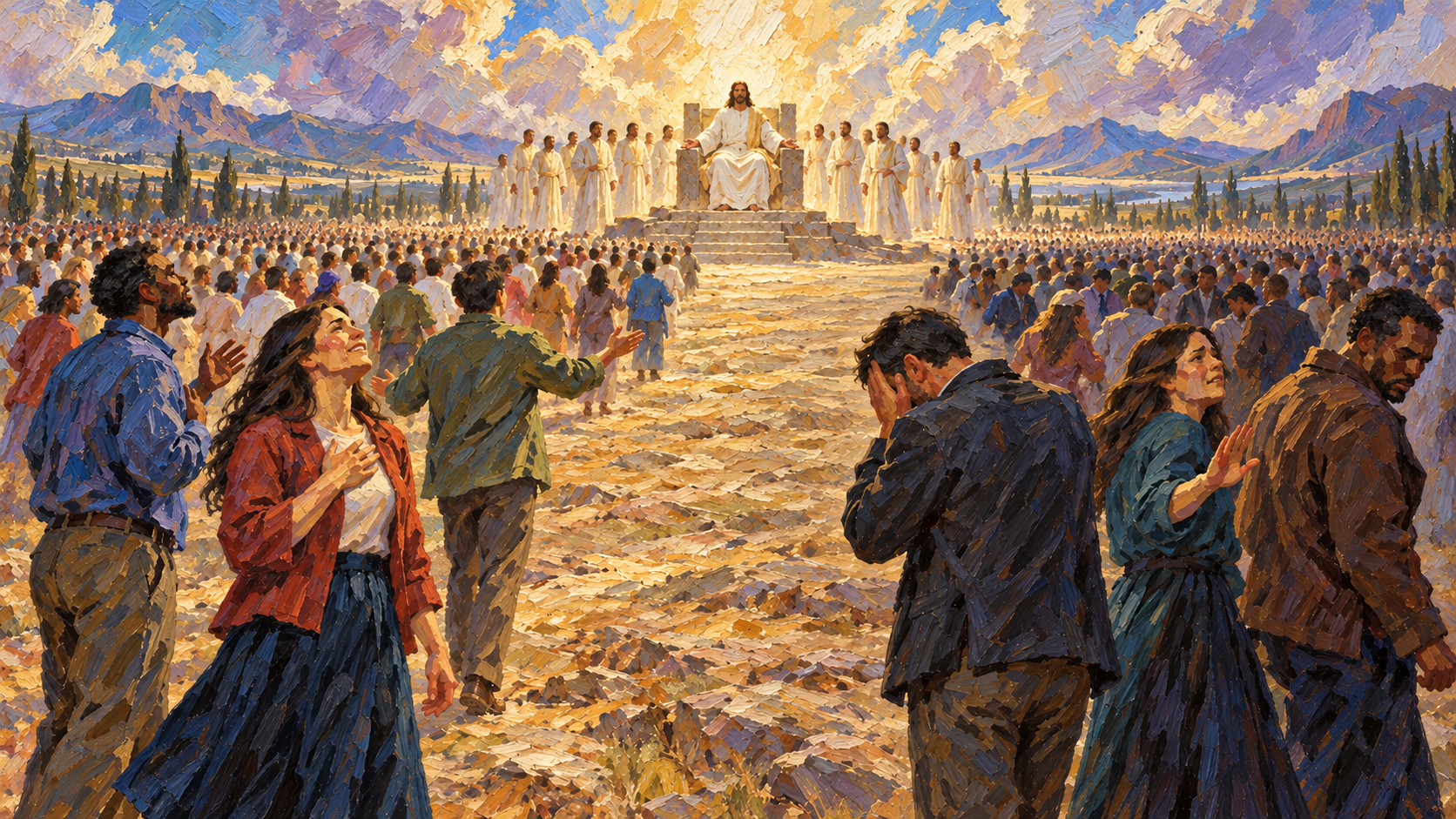
Jesus then described the Son of Man coming in glory with the holy angels and gathering the nations before Him. This is a scene of royal judgment after His public appearing, rather than another ordinary parable drawn from daily life.
When the Son of Man comes in His glory, and all the holy angels with Him, then He will sit on the throne of His glory. All the nations will be gathered before Him, and He will separate them one from another, as a shepherd divides his sheep from the goats.
The sheep inherit the kingdom prepared for them from the foundation of the world, while the goats are sent away under judgment. The visible distinction is how they treated those Jesus calls His brethren. He names hunger and thirst, then the needs of strangers without clothing. He also speaks of those who were sick or imprisoned.
I understand “these My brethren” in the setting Jesus has been describing throughout Matthew 24-25. His teaching concerns the Tribulation, with its persecution and deception, leading to the Son of Man’s coming. In that setting, the phrase most naturally refers to those who belong to Him, especially His persecuted people. The nations’ treatment of His people reveals their allegiance to Christ or their rebellion against Him.
And the King will answer and say to them, “Assuredly, I say to you, inasmuch as you did it to one of the least of these My brethren, you did it to Me.”
Grace through faith has not disappeared at the end of Matthew 25. Charitable works do not purchase salvation, but they reveal the people who do them. Love for Christ becomes visible in costly care for those who belong to Him. Hatred or settled indifference toward His people reveals rebellion against their King.
I cannot claim loyalty to Jesus while despising His people or use an interest in prophecy to excuse a lack of mercy. He identifies with His own so closely that He counts kindness toward them as kindness toward Himself. Cruelty toward them is likewise treated as cruelty toward Him.
And these will go away into everlasting punishment, but the righteous into eternal life.
The righteous enter eternal life, while the wicked go into everlasting punishment. Scripture’s larger testimony describes the final punishment of lost human beings as the second death: the irreversible destruction of body and soul in the lake of fire. This judgment is eternal in its result, and no one should soften it.
Jesus’ teaching about the future reaches into how we live before Him now. The Lord who knows the end also sees the cup of water offered in mercy and the prisoner left neglected. He knows when a servant has buried what was entrusted to him, just as He sees the lamp without oil. I cannot study His coming as a matter of curiosity while keeping those questions away from my own conscience.
My Final Thoughts
After working through Matthew 24 and 25, I believe Jesus gives a real sequence that leads through the Tribulation to His public return in glory. He does not call us to date-setting or panic, but to believe His words and live faithfully before Him. The church waits for its promised gathering to Christ, knowing that the same King will return publicly and judge with perfect righteousness. In a troubled and uncertain world, I believe that hope is found only in Him.