
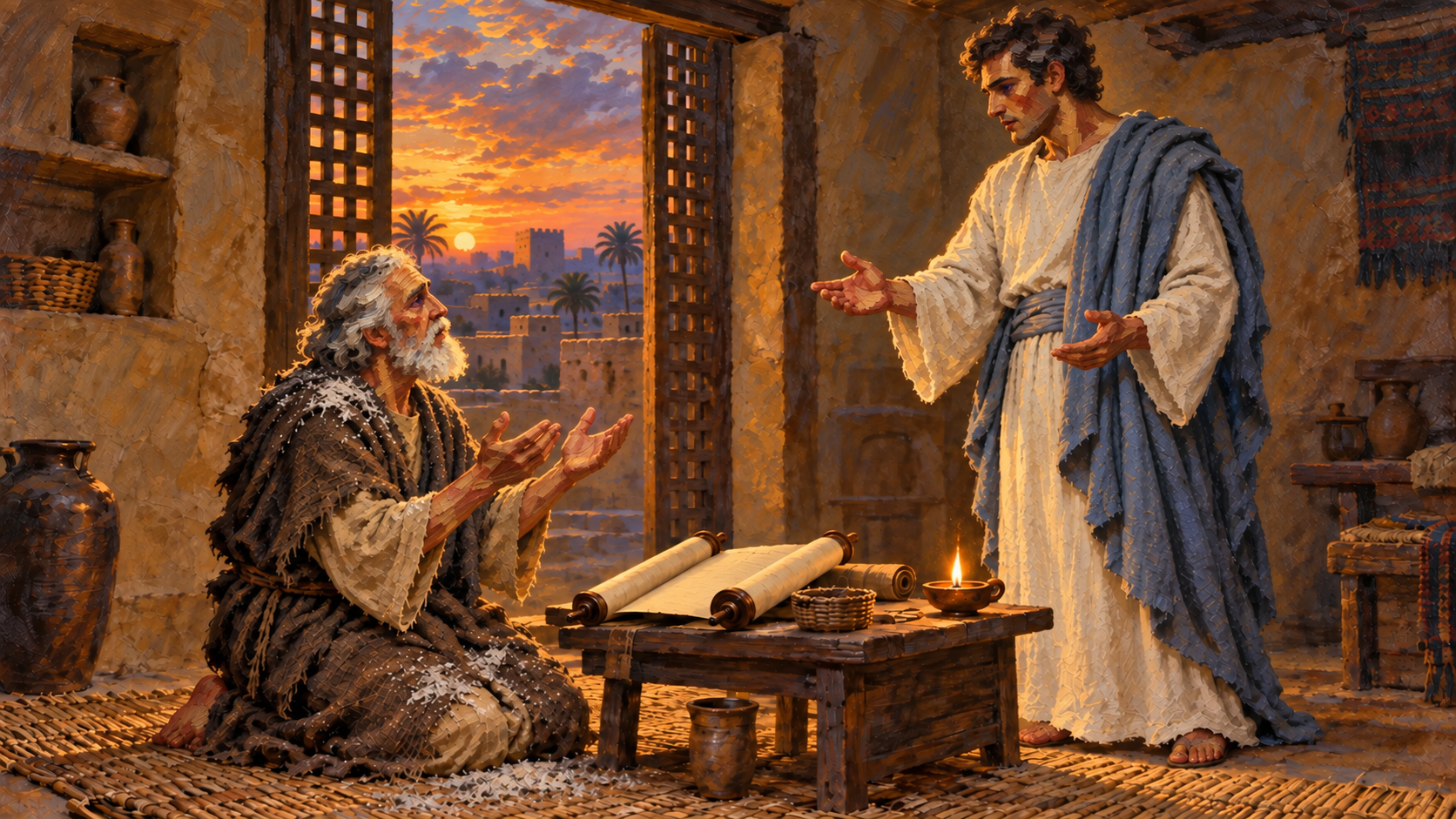
What are we supposed to make of the seventy weeks in Daniel 9? Gabriel tells Daniel to understand, so I want to keep Daniel’s prayer and the order of the prophecy in view. The seventy weeks measure 490 years, with sixty-nine weeks leading to Messiah. After that, Messiah is cut off and Jerusalem is later destroyed. One final seven-year week remains.
Daniel’s Prayer and the Seventy Sevens
Daniel 9 begins with Daniel reading Scripture and believing what it says. He was far from Jerusalem in exile after Babylon’s armies had conquered the city and destroyed its temple. From Jeremiah, he understood that Jerusalem’s desolations were appointed to last seventy years. He took those years as a real period rather than turning the prophecy into a vague spiritual feeling. That measured time prepared him for the measured answer Gabriel would bring.
In the first year of his reign I, Daniel, understood by the books the number of the years specified by the word of the LORD through Jeremiah the prophet, that He would accomplish seventy years in the desolations of Jerusalem. Then I set my face toward the Lord God to make request by prayer and supplications, with fasting, sackcloth, and ashes.
Daniel 9:2-3, NKJV
Daniel’s response makes me consider what prophecy should do in us. He did not study it merely to satisfy his curiosity or set himself above other people. Though personally faithful, he confessed Israel’s sin and repeatedly said “we.” He stood with his people under God’s righteous judgment and pleaded for mercy, rather than looking on as a detached critic.
Jeremiah 25 and 29 spoke of Babylon’s domination and the return after the appointed seventy years. Daniel believed both the warning and the promise. He accepted exile as just because Israel had broken God’s Word, while trusting that God had not forgotten His people. With the seventy years nearing their end, he had reason to pray in agreement with what God revealed. The promise gave his prayer direction instead of making it unnecessary.
With the sanctuary desolate and God’s people a reproach among the nations, Daniel prayed for Israel and Jerusalem. God’s own name was involved in their condition. Daniel did not claim that Israel deserved restoration but appealed to God’s great mercies, asking Him to act for His name’s sake.
“O my God, incline Your ear and hear; open Your eyes and see our desolations, and the city which is called by Your name; for we do not present our supplications before You because of our righteous deeds, but because of Your great mercies. O Lord, hear! O Lord, forgive! O Lord, listen and act! Do not delay for Your own sake, my God, for Your city and Your people are called by Your name.”
Daniel 9:18-19, NKJV
Gabriel arrived while Daniel was still praying, at the time associated with the evening offering. Although the temple service no longer functioned as God had established it, that pattern still shaped Daniel’s thinking. He wanted God’s name vindicated and the holy place restored, not simply a more comfortable life for his nation. He knew Israel’s sin had to be dealt with too.
Gabriel told Daniel that the command went out when his supplications began. God had heard him before he finished speaking. The angel came to give him “skill to understand,” yet Daniel still had to consider the message carefully. That helps me see study as part of responding in faith to God’s Word. Daniel’s prayer grew from Scripture, and both called him to think seriously about what God had said.
Daniel had prayed about his people and their city, including the desolate sanctuary. The angel answered about “your people” and “your holy city.” His wording kept the answer tied to those concerns. I need to carry that connection into the rest of the prophecy.
At the beginning of your supplications the command went out, and I have come to tell you, for you are greatly beloved; therefore consider the matter, and understand the vision: Seventy weeks are determined for your people and for your holy city.
Daniel 9:23-24, NKJV
The Hebrew shavu’im is translated “weeks” and is the plural of a word for “seven.” It means sevens, but the context tells us what those sevens measure. Daniel had been reading about seventy years, and Gabriel described events that could not fit within seventy ordinary weeks of days. The natural reading is therefore seventy sevens of years, totaling 490 years.
The weeks are “determined.” God has decreed or allotted the period, rather than leaving Daniel with a human estimate. Even where the chronology requires patient study, I can rest on what is clear: God has marked out history, and no ruler can overturn His appointments.
These weeks concern Israel and Jerusalem, Daniel’s people and holy city. Messiah’s work brings blessing to the nations, but that wider blessing does not make Daniel 9 a general outline of church history. Gabriel describes God’s program for Israel, in which sin must be answered and everlasting righteousness must come through Messiah.
The Six Goals and the Starting Command
Daniel 9:24 gives six goals for the seventy weeks. They begin with Israel’s transgression and sin, then speak of reconciliation. The promised outcome includes everlasting righteousness, the completion of prophecy, and a final holy anointing.
Seventy weeks are determined For your people and for your holy city, To finish the transgression, To make an end of sins, To make reconciliation for iniquity, To bring in everlasting righteousness, To seal up vision and prophecy, And to anoint the Most Holy.
Daniel 9:24, NKJV
To “finish the transgression” points toward God’s determined answer to Israel’s long rebellion. To “make an end of sins” looks ahead to the order God will establish, in which sin no longer rules, rather than claiming that nobody sins in the present age. The promise of reconciliation for iniquity addresses guilt, and its answer rests entirely on Christ’s work.
I need to hear each of those expressions without treating them as interchangeable. Transgression emphasizes rebellion against God’s authority, while sin describes falling short of His righteous standard. Iniquity carries the idea of crookedness and the guilt that needs reconciliation. Together they show how seriously Gabriel addressed Israel’s condition. The evil that brought exile had to be dealt with truthfully before the promised future could come.
Everlasting righteousness reaches beyond a temporary reform. It looks toward Messiah’s righteous kingdom and the enduring order He will establish. To “seal up vision and prophecy” speaks of God’s prophetic Word reaching confirmed completion when what He foretold has been fulfilled.
Jerusalem had seen reforms before Daniel’s lifetime, but none had lasted forever. Even the return from Babylon would not establish the final righteous order. Gabriel’s promise takes us beyond that return to a righteousness that endures because Messiah rules. I find assurance here that God will complete what He announced, bringing vision and prophecy to their goal instead of leaving His promises unfinished.
The final phrase, “to anoint the Most Holy,” has been understood in more than one way. The wording may be discussed in relation to a holy place or a holy person. I would not force that debated expression beyond what the text establishes. At minimum, it points to something holy that God consecrates as His program reaches completion. The main chronology does not depend upon settling every detail of the phrase.
Gabriel’s sequence keeps me from placing all six goals at one instant. He spreads the events across the seventy sevens, with Messiah cut off after the first sixty-nine weeks and Jerusalem destroyed afterward. The final week contains further events leading toward the decreed end. We need to let that sequence unfold as he gives it.
The prophecy next identifies its starting point: the command to restore and build Jerusalem. Gabriel speaks about the city rather than merely a decree concerning the temple. The street and wall are to be rebuilt during troublesome times, which points toward Jerusalem functioning again as a city.
Know therefore and understand, That from the going forth of the command To restore and build Jerusalem Until Messiah the Prince, There shall be seven weeks and sixty-two weeks; The street shall be built again, and the wall, Even in troublesome times.
Daniel 9:25, NKJV
Ezra records Persian decrees in chapters 1, 6, and 7 concerning the Jewish return, the temple, and restored worship. Those belong in the discussion, but Daniel 9:25 places particular emphasis on Jerusalem itself. Nehemiah 2 provides the clearest setting for a commission to rebuild it as a functioning city.
Cyrus authorized the return and the rebuilding of God’s house, with later decrees supporting that work. Gabriel, however, spoke specifically of Jerusalem’s street and wall. That difference helps me understand why Nehemiah’s commission fits. He approached the Persian king about his fathers’ city, still broken down with its gates burned, and the king granted what the city project required.
And I said to the king, “If it pleases the king, and if your servant has found favor in your sight, I ask that you send me to Judah, to the city of my fathers’ tombs, that I may rebuild it.”
Nehemiah 2:5, NKJV
Jerusalem’s gates and walls had to be restored while Nehemiah and the people faced determined opposition. The work was visibly connected with the city, and it happened in troublesome times just as Gabriel said. For those reasons, Nehemiah’s commission fits the starting language especially well.
Sixty-Nine Weeks to Messiah the Prince
Gabriel divides the period before Messiah into seven weeks followed by sixty-two more. Together they equal sixty-nine weeks, or 483 years. The first forty-nine years fit the early work of rebuilding and reestablishing Jerusalem in a hostile setting. The remaining sixty-two weeks continue from that period until Messiah the Prince.
Some students calculate the time using prophetic years of 360 days. Revelation describes the same span as forty-two months and 1,260 days, which gives that model a biblical basis. Traditional calculations using it place the end of the sixty-nine weeks within the historical setting of Jesus’ public presentation to Israel.
In that model, each month has thirty days, making twelve months a 360-day prophetic year. Multiplying 483 years by 360 gives the number of days to measure from the decree. I appreciate the effort to take Gabriel’s numbers seriously and connect them with Revelation’s description of the final half-week. But I also want the calendar choices made plain. A disputed modern date should not be presented as though Daniel’s verse supplied it.
That does not make the exact dates simple. We do not need to claim that every ancient civil year always contained 360 days, and moving between ancient and modern calendars requires care. The main conclusion does not depend upon announcing one exact modern date. Gabriel clearly gives sixty-nine sevens before Messiah, and any more detailed calculation should admit its assumptions.
God’s command to “know therefore and understand” assures me that the main line can be understood, even if some chronological questions remain difficult. He gave Daniel a measured prophecy placing Messiah’s coming within real history, not a meaningless code.
Gabriel names “Messiah the Prince.” The endpoint is a promised ruler with the right to reign, not merely a general hope or spiritual renewal. The Hebrew title mashiach means Anointed One, as does the Greek title Christ.
Jesus is that Messiah, the Son of David and King who came at God’s appointed time. Luke 19 shows a fitting scene of His public presentation as He approached Jerusalem. His disciples openly praised Him as King while the rejection that would lead to His death was already taking shape.
Then, as He was now drawing near the descent of the Mount of Olives, the whole multitude of the disciples began to rejoice and praise God with a loud voice for all the mighty works they had seen, saying: “‘Blessed is the King who comes in the name of the LORD!’ Peace in heaven and glory in the highest!”
Luke 19:37-38, NKJV
Jesus wept over Jerusalem because judgment was coming. Daniel 9 helps me understand the sorrow in that scene. Messiah came to His people, yet the nation did not receive Him as its reigning King. Their rejection still could not make God’s timetable fail.
Luke says Jerusalem did not recognize the time of its visitation, fitting Daniel’s prophecy of Messiah’s coming in advance. Yet Jesus’ tears will not let me treat fulfillment as a cold calculation. The King grieved over the city because He knew the judgment its rejection would bring, even as He moved toward the cross.
Messiah Cut Off and Jerusalem Destroyed
Daniel 9:26 places Messiah’s being cut off after the sixty-two weeks that follow the first seven. He would be removed through death, not retire peacefully or merely lose popularity. Daniel then adds “but not for Himself.” Messiah had no guilt of His own for which He had to die.
And after the sixty-two weeks Messiah shall be cut off, but not for Himself; And the people of the prince who is to come Shall destroy the city and the sanctuary. The end of it shall be with a flood, And till the end of the war desolations are determined.
Daniel 9:26, NKJV
Isaiah 53 explains how the righteous Servant can be cut off for others. He suffers for sins that are not His own and bears the guilt of people who have gone astray.
But He was wounded for our transgressions, He was bruised for our iniquities; The chastisement for our peace was upon Him, And by His stripes we are healed. All we like sheep have gone astray; We have turned, every one, to his own way; And the LORD has laid on Him the iniquity of us all.
Isaiah 53:5-6, NKJV
All of these dates and divisions lead us to Jesus Christ. He is the eternal Son who became fully man without ceasing to be fully God. Born of a virgin, He lived a completely sinless and righteous life. Wicked men physically tortured, punished, and killed Him. Jesus willingly bore that real punishment for our sins in His innocent body. He shed His blood, died, was buried, and rose bodily. The Father did not punish, curse, abandon, strike, bruise, or pour wrath on Jesus.
Christ died for the whole world, and He is the propitiation for the whole world. Propitiation means that His sacrifice is the sufficient atoning answer to sin. God’s offer of salvation is genuine. People may resist and reject it, but every sinner is called to repent and believe in Jesus. The one who truly believes is forgiven and justified. God brings that person to new birth, and the Holy Spirit comes to dwell within him. He is then sealed and eternally secure in Christ.
Eternal security does not permit lawlessness, and a shallow profession cannot prove that someone has been born again. Good works grow from salvation rather than purchasing it. When I read Daniel’s words “not for Himself” I am being called beyond admiration for fulfilled prophecy to personal faith in the Messiah who died for others.
Daniel then says “the people of the prince who is to come” will destroy the city and sanctuary. Roman forces fulfilled that part by destroying Jerusalem and the temple in AD 70. Jesus had also warned that armies would surround the city as its desolation drew near.
But when you see Jerusalem surrounded by armies, then know that its desolation is near.
Luke 21:20, NKJV
I need to distinguish the coming prince from the people who destroyed Jerusalem. Gabriel did not say that the future prince personally carried out that destruction. Romans carried it out, and Gabriel associates them with the prince still to come. That connects the future ruler with this stream of Gentile power. Daniel 9:27 presents the ruler himself acting in a later period.
The phrase “with a flood” pictures judgment overwhelming Jerusalem. The city’s fall was not random, for God had already declared the coming desolations. That did not excuse the rulers and soldiers for their violence. Scripture holds their responsibility together with God’s rule, under which even kings and armies must remain.
Daniel had already acknowledged that balance in his prayer. Israel’s calamity came because the nation sinned, and Babylon acted with real violence and ambition. God remained righteous in bringing the covenant judgment He had warned about. The same was true when Rome later destroyed the city. People were responsible for the acts they committed, while history remained within the judgment God had announced.
The sequence also places an interval before the final week. Messiah was cut off after the sixty-nine weeks, and Jerusalem and its sanctuary were destroyed afterward. AD 70 does not fit within seven years immediately following Jesus’ death. Daniel moves from these events after the sixty-ninth week to the future ruler who begins the last week. He neither describes everything in that interval nor names the church in this prophecy.
Reading “after” in its ordinary sense helps me follow the timing. Messiah dies after the sixty-nine weeks have ended, and Jerusalem’s destruction follows before verse 27 introduces the remaining week. Of the 490 years, 483 have already been accounted for. The events between those portions extend beyond seven years, so the last seven cannot have begun automatically when the sixty-ninth week ended.
The Final Week and the Abomination
Daniel 9:27 describes a final week of seven years, using the same measure as the earlier weeks. The ruler confirms a covenant with many but breaks the arrangement halfway through. At that point he stops sacrifice and offering. The abomination that brings desolation follows. Even before those events unfold, God has decreed the ruler’s end.
Then he shall confirm a covenant with many for one week; But in the middle of the week He shall bring an end to sacrifice and offering. And on the wing of abominations shall be one who makes desolate, Even until the consummation, which is determined, Is poured out on the desolate.
Daniel 9:27, NKJV
The nearest person mentioned before “he” is the coming prince. Verse 26 first says Messiah is cut off, then introduces the people of that future ruler. Verse 27 then describes that ruler’s covenant and betrayal, which is why I understand him to be the Antichrist. This is not Christ confirming the New Covenant.
The middle of the week marks a definite point. Revelation describes an equivalent span as forty-two months or 1,260 days, while Daniel elsewhere speaks of three and one-half times. The second half is the Great Tribulation, when the ruler openly blasphemes God and persecutes His people. His false worship reaches its fullest expression during that time, but God brings it to the appointed end.
These measurements help explain one another: forty-two months of thirty days equal 1,260 days, or three and one-half years. Revelation 11–13 places them in scenes centered on Jerusalem, where faithful testimony continues under persecution while the blasphemous ruler holds power. Daniel’s midpoint divides a measured week rather than marking a vague change in atmosphere. Scripture gives the length of the period that follows in several matching forms.
If the ruler stops sacrifice and offering, some form of sacrificial system must be operating. That cannot threaten the sufficiency of Christ’s cross, since Hebrews says He offered one sacrifice for sins forever. Those future sacrifices will neither save nor remove sin, and they cannot add anything to His atonement. They belong to the political and religious order the ruler will manipulate and violate.
I want to distinguish what Daniel predicts from what God provides for salvation. Animal blood never competed with Christ’s final work, and restoring a ritual in unbelief cannot undo the cross or open a second way of salvation. Daniel mentions sacrifice because the ruler will stop an actual practice at the midpoint. Describing that practice does not approve it as an atoning remedy.
Jesus directed His hearers back to Daniel when speaking about the abomination of desolation. He told the reader to understand the prophecy and described an idolatrous act defiling the holy place. He did not set the prophecy aside as a closed historical curiosity.
Therefore when you see the “abomination of desolation,” spoken of by Daniel the prophet, standing in the holy place (whoever reads, let him understand),
Matthew 24:15, NKJV
Paul’s warning about the man of sin describes a final evil ruler exalting himself in a temple setting and making blasphemous claims about who he is. That points in the same direction as Daniel’s prophecy. It does not justify identifying every powerful politician as the Antichrist. Scripture describes a particular ruler who will come and whom the Lord will destroy.
Let no one deceive you by any means; for that Day will not come unless the falling away comes first, and the man of sin is revealed, the son of perdition, who opposes and exalts himself above all that is called God or that is worshiped, so that he sits as God in the temple of God, showing himself that he is God.
2 Thessalonians 2:3-4, NKJV
The desolator will boast and persecute God’s people, desecrating what is holy for as long as God permits. But Daniel ends the verse with a consummation the Lord has already determined. That ruler will never control the outcome.
I don’t want to make Antichrist the center when Gabriel ends with the limit God has placed on him. The covenant and betrayal are serious, and the suffering will be real. Yet the prophecy takes us beyond the abomination to the conclusion God has fixed. The One who determined the seventy weeks also determined how far the desolator will be allowed to go.
Israel, the Church, and the Right Response
Daniel prayed about Israel and the sanctuary on Jerusalem’s holy mountain. Gabriel used those same ordinary meanings when answering about his people and their holy city. If we erase Israel or turn Jerusalem into a symbol for the church, we lose the connection between the prayer and its answer.
The church receives salvation through Israel’s Messiah and shares in the spiritual blessings He purchased. Sharing those blessings does not make the church Daniel’s people or his city. We do not need to erase Israel to receive the gospel. God’s grace to believing Jews and Gentiles displays His faithfulness without canceling the names Gabriel used.
Romans 11 looks ahead to Israel’s restoration. Paul describes a blindness in part that lasts until the fullness of the Gentiles comes in. Jewish people can and do believe in Jesus now, so the blindness is partial. Paul’s “until” also points to its temporary nature and the future turning he expects. Present unbelief does not void God’s promises.
That distinction concerns Israel’s identity as a nation and God’s faithfulness to His promises, not two gospels or two ways of salvation. Jews and Gentiles alike must receive Jesus Christ by faith. The church’s blessings show how far God’s grace reaches without requiring us to rename Israel when prophecy speaks of Jerusalem.
I understand the present church age to fall within the interval before Daniel’s final week. The church will be gathered to Christ before the future seven-year Tribulation. Once that period ends, Jesus will return bodily and establish His literal thousand-year reign. Daniel 9 supplies the framework of the seventy weeks. Other passages explain the gathering of the church and the events surrounding Christ’s return. These four verses do not need to contain every part of the end-times timeline in order to give us their place within it.
That order helps me understand why the final week returns directly to Jerusalem and its holy place, with sacrifice again in view. Gabriel’s answer describes the completion of the program he announced for Daniel’s people and city. We belong to Christ and should learn from the prophecy, without needing to turn the church into Israel for Daniel 9 to speak to our faith.
I believe this reading avoids two opposite errors. Treating the seventy weeks as merely symbolic removes Israel from their structure and turns Jerusalem into a figure. Using them to set a date for Christ’s return claims a precision Scripture does not give. We can take this real prophecy and its clear structure seriously without inventing a modern calendar for the return.
Daniel’s example brings the question back to how we respond. Reading prophecy should move me to pray from Scripture as he did, honestly facing sin while remaining humble about what I do not know. Above all, it should deepen my confidence in the God who rules history and keeps His Word.
If you have never trusted Christ, the words “but not for Himself” call you to look at the cross. Messiah shed His blood and died for sinners before rising bodily from the grave. God offers forgiveness by grace through faith. It cannot be earned through religious effort, and detailed knowledge of prophecy cannot substitute for believing in Jesus.
For those who know Christ, Daniel 9 gives reason for patience. God has not forgotten Israel, and the world has not drifted beyond His reach. Even the terrible final week has boundaries He has already set, so evil rulers cannot have the last word. Christ will return bodily and judge with perfect righteousness. He will fulfill His promises of deliverance and reign as King.
That patience is different from indifference. Daniel’s confidence in God’s schedule moved him to confession and prayer, and knowing the end is determined should make us more faithful now. We can live without panic as we let the returning King shape our lives.
My Final Thoughts
After working through Daniel’s seventy weeks, I believe the prophecy gives us firm ground without giving us permission to become proud about a calendar. God brought the exile to its appointed end and sent Messiah in the measured course He revealed. After Messiah was cut off, Jerusalem also faced the destruction God had foretold. One future week remains for Israel and the city, but its most powerful ruler will still operate inside limits God has already set. Through all of this, the prophecy directs us to Jesus, who died for others and rose bodily from the grave. Trust Him, and let the certainty of God’s Word make you steadier while His plan moves toward the return and reign of the rightful King.