
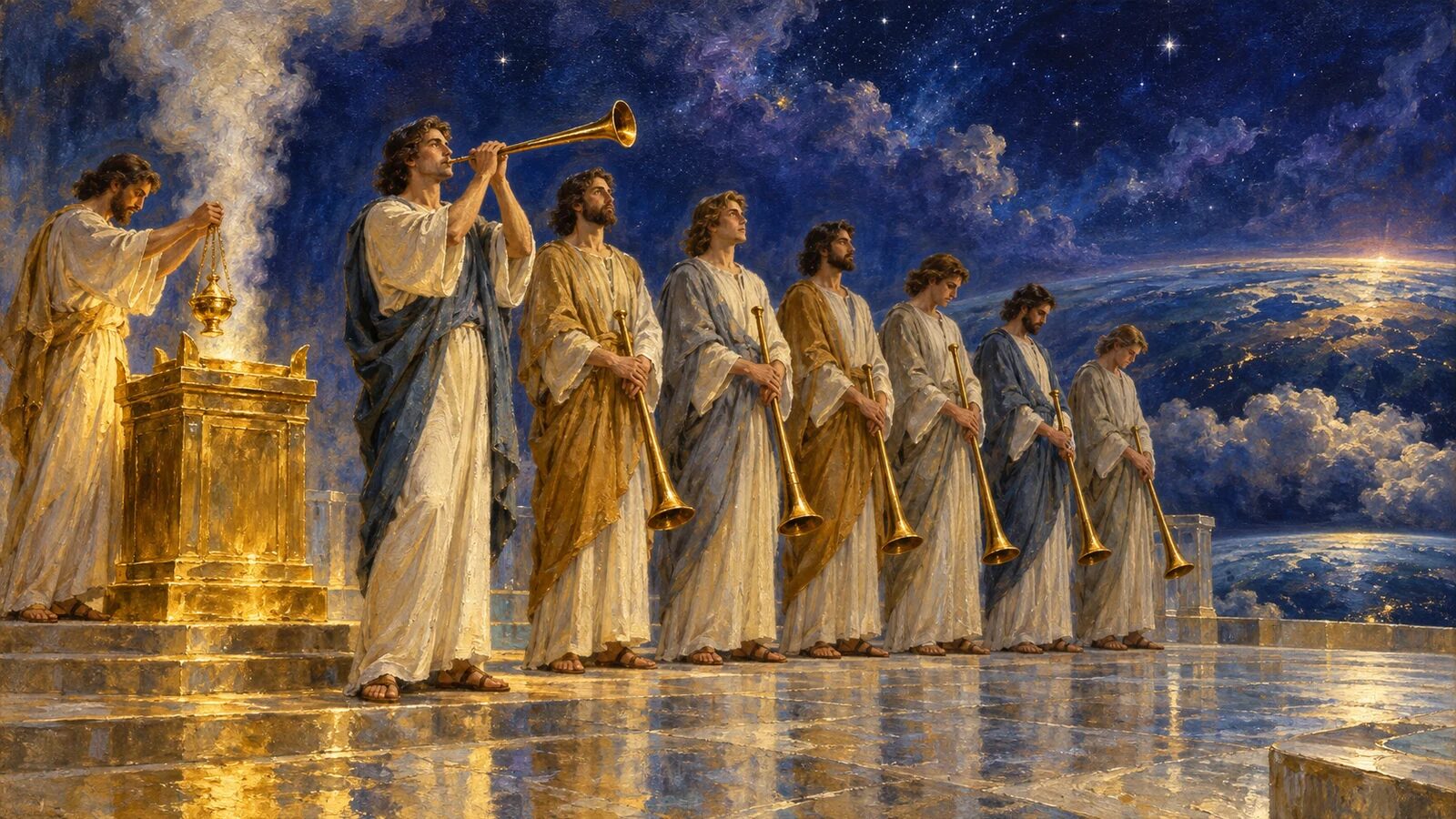
What are we supposed to understand when the seven trumpets sound in Revelation? John’s visions are terrifying, but they come in an ordered sequence, and earlier Scripture helps us understand the trumpet language he uses. I want to follow that background and what John actually says without reducing prophecy to vague symbols or searching for today’s headlines in every detail.
Trumpets Are Public Alarms Under God’s Rule
Revelation shows us history under the authority of a King. The Lord Jesus Christ opens the seals, heaven prepares the judgments that follow, and angels sound the trumpets. Human rebellion is moving toward the end God has appointed for it. We need to understand the seven trumpets within that larger vision.
That is why I understand the trumpets as future judgments during the Tribulation. They reach the created world and the people in it, including armies and kingdoms. John is not describing random disasters or private spiritual experiences, nor is he using a code for the ordinary hardships every generation faces.
We still need to pay attention when John says something was “like” something else. Prophecy uses visions and signs, and reading every detail in the same rigid way would ignore the comparisons he gives us. A symbolic description does not make an event unreal. John’s vivid language describes judgments with real effects on the earth.
When I refer to the Tribulation in this study, I mean the future seven-year period connected with Daniel’s seventieth week. The study on the 70 Weeks of Daniel explains that prophetic framework in greater detail. Christ gathers His church before this period begins. The seals, trumpets, and bowls are therefore not God’s wrath upon the church. They belong to His end-time dealings with a rebellious world and with Israel as prophecy moves toward Jesus’ bodily return and literal thousand-year reign.
Several parts of Scripture help us follow this sequence. Numbers 10 explains why a trumpet can serve as an alarm and an appeal for God to act. Joshua 6 then joins trumpet sound with judgment upon a city. The plagues of Exodus show the Lord striking creation to confront idolatrous power. With that background in place, Revelation 8 and 9 describe the first six trumpets before chapters 10 and 11 pause for prophetic testimony. The seventh trumpet finally announces the certainty of Christ’s kingdom.
Before we reach Revelation 8, the Old Testament has already shown us how trumpets were used. We might think first of music, but their sound often served as a public signal. A trumpet could gather Israel or tell a camp to move. It could mark an appointed time or announce a king’s arrival. In war, its piercing sound warned people that danger was near and called them to attention.
Numbers 10 gave Israel practical instructions for using silver trumpets in the wilderness, both on days of gladness and as alarms when war threatened. I notice that verse 9 tells Israel to sound the alarm when an enemy is oppressing them. The Lord promises to remember His people and save them.
When you go to war in your land against the enemy who oppresses you, then you shall sound an alarm with the trumpets, and you will be remembered before the LORD your God, and you will be saved from your enemies.
Israel was to sound the alarm because the Lord had told them to do so when war threatened. By obeying, they would publicly acknowledge that only He could rescue them. The instrument had no magical power, and neither the technique nor the volume of the blast could save them. Their confidence belonged in God.
The words “you will be remembered” do not mean God forgot His people until someone reminded Him. In the Old Testament, God’s remembrance means He acts faithfully on His covenant promise. He remembered Noah and caused the floodwaters to recede. His remembrance of Abraham led to Lot’s deliverance, and His remembrance of His covenant with the patriarchs led Him to rescue Israel from Egypt. These were acts of faithfulness to His promises, not occasions when He recovered lost information.
The Hebrew phrase translated “you shall sound an alarm” is wa-ha-re’otem, which uses a form of a verb associated with raising a shout, signal, or alarm. In Numbers 10:9, the wartime setting makes that sound urgent and public. Understanding the expression in its setting helps us hear Revelation’s trumpets as heaven’s alarms, not merely dramatic background sound.
At Jericho, God gave Israel instructions that made His power unmistakable. This was not a normal siege. Priests carried trumpets as the people marched, and the appointed blast came after they had followed His command.
It shall come to pass, when they make a long blast with the ram’s horn, and when you hear the sound of the trumpet, that all the people shall shout with a great shout; then the wall of the city will fall down flat. And the people shall go up every man straight before him.
Israel had to obey, but neither human strength nor a supposedly magical sound brought down Jericho’s walls. God judged the city and gave His people victory. We need to remember that when Revelation describes Him using created things or angelic beings. The trumpet judgments remain His acts.
Jericho’s fall also helps us understand that judgment has a moral basis. God was keeping His word in judging that city. In Revelation, we do not see power exercised apart from righteousness. The holy God has warned the world and patiently sent testimony, and He will not let evil rule forever.
In Exodus, God first struck the water, then brought judgment across Egypt’s land. Animals and crops suffered before darkness covered the country as He exposed the emptiness of its false gods. Pharaoh repeatedly hardened his heart. Revelation describes similar judgments on a wider scale, yet the survivors later refuse to repent. That should make us question the assumption that a more extraordinary sign would necessarily produce faith. Signs can expose rebellion, but they cannot force a hard heart to love God.
The Seventh Seal Opens into the First Four Trumpets
Revelation 4 and 5 establish the scene before a trumpet ever sounds. John sees God’s throne and a scroll sealed with seven seals. No created being is worthy to open it. Then Jesus appears as the Lamb who was slain. He alone takes the scroll because He redeemed people to God by His blood.
In Revelation 6, the Lamb opens the first six seals. Conquest and war follow, along with scarcity and death. John also describes martyrdom and cosmic disturbance. Chapter 7 pauses to show God’s sealing and saving purposes before returning to the final seal. The opening of that seventh seal begins the seven trumpet judgments.
The order helps me follow what John is being shown. The seals lead into the trumpets, which move the account toward the bowls. I understand this as a progression from the throne, not a loose collection of disasters.
And I saw the seven angels who stand before God, and to them were given seven trumpets. Then another angel, having a golden censer, came and stood at the altar. He was given much incense, that he should offer it with the prayers of all the saints upon the golden altar which was before the throne.
I don’t want to overlook the prayers in this scene. The martyrs under the altar had already asked how long it would be before the Lord judged and avenged their blood. Revelation 8 shows that heaven has not ignored their cries. God’s people are asking for justice, and His attention to them does not make them vindictive.
Before the angels prepare to sound, fire from the altar is thrown to the earth. The judgment comes from before God’s throne, rather than arising out of human panic. Even the angels wait until they are ready and have their place in the sequence. What shakes the earth begins with heaven’s action.
The first four trumpets move across creation. The first strikes the land with hail and fire mingled with blood. A third of the trees burn, along with all the green grass. The second trumpet brings something like a great burning mountain into the sea. A third of the sea becomes blood, a third of its creatures die, and a third of the ships are destroyed.
These judgments touch what people depend on every day. Damaged vegetation affects food production on land. Sea creatures die, and destroyed ships disrupt trade and travel. The next trumpet makes fresh water dangerous, and the fourth disturbs the daily pattern of light. We depend on a created order we neither made nor can finally control.
The third trumpet reaches fresh water. A great star called Wormwood falls upon a third of the rivers and springs, making the water bitter and deadly. The fourth trumpet then affects the lights that govern life on earth. The sun, moon, and stars are struck so that a third of their light is withheld.
Then the fourth angel sounded: And a third of the sun was struck, a third of the moon, and a third of the stars, so that a third of them were darkened. A third of the day did not shine, and likewise the night.
The repeated fraction helps me notice the restraint within these severe judgments. The world has not yet reached the total collapse that comes later. God is giving a warning no one should ignore while leaving room for testimony and repentance.
The resemblance to Egypt’s plagues is clear. Hail destroyed what remained in the fields, water was struck, and darkness covered the land. Pharaoh’s confidence proved false, and Egypt’s gods were powerless. In Revelation, the Creator judges on a far greater scale, but we encounter the same painful hardness in people’s response.
John gives the star at the third trumpet a name, so let’s look more closely at what he describes. It falls from heaven burning like a torch and strikes rivers and springs. People die because the water becomes bitter. That physical consequence prevents us from treating Wormwood merely as an image of emotional bitterness.
Then the third angel sounded: And a great star fell from heaven, burning like a torch, and it fell on a third of the rivers and on the springs of water. The name of the star is Wormwood. A third of the waters became wormwood, and many men died from the water, because it was made bitter.
I don’t want to attach a scientific or military label to Wormwood that John never gives it. He describes a great star falling while it burns like a torch and tells us what happens to the water. This may be a real heavenly object or another kind of blazing judgment. We can be certain about the deadly event without claiming to know its exact classification.
The name apsinthos is the Greek word for wormwood, a bitter plant. Its moral meaning becomes clearer when we consider the Old Testament use of the Hebrew term la’anah in passages about bitterness and judgment. Deuteronomy 29 compares an idolatrous heart to a root bearing wormwood. Jeremiah 9 describes rebellious people receiving wormwood and bitter water, and Lamentations uses the image for grief under Jerusalem’s judgment.
In Revelation, that familiar image of bitterness becomes physically deadly. A world that has embraced rebellion tastes its bitter result under God’s judgment. I need to keep both parts of the description in view: the moral meaning explains the name without taking away the actual judgment on the water. The related study on Wormwood in Revelation follows that language and passage more fully.
The Fifth and Sixth Trumpets Bring Woe
After the fourth trumpet, a loud warning announces that the remaining three will be woes. The judgments are about to become more severe. The first four struck the created world around people, while the fifth and sixth reach people more directly.
And I looked, and I heard an angel flying through the midst of heaven, saying with a loud voice, “Woe, woe, woe to the inhabitants of the earth, because of the remaining blasts of the trumpet of the three angels who are about to sound!”
The phrase “inhabitants of the earth” often refers in Revelation to people who have settled into rebellion and attached themselves to a world order that rejects God. The warning to them is public. I see mercy in God telling them the truth before the next judgment falls, even though He owes rebels no further warning.
These dreadful judgments should not make us accuse God of cruelty. Sin is dreadful, and He is holy. Even here, He limits the judgments and continues to warn people and send testimony. He has not failed to speak. Fallen people love darkness and may harden themselves while suffering the consequences of their own rebellion.
The fifth trumpet opens the abyss. Smoke rises before locust-like beings come out with power to torment. John is plainly not describing normal insects. The scene reveals demonic darkness, but it never suggests that demons have escaped God’s rule.
The abyss opens only when permission is given, and the beings released from it receive authority for a limited time. They are told exactly what they may harm and serve under the king appointed over them. Their power is terrifying, but none of those boundaries lies outside God’s authority.
I notice how often John’s wording directs us to permission these beings have received. They cannot choose their own targets or consume vegetation as ordinary locusts would. They may harm a defined group of people, but they are restrained from harming another. God is not struggling to contain an equal enemy. Even these evil beings act within a judgment whose terms He alone sets.
They were commanded not to harm the grass of the earth, or any green thing, or any tree, but only those men who do not have the seal of God on their foreheads.
God’s seal makes clear that He knows who belongs to Him. He preserves His people according to His purpose and limits what may touch them. I believe the church has already been gathered before this hour of trial, but that truth still gives me confidence now. God does not need favorable conditions to recognize and keep His own.
We should not turn that preservation into a promise that every servant of God will avoid suffering. Revelation honors martyrs, and its two witnesses die when their testimony is complete. No hostile power can overturn God’s purpose, whether He preserves a servant through danger or allows that servant to die after the work is done. Here He sets the limits of the fifth trumpet and marks those excluded from its torment. He remains Lord over life and death in either case.
The torment also shows where rebellion leads. People expect freedom when they reject God, but sin’s promise of independence brings them into bondage. Being given over to deeper darkness does not make the world nobler or more rational. The cruel masters people chose torment them instead of giving them liberty.
The sixth trumpet brings death after the torment of the fifth. Four bound angels are released at the Euphrates, and a vast killing force appears. John gives the army’s number and describes its power in vivid prophetic language. I may find some details difficult to understand, but I cannot miss his main statement: a third of humanity dies.
So the four angels, who had been prepared for the hour and day and month and year, were released to kill a third of mankind.
The exact timing catches my attention. These angels have been prepared for an appointed hour, day, month, and year. Everything may look out of control from the earth, yet judgment arrives when God has determined. Heaven is not improvising a response to events.
I find the end of Revelation 9 deeply sad. After all these judgments, the survivors still refuse to repent. We might assume overwhelming signs would automatically produce faith, but these people see catastrophe and suffer pain without turning to God. Their response shows how hard a heart can become.
But the rest of mankind, who were not killed by these plagues, did not repent of the works of their hands, that they should not worship demons, and idols of gold, silver, brass, stone, and wood, which can neither see nor hear nor walk. And they did not repent of their murders or their sorceries or their sexual immorality or their thefts.
The sins listed here show why false worship cannot be treated as a harmless private error. People give themselves to demons and lifeless idols, and their rebellion affects how they treat each other. Rejecting God’s authority leads to murder and theft. Sorcery and sexual immorality express that same refusal to live under His rule.
Their refusal should make me take God’s warning seriously today. We should not wait for a stronger alarm before repenting, because stronger warnings do not soften a heart determined to remain hard. The right response to the mercy God offers now is to turn to Him now.
God Continues to Speak During Judgment
After the sixth trumpet, Revelation pauses through chapters 10 and 11 before the seventh sounds. This interlude shows us what God continues to say while judgment unfolds. It belongs to the account rather than being filler or an unrelated diversion.
If I concentrate only on the disasters, I can miss the mercy in God’s continued testimony. His prophetic word explains what He is doing, and the witnesses He raises speak it openly. Revelation records devastating plagues while also calling people to repent and believe. God’s servants are called to endure as they worship Him.
God is doing more than pouring out wrath in these chapters. He measures what belongs to Him and commissions His servants to speak. People resist, but His message remains available to them. Judgment does not silence the truth, and hostility cannot stop the witness He has appointed from being completed.
In Revelation 10, John receives a little scroll and is told to eat it. Ezekiel had likewise been required to take God’s prophetic message into himself before speaking to a rebellious house. The message is sweet because it is God’s truth and ends in His victory. Yet the reality of judgment makes it bitter, and speaking that word to rebels is a heavy responsibility.
Then I took the little book out of the angel’s hand and ate it, and it was as sweet as honey in my mouth. But when I had eaten it, my stomach became bitter.
I cannot treat prophecy as entertainment when God’s message carries that weight. We need to receive His Word inwardly and treasure it because it is true, while also feeling the seriousness of its warnings. Revelation calls us to obey and endure rather than remain fascinated observers of frightening events.
Revelation 11 introduces two witnesses who prophesy in sackcloth for a set time. Their clothing suits a ministry of mourning that calls people to repentance. They speak during a dark hour, but through them the world still receives a clear word from God.
And I will give power to my two witnesses, and they will prophesy one thousand two hundred and sixty days, clothed in sackcloth.
The 1,260 days equal forty-two prophetic months, or three and a half years. God protects the witnesses throughout that appointed period so their enemies cannot stop them before they finish their testimony. They do not depend on favorable public opinion or political strength to keep them safe.
When their testimony is complete, the beast from the abyss kills them. Their bodies remain exposed in the city where the Lord was crucified, and the rebellious world celebrates their death. After three and a half days, God raises them and calls them to heaven while their enemies watch. What looked like defeat becomes a public display of His authority.
The similarities between these witnesses and Moses and Elijah are worth considering. Still, Revelation does not name the two men here. I understand wanting to identify them immediately, but I don’t want to turn a reasonable comparison into something John explicitly says. We need to preserve what he actually emphasizes about their ministry.
God does not leave Himself without witness. He protects these men while they minister, and their enemies can kill them only after their testimony is complete. Even then, death cannot hold them when He raises them and calls them to heaven. He determines the timing at every stage. People are judged because they reject the God who speaks, not because He failed to make truth known.
The Seventh Trumpet Announces Christ’s Kingdom
At the seventh trumpet, loud voices in heaven announce that the kingdom belongs to the Lord and His Christ. Instead of simply describing another plague, they look ahead to judgment’s completion and Jesus’ open reign. This is the climax of the trumpet sequence because it tells us where history is going.
Then the seventh angel sounded: And there were loud voices in heaven, saying, “The kingdoms of this world have become the kingdoms of our Lord and of His Christ, and He shall reign forever and ever!”
We still have to account for the events Revelation describes after that announcement. The bowls complete God’s wrath, Babylon falls, and Christ returns before the kingdom is openly established on earth. The seventh trumpet declares that outcome certain before all the remaining events have taken place.
Revelation 11 places reward alongside judgment. The nations are angry, but their anger cannot stop God’s wrath or delay His appointed time. He judges the wicked and rewards His servants, including those who fear His name. The passage also describes Him destroying those who destroy the earth. Christ’s kingdom answers a world order that has corrupted what belongs to its Creator.
Heaven can speak of the kingdom as secured because God’s decree cannot fail. The rebellious world may rage for a time, but it cannot keep the throne. My hope rests in Christ bringing His kingdom into the open through holy judgment and righteous rule, rather than in things somehow getting better on their own.
I understand the passage as both futurist and premillennial. By futurist, I mean that the trumpets describe events still to come rather than a symbolic cycle running through the whole church age. Premillennial means that Christ returns bodily and visibly before He reigns in the literal thousand-year kingdom of Revelation 20. He gathers His church before Daniel’s seventieth week begins, and His visible return comes at the conclusion of those seven years.
The seventh trumpet points toward that reign. Jesus does not gradually become King as human governments improve. He openly takes the rule that has always rightfully belonged to Him. Other kingdoms are temporary, but His reign will never end.
Reading the Trumpets Without Speculation or Fear
Some serious readers understand the trumpets as a symbolic cycle of trouble throughout the church age. That view recognizes Revelation’s use of prophetic imagery, but I remain unconvinced because of the movement from seals to trumpets and then toward bowls. The repeated measurements and the interlude’s placement also point to an ordered future sequence.
Others try to match every detail with a current nation or weapon, then search the news for confirmation. They may begin with a sincere desire to take prophecy seriously, but the approach soon produces confident labels and dates Scripture never gives. Consider Wormwood. John names it and describes how it looks as it falls, then tells us its deadly effect. None of that authorizes us to identify a specific modern event in advance.
We also cannot reduce these judgments to distant natural consequences. Revelation repeatedly shows God actively directing them. The Lamb opens the seals before the angels receive their trumpets, and fire comes from the altar. Every destructive being acts within an assigned limit. God is judging, and every judgment He gives is holy.
His active judgment is not cruelty. God has warned the world and continues to do so as the judgments advance. He limits their reach and sends testimony during the interlude. Even demonic forces cannot go beyond His commands. The horror of rebellion appears alongside His patience with people who keep refusing Him.
The church is not placed within these judgments as an object of wrath. The related study on the Pre-Tribulation Rapture develops the case that Christ gathers His church before the coming hour of trial. Believers can therefore read the trumpets with sober attention without treating the passage as a threat to their security in Christ.
I don’t need to put the church inside these judgments to hear what they teach us. The passage concerns God’s future dealings with a rebellious earth and with Israel. Revelation does address churches, so we should receive its warning and hope without making ourselves the center of these events. Knowing who rules history and where earthly kingdoms are headed should shape our faithfulness now. It should also keep us from treating rebellion lightly.
Taking the trumpets seriously does not require fear-driven speculation. They show that the world has never escaped God’s reach. Evil cannot rule forever or possess final authority. Demonic powers remain subject to His limits, and human rulers cannot control the outcome. Christ will judge rebellion and reign.
The survivors after the sixth trumpet also warn me against pride. They do not merely lack evidence; they refuse the God who has confronted them openly. That should make us grateful that our salvation rests in Christ rather than in our own wisdom or moral strength.
The gospel is the urgent answer to the trumpet alarms. Jesus Christ is the eternal Son of God who became truly man without ceasing to be God. He lived without sin. On the cross, He willingly and physically bore the punishment for our sins in His innocent body. Wicked people tortured Him, shed His blood, and killed Him, but He rose bodily from the dead.
Christ died for the whole world, and everyone may genuinely come to Him. Salvation is by grace through faith, not something earned by religious performance or frightened promises to reform. The person who is truly born again becomes a new creation. The Holy Spirit indwells and seals that believer, whose salvation remains eternally secure.
Our security in Christ does not make these warnings useless. It gives us confidence to worship and speak, knowing both that judgment is real and that the Savior receives everyone who comes to Him. We should use Revelation to speak the gospel while mercy is still being offered, rather than to frighten other believers or show off clever theories.
My Final Thoughts
After following the trumpets from Numbers and Jericho into Revelation, I believe they are public alarms announcing real future judgments under God’s complete authority. Their measured devastation reveals the holiness of His wrath while continued warnings display His mercy. Revelation 9 also shows that stronger signs cannot force a hard heart to repent. The interlude assures us that God keeps speaking, and the seventh trumpet points beyond every temporary kingdom to the open reign of Jesus Christ. Believers do not need to chase headlines or live in fear, because our lives are secure in the Savior who will reign. If you have not trusted Him, do not wait for a louder alarm; come to Christ while His gospel is being offered in mercy.