
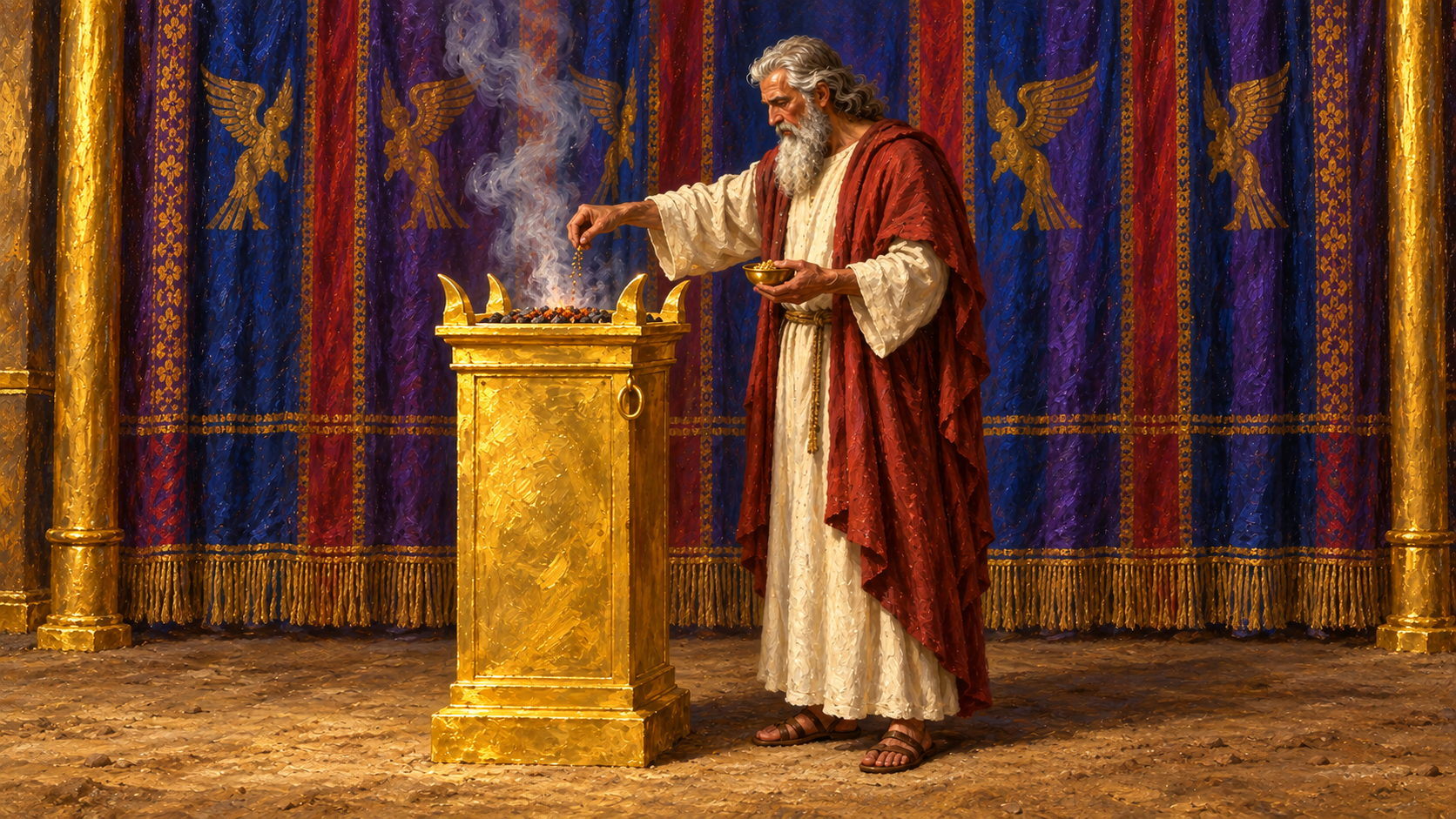
The altar of incense stood in the Holy Place, just in front of the veil that separated it from God’s covenant meeting place. I notice how close the priests could come, yet the veil still stood between them and the Most Holy Place. Why did God put the altar there, and why did incense rise from it every morning and evening? Israel’s priestly worship helps us understand those details before we follow their connection to Christ’s intercession and the coming judgment shown in Revelation.
A Holy Altar Before the Veil
God gave Israel the tabernacle so He would dwell among His people. It was not built for religious spectacle. Every part taught them how a holy God could live among sinful people. Sacrifices were made at the altar of burnt offering in the courtyard. Inside the Holy Place were the lampstand and table, along with the altar of incense. The veil separated that room from the Most Holy Place, where the ark and mercy seat marked God’s covenant meeting place.
Incense rose before the LORD from the altar nearest the veil, where the priests approached Him in worship. Yet that nearness did not remove the boundary around the Most Holy Place. I need to keep both details in view: God truly invited His people to draw near, and He defined how they could come. An invitation from Him gives us reason for reverence rather than permission to treat His presence casually.
The LORD specified the altar’s design and materials, along with its location and the priests’ use of it. Israel did not devise this arrangement. The altar was made of acacia wood overlaid with gold, with horns formed as one piece with it. A gold molding surrounded it, and rings held the poles used to carry it. Though smaller than the bronze altar in the courtyard, it stood in a place that called for reverence.
You shall make an altar to burn incense on; you shall make it of acacia wood. A cubit shall be its length and a cubit its width–it shall be square–and two cubits shall be its height. Its horns shall be of one piece with it.
The gold altar was set apart for incense rather than animal sacrifice. Exodus 30:9 forbids strange incense there and rules out burnt offerings, grain offerings, and drink offerings. The priests were to follow the pattern God had given instead of deciding for themselves what would make the Holy Place feel spiritual.
If I assume that sincere intentions make any form of worship acceptable, this altar gives me reason to reconsider. Sincerity matters, but it does not free me to disregard what God has said. Even the beauty of the tabernacle could not take the place of obedience to its Designer. Reverence includes listening to Him.
The LORD told Moses to place the altar before the veil, in front of the ark of the Testimony and the mercy seat. Its position connected it with nearness to God’s presence while keeping the God-given boundary clearly in view.
And you shall put it before the veil that is before the ark of the Testimony, before the mercy seat that is over the Testimony, where I will meet with you.
When Moses assembled the tabernacle, he placed the altar where God had told him and burned sweet incense on it. Exodus repeatedly says that he acted “as the LORD had commanded Moses.” I don’t want to pass over that line as though it were merely part of the description. Following God’s pattern was how Moses expressed faithfulness in the worship itself.
He put the gold altar in the tabernacle of meeting in front of the veil; and he burned sweet incense on it, as the LORD had commanded Moses.
An ordinary Israelite could not enter the Holy Place to burn incense; that service belonged to the priests. Only the high priest could go beyond the veil, once a year on the Day of Atonement and under the conditions God had given. God provided real access to Himself, but those restrictions remained until Christ opened the way.
Incense Morning and Evening
Aaron was to burn sweet incense every morning while tending the lamps and again at twilight when he lit them. This was to continue throughout Israel’s generations as a perpetual part of their worship. The light was tended and the fragrance rose each day according to the time God had appointed.
Aaron shall burn on it sweet incense every morning; when he tends the lamps, he shall burn incense on it. And when Aaron lights the lamps at twilight, he shall burn incense on it, a perpetual incense before the LORD throughout your generations.
In Psalm 141, David drew on that familiar worship when he asked God to receive his prayer as incense and the lifting of his hands as the evening sacrifice. He used the language of the priestly worship to express his own desire to be heard by God. The comparison helps us understand his prayer without making it a replacement for the priesthood or a new private tabernacle rite.
Let my prayer be set before You as incense, The lifting up of my hands as the evening sacrifice.
Revelation makes the connection between incense and prayer even clearer. Golden bowls of incense are identified as the prayers of the saints, and another scene shows incense offered with their prayers on the golden altar before God’s throne. I understand these pictures as communion with the living God through the access He provides. The fragrance itself does not give our words power, and prayer does not work by magic.
The morning and evening pattern makes me consider whether I turn to God only when something has gone wrong. The New Testament tells believers to pray without ceasing, so prayer is not limited to those two times of day. Still, the regular service at the altar teaches dependence that continues through ordinary days. We need God before a crisis begins as surely as we need Him in the middle of it.
Exodus 30 specified the holy incense’s composition and forbade Israel from copying that mixture for personal use. Ordinary fragrance was not sinful. This particular mixture belonged to the worship the LORD had appointed, so it was not available for someone’s private enjoyment.
But as for the incense which you shall make, you shall not make any for yourselves, according to its composition. It shall be to you holy for the LORD.
To be holy is to be set apart to God. That explains why this mixture could not be used as an ordinary fragrance or decoration to create a spiritual mood. The connection with prayer also asks something of me: am I coming to God in genuine communion through Christ, or trying to make myself look spiritual? We may praise Him and thank Him for His care, as well as bring the needs that concern us. Confession belongs in that conversation too. We can intercede for someone else or grieve before Him while learning to submit our desires to His will. None of this gives us a technique for forcing His hand.
Unauthorized Fire and the Day of Atonement
Nadab and Abihu show how seriously God regarded His instructions for worship. Leviticus 10 concerns Aaron’s own sons, appointed priests who had received extraordinary privilege. They were not outsiders mocking the tabernacle, yet they offered profane or unauthorized fire that the LORD had not commanded them to bring.
Then Nadab and Abihu, the sons of Aaron, each took his censer and put fire in it, put incense on it, and offered profane fire before the LORD, which He had not commanded them. So fire went out from the LORD and devoured them, and they died before the LORD.
Leviticus 10 identifies their offense as offering what God had not commanded. Other passages may prompt questions about the source of the fire or whether the time and place of their service were wrong. We may also wonder whether intoxication played a role. None of those inferences is named here as the complete explanation, so I would not make one of them the basis of the warning. The stated offense is enough to show their presumption: they acted in priestly worship contrary to the order God had given.
Nadab and Abihu crossed a revealed priestly boundary within Israel’s covenant worship. Their deaths call us to approach Him with reverence by taking His word seriously and obeying what He has revealed.
On the Day of Atonement, the high priest entered beyond the veil according to God’s instructions. He could not come casually or without blood. He also brought a censer full of burning coals from the altar before the LORD and sweet incense beaten fine. Inside the veil, the cloud of incense covered the mercy seat so that he would not die. This was the approach God had appointed for that annual service.
Then he shall take a censer full of burning coals of fire from the altar before the LORD, with his hands full of sweet incense beaten fine, and bring it inside the veil. And he shall put the incense on the fire before the LORD, that the cloud of incense may cover the mercy seat that is on the Testimony, lest he die.
The connection between incense and prayer means I cannot leave holiness and atonement out of my understanding of prayer. The high priest came under God’s command, and although the incense cloud covered the mercy seat, Leviticus 16 also required sacrificial blood. Incense alone did not forgive sin. The blood was essential to what God was teaching His people: sinners need the mediator He appoints and the sacrifice He accepts.
Exodus 30:10 required Aaron to make atonement on the horns of the incense altar once a year, using blood from the sin offering of atonement. Alongside the daily offering of incense, that annual cleansing taught Israel that access to a holy God depended on what He Himself provided.
From the Hour of Incense to Christ Our High Priest
Luke brings us into this same priestly rhythm at an important moment. Zacharias was a priest from the division of Abijah. He was chosen by lot to burn incense in the temple, and the people prayed outside while he served. At that hour, an angel of the Lord appeared and announced the coming birth of John the Baptist.
So it was, that while he was serving as priest before God in the order of his division, according to the custom of the priesthood, his lot fell to burn incense when he went into the temple of the Lord. And the whole multitude of the people was praying outside at the hour of incense.
Luke places the announcement of the Messiah’s forerunner in the setting of prayer and priestly service. While the old order was still carrying out its appointed work, God was preparing to bring the promised Savior into public view.
Hebrews helps us understand why that priestly service could not be the final answer. The earthly sanctuary was a copy and shadow of heavenly things, given by God to teach His people truth. Yet priests had to keep serving and offering sacrifices while the veil remained in place. Those repeated animal offerings could not perfect the conscience. They pointed forward to a better High Priest.
But Christ came as High Priest of the good things to come, with the greater and more perfect tabernacle not made with hands, that is, not of this creation. Not with the blood of goats and calves, but with His own blood He entered the Most Holy Place once for all, having obtained eternal redemption.
Jesus fulfills what the tabernacle anticipated. He is the sinless Son of God, truly Man, and the High Priest after the order of Melchizedek. He entered the true heavenly sanctuary with His own blood and obtained eternal redemption. His sacrifice was offered once for all and will never be repeated.
Wicked men physically tortured, punished, and killed Him. Jesus willingly bore that real punishment for our sins in His innocent body. He shed His blood, died, was buried, and rose bodily. The Father and the Son were united in this work of redemption; the cross was not the Father turning against or abandoning His Son.
Christ’s sacrifice is complete, yet Hebrews says He always lives to intercede for those who come to God through Him. I find reassurance in keeping those truths together. His intercession does not repeat the sacrifice or suggest that His payment remains unfinished. Our risen High Priest represents His people on the basis of the work He has already completed.
Therefore He is also able to save to the uttermost those who come to God through Him, since He always lives to make intercession for them.
The earthly altar could never save anyone. Its position near the veil, together with the daily incense and atoning blood, directed Israel beyond the furniture to the One it anticipated. Jesus Christ is the final High Priest and the only Mediator between God and man. Through Him, believers now have an open and living way to God where the earlier picture had shown restricted access. I can come confidently because God has provided this High Priest, without trying to make my prayers sound spiritual enough to be heard.
Prayer and Judgment Before the Throne
In Revelation 5, the four living creatures and the twenty-four elders fell before the Lamb with harps and golden bowls full of incense. John is told that the incense represents the saints’ prayers. Seeing prayer given this place before God helps me understand how precious His people’s prayers are to Him. Heaven does not dismiss them as noise.
Now when He had taken the scroll, the four living creatures and the twenty-four elders fell down before the Lamb, each having a harp, and golden bowls full of incense, which are the prayers of the saints.
In John’s vision in Revelation 8, after the seventh seal was opened, heaven was silent for about half an hour. Another angel then stood at the altar with a golden censer and received much incense. He was to offer it with the prayers of all the saints on the golden altar before the throne.
Then another angel, having a golden censer, came and stood at the altar. He was given much incense, that he should offer it with the prayers of all the saints upon the golden altar which was before the throne. And the smoke of the incense, with the prayers of the saints, ascended before God from the angel’s hand.
God receives His people’s prayers and answers according to His holy will. Revelation gives those prayers a real place within His sovereign purpose, so I should not think of them as empty gestures. Neither do they give me control over His throne. Prayer is a means God includes in His plan, without becoming a way to manipulate Him.
The angel then filled the censer with fire from the altar and threw it to the earth. Noises and thunderings followed, along with lightning and an earthquake. As the seven angels prepared to sound their trumpets, the scene moved from prayer toward judgment.
Then the angel took the censer, filled it with fire from the altar, and threw it to the earth. And there were noises, thunderings, lightnings, and an earthquake.
In this vision, judgment comes from the same heavenly setting where prayer is received. Earlier, the martyrs beneath the altar had cried, “How long, O Lord, holy and true, until You judge and avenge our blood on those who dwell on the earth?” Their cry helps me understand the connection. God has not forgotten the blood of His witnesses, and His patience does not mean He is indifferent to their deaths.
I understand Revelation 8–11 to describe future, real judgments during the Tribulation. The trumpet judgments are divine actions, not poetic descriptions of ordinary hardship. Heaven directs them, and God measures their severity. Even as they fall, testimony continues and people remain responsible for how they respond. Revelation 9:13 even speaks of a voice from the four horns of the golden altar before God when the sixth trumpet proceeds.
Jesus is both our High Priest and the righteous Judge. John 5:22 says the Father has committed all judgment to the Son. I need to remember that the One who saves is also the One who will judge. His mercy does not compete with His justice; both belong to God’s character.
What the Altar Teaches Us About Prayer
Understanding the original words helps us read these passages accurately, but each altar’s purpose still has to be understood from its context. The common Hebrew word for altar, mizbeach (מִזְבֵּחַ), is related to slaughter or sacrifice. That connection does not make the gold altar a place for burnt offerings. Those belonged on the bronze altar.
The Hebrew qetoreth (קְטֹרֶת) refers here to the fragrant smoke offered before the LORD, while sammim (סַמִּים) names the spices used in the holy mixture in Exodus 30. In Revelation, the Greek word for incense is thymiama (θυμίαμα). These words help us identify what the passages describe. The connection to prayer, however, comes from Revelation’s own explanation that the bowls of incense are the prayers of the saints.
The altar’s connection to Christ gives us a place to begin when we think about our own prayer. Hebrews says believers have boldness to enter the Holiest by the blood of Jesus, through a new and living way. I don’t understand that boldness as swagger or confidence in myself. I come because our High Priest has opened the way.
The holy incense and the deaths of Nadab and Abihu also teach us to pray with reverence. God determines how we approach Him, and remembering whom we address makes our prayers truthful without making them cold. We come to the Father as His children through the Son who shed His blood for us.
The daily incense encourages steady prayer through ordinary life. We can worship when the day is calm and confess when we fail, bringing both gratitude and the needs that weigh on us. We may intercede for someone else or lament before God when grief leaves us with little strength. Even then, our High Priest continues to intercede, and we can trust Him.
Knowing that the living God truly hears us makes prayer serious. The saints’ prayers are before His throne, but God continues to act according to His own wisdom and will. I can trust Him to hear without treating prayer as a way to take control of what He does.
The judgment that follows the heavenly altar also gives prayer urgency. Now is the day of salvation. We should come to Christ ourselves and make the gospel known while God patiently offers mercy. Prayer for the lost belongs beside faithful witness; it cannot become a substitute for speaking of the Savior.
Readers who want to follow these connections further may find the studies on Prayer and The Role of the High Priest helpful. The account of The Sons of Aaron Offering Strange Fire looks more closely at the warning in Leviticus 10. The Ark of the Covenant explores the mercy seat and the Day of Atonement. The Seven Trumpets of Revelation follows the judgments that proceed from the heavenly altar.
My Final Thoughts
After following the altar of incense from Exodus to Revelation, I see a steady witness that approach to God is holy and precious. Israel’s priests served at an altar before a closed veil, but Jesus offered Himself once for all and lives as the risen High Priest who intercedes for His people. Through Him we may draw near with confidence, while the fire from the heavenly altar reminds us that God will also judge in righteousness. That makes me want to pray with greater reverence and steadiness, trusting Christ rather than the strength or beauty of my own words.